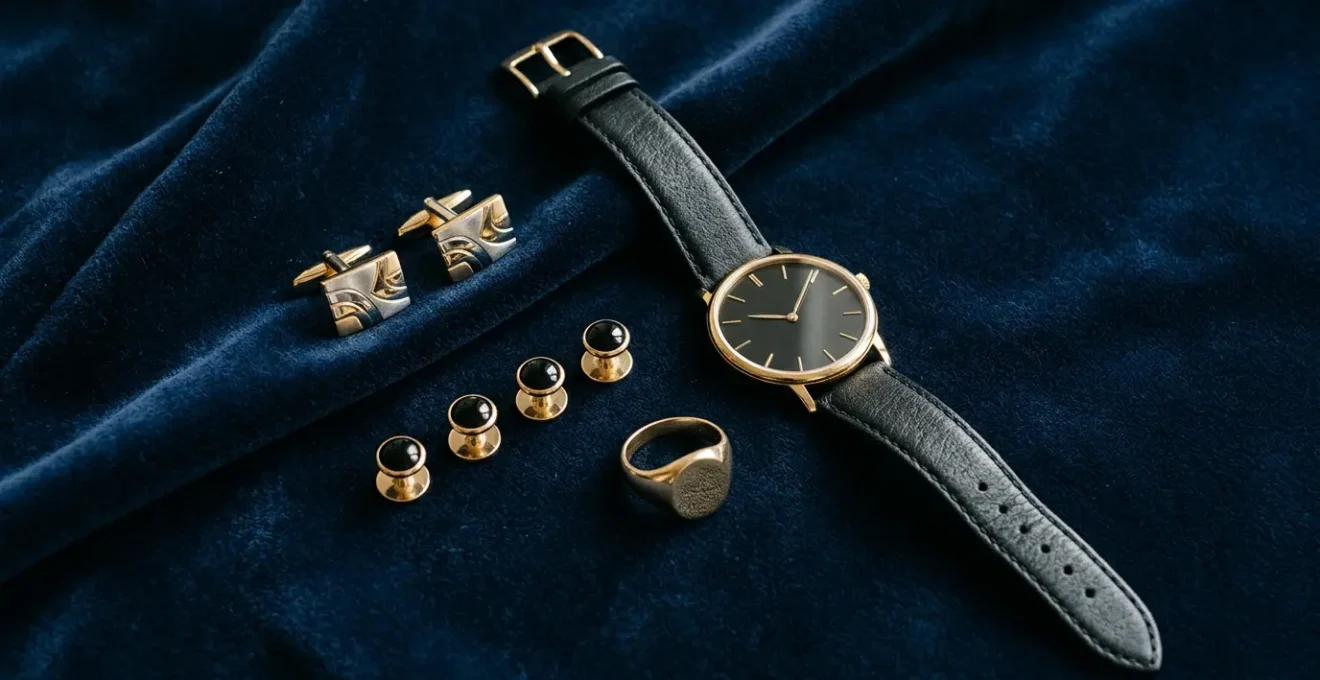
Black tie jewellery is not about fashion; it’s a test of your understanding of etiquette, where the primary goal is to honour the occasion.
- Wearing a watch is traditionally discouraged as it implies you have somewhere better to be; a slim dress watch is a tolerated compromise in modern settings.
- The choice of shirt studs depends on the event’s formality and time of day, with black onyx for evening and mother-of-pearl for daytime or summer events.
- While matching metals is the default rule, heirloom pieces (e.g., your grandfather’s gold cufflinks) carry a historical significance that transcends simple coordination.
Recommendation: When in doubt, choose subtlety and tradition. Your accessories should demonstrate respect for your host and the event, not draw attention to themselves.
Receiving an invitation with the dress code “Black Tie” can evoke a mixture of excitement and apprehension. For the gentleman attending his first formal dinner, the suit is only half the battle. The true test of understanding lies in the details: the cufflinks, the shirt studs, and the perennial question of the watch. The internet offers a torrent of conflicting advice, from dogmatic pronouncements to laissez-faire modern interpretations. One source will insist you must never wear a watch, while another showcases celebrities sporting oversized chronographs on the red carpet.
As a tailor, I assure you that the classic rules of formal jewellery are not arbitrary fashion dictates. They form a coherent code of conduct, a language of respect for the host, the occasion, and tradition itself. To wear black tie correctly is to participate in a shared understanding of decorum that has been refined over generations. The goal is not to stand out, but to fit in seamlessly, demonstrating a quiet confidence that comes from knowing the code. Ostentation is the enemy of elegance; subtlety is its greatest ally.
But what if the rules seem contradictory? Can one wear gold cufflinks with a silver-toned heirloom watch? This guide will not merely list the regulations. Instead, it will illuminate the purpose behind them, empowering you to navigate any formal event with the assurance of a true gentleman. We will dissect the logic of timepiece etiquette, explore the nuances of shirt studs, and clarify the traditions surrounding cufflinks and rings, ensuring your choices are always impeccable.
To navigate this sartorial landscape with confidence, this guide breaks down the essential rules and their underlying principles. Below, we will explore each element of a gentleman’s formal accessories, providing clear, traditional guidance for any black tie event in the UK.
Summary: A Gentleman’s Guide to Jewellery at Formal Events
- Why Wearing a Diver’s Watch with a Tuxedo Is a Faux Pas?
- Onyx or Mother of Pearl: Which Shirt Studs Match a Dinner Jacket?
- Chain vs T-Bar Cufflinks: Which Is More Traditional for Formal Wear?
- Can You Wear Gold Cufflinks with a Silver Watch?
- Are Signet Rings Acceptable with White Tie Attire?
- The ‘Watch Spotting’ Danger in London and How to Avoid It
- Gold or Silver: Which Jewellery Matches Best with Military Medals?
- Black Tie Etiquette: Can You Wear a Watch to a Formal UK Gala?
Why Wearing a Diver’s Watch with a Tuxedo Is a Faux Pas?
The most fundamental rule of formalwear is that one’s attire should honour the occasion and the host. The very act of wearing a conspicuous timepiece, particularly a bulky sports or diver’s watch, fundamentally violates this principle. It suggests that you are conscious of the time, implying you have somewhere else to be. This is considered a subtle but distinct insult to your host, as if their event is merely a stop on your evening’s schedule. As Glenn O’Brien, the revered “Style Guy” for GQ, once noted, this is a clear breach of etiquette.
Some consider it gauche to wear a timepiece to a formal occasion arguing that clock watching is contradictory to the celebratory nature of such events and insulting to the hostess.
– Glenn O’Brien, Gentleman’s Gazette on Black Tie Accessories
The functional, robust nature of a diver’s watch is also aesthetically at odds with the refined elegance of a tuxedo. The dinner jacket’s sleek lines are disrupted by a large, heavy watch, creating a jarring visual mismatch. A tuxedo is a garment of leisure and celebration, not utility. To pair it with a tool watch is a sartorial contradiction. For those who feel undressed without a timepiece, there are, however, acceptable alternatives that respect tradition:
As the visual contrast above demonstrates, the choice is one of purpose. For a black tie event, the correct choice is always the one that complements the formality. A gentleman may consider one of the following options:
- Opt for a slim, unadorned dress watch with a black leather band. The watch face should have minimal markings and ideally no seconds hand to emphasize its role as a discreet accessory rather than a time-telling instrument.
- Choose a classic pocket watch. This remains the most historically correct and elegant way to carry time with evening wear, tucked away in a waistcoat or trouser pocket.
- If a dress watch is worn, ensure the metal trim of the watch case matches the metal of your cufflinks and studs for perfect coordination.
Onyx or Mother of Pearl: Which Shirt Studs Match a Dinner Jacket?
The default and most traditional choice for shirt studs with a dinner jacket is black onyx. Its deep, polished black surface provides a formal, understated contrast against the white of a dress shirt, perfectly complementing the black of the tuxedo and bow tie. For the most formal evening events, particularly in the United Kingdom, onyx is the unimpeachably correct choice. However, the rules of black tie are not entirely without nuance; context is paramount.
The choice between onyx and mother-of-pearl is often dictated by the specific nature of the event. As British accessories brand Alice Made This notes, context is key for UK events. For a solemn occasion like the Festival of Remembrance or a formal City of London livery dinner, onyx is the only appropriate selection. Yet, for daytime black tie or celebratory summer events such as the Glyndebourne Festival Opera, the iridescent lustre of mother-of-pearl is an elegant and entirely acceptable alternative. Its lighter, more festive appearance is better suited to these contexts.
The following table, based on traditional UK etiquette, provides a clear guide for selecting the appropriate studs. As the data from a guide on the black tie dress code shows, the environment dictates the material.
| Material | Best For | UK Event Examples | Visual Impact |
|---|---|---|---|
| Onyx | Evening Black Tie | Royal Galas, City Livery Dinners | Dark, formal, traditional |
| Mother of Pearl | Daytime/Summer Black Tie | Glyndebourne, Formal Weddings | Iridescent, lighter, celebratory |
| Decorative Enamel | Creative Black Tie | BAFTAs, Arts Events | Modern, personality-driven |
Ultimately, your choice of stud should reflect an understanding of these distinctions. For a man attending his first black tie function, black onyx is the safest and most classic option. It signals a respect for tradition that will never be out of place.
Chain vs T-Bar Cufflinks: Which Is More Traditional for Formal Wear?
While both T-bar and chain-link cufflinks perform the same function, they occupy different rungs on the ladder of formality. For the purist and the gentleman dedicated to the highest standards of evening wear, double-sided chain-link cufflinks are the superior choice. Their construction, featuring a decorative face on both sides of the cuff connected by a small chain, is a hallmark of traditional jewellery engineering. This style ensures that even the inside of the cuff presents a finished, elegant appearance.
The T-bar cufflink, while ubiquitous and far easier to fasten, is a product of modern mass manufacturing. Its simplicity comes at the cost of elegance. The toggle mechanism is purely functional and lacks the aesthetic consideration of a double-sided link. For this reason, many etiquette authorities view them as a step down in formality. As the experts at Gentleman’s Gazette advise, the difference is one of polish and refinement.
Try to avoid cheap t-bar cufflinks and go with double-sided cufflinks instead as that looks a lot more polished.
– Gentleman’s Gazette, Black Tie Tuxedo Accessories Guide
Choosing between the two involves a consideration of the event’s specific level of formality. For state dinners or any event designated “White Tie,” chain-link is non-negotiable. For a standard black tie event, a high-quality T-bar may be acceptable, but a chain-link cufflink will always signal a deeper appreciation for tradition. It is worth noting that in certain contexts, such as university balls at Oxford or Cambridge, silk knots are often seen as an acceptable, albeit less formal, alternative that carries its own traditionalist credentials.
Can You Wear Gold Cufflinks with a Silver Watch?
The simple, dogmatic answer is no. The cardinal rule of men’s jewellery is to maintain consistency in your metals. If you are wearing a silver-toned dress watch, your cufflinks and shirt studs should also be silver-toned. If your accessories are gold, your watch should be gold. This creates a harmonious and intentionally curated look. Indeed, it is an unwavering rule confirmed by 100% of traditional etiquette sources that the metal of a watch should match the other jewellery worn.
However, British etiquette, in particular, allows for one powerful and significant exception: the heirloom rule. In a culture that places immense value on heritage and family history, wearing inherited pieces together carries a significance that transcends mere colour-coordination. This is not about fashion; it is about narrative. This exception is especially potent when combining pieces from different generations.
The “Heirloom Exception” demonstrates a core principle of British formal wear: story trumps style. When a gentleman wears his grandfather’s gold cufflinks with his father’s steel watch, the combination is no longer a faux pas. Instead, it becomes a statement of lineage and respect for one’s forebears. This is widely understood and accepted at traditional UK events, particularly among established families and at formal private gatherings. The visual harmony comes not from the matching metals, but from the shared history they represent.
Therefore, if you are a first-time attendee with a collection of new accessories, you must adhere strictly to the rule of matching metals. If, however, you have the privilege of wearing pieces with personal history, you may confidently employ the heirloom exception, secure in the knowledge that you are observing a deeper, more meaningful tradition.
Are Signet Rings Acceptable with White Tie Attire?
For a certain stratum of society, particularly the British upper classes and gentry, a signet ring is not merely “acceptable” with formal wear; it is an integral part of the attire. It is not considered jewellery in the decorative sense but rather a piece of personal identity, akin to a uniform. This distinction is crucial. Whereas a fashion ring would be a grave error with white tie, a traditional signet ring engraved with a family crest or monogram is considered entirely correct.
For the upper classes and gentry, a signet ring is not just ‘acceptable’; it’s part of the uniform.
– British etiquette tradition, Bentley & Skinner on Signet Ring Etiquette
The acceptance of the signet ring, however, is governed by a strict set of unwritten rules regarding its appearance and how it is worn. Ostentation is to be avoided at all costs. A discreet, well-proportioned ring is the only correct form. For a gentleman wishing to wear one, adherence to these traditions is not optional; it is mandatory to avoid looking like an upstart. The ring speaks of heritage, and must be worn in a way that respects that heritage.
To ensure your signet ring is worn correctly at a formal event, it is essential to follow the established protocol. The following points represent a checklist of traditional British rules that govern the wearing of a signet ring with evening wear.
Your Action Plan: British Rules for Wearing a Signet Ring
- Finger Placement: The ring must be worn on the little finger (pinkie) of the non-dominant hand. For a right-handed individual, this is the left hand.
- Crest Orientation: The crest should traditionally face inward, toward the wearer, as a personal emblem. It is only turned outward if it is still used for its original purpose of sealing documents.
- Exclusivity with White Tie: At a white tie event, only two rings are ever permissible: a wedding band and a traditional signet ring. No other rings of any kind are allowed.
- Discreet Design: The ring must be tasteful and traditionally styled, engraved with a family crest or initials. Large, ostentatious gemstones are the mark of a bounder, not a gentleman.
The ‘Watch Spotting’ Danger in London and How to Avoid It
While the previous sections have dealt with the sartorial etiquette of watch-wearing, a gentleman in London must also be aware of a far more practical and dangerous concern: luxury watch theft. The phenomenon of ‘watch spotting’ by organised criminals has become a significant threat in the capital. These thieves specifically target individuals wearing high-value timepieces, often following them from restaurants or public spaces to rob them. The statistics are sobering; Metropolitan Police data reveals that 5,180 high-value watches worth £3,000+ were stolen in London between January 2022 and July 2023, with a mere 59 ever recovered.
This risk adds a new dimension to the decision of what to wear to a formal event. Wearing an expensive watch, even an appropriate dress watch, can make you a target, especially when travelling late at night. A gentleman’s first priority must always be his personal safety. It is therefore prudent to be aware of the high-risk areas and the methods employed by thieves, and to take appropriate countermeasures.
The following table outlines key risk areas in London and the recommended safety measures. This is not a matter of style, but of practical security for any gentleman attending an event in the city.
| High-Risk Area | Theft Method | Safety Measure |
|---|---|---|
| Kensington & Chelsea | Follow-home robberies | Keep watch under cuff, avoid checking time in public |
| Westminster | Tourist targeting | Wear ‘decoy’ dress watch instead of valuable timepiece |
| Mayfair after dark | Street mugging | Use pre-booked taxis, avoid public transport |
| Camden | Restaurant spotting | Remove watch discreetly before leaving venue |
In this context, the traditional advice to wear no watch at all takes on a modern, practical wisdom. Opting for a pocket watch or simply forgoing a timepiece entirely is not only sartorially correct but also the safest course of action in today’s London.
Gold or Silver: Which Jewellery Matches Best with Military Medals?
When a gentleman wears military medals with formal attire, a different and higher set of rules comes into play. Personal jewellery takes a subordinate role; its sole purpose is to complement the honours without distracting from them. The medals are not accessories; they are symbols of service and achievement, and must be given the utmost respect. The guiding principle is one of harmony and deference.
The choice between gold and silver jewellery is therefore dictated entirely by the medals themselves. One must observe the dominant metallic colour of the miniature medals being worn and coordinate accordingly. For instance, if wearing medals with predominantly gilt or bronze elements, such as the Order of the British Empire, gold cufflinks and studs are the appropriate choice. Conversely, if the medals are primarily silver, as with many campaign medals, silver accessories are required. The overarching protocol is absolute, as official guidelines state.
The guiding principle is that personal jewellery must not detract from or compete with the honours being worn. Subtlety is paramount.
– UK Military Protocol, British Military Dress Code Guidelines
The British Royal Family provides the definitive example of this protocol in practice. The Prince of Wales, when in uniform or formal wear with decorations, impeccably coordinates his personal jewellery to the honours on display. This meticulous approach ensures that the focus remains squarely on the medals, a testament to service, rather than on personal style. For any man entitled to wear medals, this is the only correct path. Any personal vanity must be set aside in favour of protocol.
What to Remember
- The primary purpose of black tie rules is to show respect for the host and the occasion; your accessories are part of this code.
- Context is everything: the formality of the event, the time of day, and the country’s specific traditions dictate your choices.
- Heritage holds a special place in British etiquette; heirloom jewellery can often transcend standard stylistic rules like matching metals.
Black Tie Etiquette: Can You Wear a Watch to a Formal UK Gala?
We return to the most persistent question, and the answer, after considering all the facets of formal etiquette, remains one of nuance. There is no single “yes” or “no” that applies to every black tie event in the United Kingdom. The correct choice depends entirely on the specific nature of the gala, the expectations of the host, and the message you wish to convey. A blanket rule is the refuge of the uninformed; a gentleman understands context.
The spectrum of “black tie” is broad. A corporate awards dinner in the City has a different atmosphere and set of expectations than a royal gala at Buckingham Palace. At the former, a discreet dress watch is likely to be tolerated, if not entirely correct. At the latter, it would be a significant misstep. The key is to research the event and, if possible, understand the nature of your host. A traditional, aristocratic host will expect stricter adherence to protocol than a modern, creative organisation.
This table provides a pragmatic guide to navigating the UK gala spectrum. It synthesizes the traditional rules with an understanding of modern variations in formality.
| Event Type | Watch Acceptability | Recommended Approach |
|---|---|---|
| Royal Gala at Palace | Not Recommended | No watch – most respectful choice |
| Corporate/Charity Dinner | Tolerated | Slim dress watch worn discreetly |
| Creative Industry Awards (BAFTAs) | Acceptable | Elegant dress watch perfectly fine |
| Traditional Host (Aristocracy) | Avoid | Pocket watch or no timepiece |
For the man who feels the need for a timepiece, the pocket watch remains the most elegant and traditionally sound solution. It adheres to the principle of not having the time on open display, while still providing the function. If one is chosen, it should be carried with similar subtlety:
- Carry the pocket watch in the designated waistcoat pocket if a three-piece tuxedo is worn.
- If no waistcoat is worn, it may be placed in the trouser pocket.
- The case should be classic gold or silver, matching your other metal accessories.
- Any chain should be subtle, so as not to create excessive noise or movement.
Armed with this understanding, you can now approach any black tie event not with apprehension, but with the quiet confidence of a gentleman who knows and respects the code. Your choices will speak of elegance, tradition, and impeccable manners before you have even said a word.