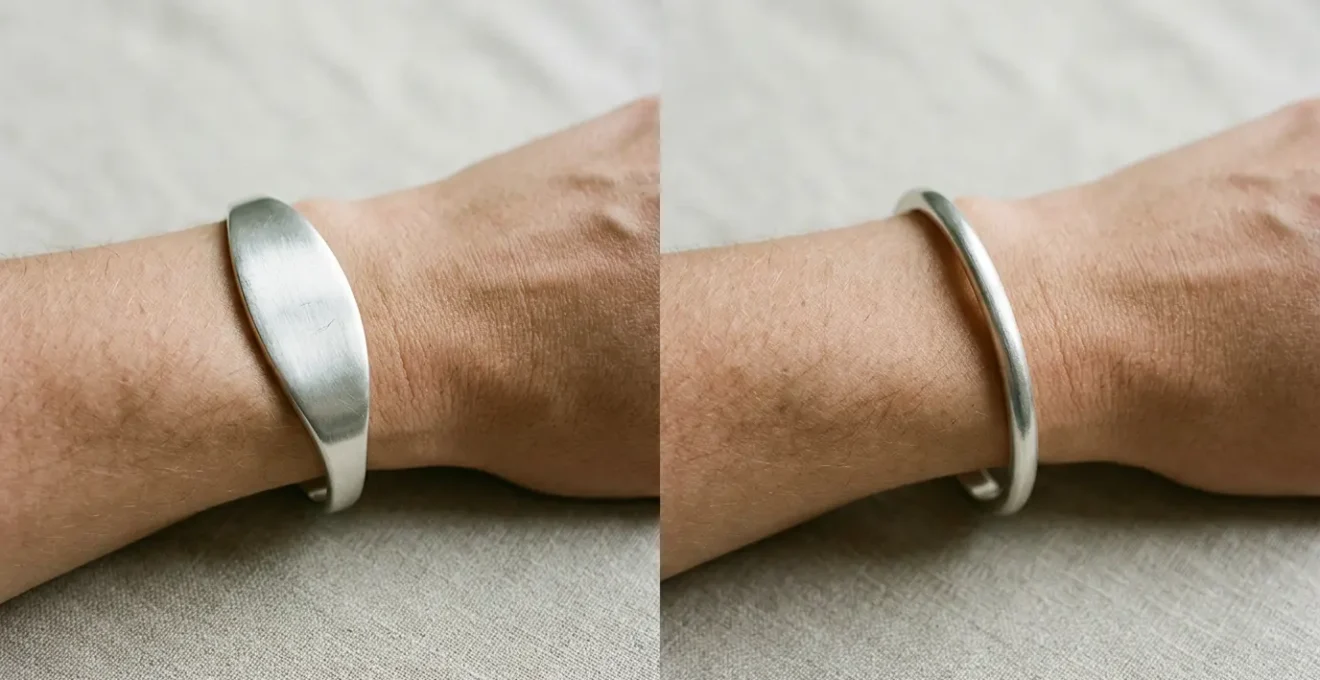
The persistent spinning of a cuff bracelet isn’t a sizing flaw; it’s an engineering mismatch between the jewelry’s shape and your wrist’s anatomy.
- A simple circumference measurement ignores the natural oval shape of your wrist, dictated by the ulna and radius bones.
- Forcing a fit by bending the metal leads to irreversible damage due to a principle called work hardening.
- The cuff’s profile (the shape of its edge) is as crucial as its size, determining comfort and preventing digging.
Recommendation: Prioritize oval cuffs that match your wrist’s cross-section and learn the correct side-on application technique instead of trying to squeeze a round cuff into place.
The frustration is universal for those with slender wrists: you find a beautiful, rigid cuff bracelet, only to have it constantly rotate, leaving the stunning centerpiece hanging uselessly on the underside of your arm. The common advice is to “get a smaller size” or “gently squeeze it shut.” This advice is not only ineffective but often destructive. The truth is, a perfect, stable fit has less to do with simple circumference and more to do with a deep understanding of anatomical engineering and material science.
Most fitting guides oversimplify the wrist, treating it as a perfect circle. However, our wrists are distinctly oval, defined by the prominent ends of our forearm bones—the ulnar and radial styloid processes. Ignoring this fundamental shape is the primary reason why even correctly “sized” round cuffs fail. The problem is exacerbated by common mistakes, such as bending the metal, which introduces fatigue and leads to eventual snapping, or choosing designs with poor weight distribution.
The solution lies not in brute force, but in precision. It’s about shifting your perspective from finding a bracelet that is the right *size* to one that is the right *shape*. This requires a more nuanced approach, considering the cuff’s opening mechanism, its cross-sectional profile, and even the material properties that dictate its sound and durability.
This guide will deconstruct the anatomy of a perfect fit. We will move beyond the measuring tape to explore the biomechanics of your wrist, the metallurgy of your jewelry, and the physics of why some pieces stay put while others endlessly spin. By understanding these principles, you can finally select and wear rigid bracelets with confidence, ensuring they remain both comfortable and correctly oriented.
To navigate the complex world of bracelet fit and function, this article breaks down the essential factors. The following summary provides a clear roadmap to each critical aspect we will explore.
Summary: Understanding the Biomechanics of a Perfect Bracelet Fit
- Why Measuring Tape Circumference Is Not Enough for Rigid Cuffs?
- Hinge or Torque: Which Cuff Opening Is Easier to Put On One-Handed?
- The Bending Mistake: Why Squeezing a Cuff to Fit Snaps the Metal?
- How to Secure a Gold Cuff Over a Sweater Without It Slipping?
- Knife-Edge vs Comfort Fit: Which Cuff Profile Digs into Your Skin?
- The ‘Jangle Factor’: Why Noisy Bracelets Kill Professional Credibility?
- Why Hollow Gold Bangles Cannot Be Repaired If Dented?
- The Physics of Tangling: How to Layer Necklaces Without Them Knotting?
Why Measuring Tape Circumference Is Not Enough for Rigid Cuffs?
The most common starting point for bracelet fitting—wrapping a measuring tape around the wrist—is also the most misleading for rigid cuffs. While it provides a single number for circumference, it completely fails to capture the most critical dimension for preventing rotation: the wrist’s cross-sectional shape. Your wrist is not a circle; it is an ellipse, significantly wider than it is thick. This is due to the structure of your forearm bones, the radius and ulna, which create a distinctly oval profile at the joint.
A round cuff, even with the “correct” circumference, will have significant gaps on the narrower top and bottom of your wrist. It’s these gaps that allow the bracelet to spin freely. An oval cuff, however, is designed to mirror this natural anatomy. By matching the shape of the wrist, it makes closer contact along the wider sides, effectively “locking” it in place and preventing it from turning upside down. Therefore, the key measurements are not just the total circumference but the diameter of the wrist from bone to bone.
Furthermore, wrist size fluctuates throughout the day due to temperature and hydration. Measuring at different times can give a better average, but it still doesn’t solve the core geometric problem. A truly well-fitted cuff acknowledges that shape, not just size, dictates stability. The goal is to find a piece whose internal geometry matches your anatomical blueprint.
Ultimately, relying solely on circumference is like trying to fit a square peg in a round hole; even if the area is correct, the fit will always be unstable.
Hinge or Torque: Which Cuff Opening Is Easier to Put On One-Handed?
The design of a cuff’s opening mechanism significantly impacts its ease of use, especially for someone dressing alone. The two primary types, hinged and torque (open-ended), require entirely different biomechanical movements. For one-handed application, a hinged cuff is unequivocally superior. It typically features a small clasp or pressure lock that can be easily secured with the thumb and forefinger of the same hand, requiring minimal dexterity.
A torque cuff, by contrast, demands a specific and often counter-intuitive technique. You should never try to force it over the top of your wrist. Instead, the correct method involves a rolling motion. As demonstrated by jewelry experts at Plata de Santa Fe, the cuff’s opening should be positioned at the narrowest part of your wrist—the side—and then rolled on. This technique is detailed in their guide on the ‘Sign Language C’ method for fitting cuffs, which uses a supination-pronation movement to slide the bracelet into place. While effective for a secure fit, this can be challenging for those with limited mobility or when in a hurry.
The visual above clearly contrasts the simple pincer motion needed for a hinged cuff with the more complex wrist rotation required for a torque cuff. While the latter often provides a sleeker look without a visible clasp, the hinged design offers far greater practicality for daily, unassisted wear. The choice between them is a trade-off between minimalist aesthetics and functional ease.
For those who prioritize speed and simplicity, the secure click of a hinged cuff is the more reliable and less frustrating option for everyday use.
The Bending Mistake: Why Squeezing a Cuff to Fit Snaps the Metal?
The tempting impulse to squeeze an ill-fitting cuff to make it tighter is the single most common cause of its destruction. This action might seem like a simple adjustment, but it introduces a metallurgical process known as work hardening. When you bend metal, you are creating microscopic dislocations in its crystal structure. The first bend makes the metal harder and more brittle at that stress point. Each subsequent bend in the same spot compounds this effect, until the metal loses all its ductility and snaps.
This is why cuffs should only be adjusted once to achieve their initial fit, and never bent repeatedly to take them on and off. The metal simply isn’t designed for that kind of stress cycle. As Wikipedia contributors note in their article on the subject, this process can be used intentionally by jewelers to strengthen certain parts of a piece.
Much gold jewelry is produced by casting, with little or no cold working; which, depending on the alloy grade, may leave the metal relatively soft and bendable. However, a jeweler may intentionally use work hardening to strengthen wearable objects that are exposed to stress, such as rings.
– Wikipedia Contributors, Work Hardening – Wikipedia
In the case of a cuff, however, repeated bending by the wearer is uncontrolled and destructive. It concentrates stress on the weakest points, typically the shoulders of the cuff, leading to cracking or a complete break. The correct approach is to select a cuff that fits anatomically and use the proper application technique (as discussed for torque cuffs) rather than deforming the piece each time you wear it.
Treat your cuff as a rigid, engineered object, not a malleable piece of wire. Its shape is its strength, and preserving that shape is paramount.
How to Secure a Gold Cuff Over a Sweater Without It Slipping?
Wearing a cuff over a sleeve is a classic style statement, but it introduces a new set of physical challenges. The fabric of a sweater reduces friction, making it easier for the cuff to slide down or spin. To counter this, you must think like an engineer and use principles of pressure, friction, and balance. The most effective method is layering multiple cuffs. Stacking two or three bracelets together creates a “pack” where the pieces press against each other, generating friction and a wider contact area that is more stable on the fabric.
Another critical factor is the cuff’s center of gravity. Cuffs with heavy, centered design elements or large gemstones are inherently unbalanced. The weight will inevitably pull the decorative part downwards, causing it to spin. When choosing a cuff to wear over a sleeve, opt for designs with more uniform weight distribution, such as a simple band or a pattern that extends around the entire circumference. This ensures no single point is heavy enough to initiate rotation.
While some suggest gently squeezing an adjustable cuff over the fabric, this should be done with extreme caution. As previously discussed, frequent adjustments weaken the metal. If you do choose this method, it should be a one-time adjustment for a specific sweater’s thickness. The safer and more versatile solution is strategic layering, which provides stability without compromising the structural integrity of any single piece.
Ultimately, a successful cuff-over-sweater look relies on creating a stable system through stacking and selecting well-balanced designs, rather than forcing a single, ill-suited piece to stay in place.
Knife-Edge vs Comfort Fit: Which Cuff Profile Digs into Your Skin?
Beyond the overall shape and size of a cuff, the geometry of its edges—its profile—plays a crucial role in comfort. A cuff that constantly digs into your skin is likely a problem of pressure distribution at a micro-level. The most common culprit is the knife-edge profile, characterized by a thin, almost sharp edge. While visually delicate, this design concentrates the entire weight of the bracelet onto a very small surface area, creating high-pressure points that pinch and irritate the skin, especially during wrist flexion.
In contrast, a comfort fit profile features rounded, smoothed, or half-round edges. This design significantly increases the contact area between the metal and your skin, distributing the cuff’s weight evenly. Instead of digging in, a comfort fit cuff glides smoothly as you move. This distinction is clearly outlined in analyses of cuff bracelet construction, as detailed in a comparative guide from jewelry-making resource Halstead Bead.
| Profile Type | Contact Area | Pressure Distribution | Comfort During Movement |
|---|---|---|---|
| Knife-Edge | Minimal (1-2mm) | High concentrated pressure | Catches and pinches during flexion |
| Comfort Fit (Rounded) | Wide (4-6mm) | Evenly distributed | Allows smooth skin gliding |
| Half-Round | Moderate (3-4mm) | Balanced distribution | Good compromise for daily wear |
The design philosophy of iconic brands often centers on this principle. In their official David Yurman bracelet size guide, the brand emphasizes how their rounded cable profiles enhance wearability. Their team’s goal is for a bracelet to feel “like a natural extension of your wrist—secure but never restrictive.” This is achieved precisely through comfort-fit engineering, which prioritizes a smooth interface between the jewelry and the wearer.
When a cuff feels uncomfortable, don’t just blame the fit; inspect its edges. A smooth, rounded profile is a hallmark of a well-engineered and truly wearable piece of jewelry.
The ‘Jangle Factor’: Why Noisy Bracelets Kill Professional Credibility?
Beyond visual aesthetics and physical comfort, the auditory feedback of your jewelry—the “jangle factor”—has a significant impact on how you are perceived in a professional environment. A constant clinking and clanking of multiple bracelets can be distracting to colleagues and project an air of carelessness. In quiet office settings, a meeting, or a presentation, excessive jewelry noise can subtly undermine your credibility, drawing attention away from your words and toward the disruption.
The sound a bracelet makes is dictated by its material and construction. Hollow pieces, particularly hollow gold or silver bangles, are the worst offenders. Their light weight and hard surfaces create high-pitched, resonant “tinkling” sounds upon impact. Conversely, denser materials produce a much more muted sound. Bracelets made of tungsten or titanium are nearly silent, producing a low “thud” if they knock against a surface. This is a key consideration for anyone working in a formal or quiet setting.
Managing this auditory signature is a mark of sartorial professionalism. It doesn’t mean forgoing bracelets entirely, but rather making conscious choices. Opting for a single, substantial statement cuff over a stack of noisy bangles is an easy solution. Alternatively, mixing materials—such as interspersing metal bracelets with leather or fabric wraps—can act as a dampener, absorbing sound before it becomes a distraction.
Action Plan: How to Choose Bracelets for a Quiet, Professional Setting
- Material Selection: Choose bracelets made from dense materials like tungsten or titanium, which produce muted, low-frequency sounds instead of high-pitched jangles.
- Construction Check: Avoid hollow gold or silver pieces, as their construction amplifies noise. Opt for solid or comfort-fit designs.
- Dampening Techniques: If you wear multiple bracelets, intersperse metal bangles with softer pieces made of leather, fabric, or silicone to absorb impact and noise.
- Strategic Simplicity: In the quietest office environments, choose a single, high-quality statement cuff or a silent watch instead of a stack of multiple bangles.
- Test for Sound: Before wearing a new bracelet to work, test its sound by moving your arm naturally. If the jangle is noticeable and high-pitched, reserve it for social occasions.
Your jewelry should complement your professional presence, not compete with it. A quiet confidence is always more powerful than a noisy distraction.
Why Hollow Gold Bangles Cannot Be Repaired If Dented?
Hollow gold jewelry, often created through a process called electroforming, offers the look of a substantial, luxurious piece at a fraction of the weight and cost. However, this lightweight advantage comes with a significant and often permanent drawback: extreme vulnerability to damage. A hollow bangle is essentially a thin shell of gold. Once this shell is dented, it is almost impossible to repair seamlessly.
The problem is one of access. With a solid piece of jewelry, a jeweler can hammer out a dent from the opposite side or use tools to push it out. With a hollow piece, there is no internal access. The thin walls of the bangle cannot be pushed out from the inside without risking further collapse or cracking. Attempting to pull the dent out from the exterior would require soldering on a tool, a process that would melt or discolor the surrounding area, leaving a repair more visible than the original damage.
Professional jewelers are well-aware of this limitation. In a blog post on jewelry wear and tear, Dallas-based JPratt Designs explains that hollow pieces are particularly susceptible to permanent damage. They note that once an electroformed piece is dented, it typically requires complete replacement, as repair is not a viable option. The metal is simply too thin and lacks the internal structure to be worked back into its original shape.
While the initial cost is lower, the lifetime value of a hollow bangle can be short. A single accidental impact can lead to irreversible damage, making a solid-gold alternative a far better long-term investment for a piece intended for daily wear.
Key Takeaways
- A cuff’s stability depends on its oval shape matching your wrist’s anatomy, not just its circumference.
- Never bend a cuff to fit; this causes metal fatigue. Use the correct side-on rolling technique for application.
- The profile of a cuff’s edge is critical for comfort. Rounded ‘comfort fit’ profiles prevent digging by distributing pressure evenly.
The Physics of Tangling: How to Layer Necklaces Without Them Knotting?
Just as the fit of a cuff is governed by physics, so is the frustrating tendency of layered necklaces to tangle into a knot. The primary culprits behind this phenomenon are friction, weight, and chain texture. When necklaces of similar weight and texture lie against each other, they move in unison. This synchronized movement allows them to twist together, and the slightest motion can turn that twist into an intricate knot. The secret to tangle-free layering is to create differentiation between the chains.
The most effective strategy is to vary the weights and textures of your chains. A heavier pendant on your shortest or longest chain will act as an anchor, pulling it taut and preventing it from intertwining with the others. Furthermore, different chain textures create different levels of friction. A smooth snake chain has very low friction and is more likely to slide and tangle with another of its kind. A textured rope or wheat chain, however, has a higher friction coefficient, which helps it “grip” its position and stay separate from its neighbors.
The table below breaks down how different chain types interact, providing a guide to strategic layering. By choosing chains with varying friction levels, you can engineer a layered look that remains distinct and organized throughout the day.
| Chain Type | Friction Level | Tangle Risk | Best Layering Position |
|---|---|---|---|
| Snake/Curb | Very Low | High | Shortest length with heavy pendant |
| Rope/Wheat | High | Low | Middle or longest length |
| Box/Cable | Medium | Medium | Any position with proper spacing |
To master the art of wearing fine jewelry, the next logical step is to analyze your existing collection using these physical principles. Assess each piece not just for its beauty, but for its anatomical compatibility, material integrity, and dynamic behavior, ensuring every item you wear is a perfect fusion of art and engineering.