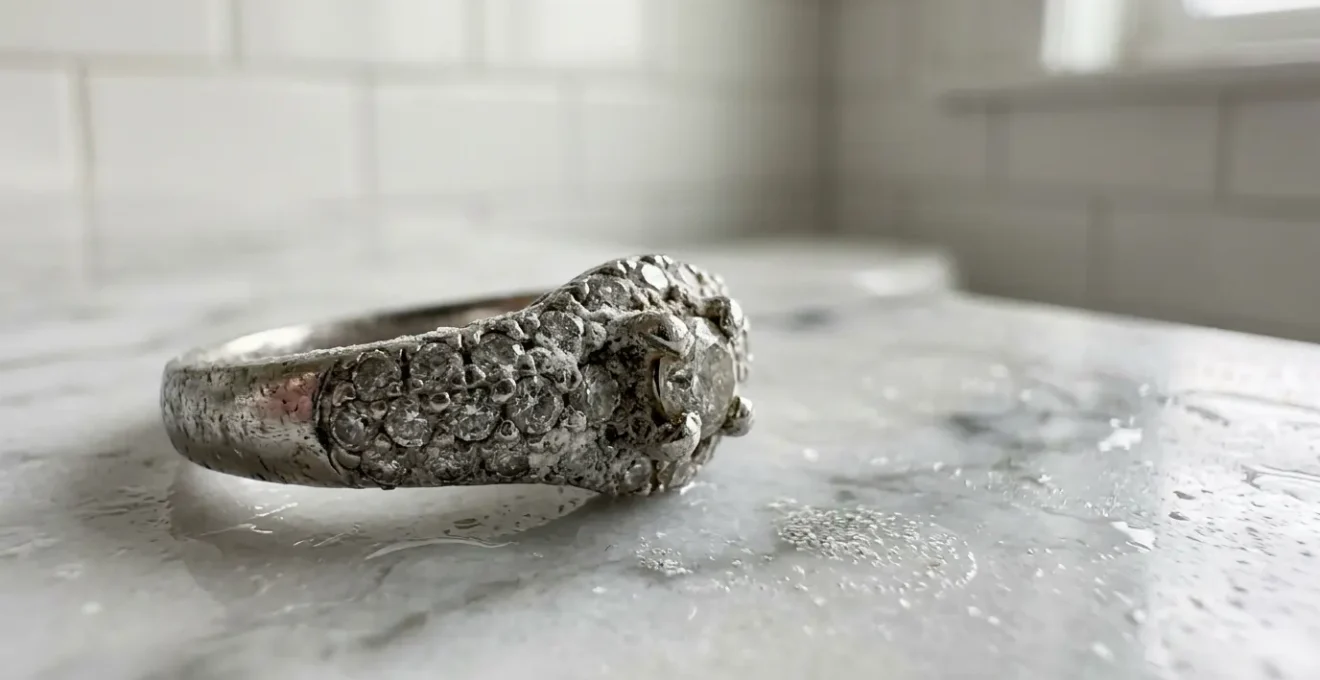
Contrary to popular DIY advice, common household cleaners like vinegar can cause costly, irreversible damage to the rhodium plating on most white gold rings sold in the UK.
- The dull film on your ring isn’t just dirt; it’s a chemical deposit called calcium stearate, formed when soap reacts with hard water minerals.
- Safe home cleaning involves a specific soak-and-scrub method with mild dish soap, followed by a crucial drying stage to prevent new mineral spots.
Recommendation: Prioritise the long-term health of your ring by using only approved methods and understanding when professional intervention is necessary, especially for hard-to-remove buildup.
There’s a unique frustration known to many living in London or the South East: you wash your hands, and the brilliant diamond ring you cherish emerges looking… cloudy. A chalky, dull film seems to cling to the setting, robbing it of its fire. You’re not imagining it. This is the direct result of a chemical reaction between your soap and the notoriously hard water flowing from your taps. The internet is flooded with quick-fix solutions, from the seemingly benign dish soap soak to more aggressive DIY “hacks” involving household staples like vinegar and baking soda. Many of these guides promise a return to showroom sparkle with minimal effort.
But what if these one-size-fits-all solutions are a trap, especially in the UK? The real enemy isn’t just daily grime; it’s a stubborn mineral deposit, and the battle to remove it requires more than just a toothbrush. The key lies in understanding the specific chemistry at play and the unique construction of British jewellery. Many white gold rings sold in the UK, for instance, have a delicate layer of rhodium plating that gives them their brilliant white lustre. Aggressive, acidic cleaners can strip this layer away, leading to a costly repair that far outweighs the price of a professional clean. The secret to restoring your ring’s sparkle isn’t a magic potion; it’s a methodical, scientific approach to cleaning and prevention.
This guide will move beyond the generic advice. We will dissect the science behind why your ring gets dull, evaluate the safety and effectiveness of different cleaning methods from a material science perspective, and provide a definitive, safe protocol for at-home care. We will explore the critical differences between ultrasonic and steam cleaning, identify the hidden dangers of thermal shock for certain gemstones, and outline the correct way to dry your jewellery to prevent the very water spots you’re trying to remove. Ultimately, you will learn not just how to clean your ring, but how to preserve its beauty for a lifetime, even in the hardest of water.
To navigate this detailed guide, the summary below outlines the key areas we will cover, from the fundamental science of soap scum to the best long-term storage practices.
Summary: A Scientific Approach to Restoring Your Ring’s Brilliance
- The ‘Soap Magnet’ Effect: Why Washing Hands with Rings On Dulls Them?
- Is Vinegar Safe for Cleaning Gold or Will It Damage the Alloy?
- Ultrasonic Bath or Steam Jet: Which Is Better for Hard Water Deposits?
- The Hot Water Mistake That Cracks Tanzanite and Opals
- How to Dry Pave Settings Without Leaving Water Spots?
- How Often Should You Ultrasonic Clean Your Daily Engagement Ring?
- Why White Gold Chains Need Rhodium Plating After Every Solder Repair?
- Oak, Leather, or Velvet: Which Jewellery Box Materials Prevent Tarnish Best?
The ‘Soap Magnet’ Effect: Why Washing Hands with Rings On Dulls Them?
The persistent dullness that plagues rings in hard water areas is not merely an accumulation of dirt. It is a specific chemical compound known as calcium stearate. This insoluble, waxy substance is formed when the fatty acids in soap react with the high concentration of calcium and magnesium ions found in hard water. Your ring, with its intricate settings and tiny crevices, acts as a perfect surface for this “soap scum” to adhere and build up. Over time, it creates an opaque film that scatters light instead of allowing it to enter and reflect off the diamond’s facets, effectively dimming its sparkle.
This problem is particularly pronounced in many parts of the UK. For example, Leicester ranks 8th in the UK for hard water, a characteristic shared with London and much of the South East, making jewellery care a constant battle against mineral buildup. The only effective at-home strategy is to dissolve this film. A simple rinse with water is ineffective as the compound is water-insoluble. You need a gentle detergent that can emulsify and lift the greasy deposit without harming the metal or gemstone. This is why the universally recommended at-home solution is a soak in warm water with a few drops of mild dish soap.
To properly tackle this buildup, a methodical approach is required:
- Mix a solution of warm (not hot) water with a few drops of a mild, ammonia-free dish soap like Fairy Liquid.
- Soak the ring for 20-30 minutes. This is the most crucial step, as it gives the solution time to penetrate and soften the hardened calcium stearate film.
- Gently scrub with a very soft-bristled toothbrush (a child’s toothbrush is ideal). Pay special attention to the areas underneath the stone and around the prongs, where buildup is heaviest.
- Rinse thoroughly, preferably with distilled or deionised water, to avoid re-depositing a new layer of minerals onto the clean surface.
- Dry immediately and completely, as even a single drop of hard water left to evaporate will leave a mineral spot.
Is Vinegar Safe for Cleaning Gold or Will It Damage the Alloy?
The internet is full of DIY cleaning “hacks,” and white vinegar is often touted as a natural, powerful solution for dissolving mineral deposits. While it works wonders on a kettle, applying this logic to fine jewellery, especially in the UK market, is a costly mistake. The problem lies not with the gold itself, but with the fragile layer that makes most white gold rings appear so bright: rhodium plating. The vast majority of 18ct and 9ct white gold rings sold in Britain are plated with rhodium, a platinum-group metal, to give them a brilliant, pure white finish and added scratch resistance. This layer is extremely thin and vulnerable to acids.
This section is not just about advice, but a stark warning. The image below contrasts a ring with intact rhodium plating against one showing the yellowish wear that can be accelerated by acidic cleaners.
The acetic acid in vinegar is aggressive enough to attack and strip this rhodium layer, exposing the slightly yellowish nickel-gold alloy underneath. This damage is not a stain; it is the physical removal of a part of your ring’s finish. As UK jewellery expert Jeremy Hinds explains, this is a common and expensive pitfall for those trying to save money on cleaning.
The acetic acid in vinegar can aggressively strip the rhodium plating standard on most 18ct and 9ct white gold rings sold in the UK.
– Jeremy Hinds, Jewelry Expert, F. Hinds UK Jewelry Care Guide
While a jeweller might use specific, controlled acids in a professional setting, a home vinegar soak is an uncontrolled chemical bath. The damage may not be visible after one use, but repeated exposure will inevitably lead to yellowing, particularly on the shank of the ring. The only remedy is to have the ring professionally re-plated, a service that far exceeds the cost of a standard professional clean.
Ultrasonic Bath or Steam Jet: Which Is Better for Hard Water Deposits?
When at-home cleaning isn’t enough to remove stubborn buildup, professional methods are the next step. The two most common technologies used by jewellers are ultrasonic cleaners and high-pressure steam jets. While both deliver a superior clean, they work on different principles and are suited for different types of grime. Choosing the right one depends on whether you’re battling oily residue or deeply embedded hard water deposits. For residents in hard water zones, understanding this difference is key to getting value from a professional service.
An ultrasonic cleaner uses high-frequency sound waves (typically 42kHz for jewellery) to create microscopic cavitation bubbles in a liquid solution. These bubbles implode on the surface of the jewellery, dislodging dirt, oil, and, crucially, the caked-on soap scum (calcium stearate) trapped in intricate settings. A steam jet, by contrast, uses high-pressure, high-temperature steam to blast away surface-level oils and grime. The following comparison, based on a recent analysis of cleaning methods, breaks down their respective strengths.
| Feature | Ultrasonic Cleaner | Steam Jet |
|---|---|---|
| Best for | Soap scum (calcium stearate) & trapped debris | Oily residues & surface limescale |
| Effectiveness on hard limescale | Moderate – loosens deposits | Low – only surface layer |
| UK Professional Cost | £25-£35 | £30-£50 when combined |
| Frequency needed | 42kHz optimal for jewelry | N/A – pressure based |
| Risk to pavé settings | Can loosen if overused | Minimal risk |
For the specific problem of hard water film, the ultrasonic bath is generally more effective. It excels at breaking down the hardened, chalky layers of calcium stearate that a steam jet might only clean from the surface. However, steam is excellent for a final “blast” to remove any loosened debris and restore maximum sparkle. This is why many jewellers use both methods in sequence for a comprehensive clean. For pavé or micro-pavé settings, it’s important to note that frequent or prolonged ultrasonic use can potentially loosen stones over time, so professional inspection is vital.
The Hot Water Mistake That Cracks Tanzanite and Opals
While warm water is the basis for safe jewellery cleaning, a common mistake is using water that is too hot. This introduces the risk of “thermal shock,” a phenomenon where a rapid and extreme change in temperature causes a material to crack or shatter. While diamonds are incredibly hard, they are not indestructible, and many other popular gemstones are extremely vulnerable to this effect. Porous stones like opal, emerald, and tanzanite contain internal fractures and water, and a sudden plunge into hot water can cause this internal structure to expand unevenly, leading to permanent damage.
This danger is not limited to naturally porous gems. It is especially acute for stones that have undergone clarity enhancement treatments, a common practice to improve a stone’s appearance. Many emeralds are treated with oils or resins to fill microscopic fissures, and some diamonds undergo a process called “fracture-filling.” These filling materials have different thermal expansion rates than the host gemstone. Hot water from a kettle or even a very hot tap can cause the filling to expand, cloud, or even leak out, drastically reducing the stone’s clarity and value.
GIA Warning on Heat-Sensitive Gemstones
The Gemological Institute of America (GIA) consistently warns that fracture-filled diamonds and oil-treated emeralds are particularly susceptible to damage from hot water, ultrasonic cleaners, and steamers. In one documented case reported by the GIA, a 0.34-carat treated diamond left in a hot cleaning solution showed permanent damage to its filling material. This alteration significantly and irreversibly impacted the diamond’s clarity grade and, consequently, its market value, turning a routine clean into a costly error.
The rule of thumb is simple: if the water is too hot for your hands, it is far too hot for your jewellery. Always use lukewarm water for any at-home cleaning. If you are unsure about the type of gemstone you have or whether it has been treated, err on the side of caution and either use cool water or entrust it to a professional jeweller who can identify the stone and select the appropriate, safe cleaning method. Ignoring this principle is gambling with the integrity of your most precious items.
How to Dry Pave Settings Without Leaving Water Spots?
The cleaning process doesn’t end when the ring is rinsed. For those in hard water areas, the drying stage is just as critical. Letting a ring air dry or wiping it with a standard towel is a recipe for disappointment. As each droplet of hard water evaporates, it leaves behind its mineral content, primarily calcium carbonate and magnesium. According to water quality experts, these micro-deposits form within seconds, creating a new layer of dulling spots, especially on the mirror-like surfaces of the metal and the facets of the diamonds.
This problem is magnified in pavé or micro-pavé settings, where dozens of tiny diamonds are set closely together. Water becomes trapped between the stones and in the intricate metalwork, making it almost impossible to dry completely with a cloth alone. The solution used by professionals is to use a controlled stream of air to force the water out of these crevices before it has a chance to evaporate. This technique can be safely replicated at home using a standard hairdryer. The visual below represents how targeted airflow can disperse water droplets before they leave mineral residue.
To achieve a professional, spot-free finish at home, follow this precise drying protocol:
- After the final rinse, gently shake the ring to remove excess water. Do not tap it against the sink, as this can damage the setting.
- Set a hairdryer to its coolest and lowest-power setting. Never use hot air, as this risks thermal shock.
- Hold the hairdryer about 6 inches away from the ring and direct the airflow into all the crevices, particularly under the main stone and across the pavé sections, for about 30 seconds.
- For a truly flawless finish, consider a final rinse with deionised water (available at retailers like Halfords for car batteries) before drying. This water is free of minerals and will leave no residue.
- Allow the ring to sit on a ceramic or glass dish for at least an hour to ensure any deep, residual moisture has fully evaporated before returning it to a jewellery box.
How Often Should You Ultrasonic Clean Your Daily Engagement Ring?
For those who wear their engagement ring daily, a regular cleaning schedule is essential to combat the constant exposure to lotions, oils, and hard water minerals. While a weekly soak in dish soap is good for maintenance, a deeper clean using an ultrasonic machine is necessary to remove stubborn, impacted debris. However, the optimal frequency for this deep clean is not universal; it is directly correlated with your local water hardness and lifestyle. Over-cleaning can risk loosening stones, while under-cleaning allows buildup to harden and become more difficult to remove.
The UK’s diverse geology means water hardness varies significantly by region. A ring worn in Scotland (soft water) will accumulate mineral deposits far slower than one worn in London (very hard water). Therefore, a tailored approach to ultrasonic cleaning frequency is required. The following guide provides a practical framework based on UK water zones, allowing you to create a sensible schedule for your at-home or professional ultrasonic cleaning sessions. This approach balances cleanliness with the long-term structural integrity of your ring’s settings.
| UK Water Zone | Regions | Ultrasonic Frequency | Professional Check |
|---|---|---|---|
| Zone 1 (Soft) | Scotland, Wales, Lake District | Every 4-6 months | Annually |
| Zone 2 (Moderate) | North England, Yorkshire | Every 3-4 months | Annually |
| Zone 3 (Hard/Very Hard) | London, South East, Midlands | Every 1-2 months | Every 6 months |
Residents in Zone 3 (Hard/Very Hard) should be the most proactive. A bi-monthly ultrasonic clean is a reasonable schedule for a daily-wear ring. It’s also critical for those in hard water areas to have a jeweller inspect the prongs and settings every six months. The vibrations from the cleaner, combined with the daily wear, can gradually loosen settings over time, and a professional check is the best way to prevent stone loss. Your lifestyle also plays a role; if you are an avid gardener, baker, or healthcare worker, you may need to increase this frequency due to higher exposure to soils, fats, and lotions.
Key takeaways
- The dull film on rings in hard water areas is calcium stearate (soap scum), a chemical deposit requiring a detergent soak to remove.
- Vinegar is a dangerous cleaner for most UK white gold rings, as its acid can strip the essential rhodium plating, causing permanent yellowing.
- Proper drying with cool, directed air is as important as cleaning to prevent new mineral spots from forming as hard water evaporates.
Why White Gold Chains Need Rhodium Plating After Every Solder Repair?
The vulnerability of rhodium plating extends beyond cleaning. It is a critical factor during any jewellery repair, particularly those involving heat, like soldering a broken chain. When a jeweller solders a white gold item, the intense heat required to melt the solder will invariably burn away the rhodium plating in the area surrounding the repair. This leaves a noticeable, yellowish patch where the underlying white gold alloy is exposed. To restore the piece to its original, uniform brilliance, re-plating the entire item with rhodium is a standard and non-negotiable final step of the repair process.
This is often an unexpected cost for consumers. You might go in for a simple chain repair and be surprised that the final bill includes a charge for rhodium plating. However, this is not an upsell; it is an essential part of a professional restoration. Skipping this step would result in a visibly discoloured and blotchy piece of jewellery. The cost of this service reflects the price of the precious metal (rhodium) and the labour involved in the electroplating process. The same logic applies to rings that are being resized.
The Hidden Cost of Damaging Your Rhodium Plating
As Jeremy Hinds of F. Hinds jewellers points out, a seemingly clever DIY cleaning solution can lead directly to this expensive repair. A DIY vinegar soak might feel like saving the £25-£50 cost of a professional clean, but the consequence of stripping the rhodium plating is a much higher bill. Current UK jewelry service pricing shows a standard rhodium re-plating service for a ring costs between £60 and £80. The visual evidence is a gradual yellowing on the ring’s shank, an effect that is particularly pronounced and accelerated in the hard water areas of London and the South East. This turns a simple maintenance issue into a significant restoration expense.
Understanding the role of rhodium plating demystifies many aspects of white gold ownership. It explains why some repairs cost more than expected and, more importantly, provides a powerful financial incentive to avoid using harsh, acidic chemicals for at-home cleaning. Protecting this delicate layer is key to maintaining your jewellery’s beauty and value.
Oak, Leather, or Velvet: Which Jewellery Box Materials Prevent Tarnish Best?
Preventing buildup is always better than removing it. Your jewellery care routine extends to how you store your items when they’re not being worn. The ideal storage environment is dry, stable, and chemically inert. The material lining your jewellery box plays a surprisingly significant role, especially in the UK’s often humid climate. Some materials can inadvertently create a microclimate that traps moisture and accelerates the formation of mineral deposits and tarnish.
Natural, untreated materials are often the worst offenders. As one expert highlights, materials that seem luxurious can be problematic.
Natural materials like unfinished oak and leather can absorb ambient humidity (high in the UK) and release it slowly, creating a damp microclimate that worsens mineral deposit issues.
– UK Jewelry Care Specialist, Professional Jewelry Storage Guide
Unfinished wood and vegetable-tanned leather are hygroscopic, meaning they absorb water from the air. When the ambient humidity drops, they release this moisture, creating a damp environment inside your jewellery box. This is why the best choices are stable, non-absorbent, and chemically neutral materials. Tarnish-resistant fabrics like velvet, velveteen, or faux suede are excellent choices. They are non-reactive and provide a soft, scratch-free surface. For a truly protective environment, look for a box with a tight-fitting lid to create a good seal against the outside air.
Your 5-Point Jewellery Storage Audit
- Drying Station: Have you created a dedicated drying spot (a ceramic or glass dish) next to your jewellery box to ensure items are 100% dry before storage?
- Air-Dry Time: Do you consistently allow rings to air-dry for at least 1 hour after cleaning and before putting them away?
- Lining Material: Is your box lined with a safe material like velvet or faux suede, or is it a moisture-trapping material like unfinished wood or leather?
- Moisture Control: Have you added a small desiccant packet (like silica gel) to your jewellery box to absorb any residual moisture from the humid UK air?
- Seal Integrity: Does your jewellery box have a tight-fitting lid to protect its contents from ambient humidity and dust?
Proper storage is the final piece of the puzzle. It transforms jewellery care from a reactive cleaning chore into a proactive act of preservation, ensuring your pieces remain as brilliant as the day you got them, regardless of the water coming out of your tap.
Frequently Asked Questions About Ring Cleaning and Care
Can daily activities affect how often I need ultrasonic cleaning?
Yes, if you garden, cook daily, or work in healthcare, you should multiply your cleaning frequency by approximately 1.5x. These activities dramatically increase your ring’s exposure to soils, oils, fats, and lotions that create stubborn buildup requiring a deeper clean.
Is home ultrasonic cleaning as good as professional?
Home ultrasonic cleaners, which typically operate around 42kHz, are excellent for regular maintenance between professional visits. However, a professional service offers more than just cleaning; it includes a thorough inspection of prongs and settings, professional polishing to remove surface scratches, and the use of higher-powered equipment for a deeper, more comprehensive restoration.
Can frequent ultrasonic cleaning damage my ring?
While generally safe, the micro-vibrations can gradually loosen settings over a long period, especially in delicate pavé or micro-pavé designs. As a rule of thumb, it is wise to have a professional jeweller inspect the integrity of all settings after every 3-4 at-home ultrasonic cleaning cycles to catch any potential issues before a stone is lost.