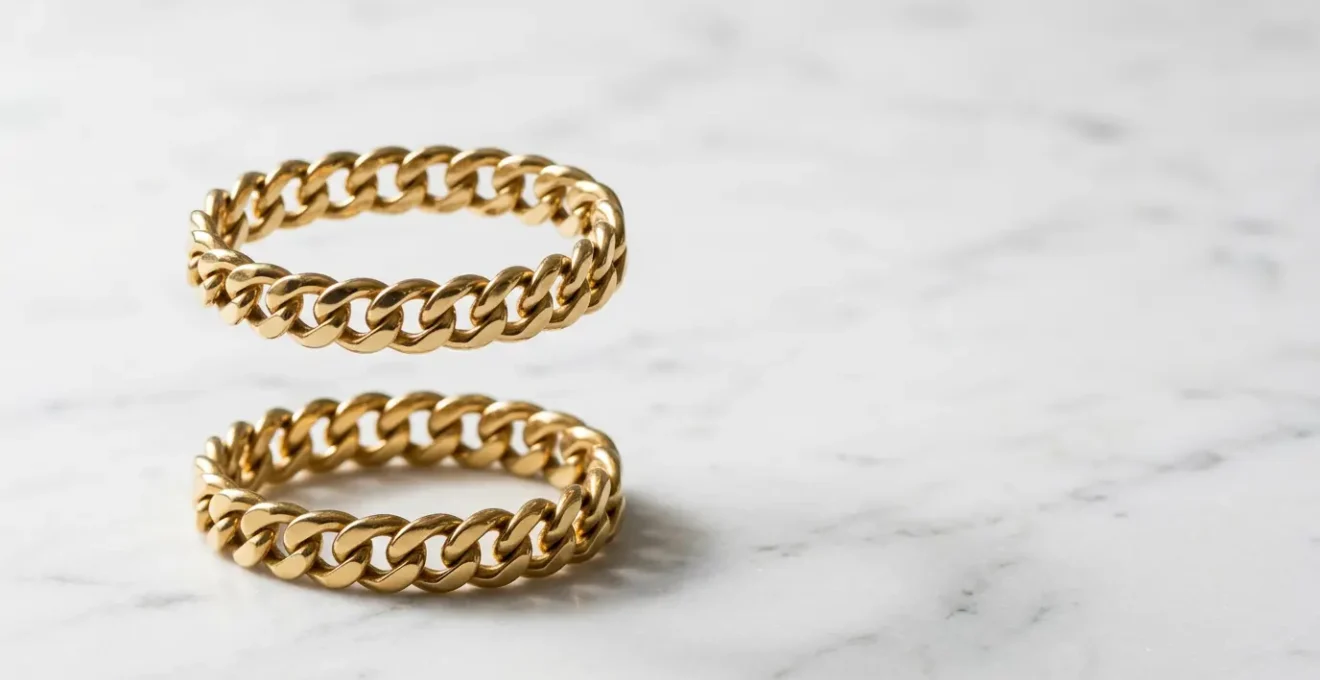
Contrary to what slick online photos suggest, the ‘heft’ of a gold bracelet is often an illusion; the real difference between a lifetime investment and a dent-prone disappointment is not what you see, but what you can scientifically deduce.
- Hollow gold is structurally weak due to using 50-70% less metal, making it prone to dents that are virtually impossible to repair.
- Forensic signals like the type of clasp, the sound it makes, and especially its weight-to-volume ratio are more reliable indicators of quality than the seller’s description.
Recommendation: Trust, but verify. Always use a simple kitchen scale to check the gram weight against a plausible estimate for a solid piece as soon as you receive it, well within your return window.
You’re scrolling through online listings, and there it is: a stunning, chunky gold bracelet that seems to radiate substance and luxury. The design is perfect, the finish is impeccable, and the price is… surprisingly reasonable. This is the precise moment of vulnerability for any buyer. In the digital marketplace, where you can’t feel the weight in your hand, you are gambling on the difference between a treasured heirloom and a fragile, air-filled piece of metal that will dent at the slightest knock.
Most advice centres on the obvious: “solid gold is heavier”. While true, this is useless when you’re looking at a picture. Sellers often use misleading photography and vague descriptions to sell pieces with high “deceptive volume”—they look big, but are structurally hollow and weak. This isn’t just about getting less gold for your money; it’s about buying a product with an inherent, irreparable flaw.
This guide rejects superficial advice. It is a forensic field manual for the skeptical online buyer. We will equip you with the investigative techniques to decode misleading listings, analyze forensic signals, and ultimately, verify the true nature of your purchase. Forget being a hopeful consumer; it’s time to become an empowered investigator and protect your investment.
Summary: A Forensic Guide to Differentiating Solid and Hollow Gold
- Why Hollow Gold Bangles Cannot Be Repaired If Dented?
- The ‘Gram Price’ Check: Is That ‘Heavy’ Bracelet Actually Light as Air?
- The Drop Test: How to Identify Hollow Gold by Sound?
- Why Safety Chains Are Essential for Heavy Solid Gold Bangles?
- Why Box Clasps Last Longer than Lobster Claws on Heavy Link Bracelets?
- Real Gold vs Plated Steel: How a Kitchen Scale Can Save You £4,000?
- Why High Street Chains Charge 300% Markup Compared to Independent Makers?
- 9ct vs 18ct Gold: Which Better Withstands Daily Wear on the London Tube?
Why Hollow Gold Bangles Cannot Be Repaired If Dented?
Hollow gold bangles are fundamentally unrepairable if dented because they lack the internal structure and material mass necessary for a jeweller to work. The process of removing a dent requires either pushing it out from the inside or meticulously hammering the surrounding area to reshape the surface. On a thin, empty shell, both actions are impossible without causing the piece to collapse entirely or creating further damage. There is simply no material to manipulate; it’s like trying to fix a dent in a crushed eggshell.
The manufacturing process itself is the root cause of this fragility. Hollow jewellery is electroformed around a wax or base metal core that is later dissolved, leaving a thin gold facade. Jewellery manufacturing data confirms that this method uses 50-70% less metal than a solid equivalent, creating a piece with compromised structural integrity from the start. This inherent weakness means the piece is not just susceptible to damage, but that the damage is permanent.
As experts at Martin Busch Jewelers note, the consequences are predictable: “Over time, hollow gold pieces can show signs of damage more quickly than solid or gold-filled jewelry. Because the gold is thin and the interior is empty, hollow gold can easily become dented, scratched, or even crushed under pressure. You might notice that your hollow gold jewelry has started to lose shape, develop small dents, or show visible signs of wear on the surface.” This isn’t a possibility; it’s an inevitability. A significant dent on a hollow piece effectively marks the end of its wearable life.
The ‘Gram Price’ Check: Is That ‘Heavy’ Bracelet Actually Light as Air?
In online jewellery sales, volume is a tool of deception. A visually large, “chunky” bracelet can command a premium price based on its perceived substance. However, for a skeptical buyer, the only metric that matters is the value density, or the price per gram. A “heavy” looking bracelet that is actually hollow is mostly air, and its price is inflated relative to the amount of precious metal you are actually receiving. The “gram price” check is your first line of defense against this common retail tactic.
To perform this check, you must become an investigator. Find a similar, verified solid gold bracelet online from a reputable dealer where the weight is listed. Compare its dimensions to your target piece. This gives you a baseline. If a 6-inch solid Cuban link bracelet weighs 40 grams, a visually identical bracelet weighing only 15 grams is clearly hollow, and its price should be dramatically lower. Any seller who is hesitant to provide a weight is waving a major red flag.
This comparison table reveals the stark reality of how visually identical chains can differ dramatically in substance. The hollow chain offers the look for less, but at the cost of durability and intrinsic value.
| Chain Type | 14K Gold Content | Weight for 20-inch chain | Relative Cost |
|---|---|---|---|
| Solid Gold Cuban Link | 58.3% pure gold | 40-60 grams | Premium price |
| Hollow Gold Cuban Link | 58.3% pure gold | 15-25 grams | 50-70% less |
| Semi-solid Gold Cuban | 58.3% pure gold | 25-35 grams | Mid-range |
Upon receiving any online gold purchase, your first action should be to verify its weight on a simple digital kitchen scale. This single act can confirm whether you received the asset you paid for or a piece with deceptive volume.
The number on this scale is the ultimate truth-teller. If the weight is suspiciously low for the item’s size, you have concrete evidence to initiate a return. Do not rely on feel alone; rely on data.
The Drop Test: How to Identify Hollow Gold by Sound?
Once the item is in your hands, you can employ another simple but effective forensic technique: the acoustic test. The sound an object makes when tapped is a direct indicator of its internal structure. As the experts at Martin Busch Jewelers explain, the principle is straightforward:
Hollow gold will produce a more ‘hollow’ or echoing sound because the interior is empty
– Martin Busch Jewelers, Professional Jeweler’s Guide
A solid piece of metal has no internal chamber to resonate, so it produces a dull, short “thud” when tapped. A hollow piece, however, acts like a small bell. The air-filled interior allows sound waves to reverberate, creating a higher-pitched, more sustained “ting” or ringing sound. This difference, while subtle, is a clear giveaway to a trained ear. The key is to have a reliable point of comparison.
Your Action Plan: The Acoustic Test Protocol
- Establish a Baseline: Gently tap the bracelet against a known solid gold item, like a solid wedding band or a coin. Listen carefully to the dull, low-pitched sound. This is your “solid” reference.
- Conduct the Test: Now, tap the questionable piece with the same force. Listen for a distinctly different sound—a lighter, higher-pitched, and slightly echoing ‘ting’.
- Confirm with a Control: For comparison, tap a known hollow object of similar material, like a metal pen cap. The sound should be similar to the hollow gold piece.
- Analyze the Pitch: Note that hollow gold often produces a higher-pitched, more sustained ring. The sound lingers for a split second longer than the dead ‘thud’ of a solid piece.
- Consider the Limitations: Be aware that this test is most effective on larger, single-form pieces like bangles. It is much harder to perform accurately on intricate link chains where each link can produce its own sound.
Performing this test systematically removes guesswork. By comparing the sound profile of the unknown item to both a known solid and a known hollow object, you can make a much more confident assessment of its construction.
Why Safety Chains Are Essential for Heavy Solid Gold Bangles?
Once you’ve verified you own a genuine, heavy, solid gold piece, your mindset must shift from detection to asset protection. A heavy solid gold bangle isn’t just an accessory; it’s a significant, portable financial asset. Fine jewelry made from solid gold holds intrinsic value based on its gold content, which can retain or increase its financial worth over time. The very quality that makes it valuable—its mass—also makes it a liability if its single point of failure, the clasp, gives way.
This is where a safety chain becomes non-negotiable. It is a simple, redundant security system. The safety chain is a thin chain that remains connected to both sides of the bracelet even if the main clasp opens accidentally. Should the main clasp fail, the safety chain prevents the heavy bangle from falling completely off your wrist, giving you a chance to notice the failure and secure your investment. It turns a potential catastrophe—the silent loss of a piece worth thousands—into a minor inconvenience.
The need for this redundancy is amplified by the sheer weight of a solid piece. While a solid gold chain can be incredibly robust—with some analyses showing solid chains demonstrate nearly 10x stronger tensile strength than hollow versions—all that force is concentrated on a small mechanical clasp. A sudden jolt or snag can be enough to pop it open. For a heavy solid gold bangle, a safety chain is not an optional extra; it’s essential insurance.
Why Box Clasps Last Longer than Lobster Claws on Heavy Link Bracelets?
One of the most telling forensic signals on a bracelet is the choice of clasp. For a heavy, solid gold link bracelet, the presence of a flimsy lobster claw is an immediate red flag. A knowledgeable maker would never secure a high-value, high-mass piece with a clasp designed for lightweight chains. The superior choice, and the mark of quality construction, is the box clasp. The reason for its superiority lies in the physics of force distribution and its mode of failure.
A lobster claw concentrates the entire weight and pulling force of the bracelet onto a single, small hook and an internal spring mechanism. This creates a critical point of failure. The spring can wear out, or the hook can deform under a sudden load. In contrast, a box clasp distributes the load across a wide, flat tongue that slides into the receiving box. This dramatically reduces the stress on any single part of the mechanism, making it inherently more secure for heavy pieces.
Furthermore, their failure modes are vastly different. When a lobster claw fails, it’s usually catastrophic and requires a full replacement. When a box clasp starts to lose its grip, the tongue has simply lost some tension. A jeweller can re-tension it in minutes, restoring its secure “click”. This serviceability makes it a far more durable and reliable long-term solution.
This table breaks down the engineering advantages of a box clasp for securing a heavy investment piece.
| Feature | Box Clasp | Lobster Claw |
|---|---|---|
| Force Distribution | Wide tongue distributes weight across large surface | Single hook point bears all weight |
| Failure Mode | Tongue loses tension (easily adjustable) | Spring mechanism breaks (requires replacement) |
| Integration | Built into final link (seamless) | Attached via jump ring (additional weak point) |
| Best For | Heavy solid gold chains | Lightweight hollow chains |
| Serviceability | Easy retensioning by jeweler | Often requires full replacement |
When you see a box clasp on a heavy bracelet, it signals that the maker understood the engineering requirements of the piece. It is a quiet testament to quality and a strong indicator that you are looking at a well-made, solid item.
Real Gold vs Plated Steel: How a Kitchen Scale Can Save You £4,000?
The most audacious fraud in the jewellery world isn’t selling hollow gold as solid; it’s passing off gold-plated steel as the real thing. To the eye, a high-quality plating can be indistinguishable from solid gold. But to a kitchen scale, the difference is as clear as day. The secret lies in one of the fundamental properties of matter: density. This immutable physical law is your ultimate tool for exposing fakes.
The numbers don’t lie. According to material science data, gold’s density is significantly higher at 19.3 g/cm³ vs 8 g/cm³ for steel. This means that for two bracelets of the exact same size and shape, one made of solid gold will weigh more than twice as much as one made of steel. Your hand might be fooled, but a simple digital scale cannot be.
Let’s consider the hypothetical scenario in the title. Imagine an online listing for a “Heavy 18ct Solid Gold Bracelet” for £4,000. Based on its visual size, a buyer might assume it weighs around 100 grams. You buy it, and upon arrival, you place it on your kitchen scale. The display reads 45 grams. This isn’t a minor discrepancy; it’s a physical impossibility for a solid gold piece of that volume. You have just used a £20 kitchen scale to prove that a £4,000 item is a fake, providing you with irrefutable evidence for a return and refund. The scale acts as your personal, impartial arbitrator of truth.
This density check is your final and most definitive test. If the look, the sound, and the clasp have all passed inspection, the scale provides the final, objective confirmation. An honest seller of solid gold products has nothing to fear from a scale; in fact, they often list the gram weight as a point of pride.
Why High Street Chains Charge 300% Markup Compared to Independent Makers?
The perception that high street jewellery chains have astronomical markups isn’t entirely unfounded, though the “300%” figure is often an exaggeration. The reality is rooted in vastly different business models. When you buy from a major chain, a significant portion of the price tag is not for the gold itself, but for the brand’s immense overheads: prime retail-space rent, multi-million-pound advertising campaigns, staff costs, and shareholder expectations.
Investigative analysis of public financial reports reveals the real numbers. For instance, combined 2020-2021 data from Signet and Tiffany shows an average markup of 116.3%. While substantial, this figure reflects the cost of their global operations. Tiffany & Co, with its luxury branding and iconic blue boxes, reported a 166.2% markup, while Signet Jewelers (owners of H.Samuel and Ernest Jones) had a lower but still significant 66.4% markup. These costs are passed directly to you, the consumer.
In stark contrast, an independent maker operates on a much leaner model. They often work from a small studio, sell directly to consumers online, and rely on word-of-mouth and craftsmanship for their marketing. Their overheads are a fraction of a major retailer’s. This means a much larger percentage of your payment goes directly towards the precious metal and the artisan’s skilled labour. While they still need to make a profit, their pricing is more closely tied to the intrinsic material and artistic value of the piece, rather than the maintenance of a global brand identity.
As a consumer champion, understanding this dynamic is crucial. You can then make a conscious choice: are you paying for the security and brand prestige of a high street chain, or the direct material and artisanal value from an independent maker?
Key Takeaways
- Hollow gold’s structural weakness makes it highly prone to dents that are virtually unrepairable, making it a poor long-term investment.
- The true value of a gold piece is its “gram price,” not its visual size; always verify the weight with a digital scale to avoid paying for deceptive volume.
- Forensic signals like the use of a robust box clasp over a lobster claw, or a dull ‘thud’ versus a ringing ‘ting’ in a sound test, are critical indicators of a piece’s solid construction and quality.
9ct vs 18ct Gold: Which Better Withstands Daily Wear on the London Tube?
Choosing between 9ct and 18ct gold for a daily-wear bracelet, especially one subjected to the rigors of the London Tube, presents a classic engineering trade-off: hardness versus purity. There isn’t one “better” option; the right choice depends on which type of wear and tear you are most concerned about. It’s a battle between impact resistance and chemical resistance.
For surviving the physical world of the Tube—knocks against poles, scrapes against ticket barriers, and general commuter jostling—9ct gold has a distinct advantage in hardness. Because it is an alloy containing only 37.5% pure gold and 62.5% other, stronger metals like copper and silver, it is significantly more resistant to scratching and denting than its purer counterpart. This makes it a workhorse choice for someone prioritizing resilience against physical impacts.
However, this lower gold content comes with a chemical disadvantage. The higher percentage of alloy metals, particularly copper, makes 9ct gold more susceptible to tarnishing. The combination of urban air pollution and acidic sweat—both unavoidable parts of a London commute—can cause 9ct gold to darken or discolor over time. In some cases, for individuals with sensitive skin, this chemical reaction can even cause a harmless but unsightly green stain on the skin. 18ct gold, being 75% pure, is far more noble and resistant to these types of chemical reactions, maintaining its lustre and color with much less maintenance.
Ultimately, the decision is a personal one. If your primary concern is preventing dents and dings from a physically demanding daily routine, 9ct gold is the more robust mechanical choice. If your priority is color stability, tarnish resistance, and minimizing skin reactions, the chemically superior 18ct gold is the clear winner.
Armed with these investigative techniques, you are no longer a passive consumer but an informed buyer capable of protecting your assets. Scrutinize every listing, question every claim, and trust only the verifiable data of weight, sound, and material science. Your next gold purchase won’t be a gamble; it will be a calculated, confident investment.
Frequently Asked Questions About 9ct vs 18ct Gold
Which gold karat is harder for daily wear?
9ct gold is harder due to higher alloy content (62.5% other metals), making it more resistant to dents from daily impacts like poles and ticket barriers.
Does lower karat gold tarnish more easily?
Yes, 9ct gold with its higher copper and silver content is more prone to tarnishing from sweat and urban air pollution compared to 18ct gold.
Can 9ct gold cause skin discoloration?
The higher percentage of copper and silver in 9ct gold can react with acidic sweat, potentially causing green skin discoloration in sensitive individuals.