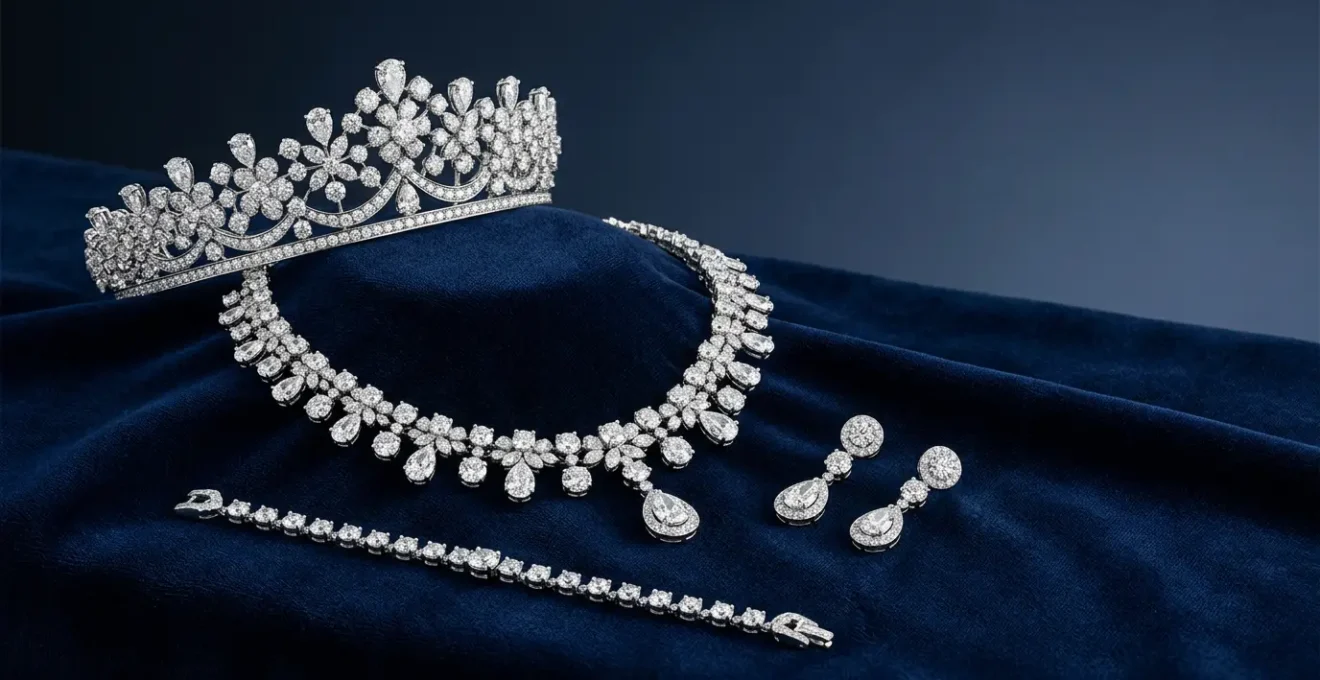
Wearing high jewellery today is less about following archaic rules and more about mastering a modern language of social signalling. The decision to wear a full parure or deconstruct it is a strategic choice that communicates your social awareness. This guide decodes that language, helping you navigate any occasion with confidence and sophistication, ensuring your collection enhances your presence rather than defines it in a dated way.
The velvet-lined box opens, revealing a constellation of diamonds. A complete parure—necklace, earrings, bracelet, perhaps even a tiara—lies waiting. For the wearer preparing for a state banquet or a significant gala, a moment of hesitation is common. To wear the full set is to make a statement of unparalleled grandeur, but it also risks a social misstep, a feeling of being a “museum piece” rather than a modern, sophisticated individual. The fear of looking dated or ostentatious is a valid one in today’s nuanced social landscape.
Conventional wisdom offers simple, yet often inadequate, advice: reserve full sets for the most formal of white-tie events and break them up for anything less. While fundamentally sound, this advice barely scratches the surface. It treats high jewellery as a costume with a rigid instruction manual, ignoring its power as a tool of communication. The real art lies not in what the etiquette books say, but in understanding the subtle signals each piece—worn alone or in concert—sends to a discerning audience.
But what if the true key to navigating high jewellery is not memorising rules, but learning to speak its language? This guide reframes the question entirely. It moves beyond “Can I wear this?” to “What do I want to say?”. Wearing a parure becomes a conscious act of social signalling, a way to project discernment, confidence, and an understanding of contemporary luxury. It’s the difference between merely displaying wealth and demonstrating impeccable taste.
This article will explore the strategic deconstruction of a parure for modern wear, the critical importance of storage in preserving a piece’s legacy, the calculated risks of insurance, and the unwritten rules that separate the truly elegant from the merely adorned. We will decode the visual grammar of high jewellery, empowering you to make choices that are not only appropriate but also authentically you.
To navigate this intricate world of sparkle and signals, we will explore the key considerations that transform a collection of jewels into a strategic asset of personal expression. The following sections provide a comprehensive overview of mastering the modern parure.
Summary: The Modern Guide to High Jewellery Etiquette
- How to Deconstruct a Diamond Suite for Casual Daywear?
- Fitted Boxes or Vault Trays: Best Way to Store Complex Necklaces?
- The ‘Away from Home’ Limit: Are You Covered Wearing £50k to Dinner?
- The Detachable Drop Risk: How to Secure Convertible Tiara-Necklaces?
- Complete Set vs Individual Pieces: Which Fetches More at Auction?
- Why Wearing a Tiara Before 6pm Is a Social Faux Pas?
- Why Wearing Your Claddagh Ring the Wrong Way Sends the Wrong Signal?
- Rent or Buy: Is Renting High Jewellery for a Wedding Worth the Insurance Risk?
How to Deconstruct a Diamond Suite for Casual Daywear?
The concept of “casual daywear” for the owner of a diamond suite is, of course, relative. Yet, the art of deconstructing a parure is the single most important skill in modern jewellery etiquette. It signals an effortless relationship with luxury, a confidence that doesn’t require the full declaration of a matched set. The goal is to integrate a single, magnificent piece into a polished daytime ensemble without it appearing out of place. This practice has been masterfully adopted by modern royals, who understand the power of a singular statement. For instance, the Princess of Wales has been seen in at least five different diamond tiaras since 2011, but far more frequently wears individual earrings or necklaces from historic suites for public duties.
Deconstruction is a deliberate process. It’s about choosing one “hero piece” to be the focal point and building a look around it. This prevents the ensemble from feeling like a costume. The key is balance; a statement necklace from a parure calls for minimal other jewellery, while a pair of dramatic earrings might be perfectly balanced with the matching bracelet. The process is less about rules and more about an intuitive sense of proportion and context.
To master this art, consider a systematic approach to breaking down a formal set for less formal, yet still significant, occasions:
- Select your ‘hero piece’: Choose the most substantial element, which is typically the necklace or a statement bracelet, to act as your focal point for the outfit.
- Apply the ‘Three-Piece Rule’: Combine your one parure piece with one simple metal item (like a fine gold chain or plain hoop earrings) and one personal or sentimental item (such as a signet ring or a simple watch). This grounds the magnificent piece in reality.
- Consider the context: The environment dictates the choice. For a city lunch or gallery opening, pair dazzling diamond earrings with a structured blazer. For a country weekend, the suite’s bracelet can be worn elegantly alongside a casual field watch.
- Balance proportions: If you are wearing the grand necklace, keep all other jewellery to an absolute minimum. If you have chosen the earrings, consider adding the bracelet for a sophisticated sense of balance across the body.
Ultimately, deconstructing a parure is about claiming ownership over its narrative. It transforms an heirloom from a relic of the past into a vibrant, versatile component of a contemporary wardrobe, signalling taste over mere possession.
Fitted Boxes or Vault Trays: Best Way to Store Complex Necklaces?
The conversation around jewellery storage transcends mere organization; it is a critical decision that impacts a piece’s physical integrity and its long-term financial and historical value. For complex parures, the choice between retaining the original fitted box and transferring the pieces to modern vault trays represents a philosophical split between the ‘Archivist’ and the ‘Wearer’. Each approach has significant implications for what one might call the curated legacy of the collection.
The original fitted box, often crafted with the same attention to detail as the jewellery itself, is a piece of history. It can significantly enhance a parure’s value at auction by preserving its provenance and completeness. For example, a Victorian demi-parure by D & J Wellby, complete with its original signed box, is not just a set of jewels but a historical artefact, a snapshot of its era. This completeness is what collectors and museums prize. However, these historic boxes carry a risk: the velvets and silks used in the 19th and early 20th centuries can contain acidic compounds that may tarnish or damage metals over many decades.
On the other hand, custom-lined vault trays are designed for the modern wearer. They offer superior practical benefits, allowing for easy access and ensuring that articulated necklaces and bracelets lie flat, preventing stress on delicate links and settings. They are often made with modern, tarnish-resistant materials. The trade-off is a potential reduction in historical value, as separating a piece from its original housing can break a tangible link to its past.
To make an informed decision, it’s essential to weigh the competing priorities of preservation and accessibility. The following analysis compares the primary methods for storing high jewellery.
| Storage Method | Best For | Pros | Cons |
|---|---|---|---|
| Original Fitted Box | ‘Archivist’ Collectors | Preserves provenance & auction value | Old silks/velvets may contain acids that tarnish metals |
| Custom Vault Trays | ‘Wearer’ Enthusiasts | Easy access, prevents stress on articulated links | May reduce historical value |
| Modern Archival Storage | Museum-Quality Preservation | Tarnish-resistant materials, optimal protection | Higher initial investment |
Therefore, the ideal solution is often a hybrid one: retain the original fitted box in a climate-controlled environment as a historical document, while using a custom modern tray for the pieces that are worn regularly. This approach respects both the past and the present life of the jewellery.
The ‘Away from Home’ Limit: Are You Covered Wearing £50k to Dinner?
Wearing a significant piece of jewellery outside the home is an exercise in calculated risk. While the joy of adornment is the very purpose of a collection, it is accompanied by the pragmatic concern of loss, theft, or damage. The question of whether you are covered for wearing a £50,000 bracelet to dinner is not a simple yes or no; it depends entirely on the specifics of your insurance policy. Standard homeowner’s policies are notoriously inadequate for high jewellery, often having low single-item limits and numerous exclusions.
This is where a specialized Valuable Articles Policy becomes non-negotiable. These policies are designed specifically for items like fine art and jewellery and offer what is known as “all-risk” or “worldwide” coverage. This is the crucial distinction. It means the item is protected whether it’s in a vault, on your person at a gala in London, or on a yacht in the Mediterranean. As the leading insurer in this space, Chubb offers a clear promise to its clients.
Wear and enjoy your jewelry anywhere in the world knowing it’s protected against most types of loss with no deductible.
– Chubb Insurance, Chubb Valuable Articles Coverage
Key to this coverage is an up-to-date appraisal. Most insurers require pieces to be appraised every three to five years to ensure the coverage amount reflects the current market value. Without this, you could find yourself significantly underinsured in the event of a total loss. The “Away from Home” limit, therefore, is less about a specific monetary cap and more about ensuring your policy has worldwide coverage and is based on a recent valuation.
Before attending any event with a high-value piece, a quick call to your broker to confirm the scope of your policy is a prudent and necessary step. It ensures that the pleasure of wearing a masterpiece is not overshadowed by financial anxiety.
The Detachable Drop Risk: How to Secure Convertible Tiara-Necklaces?
Convertible jewellery, particularly historic tiara-necklaces, represents the pinnacle of jewellery craftsmanship and versatility. These ingenious creations can be worn in multiple ways, transforming from a formal headpiece to a grand necklace. However, this very versatility introduces a unique and significant risk: the security of detachable components. A loose clasp or a faulty screw mechanism on a priceless diamond drop is the stuff of nightmares for any collector. Securing these pieces is not just about preventing loss, but about preserving an irreplaceable work of art.
The allure of these transformable pieces often lies in their history of being worn in unconventional ways. Princess Diana famously defied convention during a 1985 royal tour by wearing an Art Deco emerald choker, part of the Cambridge Emerald Parure, as a forehead bandeau. This act of stylish rebellion made headlines worldwide and showcased the powerful statement that re-imagined jewellery can make. It also highlighted the robust construction of these pieces, but serves as a reminder that any time a piece is adapted, every connection point becomes a potential vulnerability.
Ensuring the security of these mechanisms before an important event is a non-negotiable responsibility. It requires a proactive, systematic check to mitigate the risk of a detachable element failing. This is not a task for an amateur; it often requires the expertise of a master jeweller or the original Maison.
Your Pre-Event Security Protocol for Convertible Pieces
- The ‘Pre-Wear Wiggle Test’: Gently test each clasp, pin, and screw mechanism by applying light, multi-directional pressure. There should be no give, looseness, or unusual movement in any component.
- Schedule a ‘Health Check’: For truly important pieces, book an appointment with the original Maison (e.g., Cartier, Garrard) for a complimentary pre-event inspection and cleaning. Their workshops have the specific expertise for their own historical mechanisms.
- Document all components: Before leaving for your jeweller or the event, photograph the piece fully assembled and then disassembled. This creates a visual inventory, ensuring all parts are accounted for upon return.
- Consider an ‘Invisible Safety’ retrofit: For a piece that is worn frequently, have a master jeweller add a discreet platinum safety chain. When done correctly, this can provide an extra layer of security without compromising the piece’s historical or aesthetic integrity.
- Plan for Integration: After any service, ensure that any “repaired” or “tightened” elements are tested again. The goal is to replace any uncertainty with the confidence that the piece is secure for wear.
This protocol transforms anxiety into assurance, allowing the wearer to focus on the occasion, confident that their treasured—and valuable—history is secure.
Complete Set vs Individual Pieces: Which Fetches More at Auction?
The question of whether to keep a parure intact or break it up for auction is a complex one, touching on the tension between market trends and historical rarity. While the modern trend is towards wearability, which often involves deconstructing sets, the pinnacle of the auction market tells a different story. Unequivocally, a complete, original parure from a renowned Maison, especially with its fitted box, will almost always command a significant premium over the sum of its individual parts.
The reason for this is simple: rarity. Over generations, complete sets are incredibly difficult to keep together. Heirs may divide pieces among themselves, or individual items are sold off to meet financial needs. Finding a Georgian or Napoleonic parure with all its components—necklace, earrings, brooch, bracelets, and perhaps a tiara—is an exceptionally rare event in the world of haute joaillerie. These sets are not just collections of jewellery; they are cultural artifacts that offer a complete view of the style and craftsmanship of a specific period.
As one expert notes, the survival of a complete set is an event in itself. This rarity is what drives connoisseurs and institutions to compete fiercely when one does appear on the market.
it is hard enough to find one special jewel — families that inherit parures tend to break them up. So this set, he adds, is a real treat.
– Ariel Saidian, 1stDibs Interview on Van Cleef & Arpels Parures
However, this premium applies primarily to signed, antique, or historically significant sets. For more contemporary or unsigned parures, the financial calculation can be different. In some cases, selling standout individual pieces, like a magnificent pair of earrings or a statement necklace, into a market hungry for wearable items can yield a higher total return. The decision requires a nuanced understanding of both the jewellery’s provenance and the current auction climate.
Ultimately, for a collector focused on legacy, preserving the integrity of a complete parure is the superior long-term strategy. It ensures the set is viewed as a work of art, a holistic statement of its time, which is a form of value that transcends simple carat weight.
Why Wearing a Tiara Before 6pm Is a Social Faux Pas?
The rule that tiaras should not be worn before the evening—traditionally 6 p.m. or, at the earliest, 5 p.m.—is one of the most famous and steadfast in the world of high jewellery etiquette. To the uninitiated, it can seem arbitrary, but it is a powerful act of social signalling rooted in centuries of court protocol. This rule is not merely about time; it is about signifying a transition from the day’s business to the evening’s formal festivities. A tiara is the ultimate emblem of a white-tie affair, and its appearance signals that the highest level of formality has been reached.
Wearing a tiara during the day is considered a significant faux pas because it breaks this symbolic code. It suggests a misunderstanding of the occasion’s gravity, much like wearing a ballgown to a luncheon. As etiquette experts confirm, diamond headwear is reserved strictly for formal evening attire. The sparkle of diamonds is intended for candlelight and electric light, not sunlight. This long-standing rule dates back to a time when displays of such immense wealth and status were considered inappropriate for daytime activities.
Of course, there are notable exceptions. As detailed by jewellery authorities, these moments are rare and tied to events of national or royal importance. According to an editorial on royal tiara rules from Natural Diamonds, “The only exceptions occur during major ceremonial occasions—such as royal weddings, coronations, or jubilees—when protocol allows tiaras to be worn earlier in the day due to the event’s significance and formal dress code.” Outside of these rare historical moments, the tiara remains an after-dark adornment, its power deriving from its exclusivity to state banquets, diplomatic receptions, and the most formal of evening events.
Therefore, adhering to the 6 p.m. rule is not about being old-fashioned. It is about demonstrating a sophisticated understanding of tradition and the non-verbal language of occasion, a signal that is immediately understood and respected in high society.
Why Wearing Your Claddagh Ring the Wrong Way Sends the Wrong Signal?
While a world away from the grandiosity of a diamond parure, the humble Irish Claddagh ring offers the clearest and most powerful lesson in jewellery as a language. The way this simple ring is worn sends an immediate, unambiguous signal about the wearer’s romantic status. This “visual grammar” is not an opinion; it is a code, understood within its cultural context. It serves as a perfect microcosm for understanding how all jewellery, no matter how grand, communicates non-verbally.
The Claddagh’s design features two hands clasping a heart, topped with a crown, symbolizing love, loyalty, and friendship. The signal it sends is determined by two factors: which hand it’s worn on and the direction the heart is pointing. Worn on the right hand with the heart pointing outwards, away from the body, it declares, “My heart is open.” When the ring is turned around on the same hand, with the heart pointing inwards, it signals, “My heart is taken.” Moving the ring to the left hand with the heart still pointing inwards signifies a permanent commitment, an engagement or marriage, proclaiming, “My heart is promised forever.”
This simple, elegant system demonstrates the core principle of social signalling. The object itself does not change, but its context and orientation alter its meaning entirely. If a piece as modest as a Claddagh ring carries such a precise code, one can begin to appreciate the volume of information conveyed by a full diamond parure at a state function. A full parure is a declaration of immense status, an acknowledgement of the occasion’s formality, and a display of significant wealth and heritage. It is a complex, multi-layered statement.
By appreciating the simple clarity of the Claddagh’s message, we can better understand the nuanced and powerful statements we make with every piece of jewellery we choose to wear, from a simple ring to a magnificent tiara.
Key Takeaways
- Jewellery as Language: Wearing a full parure is a formal declaration. The most sophisticated wearers know when to speak formally and when to use a single, eloquent “word.”
- The Art of Deconstruction: Modern elegance is often achieved by wearing one “hero piece” from a suite, balanced with simpler, personal items to create a look that is confident, not costumed.
- Provenance is Paramount: The long-term value of a historic parure is intrinsically linked to its completeness, including its original fitted box, which can significantly increase its price at auction.
Rent or Buy: Is Renting High Jewellery for a Wedding Worth the Insurance Risk?
For a singular event like a wedding, the allure of renting a breathtaking piece of high jewellery is undeniable. It offers access to a level of magnificence that may be beyond a purchase budget, allowing for a “Cinderella moment” without the lifetime financial commitment. However, this fairytale comes with a very real-world consideration: the burden of insurance and liability. The decision to rent or buy is not just a financial one; it’s a question of your personal tolerance for calculated risk.
Renting is, at its core, a pure expense. You pay a percentage of the item’s retail value (typically 1-3%) for temporary use. While this is a fraction of the purchase price, it comes with stringent insurance requirements. The rental company will mandate a short-term ‘binder’ policy for the full value of the item, which you are responsible for securing. This process can be complex, and as reported by CNBC’s analysis, premier insurers like Chubb may require a minimum coverage of $15,000 just to initiate a policy. The emotional weight of being responsible for a piece you don’t own can also be significant, with the anxiety of potential damage or loss sometimes overshadowing the joy of wearing it.
Buying, on the other hand, is an investment in an asset. While the initial cost is exponentially higher, the piece becomes part of your legacy. The annual insurance premium (usually 1-2% of the appraised value) is an ongoing cost, but it’s for an item that you own and can enjoy for years, pass down to future generations, or that may even appreciate in value. The emotional connection to an owned piece is one of joy and pride, free from the liability anxiety of renting.
The following table breaks down the core differences between these two approaches, highlighting the trade-offs between short-term glamour and long-term value.
| Factor | Renting | Buying |
|---|---|---|
| Initial Cost | 1-3% of retail value | Full retail price |
| Insurance | Mandatory short-term ‘binder’ policy required | Annual premium (typically 1-2% of value) |
| Emotional Connection | Anxiety about liability and damage | Joy of ownership and potential heirloom value |
| Long-term Value | Zero – pure expense | Potential appreciation or family legacy |
| Flexibility | Different pieces for each occasion | Limited to owned collection |
For a once-in-a-lifetime event, renting can be a viable option if one is fully prepared for the insurance hurdles and the associated stress. However, for those looking to build a collection and a legacy, purchasing a timeless piece, even if more modest, is almost always the more rewarding long-term strategy.
Frequently Asked Questions on The Symbolism of Jewellery
What does a Claddagh ring position signify?
The position and orientation of a Claddagh ring is a clear code for romantic availability. Worn on the right hand with the heart pointing out means ‘my heart is open’. Worn on the right hand with the heart pointing in means ‘my heart is taken’. Finally, worn on the left hand with the heart pointing in signifies a permanent bond, meaning ‘my heart is promised forever’.
How do parures function as social signals?
A full parure is one of the most powerful social signals in the world of jewellery. It non-verbally declares immense status, a deep understanding of formal occasion etiquette, and significant generational or personal wealth. It is a statement of one’s established position within high society.
What are modern symbolic jewelry traditions?
Contemporary society has developed its own symbolic jewellery traditions beyond wedding rings. These include ‘push presents’—gifts of jewellery to a new mother—as well as ‘divorce rings’ often worn on the right hand to signify a new chapter, and the resurgence of pinky signet rings to indicate family heritage or personal affiliation.