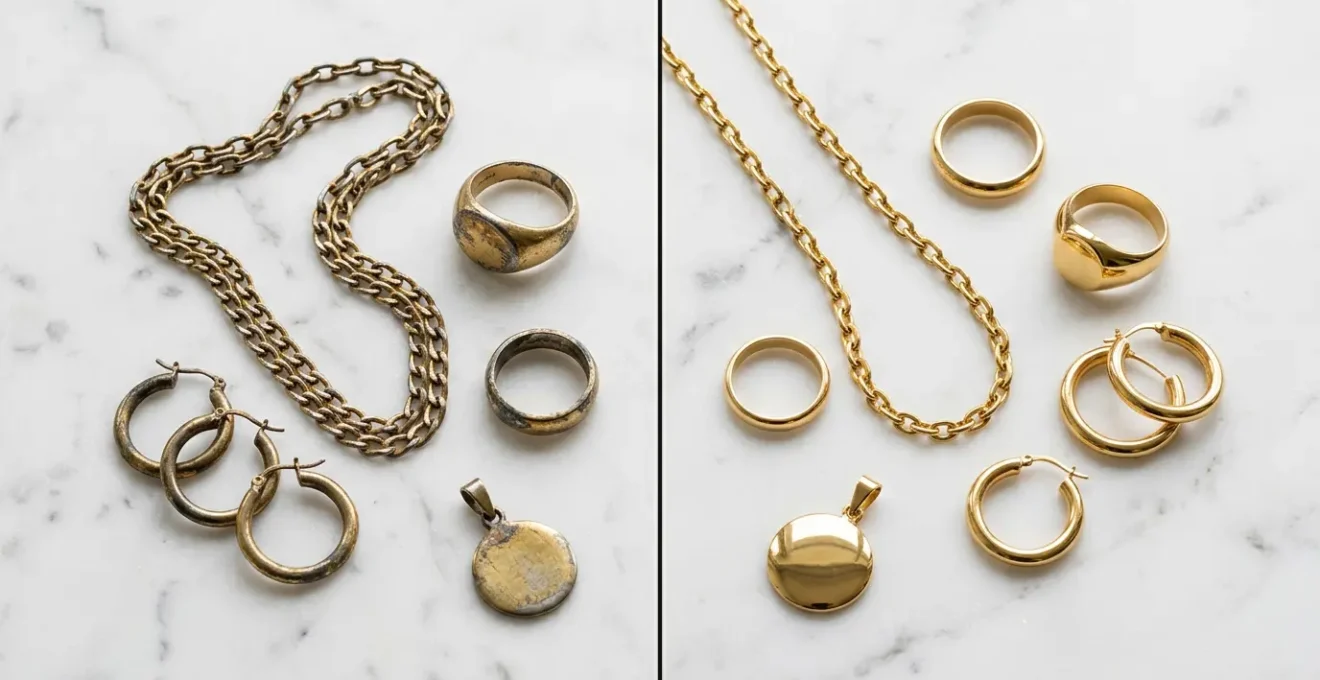
The true cost of trendy demi-fine jewellery isn’t its price tag, but its rapid decline to zero value, making solid gold a smarter long-term financial choice.
- Gold vermeil often requires replacement within 6 to 18 months of regular wear, rapidly eroding any initial cost savings.
- Solid 9ct gold, despite a higher upfront cost, becomes cheaper than repeatedly replacing vermeil pieces and retains intrinsic, resellable value.
Recommendation: Before your next jewellery purchase, calculate the Total Cost of Ownership (TCO) over five years. The result will almost certainly favour investing in solid gold as the more sustainable and financially prudent decision.
The allure of demi-fine jewellery is undeniable. Scrolling through Instagram, it’s everywhere: gleaming gold vermeil rings, necklaces, and earrings from chic, direct-to-consumer brands promising the look of luxury without the daunting price tag. For the fashion-conscious buyer, it presents a tempting proposition: stay on-trend with multiple pieces for the price of one solid gold item. This seems like a savvy way to manage a style budget, allowing for frequent updates and experimentation. The marketing is slick, the designs are current, and the initial outlay feels manageable.
But a nagging question often surfaces a few months later, as a favourite ring starts to reveal a silver glint or a necklace loses its lustre. Was it truly a good deal? The common advice focuses on gentle care—avoiding water, lotions, and exercise—to prolong the life of plated jewellery. Yet, this approach only delays the inevitable. It treats the symptom, not the cause. The real conversation isn’t about maintenance; it’s about material integrity and long-term financial sense. The prevailing wisdom pits accessible trends against lifelong investment, but it rarely quantifies the decision.
What if the key wasn’t just choosing between affordability and durability, but understanding the precise economic tipping point where one becomes more logical than the other? This is the core of a slow-fashion mindset: moving beyond the initial purchase price to analyse the Total Cost of Ownership (TCO). This article deconstructs the popular demi-fine trend from an economic and sustainability perspective. We will move past the surface-level style debate to provide a calculated framework for your next jewellery investment.
We’ll examine the physical lifespan of gold vermeil, its non-existent resale value, and the hidden costs in its supply chain. By comparing this directly with the enduring value of 9ct solid gold, we will reveal when and why ‘saving up’ is not just a romantic notion, but a demonstrably smarter financial strategy.
Contents: Decoding the True Value of Your Jewellery
- Why Gold Vermeil Rings Turn Silver Within 6 Months of Daily Wear?
- The ‘Green Finger’ Risk: Which Base Metals Cause Allergic Reactions?
- Can You Re-plate Designer Costume Jewellery with Thicker Gold?
- Do Designer Vermeil Pieces Hold Any Resale Value on Vestiaire?
- Why Buying New Jewellery Costs You 20% in VAT You Cannot Claim Back?
- Why High Street Chains Charge 300% Markup Compared to Independent Makers?
- Gold or Silver: Which Metal Suits Pale British Complexions Best?
- The £500 Rule: When Does Solid Gold Become Cheaper Than Plated?
Why Gold Vermeil Rings Turn Silver Within 6 Months of Daily Wear?
The primary reason your gold vermeil ring reveals its silver core is a simple matter of physics and chemistry: the gold layer is incredibly thin and wears away. Gold vermeil is defined as a layer of gold electroplated over a sterling silver base. While this sounds superior to standard plating over brass, the crucial factor is the thickness of that gold layer. For a piece to be legally called “vermeil” in the US, it must have a gold layer of at least 2.5 microns. While this standard provides some initial durability, it is not designed to withstand the constant friction of daily life, especially on an item like a ring.
As the illustration above vividly shows, areas of high contact—the sides of the ring band that rub against your other fingers, the back that touches desks and steering wheels—suffer from accelerated abrasion. This friction physically scrapes away the gold, one micron at a time. Sweat, hand sanitisers, and lotions introduce chemical factors that further hasten this degradation. The result is that a ring worn daily by someone with an active lifestyle can show significant silvering in as little as six to twelve months. Office workers might get longer, but the outcome is always the same: the piece’s aesthetic lifespan is finite and often brutally short.
This ephemeral nature is the fundamental flaw in its value proposition. You are not buying a gold piece of jewellery; you are, in essence, renting a gold-coloured surface. As one analysis notes, demi-fine jewellery uses a plating technique that deliberately lowers the price, but this comes at the direct expense of permanence. The beauty is temporary, and its decline is a built-in feature, not a bug.
The ‘Green Finger’ Risk: Which Base Metals Cause Allergic Reactions?
Beyond the disappointment of a tarnished finish lies a more personal risk: skin reactions. The dreaded ‘green finger’ is a common complaint with costume jewellery, caused by the oxidation of copper in the base metal reacting with the skin’s acidity. While gold vermeil uses sterling silver as its base, this doesn’t entirely eliminate the risk. Sterling silver itself is an alloy. Its composition is typically 92.5% pure silver mixed with 7.5% of copper to add hardness and durability. As the thin gold plating wears away, your skin comes into direct contact with this silver-copper alloy, which can still cause green staining for some individuals, albeit less aggressively than brass.
The more significant concern for sensitive individuals is an allergic reaction, most commonly to nickel. While high-quality sterling silver should be nickel-free, cheaper manufacturing processes can sometimes introduce it as part of the alloy mix. A ‘925’ stamp, which denotes the silver content, is unfortunately not a guarantee of being nickel-free. This hidden allergen can cause contact dermatitis, leading to redness, itching, and discomfort. For those with sensitive skin, the gamble on a plated piece can have genuinely unpleasant physical consequences once the protective gold layer is breached. Solid gold, particularly 9ct, is alloyed with more stable metals like silver and copper in controlled amounts, making it a far more reliable and hypoallergenic choice for everyday wear.
Your Checklist for Choosing Skin-Friendly Metals
- Prioritise Hypoallergenic Heroes: For maximum safety, opt for platinum, titanium, or solid gold (9ct or higher) which are known for their inert properties.
- Verify Your Silver: When buying sterling silver, always ask the seller to confirm it is explicitly nickel-free. Do not rely solely on the 925 stamp for this assurance.
- Identify Oxidation Culprits: Be wary of jewellery with brass or copper bases. These are the primary causes of the green discolouration on the skin.
- Seek Protective Coatings: For white gold, which is alloyed with white metals, request rhodium plating. This provides an extra inert barrier between the metal and your skin.
- Conduct a Patch Test: Before committing to wearing a new piece for an extended period, test it on a small, discreet area of skin (like behind your ear) for 24 hours to check for any reaction.
Can You Re-plate Designer Costume Jewellery with Thicker Gold?
When a cherished vermeil piece begins to tarnish, the logical question is whether it can be restored. The answer is technically yes, but it is often an economic and practical dead end. Re-plating is a service offered by some jewellers, but it comes with significant costs and risks that frequently outweigh the benefits. The process involves chemically stripping any remaining gold, polishing the base metal, and then re-applying a new electroplated layer. The cost for this service can range from £50 to £150, depending on the complexity of the piece and the desired thickness of the new gold layer.
The problem is that this cost often approaches or even exceeds the original price of the demi-fine item. You are paying a substantial fee to add another 6-12 months of life to a piece that will inevitably tarnish again. Furthermore, the process is not without risk. Delicate designs, intricate settings, or unknown costume gemstones can be easily damaged by the harsh chemicals and polishing involved. As the experts at Blue Nile point out, this reality makes repair a challenging proposition:
Tricky base metals, thin plating, unknown costume gemstones, and delicate designs make demi-fine jewelry difficult for many jewelers to repair. For pieces that can be repaired, you may find that the repair cost for demi-fine jewelry costs more than the price of the jewelry itself.
– Blue Nile, Guide to Demi-Fine Jewelry
From a slow-fashion perspective, re-plating is a temporary fix that reinforces a cycle of degradation and cost. It is an attempt to prolong the life of a fundamentally disposable item, rather than investing in one with inherent longevity. The money spent on re-plating a vermeil ring twice could often have been put towards the initial purchase of a solid gold equivalent that would require no such costly maintenance.
Do Designer Vermeil Pieces Hold Any Resale Value on Vestiaire?
One of the most compelling arguments for investing in fine jewellery is its ability to hold value. A solid gold piece is an asset; it can be sold, passed down, or even melted down and its material value recovered. Demi-fine jewellery, regardless of its designer label, has virtually none of this long-term value. Its value proposition is tied entirely to its fleeting surface appearance. The moment you purchase a designer vermeil piece, its value plummets dramatically. Market analysis reveals a staggering 70-80% instant value loss upon purchase for designer vermeil items.
This depreciation is starkly evident on resale platforms like Vestiaire Collective. A quick search reveals that even popular brands known for their vermeil collections command very little on the secondary market. The reality is that these pieces are fashion expenses, not investments.
Case Study: Resale Value of Popular Demi-Fine Brands
An analysis of listings on platforms like Vestiaire Collective and Depop shows a clear trend. Vermeil pieces from sought-after brands such as Missoma and Monica Vinader, even when listed in ‘good’ or ‘unworn’ condition, typically resell for just 20-30% of their original retail price. Once a piece shows any visible signs of wear, such as tarnishing or scratches, it becomes almost impossible to sell at any meaningful price. As experts from Fine Matter state, the distinction is clear: “Unlike demi-fine, fine jewellery holds intrinsic value due to its materials. Whether you’re looking to sell a piece in the future or remodel it into something new, fine jewellery retains its worth and versatility.” The resale market simply does not value a thin layer of gold over silver; it values the substance of the metal itself.
This economic reality reframes the initial purchase. A £150 vermeil necklace is not an “affordable” alternative to a £500 solid gold one if the former becomes worthless and the latter retains a significant portion of its value. The £150 is a sunk cost, a pure expense on par with a piece of clothing that goes out of style. The £500, however, is a conversion of cash into a tangible, durable asset.
Why Buying New Jewellery Costs You 20% in VAT You Cannot Claim Back?
When evaluating jewellery as an investment, it’s crucial to factor in the unavoidable costs that are not part of the material’s value: taxes. In the UK, any new piece of jewellery you purchase is subject to a 20% Value Added Tax (VAT). This amount is built into the retail price but goes directly to the government. It is an immediate, irrecoverable loss on your ‘investment’. For a £500 solid gold ring, £83.33 of that price is tax, meaning the actual value of the item (materials, labour, markup) is only £416.67 from the moment of purchase.
This is a critical distinction between buying jewellery and investing in raw gold bullion, which is VAT-exempt in the UK. While this tax applies to both demi-fine and fine jewellery, its impact is felt more acutely when considering long-term value. On a £100 vermeil piece, the £16.67 lost to VAT might seem negligible. However, since the piece has no resale value, you are losing 100% of the item’s pre-tax cost plus the VAT over time. With solid gold, you lose the VAT, but the remaining 80% of the purchase price is tied to an asset that retains its value and can even appreciate.
Furthermore, should you ever sell a piece of jewellery for a significant profit, it could be subject to Capital Gains Tax. According to some financial analyses, this can add another layer of cost to treating jewellery as a pure financial instrument. For instance, some reports highlight potential tax implications that can include a 28% capital gains tax on profits from collectables, a category that can include jewellery. While this is more relevant to high-value items, it underscores that jewellery as an ‘investment’ is complex and saddled with tax burdens that commodity investments avoid. The 20% VAT, however, is the most immediate and universal financial drag on any new jewellery purchase.
Why High Street Chains Charge 300% Markup Compared to Independent Makers?
The price tag on a piece of jewellery, whether demi-fine or fine, is not a direct reflection of its material worth. It is the result of a long supply chain and business model, with markup being the most significant variable. Major high street chains and popular online brands operate on a model that prioritises marketing, branding, and retail overheads. These costs are passed directly on to the consumer, resulting in enormous markups. A pricing comparison reveals that while specialist or independent retailers might have a 30-55% markup on cost, major chains can apply markups of 200-300% or even higher.
This means that for a designer vermeil piece retailing at £150, the actual cost of the silver, gold plating, and manufacturing could be as low as £30-£50. The remaining £100-£120 you pay covers everything from influencer collaborations and glossy magazine ads to prime retail space and corporate salaries. You are paying for the brand’s story, not for the intrinsic value of the item. This is clearly illustrated when breaking down the cost components.
The table below provides a general breakdown of where your money goes when you buy from a large chain versus a small, independent maker. It starkly shows that with an independent, a much larger percentage of your payment goes directly towards the precious materials and skilled labour.
| Cost Component | High Street Chain | Independent Maker |
|---|---|---|
| Material Cost | 10-15% | 40-50% |
| Marketing/Advertising | 30-40% | 5-10% |
| Retail Overhead | 25-30% | 10-15% |
| Profit Margin | 20-25% | 20-30% |
| Corporate Structure | 10-15% | 0% |
This disparity is central to the slow-fashion argument. By choosing to buy solid gold from a direct-to-consumer independent jeweller, you are not only getting a piece with lasting material value but also ensuring your money supports craftsmanship over corporate advertising budgets. The perceived high cost of fine jewellery is often inflated by the same business models that make demi-fine seem attractively priced.
Key Takeaways
- Durability is an Economic Issue: Gold vermeil’s limited lifespan (6-18 months) turns it into a recurring expense, not a one-time purchase.
- Value is Intrinsic, Not Branded: Demi-fine jewellery suffers from 70-80% instant depreciation and has almost no resale value, making it a pure fashion expense. Solid gold retains value as a tangible asset.
- Price is Not Value: High street markups of up to 300% mean you primarily pay for marketing and overheads, not for the precious metal in your demi-fine piece.
Gold or Silver: Which Metal Suits Pale British Complexions Best?
Once you’ve made the sound economic decision to invest in solid metal over plated, the final choice often comes down to aesthetics: gold or silver? For those with the pale complexions common in the UK, often characterised by cool, pink, or blue undertones, this can be a key question. The traditional wisdom follows the ‘colour season’ analysis: cool-toned skin is said to be flattered by cool-toned metals like silver, platinum, and white gold, while warm-toned skin (with yellow, peach, or golden undertones) pairs best with yellow and rose gold.
However, this is a guideline, not a rule. The soft, often-overcast natural daylight in Britain can be very forgiving and changes the way metals reflect against the skin. Yellow gold can bring a welcome warmth and richness to a pale complexion, preventing it from looking washed out. A delicate 9ct gold chain, for example, can add a subtle glow that complements fair skin beautifully. Conversely, the crisp, bright finish of silver or white gold can create a striking, modern contrast, enhancing the cool tones in the skin for a clean and elegant look.
Ultimately, the best choice is deeply personal. Rather than adhering to strict rules, the most effective approach is to try both. See how the metals look against your skin in natural daylight. Pay attention not just to which one “matches,” but which one makes you feel most confident. Do you prefer the gentle warmth of gold or the bright clarity of silver? As your jewellery collection will now be built on lasting, valuable pieces, it’s worth choosing the metal tone you will be happy to wear for decades to come, regardless of passing trends or traditional colour theory.
The £500 Rule: When Does Solid Gold Become Cheaper Than Plated?
This is the central question for any savvy buyer. After accounting for wear, depreciation, and repair costs, at what point does the “expensive” solid gold piece become the cheaper option? We can determine this by calculating the Total Cost of Ownership (TCO) over time. Let’s establish a common scenario: a fashion-conscious buyer purchases a trendy £100 gold vermeil ring. Based on average wear, this ring will need to be replaced every 18 months to maintain its appearance. The alternative is to invest in a classic, timeless 9ct solid gold ring for £500.
Initially, the £400 price difference is significant. However, the vermeil ring is not a one-time purchase; it’s the first instalment in a series of replacements. The solid gold ring is a single, lifetime purchase. By tracking the cumulative cost of replacing the vermeil piece, we can identify the economic tipping point where the recurring expense overtakes the one-time investment.
The following analysis demonstrates the Total Cost of Ownership for both options over a ten-year period. It presumes the vermeil piece is replaced every 1.5 years at a cost of £100, while the solid gold piece has a one-time cost of £500 and zero replacement costs (maintenance is negligible).
| Year | £100 Vermeil (replaced every 18 months) | £500 9k Solid Gold (one-time purchase) | Cost Difference |
|---|---|---|---|
| Year 1 | £100 | £500 | -£400 |
| Year 3 | £200 | £500 | -£300 |
| Year 5 | £333 | £500 | -£167 |
| Year 7.5 | £500 | £500 | £0 |
| Year 10 | £666 | £500 | +£166 |
The data is unequivocal. The economic tipping point occurs at the 7.5-year mark. From this point forward, you have officially spent more on disposable, low-quality jewellery than you would have on a single, high-quality, lasting piece. By year 10, you are £166 worse off, and this gap will only widen. Crucially, at the end of this period, the owner of the vermeil pieces has nothing of tangible value, while the owner of the solid gold ring possesses an asset worth at least its weight in gold, which is likely to have appreciated. This is the £500 rule in action: a higher upfront cost leading to a lower total cost and a better financial outcome. This is the essence of a sustainable, slow-fashion investment strategy.