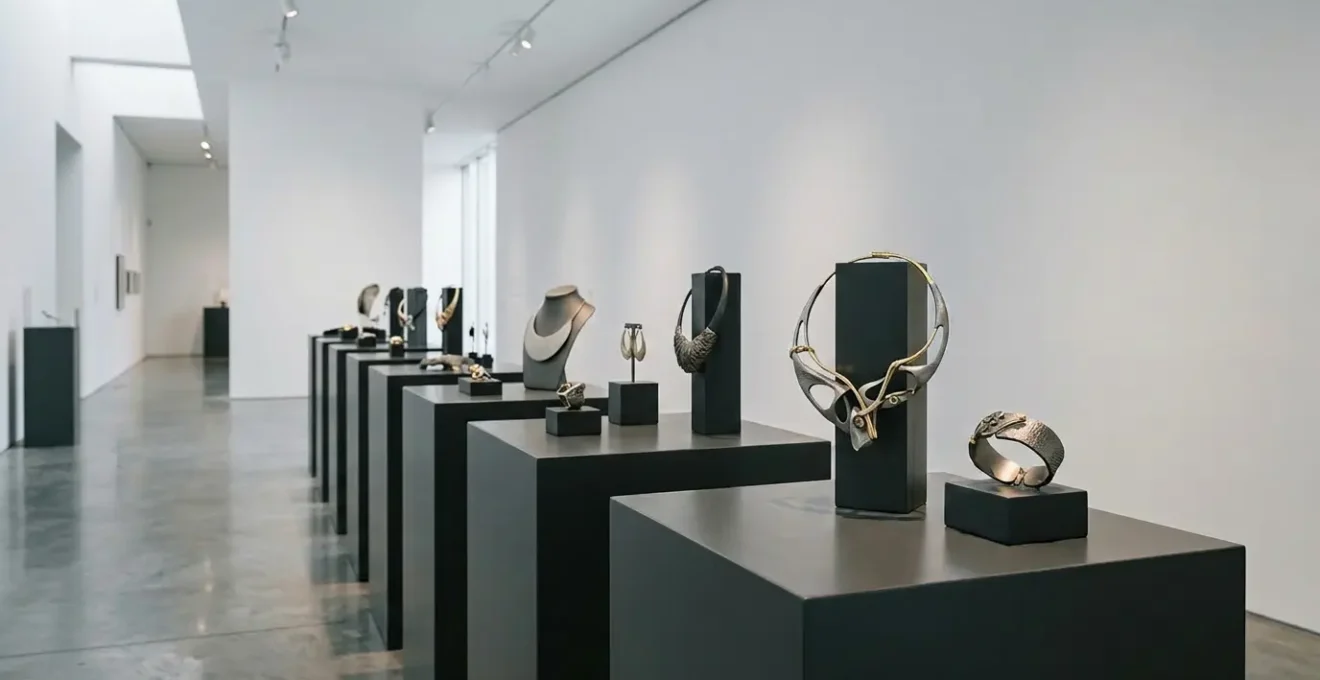
Investing in contemporary British art jewellery is not about acquiring precious materials; it’s about curating a legacy through visionary foresight.
- True value resides in the trifecta of a unique artistic signature, radical material innovation, and impeccably documented provenance.
- The secondary market increasingly rewards narrative, craftsmanship, and ethical integrity over simple carat weight.
Recommendation: Shift your focus from a jeweller’s current market price to the strength of their artistic voice and their potential for historical significance.
For the discerning collector, the pursuit of the ‘next Fabergé’ within the vibrant landscape of contemporary British jewellery is the ultimate challenge. It’s a quest that extends far beyond the GIA certificate and the lustre of precious metals. While the mainstream investment discourse remains fixated on the four Cs and the reassuring weight of bullion, this approach is fundamentally misaligned with the art jewellery market. Many believe that acquiring pieces from established luxury houses is the safest path, yet this strategy overlooks the exponential value creation that occurs when one identifies and acquires work from an artist on the cusp of historical importance. The UK jewellery market is significant, with projections suggesting it could reach £7.8 billion by the end of 2025, but the most profound returns—both financial and cultural—are found elsewhere.
The true art of collecting lies in developing a curatorial eye. It requires a paradigm shift from viewing jewellery as a commodity to understanding it as a cultural artefact. The key is not simply asking “What is it made of?” but rather, “What does it say?”. This involves a deeper analysis of the artist’s unique signature, their contribution to material innovation, and the narrative captured in the piece’s provenance. The platitudes of traditional jewellery investment are insufficient here. We must look past the polished surface to the intellectual and technical rigour that underpins a ‘legacy-grade’ object.
This guide abandons the conventional rulebook. Instead, it provides a curatorial framework for identifying the modern British jewellers whose work has the potential to become the treasured antiques of tomorrow. We will explore the critical importance of a maker’s mark, assess the investment potential of new materials, and establish protocols for documenting a commission to secure its future value. By adopting the mindset of a curator, you can learn to spot the signals of lasting significance and build a collection that is not only an asset but a testament to artistic foresight.
This article provides a detailed roadmap for the serious collector. Each section addresses a critical facet of evaluating contemporary work, from the artist’s signature to the piece’s ethical and material integrity, building a comprehensive methodology for investment.
Summary: Collecting Future Antiques: Which Modern British Jewellers Are Investment Grade?
- Why a Maker’s Mark Is Crucial for Contemporary Art Jewellery Value?
- Titanium Art: Is It a Fad or the Future of High Jewellery?
- How to Document a Commission from a Living Artist for Future Valuation?
- The Durability Risk: Buying Art Jewellery Made of Fragile Resins
- Central Saint Martins Graduates: How to Spot Talent Before Prices Rise?
- Why ‘Conflict-Free’ Is Not the Same as ‘Ethically Sourced’?
- How Commissioning Bespoke Helps Save Endangered Heritage Skills?
- How to Style Victorian Brooches with Modern Office Wear?
Why a Maker’s Mark Is Crucial for Contemporary Art Jewellery Value?
In the world of art jewellery, a maker’s mark is far more than a simple stamp of origin; it is the foundational anchor of a piece’s identity and future value. For the collector, it serves as the primary link to the artist’s entire body of work, their exhibition history, and their evolving market trajectory. While a hallmark from an assay office guarantees material purity, the artist’s personal mark authenticates the intellectual property and artistic vision. It transforms an object of precious material into a signed work of art, placing it within the art historical canon and making it traceable for future valuation, scholarship, and museum acquisition.
The mark’s power to amplify value is most evident at auction. It is the definitive proof of provenance that allows a piece to be attributed with certainty. An unsigned work, however beautiful, will always be approached with caution by the secondary market, its value capped by its material worth. A signed piece, by contrast, carries the full weight of the artist’s reputation. This is powerfully illustrated by the 2017 Sotheby’s auction of the Shaun Leane and Alexander McQueen collection. The Coiled Corset, the only piece bearing the dual signature of both Leane and McQueen, achieved a staggering $807,000. This result demonstrates that the signature itself becomes a critical component of the artwork, embodying a unique creative partnership and dramatically elevating its investment-grade status.
Therefore, the discerning collector must prioritise the clarity, uniqueness, and documentation of the maker’s mark. It is the first and most important criterion in assessing a contemporary piece. It is the signature on the canvas, the guarantee of authorship that unlocks the door to long-term appreciation. Without it, you are merely acquiring materials; with it, you are collecting a legacy.
Titanium Art: Is It a Fad or the Future of High Jewellery?
The introduction of novel materials into high jewellery has always been met with a mixture of excitement and skepticism. Titanium, with its iridescent hues and formidable strength-to-weight ratio, is at the forefront of this contemporary debate. For decades, the hierarchy of materials was rigid, with platinum and gold at its apex. However, visionary artists are now challenging this orthodoxy, not by abandoning tradition, but by expanding its vocabulary. They are choosing materials like titanium not as a cost-saving measure, but for their unique expressive properties, heralding a shift where artistic intent dictates material choice, not the other way around.
Pioneers like Wallace Chan have elevated titanium from an industrial metal to a medium for high art. After years of research, he mastered techniques to anodize and set gems in the metal, creating large, voluminous pieces that would be impossibly heavy in traditional materials. As pioneering jeweller Wallace Chan discovered, titanium weighs just one-fifth of gold for the same volume, allowing for a previously unattainable scale and sculptural freedom. This is not a fleeting trend; it is a fundamental expansion of what jewellery can be, driven by artists who are as much engineers as they are sculptors. The ability to achieve vibrant colour without enamel and create structures of immense size with ethereal lightness is a technical feat that the market is beginning to recognize as a significant value driver.
For the investor-collector, the key is to differentiate between novelty and true innovation. A piece’s value is not derived from the mere presence of titanium, but from the mastery of its application. Does the artist exploit its unique properties to create something that could not be achieved in gold or platinum? Does the material serve a clear artistic purpose? When the answer is yes, titanium pieces represent not a fad, but the very future of high jewellery—a synthesis of art, science, and craft that will define the masterworks of our era.
How to Document a Commission from a Living Artist for Future Valuation?
Commissioning a piece directly from a living artist is one of the most rewarding ways to collect, offering an opportunity to acquire a work imbued with personal significance. However, from an investment perspective, the value of this unique story is only as strong as its documentation. For a one-of-a-kind commission to achieve its maximum potential on the secondary market or be considered for museum acquisition, its creation must be chronicled with the rigour of an archivist. This process transforms anecdotal history into verifiable provenance, a critical factor in any future valuation.
The goal is to create a “commission bible”—a comprehensive dossier that leaves no aspect of the piece’s genesis to chance. This should include initial design sketches signed and dated by the artist, high-resolution photographs of the work in progress within the artist’s studio, and even preserved material offcuts. All correspondence, from initial emails to final invoices, should be meticulously maintained. A notarized Certificate of Authenticity is essential, but its value is magnified when supplemented with a video interview where the artist discusses the work’s conceptual underpinnings and technical challenges. This multi-layered documentation provides an irrefutable narrative that is compelling to future buyers and curators alike.
The importance of this process is validated by museum acquisition standards. Consider the entry of Wallace Chan’s ‘A New Generation Ring’ into the British Museum’s permanent collection. The ring was the first piece ever made with “The Wallace Chan Porcelain,” a material five times stronger than steel that took seven years to develop. As the museum’s acquisition demonstrated, the thorough documentation of this innovative process was as crucial as the object itself. It proved the piece was not just an aesthetic triumph but a milestone in materials science. For the collector, the lesson is clear: documenting a commission is not a supplementary task but an integral part of value creation.
The Durability Risk: Buying Art Jewellery Made of Fragile Resins
The contemporary artist’s palette is expanding into experimental materials like resins, polymers, and even 3D-printed plastics. These materials offer an exhilarating freedom of form, colour, and translucency, allowing for creations that would be impossible in metal. This spirit of innovation is highly attractive to collectors with a curatorial eye, as it often signals a bold artistic voice. However, this aesthetic reward comes with a significant and often underestimated counterpoint: durability and conservation risk. Unlike gold or platinum, which are fundamentally stable, many experimental materials have a limited lifespan and are susceptible to degradation from UV light, temperature fluctuations, and even atmospheric pollutants.
The investment-minded collector must approach these works with the mindset of a museum conservator. The long-term value of an art object is inextricably linked to its physical integrity. A resin piece that yellows, becomes brittle, or crazes over time may retain its conceptual importance but will see its financial value plummet. Therefore, a critical risk assessment is required before acquisition, weighing the piece’s artistic merit against its material fragility and the associated long-term conservation costs.
This table provides a simplified risk framework for evaluating different material categories, a crucial tool for the discerning collector. As the data from a recent investment guide analysis shows, there is often an inverse relationship between a material’s experimental appeal and its resale liquidity.
| Material Type | Durability Rating | Museum Interest | Resale Liquidity | Conservation Cost |
|---|---|---|---|---|
| Traditional Gold/Platinum | Excellent | Moderate | High | Low |
| Titanium (Wallace Chan) | Excellent | Very High | Growing | Low |
| Resins/Experimental | Poor-Fair | Very High | Limited | High |
| Mixed Media | Variable | High | Moderate | Moderate-High |
This does not mean one should avoid experimental materials entirely. On the contrary, they are often the site of the most exciting artistic developments. It means the acquisition must be an informed one. The collector must be prepared for the responsibilities of ownership, which include climate-controlled storage and a potential budget for future conservation. Investing in fragile art jewellery is a high-stakes game, but for those willing to manage the risk, the reward is owning a piece that truly pushes the boundaries of the medium.
Central Saint Martins Graduates: How to Spot Talent Before Prices Rise?
The annual graduate shows of prestigious institutions like Central Saint Martins or the Royal College of Art are the primary hunting grounds for the visionary collector. It is here, amidst a flurry of raw creativity, that the artistic signatures of the next generation are first revealed. Identifying future investment-grade talent at this nascent stage is perhaps the most challenging, yet potentially most rewarding, act of collecting. It requires moving beyond the polish of the final piece to assess the underlying coherence of the artist’s vision, their technical ambition, and the conceptual rigour of their work. The key is to look for indicators of future trajectory, not just current accomplishment.
Spotting this potential is a disciplined process, not a matter of pure intuition. An artist who has already won a prestigious award, such as from the Goldsmiths’ Craft & Design Council, has received an early, critical endorsement. An invitation to exhibit at a “kingmaker” venue like Goldsmiths’ Fair is another powerful signal, indicating that established curators have already identified their work as commercially and artistically viable. Furthermore, a new generation of collectors is entering the market, bringing fresh perspectives. An analysis of recent sales revealed that 20% of bidders at Sotheby’s luxury sales in 2024 were in their 20s and 30s, suggesting a growing appetite for contemporary and innovative design that will fuel the market for today’s graduates.
Ultimately, the most promising young artists demonstrate a unique and consistent artistic voice across their entire graduate collection. They are not merely designing objects; they are building a world. They show a mastery of difficult materials or a commitment to reviving an endangered craft, and their work often possesses a sculptural quality that allows it to cross over into the fine art market. By using a strategic scorecard, the collector can move from passive observer to active talent scout.
Your Scorecard for Emerging Artist Investment
- Prestigious Awards: Check for recognition from bodies like the Goldsmiths’ Craft & Design Council or similar institutions.
- Exhibition Pedigree: Note any invitations to exhibit at highly curated fairs such as Goldsmiths’ Fair, PAD, or TEFAF.
- Technical Mastery: Assess the artist’s skill with difficult materials or their command of rare and endangered heritage techniques.
- Post-Graduate Trajectory: Track their path after graduation, including acceptances into top residencies like the Sarabande Foundation.
- Artistic Voice: Evaluate the coherence and originality of their creative vision across their entire graduate collection.
Why ‘Conflict-Free’ Is Not the Same as ‘Ethically Sourced’?
In recent years, the term “conflict-free” has become a common marketing assurance in the jewellery industry. While commendable, it represents the absolute minimum standard of ethical responsibility. The designation, primarily born from the Kimberley Process, certifies only that a diamond has not financed a rebel war. It fails to address a host of other critical ethical concerns, including forced labour, child labour, unsafe working conditions, environmental degradation, and fair wages. For the contemporary collector, understanding this distinction is paramount, as true ethical provenance is emerging as a significant driver of long-term value and narrative power.
“Ethically sourced” is a far more comprehensive and demanding standard. It requires a transparent and traceable chain of custody from mine to market, ensuring that every hand that touched the material was treated fairly and that the environment was respected. Certifications like Fairmined Gold or Canadamark diamonds provide this deeper level of assurance. These standards not only guarantee ethical integrity but also add a powerful, verifiable story to a piece. For a growing cohort of collectors, the “how” and “why” of a piece’s creation are becoming as important as the “what.” This narrative richness directly translates into desirability and, consequently, future market value.
The work of contemporary British jewellers like Jessie Thomas exemplifies this principle. By exclusively using Fairtrade or recycled gold and traceable stones, she imbues her work with a character and provenance that transcends its material composition. This commitment is not an afterthought but a central tenet of her artistic practice. As the following table illustrates, the market is beginning to assign a clear price premium to these higher standards of verification.
| Certification Type | Verification Level | Price Premium | Future Market Appeal |
|---|---|---|---|
| Conflict-Free (Basic) | Minimal | 0-5% | Declining |
| Fairmined Gold | Full Chain | 15-20% | Growing |
| Canadamark Diamonds | Mine to Market | 10-15% | Stable High |
| Blockchain Verified | Complete | 20-30% | Emerging Strong |
For the forward-thinking collector, seeking out artists who embrace these higher standards is a strategic move. It aligns the collection with a powerful cultural shift towards transparency and sustainability, ensuring its relevance and desirability for generations to come. A “conflict-free” stone is a baseline; a truly ethically sourced piece is an investment in a better future for the craft.
How Commissioning Bespoke Helps Save Endangered Heritage Skills?
In an age of computer-aided design and mass production, the traditional, handcrafted skills that have defined British goldsmithing for centuries are at risk of extinction. Techniques like plique-à-jour enamelling, intricate hand-engraving, or the painstaking art of chain-making are now practised by an ever-dwindling number of master craftspeople. For the collector with a sense of legacy, this impending loss presents a unique opportunity: to become a patron of the arts and, in doing so, make a profoundly astute investment. By strategically commissioning bespoke pieces that require these endangered heritage skills, a collector does more than acquire a beautiful object; they help keep a vital part of cultural history alive.
This act of patronage creates a powerful feedback loop. It provides a master craftsperson with the financial means and artistic incentive to continue their work and, crucially, to train an apprentice. The resulting piece becomes a vessel for that rare skill, a tangible record of a technique that might otherwise vanish. From an investment standpoint, this creates an undeniable scarcity premium. A piece that showcases a technique practised by fewer than fifty people globally possesses an intrinsic rarity that transcends its material value. Its future importance is virtually guaranteed, as it will be studied by future generations as a high-water mark of a near-lost art form.
The process requires research and foresight. The collector must first identify which skills are most at risk and who the remaining masters are. The commission should be designed in collaboration with the artist to specifically highlight this technique. Documenting the creation process, particularly capturing the craftsperson demonstrating the skill, adds another layer of historical and financial value to the final work. As these masters retire or pass away, the value of the pieces they created, especially well-documented commissions, will inevitably appreciate. It is a form of collecting that offers a double return: the preservation of culture and the creation of a legacy-grade asset.
Key Takeaways
- An artist’s unique signature and maker’s mark are the primary anchors of future value, transcending material worth.
- True material innovation, such as the mastery of titanium, expands the language of jewellery and signals a future-proof investment.
- Impeccable provenance, built through meticulous documentation of a commission, transforms a piece’s story into a verifiable and valuable asset.
How to Style Victorian Brooches with Modern Office Wear?
While the focus of a forward-looking collection is on contemporary creation, a discerning eye also understands the cyclical nature of taste and the dialogue between past and present. The recent resurgence of antique jewellery, particularly the Victorian brooch, is not merely a fashion trend; it is a market signal that the modern collector cannot afford to ignore. Understanding how and why these historical pieces are being integrated into contemporary life provides crucial insights into the qualities that give jewellery enduring appeal—wearability, narrative, and personal expression. This is not about historical reenactment; it is about market intelligence and understanding the long-term lifecycle of an investment.
The trend of styling a Victorian mourning brooch on the lapel of a minimalist blazer or using a sentimental cameo to fasten a modern silk scarf speaks to a deeper desire for objects with soul and history. This renewed interest directly fuels the secondary market, a critical component of any investment strategy. The growth of the luxury category at major auction houses like Sotheby’s and Christie’s is a defining trend, with private sales also accounting for a significant portion of total revenue. This indicates a robust and liquid market for high-quality pieces with strong provenance, whether antique or contemporary. The ability for a piece to be worn and enjoyed increases its visibility and desirability, ultimately impacting its long-term value.
For the collector of contemporary work, the lesson is twofold. Firstly, it underscores the importance of wearability. An avant-garde piece that can also be elegantly integrated into a modern wardrobe is more likely to be cherished and valued over time. Secondly, it highlights the enduring power of narrative. A Victorian brooch is not just an accessory; it is a story of sentiment, craft, and a bygone era. A contemporary piece that possesses an equally compelling narrative—whether through its ethical sourcing, material innovation, or the revival of a heritage skill—is more likely to capture the imagination of future generations and achieve the status of a future antique.
Your journey as a collector of future antiques, therefore, begins not with a purchase, but with the deliberate cultivation of your curatorial eye. It is an investment in knowledge, foresight, and a deep appreciation for the artists who are defining the future of British jewellery today.