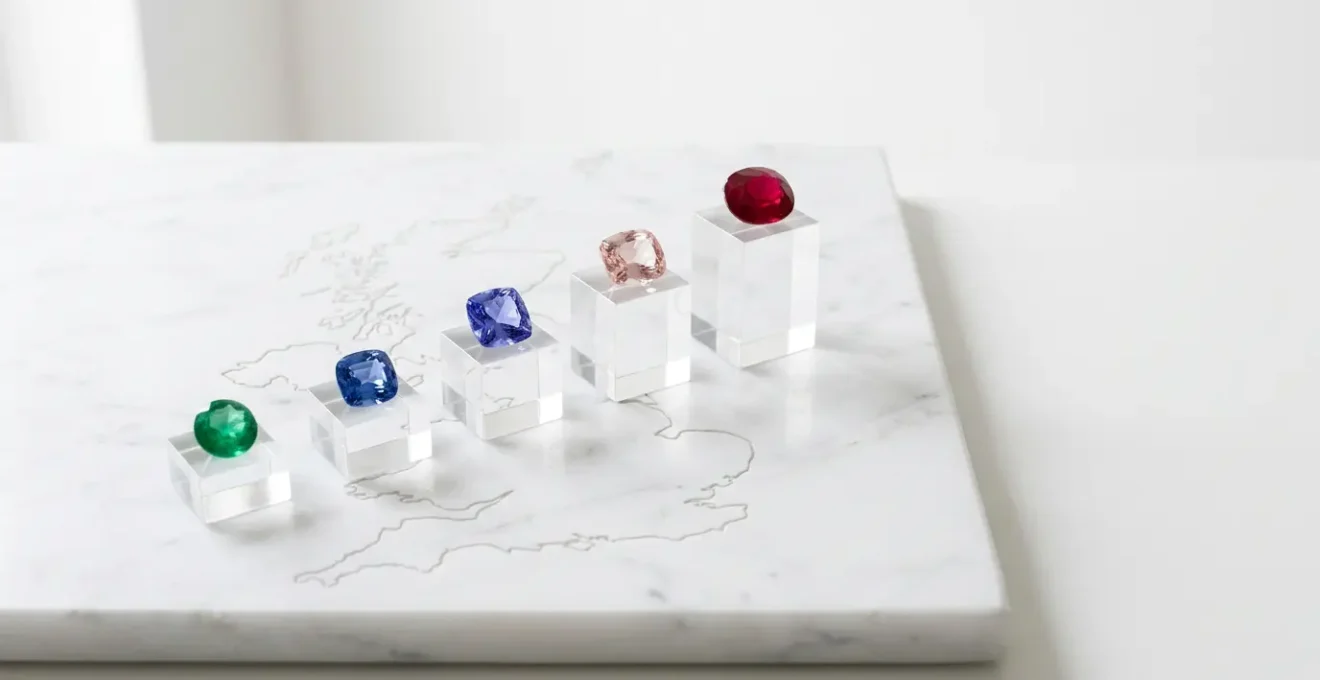
The durability of a coloured gemstone ring isn’t just its Mohs hardness score; it’s a system combining a gem’s hidden weaknesses with the engineering of its setting.
- Hardness (scratch resistance) is useless without toughness (chip resistance), which is why emeralds are fragile despite a decent hardness score.
- Softer stones like Tanzanite and Morganite incur hidden “ownership costs” in frequent cleaning and re-polishing that harder stones like sapphire avoid.
Recommendation: Prioritise sapphires or tough garnets in a protective bezel setting for a coloured stone engagement ring that is genuinely built for life.
You’ve found the one, and a diamond isn’t quite right. You envision a flash of deep blue, a soft pink, or a vibrant green on your finger—a ring that reflects your personality. But then, a nagging, practical fear creeps in. What happens when that beautiful ring meets a kitchen counter, a car door, or just the grit of daily life? You’re a bride-to-be, not a museum curator for your own hand. You need a ring that can survive more than just the wedding day.
The common advice is to simply look at the Mohs scale of hardness. You’ll see lists ranking gems from 1 to 10, and you might be told to just “be careful” with anything less than a sapphire. This is dangerously incomplete advice. It ignores the crucial difference between hardness (resistance to scratching) and toughness (resistance to chipping and breaking). It also fails to account for a gem’s internal structure, its reaction to household chemicals, or the critical role the metal setting plays in its protection.
This guide takes a different approach. We’re moving beyond simplistic numbers to give you a practical, gemmologist’s perspective on what makes a coloured gemstone truly durable for daily wear in the UK. We will explore why some stones are a long-term liability, how the wrong metal can lead to disaster, and how to build a ring that is both beautiful and resilient. It’s about understanding the complete system—the stone, the setting, and the wearer—to ensure your symbol of love lasts a lifetime, knocks and all.
This article provides a structured breakdown of the crucial factors determining a gemstone’s real-world durability. The following summary outlines the key areas we will explore to help you make an informed and confident choice.
Summary: A Practical Guide to Indestructible Coloured Gemstone Rings
- Why Emeralds Are Too Soft for Daily Engagement Rings?
- Sapphire vs Tanzanite: Why One Is Forever and the Other Scratches?
- The Morganite Trap: Why It Looked Pink in the Shop but Peach at Home?
- Bezel vs Claw: Which Setting Protects Soft Stones Best?
- Can You Polish Scratches Out of a Ruby While It Is Still Set?
- Why 9ct Gold Can Snap While 18ct Just Bends Under Pressure?
- Glass Filled Rubies: The Durability Nightmare You Must Avoid
- 9ct vs 18ct Gold: Is Higher Carat Always Better for Jewellery in the UK?
Why Emeralds Are Too Soft for Daily Engagement Rings?
The greatest misconception in gemstone durability lies with the emerald. On paper, its hardness of 7.5 to 8 on the Mohs scale seems adequate, placing it well above many other popular gems. However, hardness only measures resistance to surface scratching. The true weakness of emerald is its exceptionally low toughness—its resistance to chipping and breaking. This fragility is a direct result of how emeralds form under intense pressure, a process that creates a beautiful but flawed crystal.
Nearly all natural emeralds contain a complex web of internal fractures and tiny inclusions, poetically called the “jardin” (garden). While this is a hallmark of a natural stone, it also acts as a series of built-in weaknesses. An impact that a sapphire would shrug off can cause these inclusions to propagate, leading to a chip or even a full fracture. According to the International Gem Society’s durability guide, even though emeralds have a high hardness rating, their common inclusions make them particularly prone to chipping. This makes them a high-risk choice for a ring worn every day.
Furthermore, emeralds are highly sensitive to thermal shock. Rapid temperature changes—like moving from a hot kitchen to a cold outdoors, or cleaning with hot water—can cause these internal fractures to expand, potentially cracking the stone from the inside out. When you consider the superior durability of other green gems, the risk becomes clear. A green sapphire offers the same colour profile but with vastly superior hardness and toughness, making it a far more practical choice for a lifetime of wear.
To put this in perspective, consider the alternatives. While a Tsavorite garnet is slightly softer, it is significantly tougher and more stable than an emerald. A green sapphire, at a 9 on the Mohs scale, is in a different league of durability altogether.
| Green Gemstone | Mohs Hardness | Toughness | Daily Wear Suitability |
|---|---|---|---|
| Emerald | 7.5-8 | Poor (inclusions) | Not recommended |
| Tsavorite Garnet | 6.5-7 | Good | Suitable with care |
| Green Sapphire | 9 | Excellent | Highly recommended |
Ultimately, while undeniably beautiful, an emerald engagement ring is a commitment to high maintenance and constant worry. It is a stone best reserved for special occasion jewellery, not for the rigours of daily life.
Sapphire vs Tanzanite: Why One Is Forever and the Other Scratches?
At first glance, a high-quality tanzanite and a sapphire can look remarkably similar, both offering mesmerising shades of blue and violet. However, in terms of durability, they are worlds apart. A sapphire is a 9 on the Mohs scale, second only to diamond, making it exceptionally resistant to scratches. Tanzanite, by contrast, is a mere 6.5. This isn’t just a small difference; it’s the dividing line between a lifetime stone and a high-maintenance liability.
The real-world implications of this hardness gap are profound. As the International Gem Society points out, “Household dust is primarily quartz, which is a 7 on the Mohs scale. This means the simple act of wiping your ring can scratch a Tanzanite (6.5), while a Sapphire (9) remains completely unaffected by daily grime and cleaning.” Every wipe with a cloth, every accidental brush against a wall, introduces micro-scratches that will dull a tanzanite’s surface over time, requiring frequent re-polishing to restore its lustre.
Beyond hardness, tanzanite has a structural flaw known as “perfect cleavage.” This means it has a tendency to split cleanly along an internal plane if struck with enough force from the right direction. A sapphire has no such cleavage, making it far tougher and more resistant to chipping. This combination of softness and cleavage makes tanzanite a poor choice for a daily-wear ring, especially in a claw setting where the edges are exposed.
This leads to a hidden “total cost of ownership.” A UK-based analysis highlighted the long-term expenses associated with tanzanite. As detailed in a study on gemstone maintenance costs, tanzanite worn daily often needs re-polishing every few years, a service for which UK lapidarists charge between £100 and £200 each time. In stark contrast, a sapphire will typically retain its brilliant polish for decades, making its higher initial price far more economical over the long term.
Your Action Plan: Sapphire vs. Tanzanite Reality Check
- Assess Hardness: Acknowledge the critical difference between Sapphire (9) and Tanzanite (6.5). Choose sapphire for any ring intended for daily wear.
- Evaluate Cleavage: Understand that Tanzanite’s perfect cleavage makes it vulnerable to splitting from an impact that a sapphire would easily withstand.
- Calculate Total Cost: Factor in the long-term cost of re-polishing a tanzanite every few years (£100-£200 per service) versus the one-time cost of a sapphire.
- Position Appropriately: Designate tanzanite as beautiful occasion-wear or for protected pieces like pendants, not for an everyday engagement ring.
- Demand Transparency: When buying, ask your UK jeweller for a clear statement on the stone’s durability and suitability for your intended use.
While the allure of tanzanite’s unique colour is strong, it is a gemstone that demands to be treated with care, best suited for earrings or pendants where the risk of impact is minimal. For an engagement ring, sapphire remains the undisputed champion of coloured stone durability.
The Morganite Trap: Why It Looked Pink in the Shop but Peach at Home?
Morganite has surged in popularity as an affordable, romantic alternative for engagement rings, prized for its soft, pastel hues. With a Mohs hardness of 7.5 to 8, it seems, on the surface, to be a durable choice. However, two significant real-world issues often lead to buyer’s remorse: a disappointing colour shift and a constant struggle to keep it clean.
The most common complaint from new morganite owners is that the beautiful, clear pink stone they fell in love with under the jeweller’s bright lights now looks disappointingly peachy, muted, or even brownish at home. This isn’t a trick; it’s a phenomenon of lighting. A case study of UK jewellery shops revealed a common practice that inadvertently misleads customers. Jewellers typically use high-Kelvin LED lighting (5000-6500K), which has a cool, blue-toned cast. This light neutralises the natural warm, orange, or yellow undertones present in most morganite, making the stone appear as a purer, more desirable pink. However, once you take the ring home, it is viewed under much warmer lighting—either the UK’s typical overcast daylight (around 6500K but diffuse) or standard incandescent/warm LED home lighting (2700-3000K). Under these conditions, the stone’s true, dominant peachy-orange hue is revealed, leading to the feeling of a “colour trap.”
The second problem is more practical and persistent. Morganite is notorious for being a “grease magnet.” Its surface has a particular affinity for oils, lotions, and soaps. This means that even with normal hand washing and daily activities, a film quickly builds up on the stone’s facets, especially on the underside. This film dramatically reduces the stone’s light return, making it look dull, cloudy, and lifeless within a day or two of cleaning. While its hardness is adequate, gemstone durability experts explain that morganite’s tendency to attract grease necessitates almost daily cleaning to maintain its sparkle, a level of maintenance many find tiresome for an everyday ring.
Before committing to morganite for a daily-wear ring, it is crucial to ask the jeweller to see the stone under various light sources, including near a window or in a less intensely lit part of the store. And be prepared for a rigorous cleaning routine if you want to keep its sparkle alive.
Bezel vs Claw: Which Setting Protects Soft Stones Best?
The choice of setting is not merely a stylistic decision; it is the single most important factor in protecting your gemstone from the hazards of daily life. For any stone softer than a sapphire, a protective setting is non-negotiable. The two most common options, the claw (or prong) and the bezel setting, offer vastly different levels of security. A claw setting prioritises light performance, lifting the stone up and allowing light to enter from all angles for maximum sparkle. However, this leaves the girdle (the widest edge) of the stone almost completely exposed to knocks and impacts. A bezel setting, in contrast, encircles the entire gemstone with a thin wall of metal. This makes it the ultimate “insurance policy” for a softer gem.
This metal collar protects the vulnerable girdle from direct hits, which are the most common cause of chipping. For a stone with cleavage planes like tanzanite, or one riddled with inclusions like an emerald, a bezel setting is the only responsible choice for an everyday ring. It transforms a high-risk stone into a much more wearable piece. While it’s true that a full bezel can slightly reduce the amount of light entering the stone and may make it appear a fraction smaller, this is a small price to pay for security.
There are also hybrid options. A half-bezel or partial bezel protects the most exposed sides while leaving others open for light. For fancy shapes like marquise or pear cuts, which have fragile, sharp points, V-shaped prongs are essential to shield these delicate tips from snapping off. As one expert at Joseph Jewelry notes, “A bezel setting adds to the metal cost and can make a stone appear smaller, but it’s a one-time insurance policy. A claw setting is cheaper and maximises brilliance but may lead to future maintenance costs.” This is especially true for 18ct gold settings, where the softer claws can wear down or get knocked out of place more easily, requiring re-tipping over time.
The right setting choice is a balance of protection, light performance, and stone type. The following matrix provides a clear guide for pairing a stone with its most suitable setting to ensure longevity.
| Stone Type | Recommended Setting | Protection Level | Light Performance |
|---|---|---|---|
| Soft with cleavage (Emerald) | Full bezel | Maximum | Reduced |
| Tough stone (Sapphire) | 6-claw | Adequate | Maximum |
| Medium hardness (Tanzanite) | Half-bezel | Good edge protection | Balanced |
| Fancy cuts (Marquise/Pear) | V-prongs at points | Critical point protection | Good |
Ultimately, choosing a claw setting for a soft or included stone is prioritising short-term sparkle over long-term security. A well-made bezel setting is a testament to thoughtful design, ensuring your precious gemstone is shielded for a lifetime of wear.
Can You Polish Scratches Out of a Ruby While It Is Still Set?
It’s a question born of hope after a sickening discovery: a long, dull scratch across the face of a cherished ruby ring. The stone is a 9 on the Mohs scale, so it must have been a significant impact. The logical next thought is, can a jeweller just buff this out? The answer, unfortunately, is a definitive and technical ‘no’. It is physically impossible to professionally re-polish a gemstone while it remains in its setting.
Professional gemstone polishing is a precise art that requires complete access to the stone. As the experts at CustomMade Jewelers state unequivocally, “No, it is technically impossible to achieve a professional finish. Polishing requires the entire stone to be worked on a lapidary wheel at precise angles. Attempting this while set would inevitably damage the setting and create an uneven, unsightly polish on the gem.” The lapidary wheel must be able to grind and then polish each facet at the exact angle required to achieve proper light reflection. The ring’s setting physically blocks the wheel from accessing the entire surface of the stone, especially around the girdle and claws.
Any attempt to perform a “touch-up” polish in the setting would result in a disaster. The polishing tools would grind away at the metal prongs or bezel, damaging the setting itself. Worse, the polish on the gem would be uneven, with rounded facet edges and a dull, wavy finish that looks far worse than the original scratch. The only correct way to fix a scratched gemstone is a multi-step, labour-intensive process.
The process involves a significant cost, which underscores the importance of choosing a durable stone in the first place. A UK jewellery industry analysis of re-polishing costs breaks it down: first, the jeweller must carefully un-set the stone, which costs between £50 and £100. Then, the stone is sent to a specialist lapidarist for re-cutting and polishing, which can cost £150 or more, depending on the depth of the scratch. Finally, the newly polished stone must be re-set into the ring, costing another £70 to £150. The total minimum cost can easily reach £270 to £400, a significant expense that could have been avoided.
This reality serves as a powerful argument for prevention. Choosing a hard, tough stone like a sapphire and placing it in a protective setting is the best way to avoid ever having to face the costly and complex process of removing and re-polishing your treasured gem.
Why 9ct Gold Can Snap While 18ct Just Bends Under Pressure?
When choosing the metal for an engagement ring, many people in the UK see 9ct gold as a savvy, cost-effective option. It’s still gold, but significantly cheaper than 18ct. However, this price difference comes with a trade-off in the metal’s fundamental properties, particularly how it behaves under stress. The core of the issue lies in the purity of the gold: 9ct gold is 37.5% pure gold, while 18ct is 75% pure gold. The remaining percentage is made up of other alloys like copper, silver, and zinc, which are added to give the metal strength and colour.
Pure gold is an extremely soft and malleable metal. Paradoxically, the higher proportion of other, harder alloys in 9ct gold makes the resulting metal harder and more resistant to scratching than 18ct gold. However, this hardness comes at the cost of ductility. 9ct gold is more brittle. When subjected to a significant impact or bending force, it has less “give.” Instead of deforming, it is more likely to reach its breaking point and snap cleanly. This is especially dangerous for the claws holding a gemstone, as a snapped claw can mean a lost stone.
In contrast, 18ct gold, with its higher content of pure, malleable gold, is more ductile. It is softer and will scratch and dent more easily than 9ct gold. However, when it receives a hard knock, it is far more likely to bend or deform rather than break. A bent ring shank or a distorted claw is a much safer failure mode. It’s a visible problem that is relatively easy and inexpensive for a jeweller to fix; a bent shank can be reshaped, and a bent claw can be pushed back into place. A snapped 9ct shank, however, requires a complex and costly soldering repair that creates a permanent weak point in the ring.
For a piece of jewellery that will be worn daily and is expected to last a lifetime, such as an engagement or wedding ring, the superior ductility and repairability of 18ct gold make it the far more sensible and, in the long run, more economical choice. The risk of a catastrophic failure with 9ct gold is a gamble not worth taking with such a sentimental and valuable item.
Glass Filled Rubies: The Durability Nightmare You Must Avoid
You see it online or in a shop window: a large, vibrant, seemingly flawless ruby with a price tag that seems too good to be true. In the world of gemstones, when something seems too good to be true, it almost always is. In this case, you are likely looking at a “glass-filled” or “composite” ruby—a low-quality, heavily fractured stone that has been infused with lead glass to improve its clarity and add weight. While it may look appealing, it is a durability nightmare that has almost no place in fine jewellery.
The process involves taking a natural, low-grade ruby full of surface-reaching cracks and heating it with lead glass. The molten glass flows into the fractures, concealing them and making the stone appear much clearer. The problem is that this glass is extremely soft and unstable. It is highly susceptible to damage from even mild household chemicals, including lemon juice or standard jewellery cleaners. These substances can etch the glass, leaving the filler looking cloudy and white within the ruby’s cracks, permanently ruining its appearance.
Furthermore, the glass can be damaged by heat, such as that from a jeweller’s torch during a simple ring resizing or repair. This makes any future work on the piece incredibly risky. The difference in value is also staggering. Gemstone dealers report that while natural or standard-heated rubies can retain 60-80% of their value, glass-filled rubies have virtually no resale value in the secondary market. They are considered a composite product, not a true gemstone.
Fortunately, UK consumer law provides some protection. As Gem Classics Dallas notes, “UK law requires sellers to disclose this treatment. If the price of a large, clean ruby seems too good to be true, ask for a certificate from a reputable lab (e.g., GIA, AnchorCert) and look for the specific disclosure: ‘Lead-glass-filled composite ruby'”. A reputable seller will always be transparent about this treatment. Any hesitation to provide a certificate or a clear, written disclosure is a major red flag.
Do not be tempted by the low price. A glass-filled ruby is not a bargain; it’s a liability. Investing in a smaller, but properly and traditionally heat-treated ruby, or another durable gemstone like a red spinel or sapphire, is always a wiser, safer, and more valuable choice in the long run.
Key Takeaways
- Durability is a system: It’s not just Mohs hardness, but a combination of a gem’s toughness, cleavage, and the protective engineering of its setting.
- Hidden costs are real: Cheaper, softer stones like tanzanite and morganite often incur significant long-term costs in cleaning, re-polishing, and repairs that make them more expensive over a lifetime than a sapphire.
- Metal matters: For daily wear, the ductility of 18ct gold (it bends) is far safer and more economical to repair than the brittleness of 9ct gold (it snaps).
9ct vs 18ct Gold: Is Higher Carat Always Better for Jewellery in the UK?
The debate between 9ct and 18ct gold is a common point of confusion for UK jewellery buyers. The logical assumption is that 18ct, being more “pure” and expensive, must be superior in every way. While it is the better choice for certain applications, the answer to whether it is “always better” is more nuanced. The best choice depends entirely on the specific use case, the wearer’s lifestyle, and their budget.
For high-impact, daily-wear items like engagement and wedding rings, 18ct gold (or platinum) is unquestionably the superior choice. As a UK jeweller repair cost analysis shows, the long-term economics favour the higher carat. A bent 18ct ring shank is a simple £20-£40 reshaping job. A snapped 9ct shank, however, requires a complex soldering repair costing £80-£150, creating a weak point that is prone to future failure. The ductility of 18ct gold provides a crucial safety net for such a sentimental and frequently worn piece. Its higher gold content also makes it more hypoallergenic for those with sensitive skin.
However, for other types of jewellery, 9ct gold has distinct advantages. Its superior hardness and scratch resistance make it an excellent, practical choice for men’s signet rings, which often take a lot of abuse. For low-impact items like earrings or pendants that are not subject to constant knocks, 9ct offers a very cost-effective way to enjoy real gold without paying for the superior ductility that isn’t needed in that context. The aesthetic difference is also a factor. As noted by designer Stephen Webster, ” 18ct yellow gold has a rich, buttery hue, while 9ct is often paler.” Some may prefer the richer colour of 18ct, while others might favour the subtler tone of 9ct. In the UK, buyers can be assured of quality regardless of carat, thanks to the rigorous British Hallmarking system. A ‘375’ stamp (for 9ct) or ‘750’ stamp (for 18ct) from a UK Assay Office is a guarantee of the metal’s gold content.
| Use Case | Recommended Alloy | Key Benefits | Considerations |
|---|---|---|---|
| Daily-wear rings | 18ct or Platinum | Durability, repairability | Higher cost |
| Earrings/Pendants | 9ct | Cost-effective | Low impact wear |
| Men’s signet rings | 9ct | Scratch resistance | Good value |
| Sensitive skin | 18ct or Platinum | Hypoallergenic | Fewer alloy metals |
In conclusion, higher carat is not always better—it’s about being ‘fitter for purpose’. For the lifelong commitment of an engagement ring, 18ct is the wise investment. For other, less demanding roles in your jewellery box, 9ct gold offers excellent value and practical durability.