Your standard home insurance policy doesn’t just under-insure your new luxury watch; it’s a financial trap structured to deny claims for theft or damage, especially outside the home.
- Most policies have a low single-item limit (e.g., £2,000) that is far below the value of a typical Rolex, leaving you significantly out of pocket.
- Standard cover for theft or accidental damage away from your property is rarely included and must be specifically added as ‘All-Risks’ cover.
Recommendation: Do not assume you are covered. Immediately contact your insurer to list your watch as a ‘Specified Item’ with worldwide ‘All-Risks’ protection, or seek a standalone policy from a specialist watch insurer.
The moment you acquire your first luxury timepiece, perhaps a Rolex after a successful year, is a significant milestone. It’s a symbol of achievement you wear on your wrist. In the back of your mind, you feel secure, assuming the comprehensive home contents insurance you diligently pay for has you covered. This assumption is not just wrong; it’s a dangerous and potentially costly mistake. For a London-based professional, navigating the city with a high-value item on your wrist, this false sense of security is a financial liability waiting to happen.
Most people believe that insurance is a simple safety net. They’ve heard the advice to get items valued and tell their insurer. However, the reality of insurance underwriting is a minefield of exclusions, specific definitions, and conditions designed to limit payouts. Standard policies are built for mass-market contents, not for single, high-value, portable assets like a luxury watch. They are a financial trap, relying on your assumptions to function.
The truth is that protecting your investment goes far beyond simply owning a policy. It requires a strategic understanding of what insurers call ‘clause warfare’—the specific terms and conditions that differentiate between a successful claim and a devastating financial loss. The key isn’t just getting insurance; it’s getting the *right* insurance and building an undeniable ‘evidence chain’ to support any future claim. This is especially true in a high-risk geography like London, where ‘watch spotting’ has become a criminal enterprise.
This guide is designed to dismantle your assumptions. We will move beyond the generic advice and delve into the critical details your standard insurer hopes you’ll overlook. We will explore why single-item limits are your biggest enemy, how to document your watch correctly, the vital difference between policy types, and the specific risks associated with owning and storing a luxury watch in the UK.
Summary: Your Guide to Bulletproof Watch Insurance
- Why Your £5,000 Watch Limit Leaves Your Rolex Uninsured?
- How to Photograph Your Watch to Guarantee a Successful Claim?
- Specified Items vs General Contents: Which Covers Accidental Damage?
- The ‘Watch Spotting’ Danger in London and How to Avoid It
- Do You Really Need a Graded Safe to Insure a Watch Collection at Home?
- The Shipping Mistake That Voids Your Insurance When Selling Online
- Silica Gel Packs: Are They Essential for Storing Watches in the UK?
- How to Store Antique Timepieces to Prevent Moisture Damage in the UK?
Why Your £5,000 Watch Limit Leaves Your Rolex Uninsured?
The most common and dangerous misunderstanding lies in the ‘single-item limit’ of a standard home contents policy. You might have £75,000 of total cover and assume your £10,000 Rolex is protected. This is incorrect. Buried in the policy wording is a clause that caps the payout for any single item, often at a level between £1,500 and £5,000. This means if your watch is stolen, the insurer will only pay out this maximum limit, regardless of the watch’s actual value. The rest of the loss is entirely yours to bear.
Insurers use this to manage their risk on valuables that are easily stolen and resold. It’s a fundamental part of the financial trap. Research shows that most homeowners’ policies provide minimal coverage for luxury watches, with caps that are wholly inadequate for brands like Rolex, Patek Philippe, or Audemars Piguet. For example, a Rolex Daytona valued at over £100,000 might only receive a £1,500 payout under a typical policy. This isn’t just underinsurance; it’s a catastrophic financial failure for the owner who believed they were protected.
The only way to bypass this trap is to have the watch listed as a ‘Specified Item’ on your policy. This process involves providing the insurer with a formal valuation and agreeing on a specific value for the watch. It is then listed separately from your general contents, with its own cover limit that reflects its true worth. Without this crucial step, your luxury watch is, for all practical purposes, uninsured.
How to Photograph Your Watch to Guarantee a Successful Claim?
In the event of a loss, your claim’s success hinges on one thing: irrefutable proof of ownership and condition. Simply having a receipt is not enough. You must build a robust ‘evidence chain’ that leaves no room for doubt or dispute by the insurer’s loss adjuster. High-quality, detailed photographs are the cornerstone of this evidence. They serve as a visual contract, documenting the watch’s existence and specific characteristics before the incident occurred.
You need to think like a forensics expert. Go beyond a simple wrist shot. Take clear, well-lit macro photographs of every key feature. This includes the dial, the caseback with the full serial number clearly legible, the clasp, the crown, and any unique engravings or identifying marks. The goal is to create a complete visual fingerprint of your specific timepiece. This documentation not only proves you owned the watch but also helps global recovery databases, like The Watch Register, identify it if it’s ever recovered.
This paragraph introduces a complex concept. To well understand it, it is useful to visualise its main components. The illustration below breaks down this process.
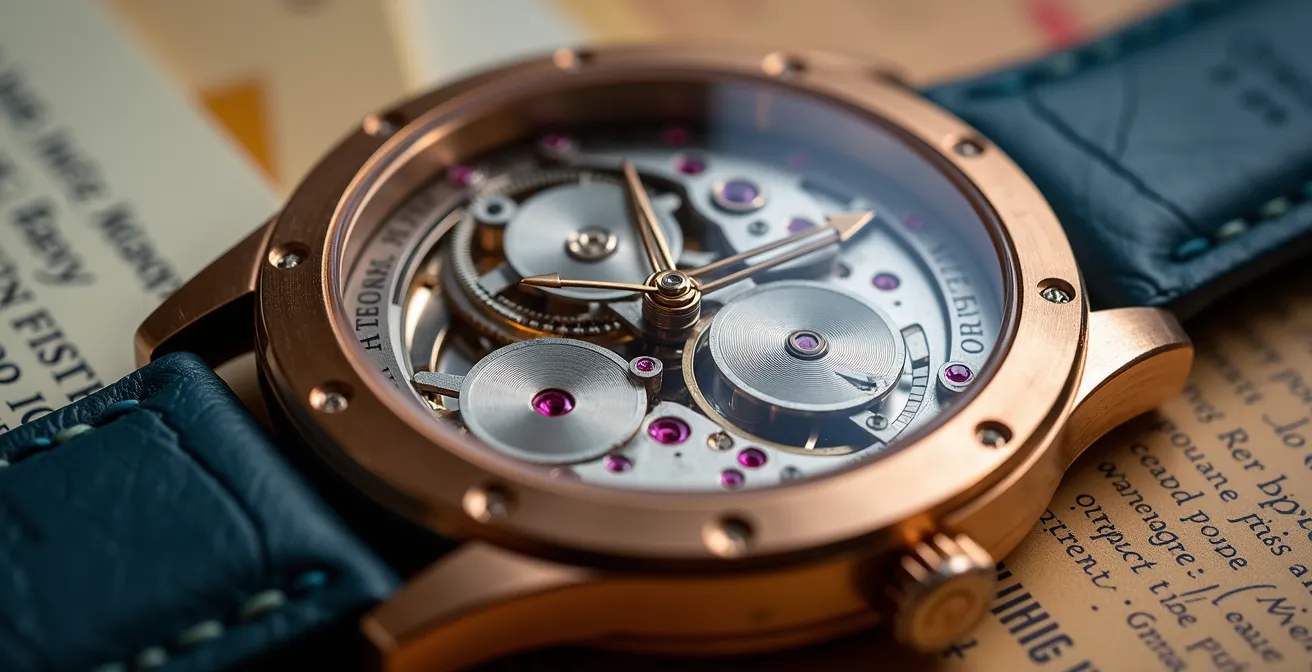
As this image suggests, focusing on the intricate details is paramount. These high-resolution images, along with copies of the warranty card, purchase receipt, and any service papers, should be stored securely in an encrypted cloud folder. It’s also wise to share access with a trusted third party, such as a solicitor, as a further backup.
Your Action Plan: Building an Undeniable Evidence Chain
- Detailed Photography: Take macro shots of the dial, caseback (showing serial number), clasp, and any unique marks.
- Video Verification: Create a single-take video showing the watch, the matching serial number on its warranty card, and a newspaper with the current date.
- Secure Digital Storage: Store all photos, videos, and digital copies of receipts and appraisals in an encrypted cloud folder (e.g., Dropbox, private server).
- Trusted Third-Party Access: Share access to your evidence folder with a solicitor or a trusted family member as a fail-safe.
- Annual Review: Update your documentation and valuation annually, especially after significant market price fluctuations for your model.
Specified Items vs General Contents: Which Covers Accidental Damage?
Understanding the distinction between ‘General Contents’ and ‘Specified Items’ cover is central to the ‘clause warfare’ of insurance. As we’ve seen, relying on general contents cover is inadequate due to low single-item limits. But another critical failure of this basic cover is its frequent exclusion of accidental damage. Dropping your watch and cracking the crystal or damaging the movement might not be covered at all under a standard policy.
To secure protection against such mishaps, you must insure the watch as a ‘Specified Item’ with ‘All-Risks’ cover. This specifically extends the policy to include accidental damage and, crucially, theft or loss away from the home, both in the UK and often worldwide. It is the only way to ensure your watch is protected whether you’re at home, in the office, or travelling abroad. This level of cover, however, requires more from you, including a professional appraisal to establish an ‘agreed value’. This is the amount the insurer will pay in the event of a total loss, providing clarity and certainty.
The following table, based on common industry standards, starkly illustrates the difference in protection. It highlights why specifying an item is non-negotiable for a high-value asset, as confirmed by recent comparative analysis from specialist brokers.
| Coverage Type | Standard Limit | Accidental Damage | Required Documentation |
|---|---|---|---|
| General Contents | £1,500-£5,000 | Often Excluded | Basic receipts |
| Specified Items | Agreed Value | Fully Covered | Professional appraisal |
| Blanket Coverage | Up to £20,000 per item | Covered | No individual appraisals under £20,000 |
It’s also important to understand the line between damage and wear. As specialist insurer BriteCo clarifies, the two are distinct:
Damage is considered any accidental cosmetic damage or breakage to a piece, while normal wear and tear is not the result of any specific accident. Insurance covers damage under most circumstances (unless intentional) and may or may not cover normal wear and tear.
– BriteCo Insurance, BriteCo Luxury Watch Insurance Guide
The ‘Watch Spotting’ Danger in London and How to Avoid It
Insurance is a response to risk, and for a luxury watch owner in London, the risk of theft is acute and growing. Criminals are actively engaged in ‘watch spotting’—identifying and targeting individuals wearing high-value timepieces in public spaces, from restaurant terraces in Mayfair to the Tube. This isn’t random opportunism; it’s an organised crime, and it directly impacts your ‘risk geography’. The global scale of this issue is staggering, with The Watch Register, the world’s largest database of lost and stolen watches, now listing more than 110,000 missing timepieces.
While insurance can cover the financial loss, avoiding becoming a victim is the primary goal. Situational awareness is key. Be conscious of your surroundings and who might be watching you. The most effective preventative measure is discretion. Avoid conspicuously displaying your watch, especially in crowded areas or on public transport. A long sleeve is your best defence. If you feel you are being followed or are in an unsafe situation, discreetly cover your watch or remove it and place it in a secure inner pocket.
This paragraph introduces a complex concept. To well understand it, it is useful to visualise its main components. The illustration below breaks down this process.

As depicted, a simple, conscious gesture can significantly reduce your visibility as a target. It is also wise to vary your routines and avoid posting pictures of your watch on social media with geotags that reveal your location. These digital breadcrumbs can make you a target for thieves who monitor these platforms. Remember, the best-insured watch is the one that is never stolen in the first place.
Do You Really Need a Graded Safe to Insure a Watch Collection at Home?
For a single luxury watch, a high-quality watch box stored out of sight may be sufficient. However, as your collection grows in value, your insurer will almost certainly mandate more robust security measures. The most common requirement is a professionally installed, graded safe. This is not just a recommendation; it’s often a condition of the policy, known as an ‘unattended home warranty’. If your home is left unoccupied and the watches are not secured in the specified safe, any claim for theft could be denied.
The type of safe required depends on the total value of your collection. Insurers typically work with the Eurograde system, a European standard for security safes. For a collection worth up to £50,000, a Eurograde 0 or 1 safe may be required. For collections exceeding this, a Eurograde 2 or higher might be necessary. It is crucial that the safe is professionally installed—bolted to a solid concrete floor or structural wall—to prevent it from being removed entirely during a burglary. You must retain the installation certificate as part of your evidence chain.
While this represents an initial investment, it’s a critical component of risk management. Furthermore, insurers recognise this proactive step. Taking measures such as installing a graded safe or a monitored alarm system often qualifies you for significant discounts on your insurance premium. It demonstrates to the underwriter that you are a responsible owner who is actively working to mitigate the risk of loss, making you a more attractive client. This investment in security, therefore, not only protects your assets but can also lead to lower long-term insurance costs.
The Shipping Mistake That Voids Your Insurance When Selling Online
Selling a watch or sending it for service introduces a new and often overlooked area of risk: transit. Many owners mistakenly assume their personal insurance policy covers the watch once it leaves their hands. This is rarely the case. The moment the watch is handed over to a third party—be it a courier, a dealer on consignment, or a watchmaker for restoration—the responsibility for who carries the risk (known as ‘insurable interest’) can become dangerously ambiguous.
Before you ship any high-value timepiece, you must clarify this in writing. As insurance experts Gregory & Appel warn, this is a critical step:
Shipping, consignment, and restoration need special handling, so confirm who carries the risk before you hand a watch to a shipper or dealer.
– Gregory & Appel Insurance, Luxury Watch Insurance Guide
If you are shipping the watch yourself, you must use a courier and service level approved by your insurer. Using a non-approved service could void your cover. Furthermore, you must declare the full and accurate value for the shipment. Under-declaring the value to save on shipping costs or attempting to disguise the contents by labelling it a “precision instrument” is considered insurance fraud. In the event of loss or damage, your claim will be denied, and your policy could be cancelled entirely.
Always use a shipping method that provides robust tracking and requires a signature on delivery. Keep all receipts and documentation meticulously. The ‘evidence chain’ does not end until the watch is safely in the recipient’s hands and you have confirmation. Overlooking these details can turn the sale of a watch into a complete financial loss.
Key Takeaways
- Your home insurance single-item limit is the biggest threat; it’s likely far too low to cover your luxury watch.
- You must declare your watch as a ‘Specified Item’ with ‘All-Risks’ cover to be protected against accidental damage and theft outside the home.
- Build a robust ‘Evidence Chain’: detailed photos, videos, and secure digital copies of all documents are non-negotiable for a successful claim.
Silica Gel Packs: Are They Essential for Storing Watches in the UK?
Beyond the immediate threats of theft and accidental damage lies a more insidious risk: environmental harm. The UK’s notoriously damp climate makes humidity a constant enemy of fine mechanical timepieces. Excess moisture in the air can penetrate a watch’s case over time, especially in older or vintage models with less effective seals. This can lead to condensation under the crystal, rust on delicate movement parts, and the degradation of leather straps.
Controlling the micro-environment where you store your watch is therefore a crucial aspect of preservation. For this reason, the use of desiccant packs, such as silica gel, is highly recommended for watches stored for any length of time in the UK. These packs absorb excess moisture from the air within a watch box or safe, helping to maintain a stable environment. The ideal relative humidity for watch storage is between 40% and 60%. A small, inexpensive hygrometer can be placed in your storage area to monitor these levels.
However, using silica gel requires care. The packs become saturated over time and must be replaced or reactivated every few months to remain effective. It’s also important to avoid placing them in direct contact with leather straps, as the aggressive drying action can cause the leather to become brittle and crack. For larger collections stored in a safe, electronic dehumidifying rods offer a more permanent and low-maintenance solution. These small, gentle heating elements raise the internal air temperature slightly, preventing condensation and keeping the humidity at a safe level.
How to Store Antique Timepieces to Prevent Moisture Damage in the UK?
Antique and vintage timepieces require an even higher level of care and specific insurance considerations. Their value is often tied to their originality, patina, and historical significance, all of which can be irreversibly damaged by improper storage. The primary threats for these watches are moisture and magnetism, both of which can cause catastrophic and costly damage.
As with modern watches, humidity control is paramount. For vintage pieces, which may have compromised gaskets and non-water-resistant cases, maintaining a dry storage environment is non-negotiable. Another significant, yet often ignored, threat is magnetism. As insurance specialists warn, strong magnetic fields from speakers, tablets, or even handbag clasps can affect a watch’s accuracy. This exposure can cause a mechanical watch’s hairspring to stick together, causing it to run extremely fast, while the motors inside a quartz watch can be permanently damaged.
From an insurance perspective, vintage watches present a unique challenge: their value can fluctuate dramatically based on market trends and auction results. A standard valuation can quickly become outdated. For this reason, experts recommend that appraisals for vintage pieces be updated every 2-5 years. This ensures that your ‘agreed value’ keeps pace with the market, so you are not left underinsured if the watch’s value appreciates significantly. Failing to do so reverts to the original problem: having insurance that won’t cover the true cost of replacement.
Your luxury watch is more than just an accessory; it’s a significant financial asset. The assumption that it is safely covered by your general home insurance is the single greatest risk to that asset. The time to act is not after a theft or an accident, but now. Take out your policy document, find the single-item limit, and call your insurer today to begin the process of properly specifying your watch. For complete peace of mind, consult a specialist insurance broker who understands the unique risks and requirements of protecting high-value timepieces. This proactive step is the only way to turn your policy from a financial trap into a genuine safety net.
Frequently Asked Questions About Luxury Watch Insurance
Which shipping services maintain insurance coverage?
For insured watch shipments, coverage typically applies when you use secure, tracked services such as Royal Mail Special Delivery Guaranteed, or specialist couriers like FedEx and UPS, depending on your policy’s specific terms. A receipt and tracking number are always required as proof.
What documentation is required for shipping claims?
You must keep all shipping receipts, tracking numbers, and proof of professional packaging. It is highly recommended to document the condition of the watch with dated photographs immediately before shipping to form part of your evidence chain.
How should luxury watches be declared when shipping?
You must always declare the full, accurate value of the watch. Never mis-declare the item as a ‘measuring tool’ or under-declare its value to save on costs. This constitutes fraud and will void your insurance coverage entirely in the event of a claim.