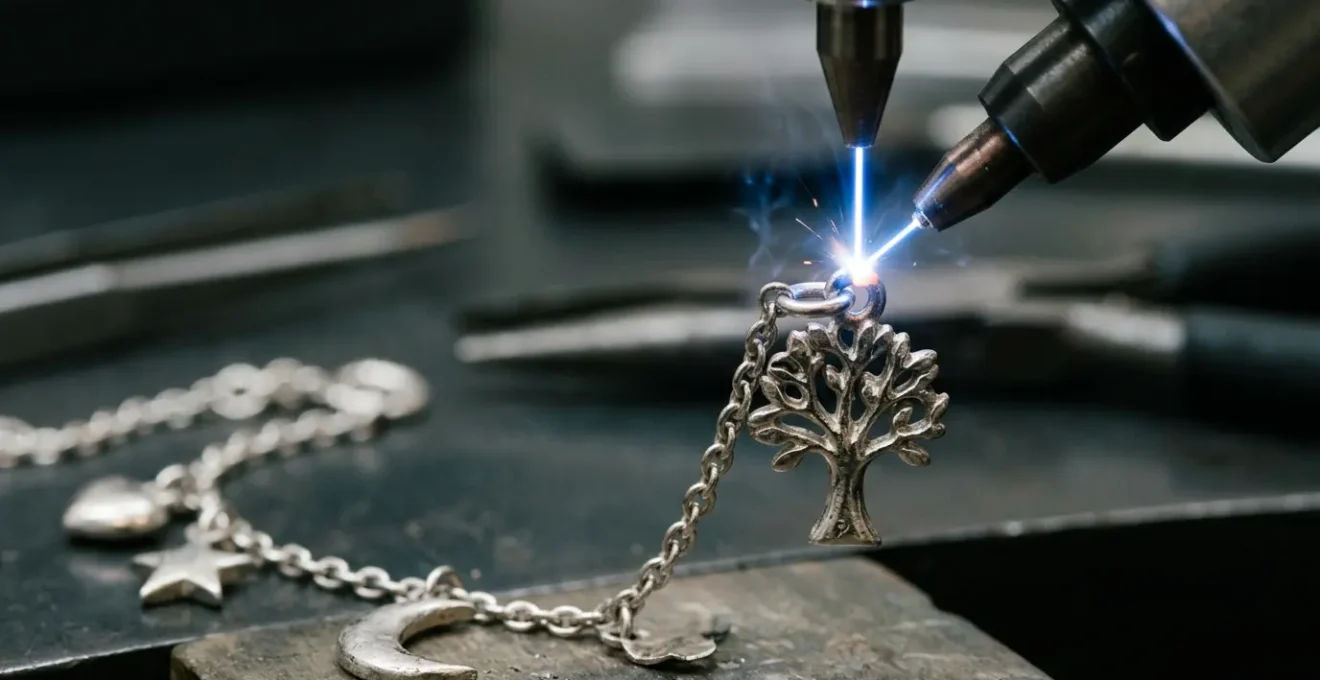
If you’re a collector frustrated by jewelers refusing to add charms to your platinum bracelet, the reason is not unwillingness but complex physics. Working with platinum requires a completely different workshop ecosystem—including specialized laser welders and safety protocols—that is fundamentally incompatible with traditional gold or silver smithing. This guide explains the specific technical and financial reasons behind this craftsmanship delta, empowering you to understand the challenges and find the right expert for the job.
You have made the ultimate upgrade, moving from gold or silver to a substantial, beautiful platinum charm bracelet. It has a satisfying heft, a cool, bright lustre, and the promise of enduring a lifetime. But when you arrive at a jeweler’s workshop with a new charm, ready to mark another milestone, you are met with a polite but firm refusal. The soldering job, which would be trivial on a gold bracelet, is deemed impossible or prohibitively expensive.
This experience is common and deeply frustrating for collectors. You have likely heard the simple, unsatisfying explanations: “it’s too hard,” “it needs a special torch,” or “the risk of damage is too high.” While true, these are merely symptoms, not the root cause. They fail to convey the fundamental shift in metallurgy and technique that platinum demands. Understanding this gap is the key to appreciating your piece and finding a true platinumsmith who can service it correctly.
The reality is that working with platinum is not just a ‘harder’ version of working with gold; it is a different discipline entirely. It is governed by extreme physics that demand a dedicated ecosystem of tools, skills, and safety protocols. This guide, from the perspective of a platinumsmith, will walk you through the specific technical reasons why adding a charm to a platinum link is a specialised task. We will explore the challenges of thermal control, the microscopic stresses within the metal, and the workshop infrastructure required, so you understand not just the ‘what,’ but the ‘why’ behind the difficulty.
In the following sections, we will deconstruct the unique properties of platinum and explain how they impact everything from the tools a jeweler must use to the very structure of the bracelet itself. This knowledge will equip you to care for your investment and distinguish between a standard jeweler and a specialist.
Summary: Why Is It So Difficult to Add Charms to a Platinum Bracelet?
- Why Traditional Torches Cannot Easily Solder Platinum Links?
- Platinum vs White Gold: Is the Extra Weight on the Wrist Uncomfortable?
- Can You Put Gold Charms on a Platinum Bracelet Without Wearing the Links?
- Why Do Platinum Jump Rings Cost 5x More Than Gold?
- Do You Need a Double Safety Catch for a Platinum Charm Bracelet?
- How to Deal with the Grey Patina That Develops on Platinum Rings?
- Why 9ct Gold Is the Best Choice for Heavy Signet Rings?
- Hollow vs Solid Gold Bracelets: How to Tell the Difference Before Buying?
Why Traditional Torches Cannot Easily Solder Platinum Links?
The primary reason most jewelers cannot simply “solder” a platinum charm lies in a single, unyielding physical property: its extreme melting point. Platinum requires immense heat, a factor that renders a traditional goldsmith’s torch not just ineffective, but dangerous to the jewelry. According to melting point data, platinum liquefies at 1,773°C (3,224°F), which is over 700°C higher than the temperature needed for gold alloys. A standard butane or propane torch simply cannot achieve this heat in a controlled manner.
To reach these temperatures, a platinumsmith must use a specialized hydrogen/oxygen torch or, more commonly today, a laser welder. The issue with an open flame torch, even a powerful one, is thermal control. The flame is a blunt instrument, heating a wide area around the target link. This “heat-affected zone” can cause adjacent links to warp, discolour, or even melt. As platinum expert Jurgen J. Maerz notes for the Ganoksin community, the intense heat is a core consideration:
When soldering, brazing, or welding platinum, you should remember that the metal has an extremely high melting point (about 1,773 degrees Celsius or 3,224 degrees Fahrenheit; temperatures will vary depending on the alloy used).
– Jurgen J. Maerz, Ganoksin Jewelry Making Community
The modern solution is the laser welder, which delivers a pinpoint of intense energy to a microscopic spot. This allows a smith to weld a jump ring shut without the heat ever reaching the next link on the bracelet. The illustration below highlights the critical difference between these two methods.
As you can see, the laser provides the surgical precision necessary for working on a delicate, multi-part item like a charm bracelet. A jeweler without access to this technology is correct to refuse the job, as attempting it with a traditional torch would almost certainly result in catastrophic damage to your valuable piece.
Platinum vs White Gold: Is the Extra Weight on the Wrist Uncomfortable?
When collectors first handle a platinum bracelet after being accustomed to gold, the most immediate difference they notice is the weight. This isn’t just a perception; it’s a measurable physical property. Platinum is a significantly denser metal than gold. In fact, platinum castings are roughly 30% heavier than identical pieces made from 18k gold. This density is a hallmark of platinum’s purity and permanence, giving it a satisfying and luxurious heft.
However, for a charm bracelet that will be worn daily and accumulate the weight of numerous charms, this density raises a valid question of comfort. Is the extra weight uncomfortable? The answer is subjective and depends on the wearer’s preference and the bracelet’s design. A well-constructed, solid-link platinum bracelet distributes its weight evenly. For many, this substantial feel is a constant, reassuring reminder of the piece’s quality. It feels secure and valuable in a way that lighter alloys do not.
The discomfort typically arises not from the weight itself, but from a poorly designed or undersized bracelet. If the links are too thin or the clasp is not robust enough to handle the structural stress, the weight can become a point of failure. A bracelet that is too loose may also feel cumbersome as it slides. Therefore, the key to comfort is not reducing the weight—which would mean compromising on the metal—but ensuring the bracelet’s engineering is appropriate for platinum’s inherent density. The feeling of substance on the wrist is part of the platinum experience; it is a feature, not a flaw.
Can You Put Gold Charms on a Platinum Bracelet Without Wearing the Links?
A common question from collectors is whether they can attach their existing 18k or 9k gold charms to a new platinum bracelet. While technically possible, it is strongly discouraged from a metallurgical standpoint due to the principle of fretting wear. When two metals of different hardness rub against each other, the softer metal will always wear away. Platinum is significantly harder and more durable than gold. Over time, the harder platinum link will act like a slow, fine file against the softer gold jump ring of the charm, eventually wearing it through.
This wear is exacerbated if a jeweler attempts to solder a gold jump ring directly to a platinum link, a practice that introduces even greater risks to the metal’s integrity. During heating, metals expand at different rates. Technical data shows that when soldering 10mm pieces together, gold expands 0.106mm versus platinum’s 0.07mm at 750°C. While microscopic, this differential creates immense internal stress at the join as the metals cool. This can lead to a weak, brittle solder joint that is prone to cracking and failure over time.
The proper method is to use a platinum jump ring for every charm, which is then laser-welded shut. This ensures that you have platinum touching platinum, creating a system with uniform hardness and wear characteristics. This prevents the accelerated wear seen when gold is paired with platinum, as depicted in the magnified view below.
Mixing these metals compromises the longevity that is the very reason for choosing platinum in the first place. For the structural integrity and security of your collection, it is essential to ensure that all components directly interacting on the bracelet are made of the same noble, durable metal.
Why Do Platinum Jump Rings Cost 5x More Than Gold?
When a collector is quoted a price for adding a charm with a platinum jump ring, the cost can be surprising—often many times that of a similar job in gold. This price difference is not primarily driven by the raw material cost, but by the specialized workshop ecosystem required to work with platinum. As we’ve established, traditional torches are unsuitable. The standard for professional platinum work is a laser welder, a significant capital investment for any workshop, with jewelry laser welders costing between $2,500 and $10,000 for benchtop units.
This single piece of equipment is just the start. The entire process requires specialized tools and safety gear that are distinct from a standard goldsmith’s bench. Platinum is highly susceptible to contamination from other metals at high temperatures. Even touching it with standard steel tweezers can infuse impurities that weaken the metal. Therefore, a platinumsmith must use dedicated tungsten-tipped tweezers and ceramic soldering blocks. Furthermore, the intense white-hot light emitted when platinum melts can cause severe eye damage. This necessitates the use of #5 or #6 welding glasses, far darker than standard safety goggles.
This table clearly illustrates the stark difference in requirements, which translates directly into higher labor and equipment overhead costs for any job involving platinum.
| Requirement | Gold Soldering | Platinum Soldering |
|---|---|---|
| Temperature | ~750°C | 1,773°C |
| Safety Equipment | Standard goggles | #5-#6 welding glasses |
| Tools | Standard tweezers | Tungsten tweezers only |
| Torch Type | Butane/propane | Hydrogen/oxygen or laser |
| Contamination Risk | Low | Extremely high |
In essence, the higher cost of a platinum jump ring is not just for the small piece of metal; it is for access to the specialized equipment, the pristine environment, and the expert skill—the craftsmanship delta—required to work with this demanding material without compromising its integrity.
Do You Need a Double Safety Catch for a Platinum Charm Bracelet?
Yes, absolutely. For a heavy, solid platinum charm bracelet, a double or even triple safety mechanism is not a luxury but a critical necessity. The need for this enhanced security is a direct consequence of the metal’s density and the resulting structural stress on the clasp. As previously noted, a platinum bracelet is substantially heavier than its gold counterpart—in some cases, platinum is up to 60% heavier than a 14k gold piece of the same dimensions. As you add solid charms, this weight increases significantly, placing immense and constant strain on the bracelet’s closure.
A standard single clasp, sufficient for a lighter gold bracelet, becomes a point of weakness. The continuous pull from the bracelet’s own weight can cause it to wear, bend, or accidentally open. To mitigate this risk, a high-quality platinum charm bracelet should feature a multi-part closure system. The primary clasp should be a robust box clasp with an integrated safety tongue. This should be supplemented by at least one, and preferably two, external safety latches.
The most common secondary mechanisms are:
- Figure-eight latches: Small, hinged wire loops that swing over and clip onto a post, providing an essential backup.
- Fold-over safety catches: A hinged latch that snaps securely over the primary clasp.
- A safety chain: A thin chain with its own clasp that connects the two ends of the bracelet, acting as a final fail-safe to prevent the bracelet from falling off the wrist completely if the main clasp fails.
These redundancies are crucial for protecting your investment. When commissioning or purchasing a platinum charm bracelet, the clasp system should be a primary point of inspection. It must be over-engineered to handle the unique structural stresses imposed by this wonderfully dense and durable metal.
How to Deal with the Grey Patina That Develops on Platinum Rings?
One of platinum’s most cherished characteristics is how it ages. Unlike silver, which tarnishes, or white gold, which can yellow as its rhodium plating wears off, platinum develops a unique finish known as a patina. It’s important to understand that this is not a chemical reaction or a sign of decay. As a Ganoksin manufacturing report notes, ” Platinum doesn’t tarnish or oxidise on air. Pt has a very good wear resistance.” The patina is a physical change, not a chemical one.
Over years of daily wear, the surface of the platinum accumulates microscopic scratches and dents. Instead of losing metal (as gold does), the metal is simply displaced, creating a rich, matte, slightly greyish finish. Many collectors find this satin-like patina highly desirable, as it tells the story of the piece’s life and gives it a distinguished, antique character. This is a hallmark of high-end platinum jewelry.
For a charm bracelet, this aging process presents a unique consideration. As the bracelet develops its beautiful patina, any new charm you add will be bright, shiny, and high-polish. This creates a visual mismatch between the aged bracelet and the new component. The solution is not to avoid the patina, but to manage it. You have two options: either allow the new charm to gradually develop its own patina to match the rest of the bracelet, or take the entire piece to a qualified platinumsmith to have it professionally re-polished to a uniform high shine. This re-polishing is a skilled job, but it can restore the bracelet to its original brilliant finish if desired. Ultimately, dealing with patina is a matter of aesthetic preference: embrace the story it tells, or periodically restore its original lustre.
Why 9ct Gold Is the Best Choice for Heavy Signet Rings?
To fully appreciate why platinum is the superior choice for a dynamic piece like a charm bracelet, it is helpful to understand why other metals are chosen for different applications. The selection of a precious metal is always a balance of properties: hardness, density, workability, and cost. There is no single “best” metal, only the best metal for a specific job. A heavy signet ring, for example, has very different requirements from a charm bracelet.
A signet ring is largely static. It needs to be very hard to resist dings and deep scratches, and affordability is often a key factor for such a large, heavy piece. This makes 9ct gold an excellent choice. Its higher alloy content makes it harder than 18k or 22k gold, and its lower gold content makes it more affordable. Its primary job is to be a durable, stationary mass of metal.
A charm bracelet, conversely, is a system of moving parts. Its primary challenge is not impact resistance, but tensile strength and wear resistance between moving links. Platinum excels here. Its density and ductility mean it resists being worn down by the constant friction of other links and charms. The following table compares ideal metal choices for different jewelry types, highlighting how properties are matched to function.
| Application | Ideal Metal | Key Property | Melting Point |
|---|---|---|---|
| Heavy Signet Ring | 9ct Gold | Hardness & affordability | ~900°C |
| Charm Bracelet | Platinum | Tensile strength | 1,773°C |
| Delicate Chain | 18k Gold | Balance of weight/strength | ~930°C |
| Wedding Band | Platinum/Palladium | Durability | 1,555-1,773°C |
This comparison demonstrates the principle of selecting the right material for the right purpose. While 9ct gold is perfect for a signet ring, its properties are not suited for the dynamic environment of a charm bracelet. For that application, platinum’s superior strength and wear resistance make it the undisputed champion, despite the challenges it presents in fabrication and modification. One metal that offers a middle ground is palladium, with a compromise at a 1,555°C melting point, but it lacks the satisfying density of platinum.
Key Takeaways
- The extreme 1,773°C melting point of platinum makes traditional torches unusable, requiring specialized and expensive laser welders for safe modification.
- Platinum’s high density gives it a luxurious weight but also places significant structural stress on clasps, mandating robust, multi-part safety mechanisms.
- Mixing softer gold charms on a harder platinum bracelet leads to accelerated wear on the gold; all components should be platinum for long-term integrity.
- The high cost of platinum work is driven by the necessary investment in a dedicated workshop ecosystem, including specialized tools, safety gear, and advanced skills.
Hollow vs Solid Gold Bracelets: How to Tell the Difference Before Buying?
While the title mentions gold, the principle of hollow versus solid construction is even more critical when evaluating a platinum charm bracelet. Given platinum’s high material cost, manufacturers are sometimes tempted to create hollow links to reduce weight and price. For a charm bracelet, this is a dangerous compromise that should be avoided at all costs. A charm bracelet must be completely solid to withstand the structural stresses it will endure.
A hollow-link bracelet is inherently weak. The walls of the links are thin, and they can easily be dented, crushed, or pulled apart by the weight of the bracelet itself, let alone the added weight of multiple charms. Repairing a crushed hollow link is often impossible. Furthermore, any attempt to add a charm by soldering or welding to a hollow link is extremely risky, as the intense heat can instantly melt through the thin metal wall, destroying the link.
The substantial weight of a platinum bracelet is your primary indicator of solid construction. It should feel significantly heavier than a gold bracelet of the same size. Before purchasing, it is essential to verify the construction with the jeweler. An informed collector should be prepared to ask direct questions to ensure the long-term integrity of their investment. The following checklist provides key points to verify before committing to a purchase.
Your Pre-Purchase Integrity Checklist: Platinum Charm Bracelet
- Ask the jeweler directly: ‘Are these links completely solid platinum, not hollow or filled?’
- Request information on how the links are constructed (e.g., cast, forged, or assembled).
- Inquire specifically about their capability for adding charms using laser welding in the future.
- Compare the physical weight to a similar-sized gold bracelet; it should feel noticeably heavier (30-60%).
- Verify that the clasp system is robust, preferably with a box clasp and at least one secondary safety latch.
Investing in a solid platinum bracelet ensures you have a piece with the necessary foundation to last for generations. Sacrificing structural integrity for a lower initial cost is a false economy that will inevitably lead to disappointment and costly repairs down the line.
Now that you understand the unique physics and craft required for platinum, the next logical step is to seek out a true specialist. Ask potential jewelers about their experience with platinum, their laser welding capabilities, and their dedicated tools. An expert will be happy to explain their process, confirming they possess the workshop ecosystem necessary to protect your valuable collection.