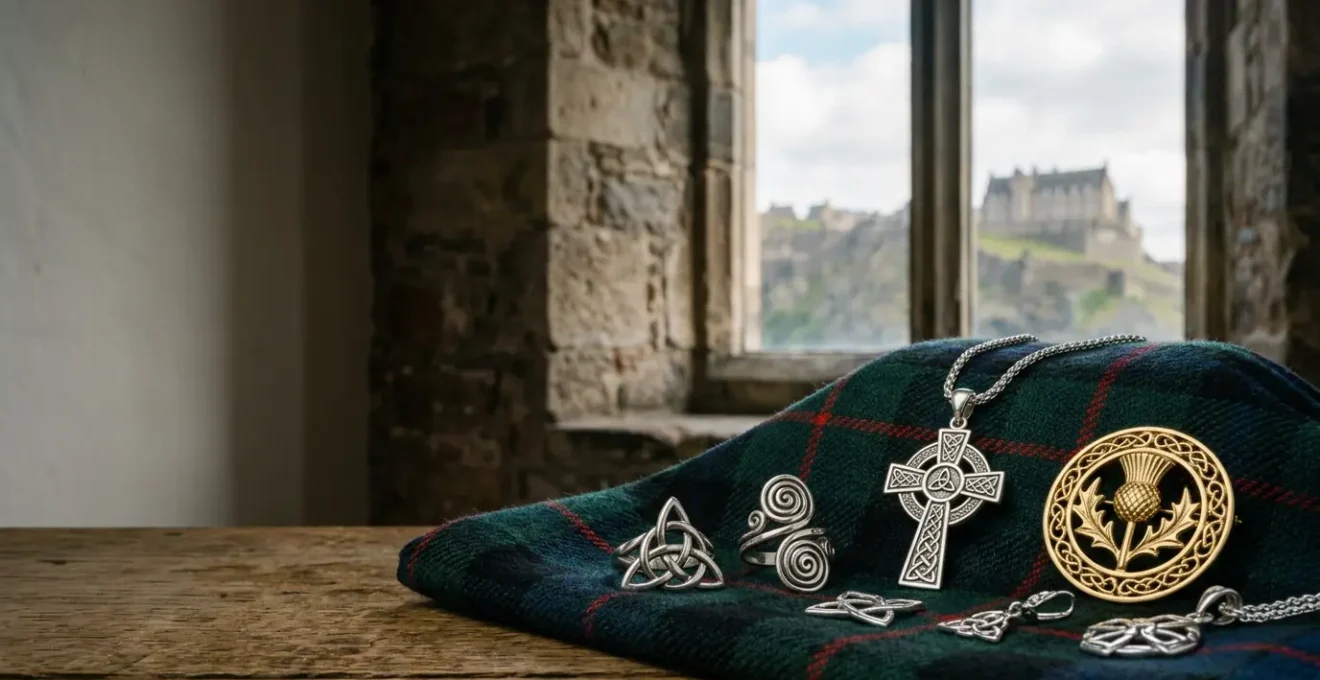
Beyond simple decoration, British and Irish heritage jewellery was a complex, silent language used to communicate love, loyalty, political allegiance, and social status.
- The way a Claddagh ring is worn signals marital availability, while Suffragette colours were a secret sign of rebellion.
- Victorian symbols like snakes and hair lockets, often misunderstood today, represented eternal love and cherished memory, not evil or morbidity.
Recommendation: To choose a truly meaningful gift, one must first learn to read this symbolic language, understanding the history and context behind the design.
When we look at a piece of Scottish heritage jewellery, our modern eyes are often captivated by the intricate, looping lines of a Celtic knot. We associate it with a vague sense of eternity, of an ancient, mystical past. This interpretation isn’t wrong, but it is incomplete. It’s like hearing a single word from a rich and complex language. The true story of this jewellery is not just in its aesthetic appeal, but in its function as a powerful social signifier—a visual vernacular that conveyed messages as clearly as spoken words. These symbols were a public declaration of one’s identity, beliefs, and place in the world.
The origins of these motifs are ancient; for instance, some Celtic knot patterns have been traced back to 500 B.C., evolving significantly over centuries. The famous Trinity Knot, or Triquetra, is a prime example of this contextual evolution. While later adopted by Christianity to represent the Holy Trinity, its older spiral form was deeply connected to Pagan beliefs, symbolizing the elemental forces of earth, fire, and water. Understanding this journey from a Pagan sigil to a Christian emblem and finally to a modern symbol of heritage is key. It reveals that the meaning of a symbol is never static; it is a narrative shaped by culture, faith, and time.
This article moves beyond the surface-level definitions. We will explore how different pieces of heritage jewellery functioned as a silent language. From the explicit rules of the Irish Claddagh ring to the clandestine codes of Suffragette brooches and the misunderstood romance of Victorian mourning lockets, we will decode the messages embedded in metal and stone. This is not just a history of objects, but a guide to reading the stories they were meant to tell—stories of love, loss, rebellion, and identity.
To fully appreciate the depth and nuance of these historic pieces, this guide explores the specific symbolism and stories behind some of the most iconic designs. Each section will decipher a different aspect of this visual language, providing the context needed to select a piece rich with history and personal significance.
Summary: The Silent Language of British and Irish Heritage Jewellery
- Why Wearing Your Claddagh Ring the Wrong Way Sends the Wrong Signal?
- Green, White, Violet: How to Identify Authentic Suffragette Jewellery?
- Hair Work in Lockets: Macabre or Romantic History?
- The Mistake of Confusing Victorian Snake Motifs with Evil Symbolism
- Snake or Love Knot: Which Victorians Used for Eternal Love?
- Scottish Gold vs Welsh Gold: Which Is Rarer and More Expensive?
- How Small Can You Engrave a Family Crest Before It Becomes a Blob?
- Vintage Akoya vs Freshwater: How to Spot Quality Pearls in UK Antique Shops?
Why Wearing Your Claddagh Ring the Wrong Way Sends the Wrong Signal?
The Irish Claddagh ring, with its iconic design of two hands clasping a crowned heart, is perhaps the most explicit example of jewellery as a social signifier. Far from being a mere decorative item, its power lies in its codified use. To wear a Claddagh is to make a public statement about your romantic status, a message understood by the community. The direction the heart points is not an arbitrary choice; it is a deliberate signal broadcast to the world, and wearing it “the wrong way” can lead to awkward assumptions or missed connections.
The rules form a clear narrative of a person’s romantic journey. Each change in the ring’s position marks a new chapter in the wearer’s life. While it is a common question, there is no “bad luck” in buying a Claddagh for oneself; it is seen as an expression of self-love and openness to friendship until a partner enters the picture. The four key positions are:
- Single and Searching: Worn on the right hand with the point of the heart facing outwards, away from the body. This signals that the wearer’s heart is open and available.
- In a Relationship: Worn on the right hand with the heart pointing inwards, towards the body. This shows that the wearer’s heart has been captured by another.
- Engaged: Worn on the left hand, the traditional ring finger, with the heart still pointing outwards. This signifies a formal commitment and promise of marriage.
- Married: Worn on the left hand with the heart turned inwards, symbolizing that the wearer’s heart belongs completely and forever to their spouse.
This symbolic literacy turns a simple ring into an active participant in social life, a tradition that carries profound meaning for those with a connection to Irish heritage.
Green, White, Violet: How to Identify Authentic Suffragette Jewellery?
In the early 20th century, jewellery became a tool of political rebellion. The Suffragettes, fighting for women’s right to vote, adopted a specific colour code: Green for Give, White for Women, and Violet for Votes. This combination, often realised with peridots, pearls, and amethysts, transformed brooches, pendants, and rings into symbols of allegiance. These pieces were not just adornments; they were a clandestine handshake, allowing supporters to identify one another and publicly display their political identity in a way that was both elegant and defiant. Historically, these pieces were also crucial fundraising tools, sold at Women’s Social and Political Union (WSPU) bazaars to finance the movement.
For a buyer today, distinguishing an authentic Edwardian-era (1901-1910) piece from a modern reproduction requires a historian’s eye for detail. The value lies not just in the materials but in the object’s direct connection to a pivotal moment in history. The key is to look for the subtle signs of age and period-specific craftsmanship.
| Feature | Authentic Edwardian Era (1901-1910) | Modern Reproductions |
|---|---|---|
| Materials | Peridot, natural pearls, amethysts | Synthetic stones, cultured pearls |
| Metal | 9ct gold or silver with period hallmarks | Modern alloys, contemporary hallmarks |
| Manufacturing | Hand-crafted, visible tool marks | Machine-made, uniform finish |
| Patina | Natural age wear, original clasps | Artificial aging, modern findings |
An authentic piece of Suffragette jewellery is more than an antique; it’s a material narrative of courage, a tangible link to the women who fought for the rights many enjoy today.
Hair Work in Lockets: Macabre or Romantic History?
Through a modern lens, the Victorian practice of keeping locks of a loved one’s hair in jewellery can seem macabre. However, to dismiss it as such is to fundamentally misunderstand the 19th-century relationship with life and death. In an era of high mortality rates, death was a far more present and intimate part of family life. ‘Memento mori’—Latin for “remember you must die”—was not a morbid obsession but a philosophical acceptance of mortality that encouraged one to cherish the living and remember the dead. These pieces were a form of sentimental jewellery, designed as a comfort, not a curiosity.
The Victorian concept of ‘memento mori’ represented a different relationship with death, where keeping a physical token of a loved one was a profound comfort, not a morbid curiosity.
– Victorian Jewelry Historian, Celtic Heritage Jewelry Analysis
The creation of these objects was a highly specialized art form. Far from being a simple lock of hair tucked away, the hair was often intricately worked by skilled artisans. These “hair-workers” used techniques like ‘palette work’, where hair was arranged into delicate scenes or initials, and ‘table work’, where it was woven into complex patterns resembling chains or fabric. This artistry elevated the hair from a mere relic to the primary medium of the piece, extending beyond lockets to brooches, rings, and even large, framed memorials that served as family tributes. It was a tangible, physical connection to a person that a portrait could not provide, a way to keep them literally close to the heart.
Therefore, these pieces are not ghoulish trinkets but deeply romantic and poignant expressions of love, memory, and the enduring human desire to hold on to those we have lost.
The Mistake of Confusing Victorian Snake Motifs with Evil Symbolism
In contemporary culture, the serpent often carries connotations of danger, temptation, or evil, largely due to its role in Judeo-Christian narratives. To apply this interpretation to Victorian snake jewellery is a significant historical misstep. In the 19th century, the snake was one of the most powerful and popular symbols of eternal love, wisdom, and protection. This symbolism has ancient roots, particularly the image of the Ouroboros—a snake devouring its own tail—which represents infinity, wholeness, and the cyclical nature of life.
The motif’s explosion in popularity can be traced to a single, highly influential gift. In 1839, Prince Albert proposed to Queen Victoria with a gold snake ring set with an emerald, her birthstone. This was not a strange or ominous choice; it was a deeply romantic gesture, symbolizing their unending love. Following this royal endorsement, snake jewelry experienced a massive surge in popularity post-1840, with serpents coiling around fingers, wrists, and necks across the British Empire. These were not symbols of sin but passionate declarations of commitment, worn as a public display of enduring affection.
When you encounter a Victorian snake brooch or ring in an antique shop, you are not looking at a symbol of evil, but at a relic of a great love story, both royal and personal.
Snake or Love Knot: Which Victorians Used for Eternal Love?
While the snake motif represented a passionate and protective form of eternal love, it was not the only symbol Victorians used to express this sentiment. The love knot, a design with ancient Celtic origins featuring intertwining, unending loops, also conveyed a message of everlasting connection. However, the two symbols were not interchangeable. They belonged to a nuanced visual vernacular, often communicating different facets of love and appealing to different social strata. The choice between a snake and a love knot was a subtle social signifier.
The snake, spurred by royal fashion, often manifested in more elaborate, bejeweled forms, making it a favourite among the upper classes. It spoke of a worldly, passionate, and sometimes possessive love. In contrast, the love knot was often simpler and more graphic in its design, resonating more with the middle classes. Its symbolism was less about passionate possession and more about a spiritual, fated intertwining of two destinies. It represented a bond that was inseparable and divinely ordained.
This table outlines the key distinctions in how these two powerful symbols were used to communicate the idea of eternal love during the Victorian era.
| Aspect | Snake Motif | Love Knot |
|---|---|---|
| Type of Love | Passionate, worldly, protective | Spiritual, fated, intertwined destiny |
| Social Class | Upper classes (elaborate, bejeweled) | Middle class (simpler, graphic) |
| Peak Popularity | Post-1840 concentrated surge | Consistent throughout 19th century |
| Royal Influence | Queen Victoria’s engagement ring | Traditional Celtic heritage |
For a gift buyer today, knowing this distinction is crucial. Choosing a snake speaks to passionate devotion, while a love knot suggests an unbreakable, soul-deep connection.
Scottish Gold vs Welsh Gold: Which Is Rarer and More Expensive?
In the realm of heritage jewellery, the material itself can carry as much meaning as the design. This is particularly true for gold sourced from specific British locales. Both Scottish and Welsh gold are exceptionally rare, mined in tiny quantities compared to the global supply, which inherently makes them valuable. However, the question of which is “more expensive” is complex, as it involves a battle between material scarcity and perceived value, largely driven by branding and royal association.
Welsh gold, particularly from mines like Clogau St David’s, holds a unique place in the public imagination. It has been used to create wedding rings for the Royal Family for a century, including those for Queen Elizabeth II, Princess Diana, and the current Prince and Princess of Wales. This royal connection has been masterfully leveraged by brands like Clogau, creating a powerful material narrative that elevates its status. Consequently, pieces containing even a trace of Welsh gold command a significant price premium, often exceeding the intrinsic value of the metal itself.
Scottish gold, sourced from areas like Kildonan and Leadhills, is similarly scarce, if not scarcer in modern production terms. However, it has not benefited from the same level of consistent royal patronage or large-scale commercial branding. While highly prized by collectors and connoisseurs, its market position is more grounded in its raw rarity rather than a carefully constructed brand identity. Thus, while an ounce of pure Scottish gold is immensely valuable, the “price” of Welsh gold jewellery is often inflated by its unparalleled story and royal pedigree.
Ultimately, Welsh gold is often more expensive at the counter due to its brand power, but both are among the rarest and most meaningful precious metals a person can own, each telling a story of its specific place of origin.
How Small Can You Engrave a Family Crest Before It Becomes a Blob?
For centuries, the signet ring engraved with a family crest has been the ultimate piece of personalized heritage jewellery. It serves as a seal of identity, a connection to one’s lineage. However, the desire to wear a crest on a smaller, more discreet ring presents a significant technical challenge: how small can the design be before its intricate details—the helmet, the mantling, the charges on the shield—merge into an illegible “blob”? The answer depends on a delicate interplay between three factors: the hardness of the material, the skill of the engraver, and the strategic simplification of the design.
Different materials hold detail to varying degrees. Softer metals like 9-carat gold require a larger surface to maintain clarity, while harder 18-carat gold or platinum can accommodate finer work. The method of engraving is also critical. Traditional hand engraving, performed by a master craftsman, creates deep, V-shaped cuts that catch the light and provide a sense of depth and character that lasts for generations. Laser engraving, while capable of achieving smaller details, often produces a shallower, flatter result that can lack the life and longevity of hand work.
Action Plan: Material-Based Engraving Guidelines
- 9ct gold (softer): A minimum surface of 8mm is recommended for readable basic crest elements.
- 18ct gold (harder): Can achieve crisp detail down to 6mm with skilled hand engraving.
- Platinum or signet stones (e.g., carnelian, onyx): The hardness allows for detail as small as 5mm, provided the design is simplified.
- Laser engraving: Can reproduce visual detail at 3-4mm, but you sacrifice the traditional depth and three-dimensional quality of hand engraving.
- Strategic simplification: For any small engraving, focus on the core elements. This often means removing the decorative mantling and helmet, and retaining only the essential shield and the charge upon it.
Ultimately, a successful small-scale crest engraving is a compromise. It requires choosing the right material and simplifying the heraldry to its most potent symbols, ensuring the ring tells its story clearly, no matter its size.
Key Takeaways
- Jewellery’s meaning is not static; it evolves with culture and is defined by how it is used (e.g., Claddagh ring rules).
- Authenticity in antique jewellery is found in material science: look for period-correct gems, metal content, and hand-crafting marks.
- The symbolism of a motif is context-dependent. Victorian snakes meant eternal love, not evil, a meaning driven by royal influence.
Vintage Akoya vs Freshwater: How to Spot Quality Pearls in UK Antique Shops?
For a buyer navigating the charming chaos of a UK antique shop, distinguishing between different types of vintage pearls is a crucial skill. The two most common you will encounter are Akoya and Freshwater pearls, and while both can be beautiful, they have different origins, qualities, and values. Understanding their key characteristics is essential to making an informed purchase and spotting a true treasure. Historically, the context of value was different; before the 1920s, most pearls were natural and thus astronomically rare and valuable. The advent of cultured pearls changed the market forever.
Akoya pearls, the classic, perfectly round pearls from Japan, are saltwater pearls famed for their brilliant lustre and near-perfect spherical shape. They are bead-nucleated, meaning a small mother-of-pearl bead is inserted into the oyster to stimulate nacre production. Freshwater pearls, traditionally from China, are cultivated in mussels and are typically solid nacre, making them very durable. While historically they were often less round and had a softer lustre, modern cultivation techniques have produced freshwater pearls that rival Akoyas in quality. In a vintage context, however, Akoyas were generally the higher-value, more sought-after variety.
To authenticate a vintage strand, an expert relies on a series of visual and tactile clues, and pointedly avoids the unreliable “tooth test,” which is ineffective and can damage the pearl’s surface. A true assessment requires a more nuanced approach:
- Inspect the Drill Hole: Use a jeweller’s loupe. A vintage Akoya will often show the edge of the bead nucleus inside the drill hole, whereas a freshwater pearl will show concentric layers of solid nacre.
- Assess the ‘Orient’: Look for the subtle rainbow-like overtone that shimmers on the surface of high-quality pearls, especially Akoyas. This is a sign of thick, excellent-quality nacre.
- Check the Thread and Clasp: The condition of the silk thread can indicate age; old silk becomes frayed or discoloured. Examine the clasp for period-specific hallmarks, wear patterns, and patina. A heavily worn clasp on a pristine-looking necklace is a red flag for restringing or replacement.
By focusing on these details of lustre, shape, and construction, a discerning buyer can look beyond the surface and confidently identify a piece of genuine quality and history.
Frequently Asked Questions About British and Irish Heritage Gold
What is ‘Welsh-infused’ gold?
This term typically describes a piece of jewellery containing only a trace amount of genuine Welsh gold, which has been mixed with other, more common gold sources. It is a marketing practice that can sometimes be misleading, as the value and rarity of the piece do not reflect 100% Welsh gold.
Are there physical differences between Scottish and Welsh gold?
Yes, subtle differences can exist. Gold from different regions, such as Gwynfynydd in Wales and Kildonan in Scotland, can have slight variations in colour and alloy composition due to the unique geology of each location. These differences are often only discernible to a trained eye.
How can buyers verify 100% pure regional gold?
Verification can be challenging as comprehensive certification systems are still limited. Buyers should always request any available provenance documentation, which traces the gold back to its source mine, and look for official assay marks that certify the metal’s purity and origin where possible.