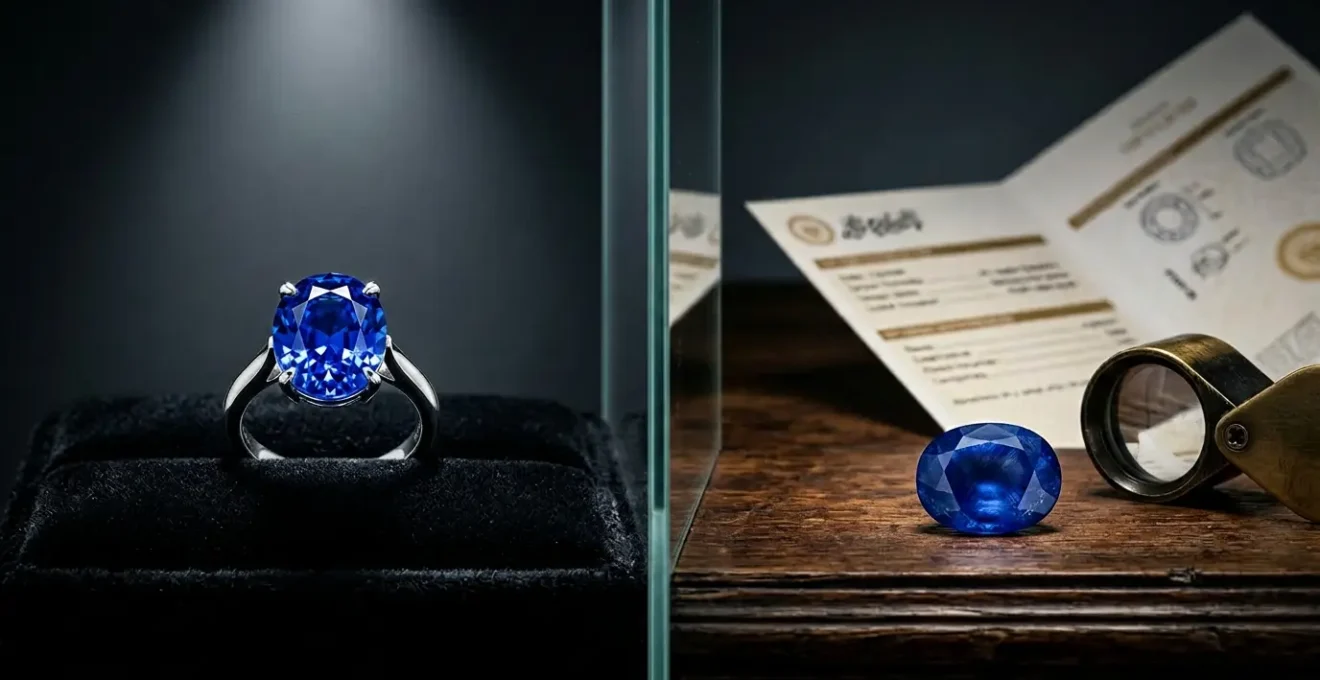
The true cost of a heated sapphire isn’t its price tag, but its drastic loss of value and liquidity on the UK secondary market.
- Heated sapphires are common and beautified, but auction houses and top dealers often prefer unheated stones, offering significantly lower prices for treated ones.
- An unheated sapphire with a top-tier lab report (GIA, SSEF, Gübelin) is not just a jewel, but a tangible asset with a proven resale market.
Recommendation: For investment, prioritize unheated sapphires under 2 carats to manage the price premium, and always demand multiple, top-tier lab reports confirming no heat and origin.
As an investor or collector standing before a jeweller’s display, you’re faced with a classic conundrum. Two sapphires, seemingly identical in their captivating blue hue, have vastly different price tags. The typical explanation is simple: one is a “heated” sapphire, treated to enhance its colour, while the other is an “unheated” natural stone, a rarity from the earth. Most discussions stop there, focusing on the aesthetics and the initial cost premium. This, however, is only half the story and dangerously incomplete for anyone concerned with value retention and future saleability.
The conversation rarely extends to the most crucial factor for an investor: the exit strategy. What happens when you decide to sell? The real difference between these two stones is not merely their treatment history, but their fundamental position in the market. One is a consumer product, the other is a tangible asset. Understanding this distinction is the key to navigating the UK gem market and avoiding costly mistakes. The secret lies not in the initial purchase price, but in the stone’s market liquidity and its performance on the secondary market, from the dealers of Hatton Garden to the auction blocks of Christie’s and Sotheby’s.
This guide moves beyond the surface-level discussion of colour and clarity. We will dissect the commercial realities of sapphire treatments. We will explore why the vast majority of stones are heated, how aggressive treatments like glass-filling create a durability and value nightmare, and why the right certification is non-negotiable. Most importantly, we will provide a transparent look at how the UK resale market actually values these stones, empowering you to make an informed investment decision, not just a beautiful purchase.
To navigate this complex topic, this article breaks down the key considerations for any serious sapphire investor. The following sections provide a clear roadmap from understanding market fundamentals to making a final, durable choice.
Summary: Unheated vs Heated Sapphires: How Much Does Treatment Affect UK Resale Value?
- Why 95% of Sapphires on the Market Are Heat Treated?
- Glass Filled Rubies: The Durability Nightmare You Must Avoid
- GIA or AnchorCert: Which Report Do You Need for an Unheated Stone?
- Burma or Mozambique: Is the Origin Premium Worth It for the Look?
- The Liquidity Mistake That Leaves Investors Stuck with Unsellable Diamonds
- How to Clean Glass-Filled Rubies Without Dissolving the Filler?
- Titanium Art: Is It a Fad or the Future of High Jewellery?
- Beyond Diamonds: Which Coloured Gemstones Can Survive Daily Wear in the UK?
Why 95% of Sapphires on the Market Are Heat Treated?
The prevalence of heat treatment in the sapphire market is a matter of simple economics and geology. The earth produces a vast quantity of corundum (the mineral species for both sapphire and ruby), but only a tiny fraction emerges with the deep, saturated colour and high clarity that the market desires. Most natural sapphires are too pale, too dark, or contain silky inclusions (rutile needles) that cloud their appearance. Heat treatment is the transformative process that turns this abundant, lower-quality rough into the vibrant gems you see in most jewellery stores. In fact, an estimated 98-99% of sapphires on the market undergo heat treatment, making it the industry standard, not the exception.
This process, which involves heating the stone to temperatures between 800 and 1,800 degrees Celsius, can dramatically improve a sapphire’s colour and dissolve those silky inclusions, enhancing its clarity. This turns a pale, less desirable stone into one with a valuable “Royal Blue” appearance. From a commercial perspective, this is a game-changer. It allows suppliers to create a consistent, beautiful, and marketable inventory from material that would otherwise be of little commercial value. The economic incentive is undeniable.
The following table illustrates how heat treatment can multiply a stone’s value, explaining its widespread use. While a pale, heated stone may serve as a baseline, a well-treated stone can command a price nearly eight times higher, approaching the value of a rare, naturally coloured unheated sapphire. This creates a large supply of beautiful, but commercially common, gems.
| Sapphire Type | 2.6ct Value (USD) | Price Factor | Market Availability |
|---|---|---|---|
| Pale Heated | $1,220 | Base Price | Common |
| Royal Blue Heated | $9,568 | 7.8x base | Readily Available |
| Unheated (Natural Color) | $9,250 | 7.6x base | Rare (1-2%) |
This economic reality is precisely why an unheated sapphire is considered an asset class of its own. Its value is derived not from an artificial enhancement, but from its natural rarity. While heat treatment creates beauty, it simultaneously removes the stone from the top tier of investable, rare assets. For an investor, understanding this distinction is the first step toward building a valuable collection.
Glass Filled Rubies: The Durability Nightmare You Must Avoid
While standard heat treatment is a stable and widely accepted enhancement, more aggressive treatments can create serious issues for an investor. Lead-glass filling in rubies is a prime example of a treatment that drastically compromises a stone’s integrity, durability, and value. This process involves taking heavily fractured, low-quality ruby material and filling the surface-reaching cracks with high-refractive-index glass. The goal is to improve transparency and mask the fractures, creating the illusion of a much higher quality stone. However, what you are essentially buying is a composite material—part ruby, part glass.
The visual deception is profound, but the value is not. Market analysis shows that glass-filled rubies sell for under $200 per carat, a tiny fraction of the price of even a standard heated ruby. The real problem for a buyer, however, is durability. The glass filler is not nearly as stable as the host ruby. It can be damaged or even dissolved by common household chemicals, heat from a jeweller’s torch during repairs, or standard cleaning methods like ultrasonic cleaners. This creates a “durability nightmare” where a seemingly solid gem can be ruined by routine care.
The microscopic view reveals the truth: the glassy, often bubbly filler sits in stark contrast to the crystalline structure of the natural ruby. In the UK, failing to disclose such a significant treatment is a serious issue. To protect your investment, you must be proactive and ask the right questions before any purchase.
Your Action Plan: 5 Questions to Ask Your UK Jeweller to Detect a Glass-Filled Ruby
- Ask for written disclosure of all treatments. The UK Consumer Rights Act 2015 requires goods to be ‘as described’, and a composite stone sold as a natural ruby is a misrepresentation.
- Request a certificate from a top-tier lab like GIA, GRS, or Gübelin that specifically states the treatment status. The comments section will explicitly mention “glass filling” or “cavities filled with a foreign substance”.
- Inquire about the stone’s specific care requirements. If the jeweller warns against ultrasonic or steam cleaning, it is a major red flag for glass-filling.
- Ask about the jeweller’s liability if their own cleaning service damages the filler material. Their response will reveal their confidence in the stone’s stability.
- Request clarification on whether the stone is a natural ruby or a “composite” material. Using this specific terminology can compel a more honest answer.
GIA or AnchorCert: Which Report Do You Need for an Unheated Stone?
For an investor, a gemstone without a top-tier certificate is merely a pretty rock. The report is the single most important document for proving a stone’s identity, quality, and, crucially, the absence of heat treatment. While labs like GIA are globally recognized and AnchorCert provides a reliable UK-based service, for a high-value, unheated sapphire, the strategy is not about choosing one lab over another. It’s about building a dossier of reports from the world’s most respected institutions. The top end of the market—where true investment-grade stones are traded—demands consensus from multiple leading authorities.
A single report is a good start, but for a stone of significant value, multiple certificates from labs like the Swiss Gemmological Institute (SSEF), Gübelin Gem Lab, and the American Gemological Laboratories (AGL) provide an undeniable confirmation of the stone’s characteristics. This is because each lab may have its own nuanced grading standards or specialized equipment, and having agreement across the board removes all doubt and maximizes market confidence. This directly translates to a higher resale value, especially at major auction houses like Sotheby’s or Christie’s in London.
Case Study: The Power of Multiple Reports at Auction
A prime example of this principle was a 6.98-carat unheated Kashmir sapphire that sold for an impressive $533,400 at Sotheby’s. The stone’s value was significantly bolstered because it was accompanied by reports from four separate, top-tier laboratories: SSEF, Gübelin, AGL, and GRS. Each report independently confirmed its coveted Kashmir origin and, most importantly, the complete absence of heat treatment. This case demonstrates that for serious investments, multiple expert opinions are the gold standard, creating an ironclad provenance that gives bidders the confidence to compete at the highest levels.
This doesn’t mean you need four reports for every stone. For those starting their investment journey, a strategic approach is key. As one expert advisor notes, it’s about finding the right entry point.
For jewelry buyers interested in unheated sapphires, buy sapphires less than 2 carats since the price difference compared to heated-sapphires is not as much. This difference exponentially increases for sapphires greater than 5 carats.
– Diamondère Gemstone Expert, Diamondère Natural Sapphire Guide
Burma or Mozambique: Is the Origin Premium Worth It for the Look?
For investment-grade sapphires, origin is a critical component of value, often eclipsing subtle differences in appearance. While a fine sapphire from Mozambique can be visually stunning, stones from classic, historically significant sources like Burma (Mogok) or Kashmir command a massive premium on the international market. This premium is not just about the “look”; it’s about provenance and rarity. These mines are either depleted or produce very little new material, transforming their finest gems from mere jewellery into finite, collectible assets. For an investor, buying a certified Burmese or Kashmir sapphire is like acquiring a piece of history with a well-established track record of value appreciation.
The term “Royal Blue,” for instance, is often associated with the finest sapphires from Burma. When a top gemological lab like SSEF bestows this colour grade and confirms a Burmese origin, it places the stone in an elite category. The market for these stones is driven by connoisseurs and investors who are willing to pay a substantial premium for the combination of exceptional quality and ultra-rare provenance. This premium is most evident at major auctions, where record-breaking prices are consistently set by stones from these fabled locations. For example, Sotheby’s 2025 market data reveals a typical range of $100,000 to over $1 million for notable Kashmir sapphires at auction.
Case Study: Origin’s Decisive Impact on Auction Price
The sale of the 114.73-carat Burmese ‘Royal Blue’ sapphire at Sotheby’s Geneva is a testament to the power of origin. The stone fetched an astounding $7.1 million, more than 2.5 times its highest estimate. The accompanying SSEF certificate was pivotal. It not only confirmed the ‘royal blue’ color but specifically noted it as ‘typical and characteristic for the finest sapphires of the Mogok gemstone tract’ (Burma). This official link to a legendary source provided the market with the confidence to push the price to record levels, proving that certified origin is an indispensable multiplier of value.
So, is the origin premium worth it? For a casual buyer seeking a beautiful gem, perhaps not. But for an investor, the answer is an unequivocal yes. The premium paid for a certified stone from a classic origin is an investment in rarity and liquidity, ensuring the asset will always be in demand among the world’s top collectors.
The Liquidity Mistake That Leaves Investors Stuck with Unsellable Diamonds
The single biggest mistake an investor can make is to conflate retail price with resale value. This is especially true for sapphires. While a fine heated sapphire can command a strong price in a retail setting, its value erodes significantly on the secondary market. This is the “liquidity mistake”: owning an asset that is difficult to sell for a fair price. Market liquidity refers to how quickly and easily an asset can be converted to cash without affecting its market price. For sapphires in the UK, the difference in liquidity between unheated and heated stones is stark.
Unheated sapphires, especially those with top-tier lab reports confirming origin, are considered a tangible asset class. They are sought after by auction houses, high-end dealers in places like Hatton Garden, and private collectors. There is an established, liquid market for them. Heated sapphires, on the other hand, are often viewed as commercial jewellery goods. While beautiful, their abundance means the secondary market is saturated. Auction houses may reject them outright unless they are of exceptional size and quality or part of a signed jewellery piece. Dealers will offer a much lower percentage of the original retail price because they can source similar stones easily from wholesale suppliers.
The professional evaluation process in the secondary market is rigorous and unforgiving. The table below provides a transparent look at what an investor can realistically expect when trying to sell their sapphire through different UK channels. The premium for an unheated stone is not just a higher percentage; it represents access to more prestigious and profitable sales venues.
This data from a recent comparative analysis of the UK market clearly shows the “resale friction” associated with heated stones. The path to cashing out your investment is simply much smoother and more profitable with a certified, unheated gem.
| Resale Channel | Heated Sapphire Typical Offer | Unheated Sapphire Premium | Requirements |
|---|---|---|---|
| Hatton Garden Dealers | 20-30% of retail | 40-50% of retail | Recent certification |
| Christie’s/Sotheby’s | Often rejected | 50-70% of retail | Top lab certificates |
| Online Platforms | 25-35% of retail | 35-45% of retail | Documentation |
| Private Buyers | 30-40% of retail | 45-60% of retail | Provenance proof |
How to Clean Glass-Filled Rubies Without Dissolving the Filler?
The question of how to safely clean a glass-filled ruby highlights the inherent instability of this composite material. The answer is profoundly simple and serves as a major warning to any potential buyer: you must treat it with extreme care, using methods far gentler than those for any other piece of fine jewellery. The glass used to fill the fractures is not as durable as the host ruby and can be easily damaged. It has a different thermal expansion rate, making it susceptible to cracking from sudden temperature changes, and it can be etched or even dissolved by certain chemicals.
Therefore, the only safe way to clean a glass-filled ruby is to use a soft, damp cloth and lukewarm water. That’s it. You must absolutely avoid all standard professional and at-home cleaning techniques. This includes ultrasonic cleaners, which can cause the glass to shatter or flake away from the vibrations; steam cleaners, whose high heat can cause thermal shock; and any jewellery cleaning solutions, which may contain chemicals like ammonia or acids that can etch or dissolve the glass filler. Attempting to clean a glass-filled ruby like a normal gem can permanently damage its appearance and destroy its already limited value.
This fragility has significant implications under UK law. If a jeweller sells you a glass-filled stone without explicitly disclosing the treatment and the required special care, they may be liable under the Consumer Rights Act 2015. The law states that goods must be ‘fit for purpose’ and ‘as described’. A gem that cannot withstand standard cleaning is arguably not fit for the purpose of normal wear. If you discover your ruby is glass-filled after purchase, you have strong grounds for a refund, and you should seek advice from consumer protection bodies.
Titanium Art: Is It a Fad or the Future of High Jewellery?
The world of high jewellery is constantly evolving, with innovative designers like JAR and Wallace Chan popularizing the use of avant-garde materials like coloured titanium. These pieces are celebrated for their artistry, lightness, and vibrant colours, often commanding high prices as works of wearable art. For the discerning investor, however, a critical question arises: are these trends the future of value, or are they ephemeral fads? While the artistry is undeniable, the long-term investment wisdom lies in focusing on assets with proven, intrinsic rarity and a history of value retention.
Materials and styles can fall in and out of fashion. The true “future” of high jewellery investment rests not in the setting material, but in the core asset: the gemstone itself. An exceptional, unheated sapphire set in a simple platinum ring holds a more stable and predictable long-term value than a lesser-quality stone in a trendy, complex titanium setting. The value of the former is anchored in its geological rarity, a finite and unchanging quality. The value of the latter is tied to artistic reputation and market trends, which can be more volatile.
The most astute investors look beyond the design of the moment and focus on the fundamental drivers of value appreciation. For coloured gemstones, this is the combination of quality, rarity, and the absence of significant treatments. Market analysis consistently shows a widening gap in the performance of treated versus untreated stones over time.
Unheated sapphires are becoming increasingly rare and have shown a substantial increase in market value over time, while fine-quality heated sapphires have shown a marginal increase in value
– RAF Jewels Market Analysis, The Big Debate: Heat vs. No Heat Sapphires
This expert observation confirms that the most reliable path to future value is not in chasing artistic fads, but in acquiring the rarest natural materials. An unheated sapphire is not a trend; it’s a tangible asset whose scarcity is guaranteed to increase, making it a cornerstone of any serious jewellery investment strategy.
Key Takeaways
- Treatment Dictates Liquidity: The key difference for an investor is that unheated sapphires have strong market liquidity, while heated stones face significant “resale friction” and value loss.
- Certification is Non-Negotiable: For investment-grade stones, a single report is the minimum. Multiple reports from top-tier labs (SSEF, Gübelin, GIA) are the gold standard for maximizing resale value.
- Durability is Value: Unstable treatments (glass-filling) and physical damage (chips, scratches) can decimate a stone’s value, making tough, stable gems like unheated sapphires a superior choice for long-term holding.
Beyond Diamonds: Which Coloured Gemstones Can Survive Daily Wear in the UK?
For a collector who wishes to both own and enjoy their investment, durability is a paramount concern. A gemstone worn daily is exposed to the rigours of life—accidental knocks, temperature changes, and exposure to chemicals. A beautiful but fragile stone is a poor investment if its value can be compromised by a single moment of carelessness. In the UK market, where an asset’s condition is critical to its resale value, choosing a gem that can withstand daily wear is a crucial part of an investment strategy. While diamonds are famous for their hardness, several coloured gemstones offer an excellent combination of beauty, rarity, and resilience.
A gemstone’s ability to survive daily wear depends on three key factors: hardness (resistance to scratching, on the Mohs scale), toughness (resistance to chipping and breaking), and treatment stability (how well any enhancements hold up over time). As we’ve seen, gems with unstable treatments like oiled emeralds or glass-filled rubies are poor choices for daily wear. A chipped or scratched stone can see a massive drop in value. According to Dawsons UK auction house valuers, a 30-50% decrease in resale value for chipped sapphires is typical, wiping out years of potential appreciation.
This is where unheated sapphires truly shine as an investment you can wear. With a Mohs hardness of 9, second only to diamond, they are exceptionally resistant to scratches. They also possess excellent toughness, making them far less prone to chipping than a stone like an emerald. Most importantly, as they are untreated, there is no enhancement that can degrade over time. The following index scores key coloured gemstones on the factors most important to a UK investor: durability for daily wear and the liquidity of that stone on the secondary market.
| Gemstone | Hardness (Mohs) | Toughness | Treatment Stability | UK Market Liquidity | Overall Score |
|---|---|---|---|---|---|
| Unheated Sapphire | 9/10 | 9/10 | 10/10 | 8/10 | 36/40 |
| Heated Sapphire | 9/10 | 9/10 | 9/10 | 6/10 | 33/40 |
| Ruby (heated) | 9/10 | 8/10 | 8/10 | 7/10 | 32/40 |
| Emerald (oiled) | 7.5/10 | 5/10 | 4/10 | 6/10 | 22.5/40 |
| Spinel | 8/10 | 8/10 | 10/10 | 5/10 | 31/40 |
| Aquamarine | 7.5/10 | 7/10 | 9/10 | 5/10 | 28.5/40 |
The data is clear. An unheated sapphire offers the ultimate combination of robust durability for daily enjoyment and strong market liquidity for a secure investment, making it the superior choice for the practical collector.
To secure the value of your gemstone portfolio, the next logical step is to ensure every significant piece is backed by a current, independent valuation from a certified gemologist. This provides the documentation needed for insurance, estate planning, and a successful future sale.
Frequently Asked Questions About Sapphire Treatments and UK Law
How should I clean a glass-filled ruby?
Use only a soft, damp cloth. Absolutely no ultrasonic cleaners, no steam cleaning, no chemicals. The glass filler can dissolve or crack with standard jewelry cleaning methods.
What are my rights if a UK jeweller damages the glass filler during cleaning?
Under the Consumer Rights Act 2015, if the treatment wasn’t clearly disclosed at purchase, the jeweller may be liable for mis-selling. Goods must be ‘as described’ and ‘fit for purpose’.
What if I discover my ‘ruby’ is glass-filled after purchase?
You have strong grounds for a refund under UK law if this treatment wasn’t disclosed. Contact Citizens Advice and keep all documentation for potential legal action.