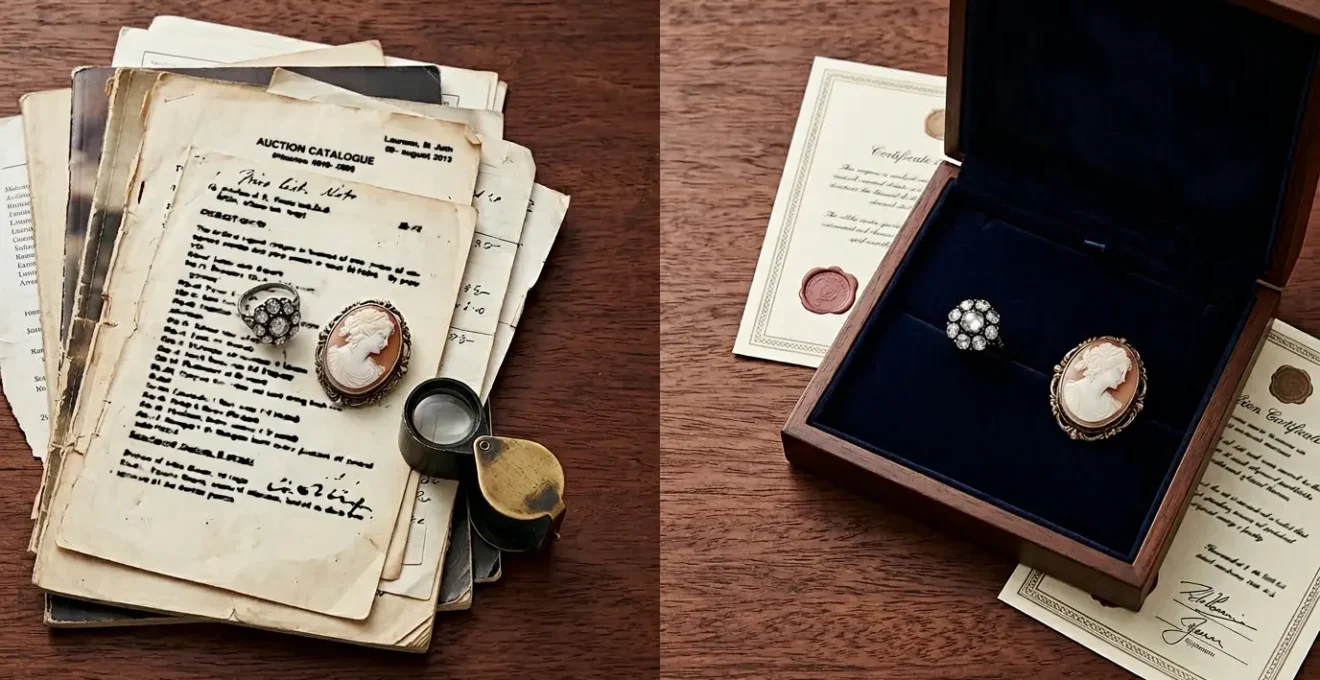
The common wisdom that dealers are ‘safe’ and auctions are ‘risky’ is a dangerous oversimplification for new collectors.
- The true cost of an auction piece is often 30% higher than the hammer price due to hidden fees.
- Dealers offer warranties, but a British hallmark provides a superior guarantee of authenticity and provenance.
Recommendation: Master the ‘hidden language’ of condition reports and hallmarks. This allows you to mitigate auction risks and find better value than relying solely on dealer assurances.
The thrill of finding a perfect piece of Georgian or Victorian jewellery is intoxicating. You can picture it: a stall on Portobello Road, a dusty corner in a Brighton lane, or the gleaming digital catalogue of a London auction house. For a budding collector, however, this excitement is quickly met with a daunting question: where should I actually buy? The conventional advice pits the perceived safety and higher prices of a dealer against the potential bargains and risks of an auction. This binary choice misses the point entirely.
Most beginners are told to “do their research” or “check the condition,” but this is like telling a new driver to “be careful on the road.” It’s true, but utterly useless without a deeper understanding of the vehicle and the rules. The real advantage isn’t found in choosing a venue, but in learning to speak the insider language of the trade. It’s about understanding why a £500 auction win isn’t £500, how to read the coded warnings in a condition report, and why a tiny stamp on a gold band can be more valuable than a dealer’s year-long warranty.
The secret isn’t about avoiding risk; it’s about calculating it. This guide moves beyond the simplistic “auction vs. dealer” debate. We will delve into the hidden mechanics of buying antique jewellery in the UK, equipping you with the savvy of a seasoned trader. We’ll deconstruct the true costs, teach you to spot clever fakes, and show you how to leverage the system to your advantage, whether you’re bidding at Sotheby’s or browsing a trusted dealer’s collection.
This article provides an insider’s framework for making informed decisions. To help you navigate this complex world, we have broken down the key strategies and considerations you need to master.
Summary: UK Auctions vs. Dealers: An Insider’s Guide to Sourcing Rare Antique Jewellery
- Why Winning an Auction for £500 Actually Costs You £650?
- How to Read an Auction Condition Report to Spot Hidden Repairs?
- Dealer Warranty or Auction Risk: Which Is Better for Novice Buyers?
- The ‘Marriage’ Trick: How to Spot Frankestein Jewellery Pieces?
- When to Bid in an Online Auction to Avoid a Bidding War?
- British Hallmarks vs Italian ‘750’ Stamps: Which Offers Better Purity Guarantees?
- How to Date a Pearl Necklace by Its Gold Clasp Style?
- Why Art Deco Pieces Outperform Other Vintage Styles in UK Resale Markets?
Why Winning an Auction for £500 Actually Costs You £650?
The most common mistake a novice makes at auction is mistaking the ‘hammer price’ for the final price. That £500 you triumphantly bid is merely the starting point. The real cost is inflated by a series of fees that dealers absorb into their sticker price but auctions add on top. The most significant of these is the Buyer’s Premium. This is the auction house’s commission, and it’s non-negotiable. Industry analysis shows buyer’s premiums typically range from 20% to 30% of the hammer price.
On top of this premium, you must pay VAT (Value Added Tax) at 20%—not on the item itself, but on the premium. So, a 25% premium on a £500 item is £125, and the VAT on that premium is another £25. Suddenly, your £500 piece is £650 before you’ve even considered shipping, insurance, or potential repairs. Dealers, on the other hand, present an all-in price. While it may seem higher initially, it often includes a margin for cleaning, minor repairs, and their own expertise, without the surprise add-ons.
This discrepancy is crucial for budget-conscious collectors. A piece from a dealer priced at £650 may seem more expensive than the same item with a £500 estimate at auction, but the final cost could be identical, or even higher at auction if the piece requires work. The dealer’s price includes their curation and a level of assurance, whereas the auction price is for the item “as is,” with all subsequent costs falling on you.
The following table illustrates the total cost of ownership, showing how a seemingly cheaper auction purchase can quickly match or exceed a dealer’s price when all factors are considered.
| Cost Component | £500 Auction Purchase | £650 Dealer Purchase |
|---|---|---|
| Base Price | £500 | £650 |
| Buyer’s Premium (25%) | £125 | £0 |
| VAT on Premium (20%) | £25 | £0 |
| Condition Report | £0 | Included |
| Warranty | None | 12 months included |
| Resizing/Repairs | Extra | Often included |
| Total Cost | £650+ | £650 |
How to Read an Auction Condition Report to Spot Hidden Repairs?
An auction condition report is not a straightforward document; it’s a carefully worded piece of text written to protect the auction house. For the savvy buyer, it’s a treasure map of potential problems if you know how to decode its euphemisms. Phrases that sound mild to the untrained ear are often glaring red flags for an expert. For example, “solder evident” doesn’t just mean a repair was done—it questions the structural integrity of the piece and the skill of the jeweller who performed it.
Other key phrases include “later additions,” which indicates non-original components that can plummet an item’s value, and the deceptively cautious “stones appear original to setting,” which is the auction house’s way of saying they are not certain the gems haven’t been replaced. A warning about a “thin shank” on a ring is a direct signal that you will be footing the bill for a costly repair in the near future. The real alarm bells should ring when you see these warnings combined, such as a report noting a thin shank and loose stones, which points to significant structural failure.
Case Study: The Victorian Brooch with Hidden Flaws
A Victorian brooch examined at Dreweatts provides a perfect example. The condition report might have vaguely mentioned “restoration evident.” However, physical inspection revealed what this truly meant: the original catch had been crudely replaced with a base metal patch, and greyish residue underneath pointed to the use of soft lead solder—a hallmark of amateur repair. These visual clues, hidden behind industry jargon, confirmed a significant reduction in the piece’s historical and monetary value.
Learning to read between the lines is a non-negotiable skill. It transforms the condition report from a simple description into a diagnostic tool, allowing you to assess the true quality and future costs associated with a piece before you ever place a bid.
Your Action Plan: Decoding Auction House Euphemisms
- ‘Solder evident’: Immediately look for discoloration or messy joints. This points to previous repairs that may be weak or poorly executed.
- ‘Later additions’: Scrutinise clasps, bails, and pin mechanisms. Compare their style and wear to the main piece to confirm they are from a different era.
- ‘Stones appear original’: Use a loupe to check for modern cutting styles on gems in an older setting or inconsistencies in stone colour and clarity.
- ‘Thin shank’: Assess the bottom of a ring band. If it’s significantly worn down, factor in the cost of a full or partial re-shank into your maximum bid.
- Combined warnings: Treat pieces with multiple warnings (e.g., ‘thin shank’ + ‘stones loose’) with extreme caution, as this often indicates major structural issues requiring expensive work.
Dealer Warranty or Auction Risk: Which Is Better for Novice Buyers?
The primary appeal of a dealer is the safety net they provide. A reputable dealer stands by their pieces, offering a warranty, a detailed history, and the assurance that the item is authentic and as described. This peace of mind is what you are paying for in their mark-up. For a novice collector, this can be invaluable. If a stone falls out or a clasp breaks a month after purchase, the dealer is your first port of call. At an auction, once the hammer falls, the piece is yours, “as is”—flaws and all. There is no recourse.
However, this safety-or-risk dichotomy is too simple. The real question is about your own knowledge. A dealer’s warranty is a substitute for your own expertise. An auction is a test of it. While a warranty is comforting, it doesn’t protect you from overpaying for a piece that is authentic but of mediocre quality. The greatest risk at an auction isn’t buying a fake, but rather emotional bidding. It’s easy to get caught in the heat of the moment and bid far beyond a piece’s intrinsic value. As former Sotheby’s auctioneer Joanna Hardy famously advised:
You must never, ever want something desperately.
– Joanna Hardy, Former Sotheby’s auctioneer
This is the golden rule of auction buying. Your power lies in detachment and a firm budget based on your own research. For a true novice, starting with a trusted dealer is a wise way to learn the feel of quality pieces and build a relationship with an expert. As your confidence and knowledge grow, you can begin to take calculated risks at auction, using your expertise as your warranty.
Ultimately, the choice depends on your goal. If you are buying a piece to wear and love, a dealer’s assurance may be worth the premium. If you are a collector looking for rare finds at value, developing the skills to navigate auctions is essential. This journey from reliant buyer to savvy collector is the true path to building a significant collection.
The ‘Marriage’ Trick: How to Spot Frankestein Jewellery Pieces?
One of the most insidious traps for new collectors is the ‘marriage’—a piece of jewellery assembled from components of different items and eras to create a more appealing, but ultimately inauthentic, whole. These “Frankenstein” pieces are far more common than outright fakes and can be incredibly deceptive. A beautiful Georgian-era pendant might be attached to a later Victorian chain, or a stick pin from the Edwardian period might be converted into a ring. While some conversions are historically legitimate, many are done to mislead buyers.
Spotting a marriage requires a keen eye for anachronism and wear patterns. The key is to ask: “Does every part of this piece belong together?” For example, a heavy, ornate pendant bail showing significant wear attached to a pristine, delicate chain is a major red flag. The components have lived different lives. The most definitive clues often come from technology. A classic example is finding a Victorian-era safety clasp (invented post-1880s) on a piece with Georgian design elements (pre-1837). This 90-year time gap is an immediate giveaway to an expert, confirming a marriage that can reduce the piece’s value by 40-60%.
You must also check for consistency in metalwork, patina, and construction style. Are the solder points clean and consistent with the period? Is the wear on the clasp consistent with the wear on the links? An expert dealer will have already vetted their stock for these issues, which is part of the service their price includes. At auction, you are the sole authenticator. Being able to spot a marriage is a critical skill that protects you from paying a premium for a piece that is less than the sum of its parts.
When to Bid in an Online Auction to Avoid a Bidding War?
In the theatre of an online auction, timing is everything. Bidding too early can inflate the price and attract competition, while bidding too late can mean missing out entirely. Seasoned bidders don’t just bid on instinct; they employ strategies. One of the most effective, yet simple, tactics for long auctions is to target the “mid-auction lull.” In a sale with hundreds of lots, bidder fatigue is a real phenomenon. The excitement of the initial lots has worn off, and bidders are saving their energy and funds for the final, high-profile items.
This creates a window of opportunity. Analysis of auction patterns suggests that the ‘sweet spot’ in long auctions typically occurs around the items in the middle of the catalogue, for instance, lot 150 of 400. This is where you’ll often find less competition and prices that hew closer to the lower estimate. To leverage this, do your homework in advance, identify your targets in this mid-range, and be ready to act when bidder attention is at its lowest.
Beyond this, two primary bidding strategies dominate: ‘sniping’ and ‘dominance’. Sniping involves placing your single, highest-possible bid in the final few seconds of the auction. This gives competitors no time to react and is most effective for lower-value items (under £1,000) where bidders are more hesitant. Conversely, dominance bidding involves placing a strong, confident bid early on to signal serious intent and intimidate less committed buyers. This strategy is better suited for high-value, sought-after pieces (above £5,000) where you want to establish yourself as the leading contender from the outset. Choosing the right strategy for the right piece is key to avoiding an emotional, budget-breaking bidding war.
British Hallmarks vs Italian ‘750’ Stamps: Which Offers Better Purity Guarantees?
While a dealer’s word provides comfort, a British hallmark provides proof. For a collector of antique jewellery, understanding the hallmarking system is your single most powerful tool for authentication and dating. It is a language of purity, origin, and time, stamped directly into the metal. In the UK, this system is not optional. Under the UK Hallmarking Act 1973, hallmarking is mandatory for all gold items over 1 gram, ensuring a level of consumer protection and traceability that is unparalleled.
A full British hallmark is a complete provenance trail in miniature. It typically consists of four or five marks: the Sponsor’s Mark (who sent the item for testing), the Fineness Mark (the metal purity), the Assay Office Mark (where it was tested, e.g., a leopard’s head for London), and a Date Letter (which can pinpoint the exact year of assay). This multi-mark system is incredibly difficult to forge convincingly.
Contrast this with a standard Italian ‘750’ stamp. This simply indicates that the manufacturer claims the piece is 18-carat gold (750 parts per thousand). It is a declaration of purity by the maker, not an independent verification by a regulated body like a British Assay Office. It offers no information about the date, the specific maker, or the location of manufacture. This makes it far easier to replicate and provides a much weaker guarantee for the buyer. When you are assessing a piece, the robust, independently verified story told by a British hallmark is infinitely more reliable than a simple purity stamp from elsewhere.
The following table breaks down the crucial differences, highlighting why a British hallmark is the gold standard for any serious collector.
| Feature | British Hallmarks | Italian ‘750’ Stamps |
|---|---|---|
| Purity Verification | Independent assay office testing | Manufacturer declaration |
| Date Information | Precise year via date letter | No dating system |
| Maker Identification | Registered sponsor’s mark | Optional maker stamp |
| Location Tracking | Assay office mark (London, Birmingham, etc.) | Regional stamps vary |
| Forgery Protection | Multiple marks difficult to fake | Single stamp easier to replicate |
| Historical Record | Complete provenance trail | Limited traceability |
How to Date a Pearl Necklace by Its Gold Clasp Style?
While pearls themselves are timeless, the clasps that secure them are firmly rooted in the technological and aesthetic trends of their time. For a collector, the clasp is often the most reliable feature for dating an antique or vintage pearl necklace, especially when hallmarks are absent or worn. Each era had its signature style, driven by fashion, engineering, and the precious metals available.
By learning to identify the distinct characteristics of clasps from different periods, you can quickly and accurately place a necklace within a specific historical context. This is not only crucial for determining authenticity and value but also for spotting potential ‘marriages’ where a modern clasp has been added to an older string of pearls. Pay close attention to the construction, decoration, and mechanism of the clasp—it tells a story that the pearls themselves cannot.
Here is a brief timeline to guide your eye:
- Georgian Era (1714-1830): Look for push-tab box clasps, often oval or rectangular. They are typically handmade and may feature intricate, hand-engraved floral or scroll motifs on the top.
- Victorian Era (1837-1901): This period saw the rise of the barrel clasp, which screws together. These were often decorated with detailed scrollwork or granulation, reflecting the era’s love of ornate detail.
- Edwardian Era (1901-1910): Delicate and light, Edwardian clasps frequently feature platinum and are characterized by lace-like filigree work, milgrain edging, and small diamond or pearl accents.
- Art Deco Era (1920-1935): Form follows function. Clasps become more geometric and angular, with fold-over safety catches and designs incorporating clean lines, calibre-cut gemstones, and bold, symmetrical patterns.
Always inspect the point where the clasp meets the pearls. Check for any mismatch in patina or wear between the clasp and the end caps of the necklace, as this can be a tell-tale sign of a later replacement, significantly affecting the piece’s integrity and value.
Key takeaways
- The true cost of an auction item is the hammer price plus a 20-30% buyer’s premium and VAT, a critical calculation for budget setting.
- A full British hallmark is a collector’s best guarantee, offering independently verified data on purity, date, and origin that surpasses any dealer warranty.
- Auction condition reports use coded language; learning to decode terms like “solder evident” and “later additions” is essential for identifying hidden flaws and future costs.
Why Art Deco Pieces Outperform Other Vintage Styles in UK Resale Markets?
While Georgian sentimentality and Victorian grandeur have their devoted followers, it is the clean lines and bold geometry of the Art Deco era (1920-1935) that consistently command the highest prices in today’s resale market. This is not merely a matter of taste; it is a convergence of rarity, wearability, and investment potential. Art Deco jewellery represents a pivotal moment in design history, a complete break from the fussiness of the preceding eras, and its appeal is universal and modern.
The style’s strong market performance is driven by several factors. Firstly, the use of platinum, which allowed for stronger, more intricate and delicate settings, combined with high-quality diamonds and calibre-cut coloured gemstones, gives these pieces an intrinsic value and durability. Secondly, the supply is finite. As Christie’s noted in a recent market analysis, “Signed Art Deco-era pieces were much sought-after because of their characteristic designs and limited supply.” This scarcity, especially for pieces from major houses like Cartier, Van Cleef & Arpels, or Boucheron, creates intense competition among collectors.
The investment-grade nature of top-tier Art Deco jewellery is undeniable. In a recent sale, for example, Art Deco period jewels from the Sassoon collection sold at Christie’s for $7.8 million for five pieces, demonstrating the profound market appetite. For a new collector, this means that while the entry price for a quality Art Deco piece may be higher, its potential for value appreciation is also significantly greater than that of more common Victorian or Edwardian items. Its timeless, geometric aesthetic makes it exceptionally wearable today, ensuring it remains not just a collector’s item but a relevant piece of fashion, further securing its long-term value.
Now, armed with an insider’s understanding of costs, condition, and authenticity, you are equipped to navigate the UK’s antique jewellery market with confidence. The next step is to apply this knowledge to your own search, transforming you from a passive buyer into a strategic collector.