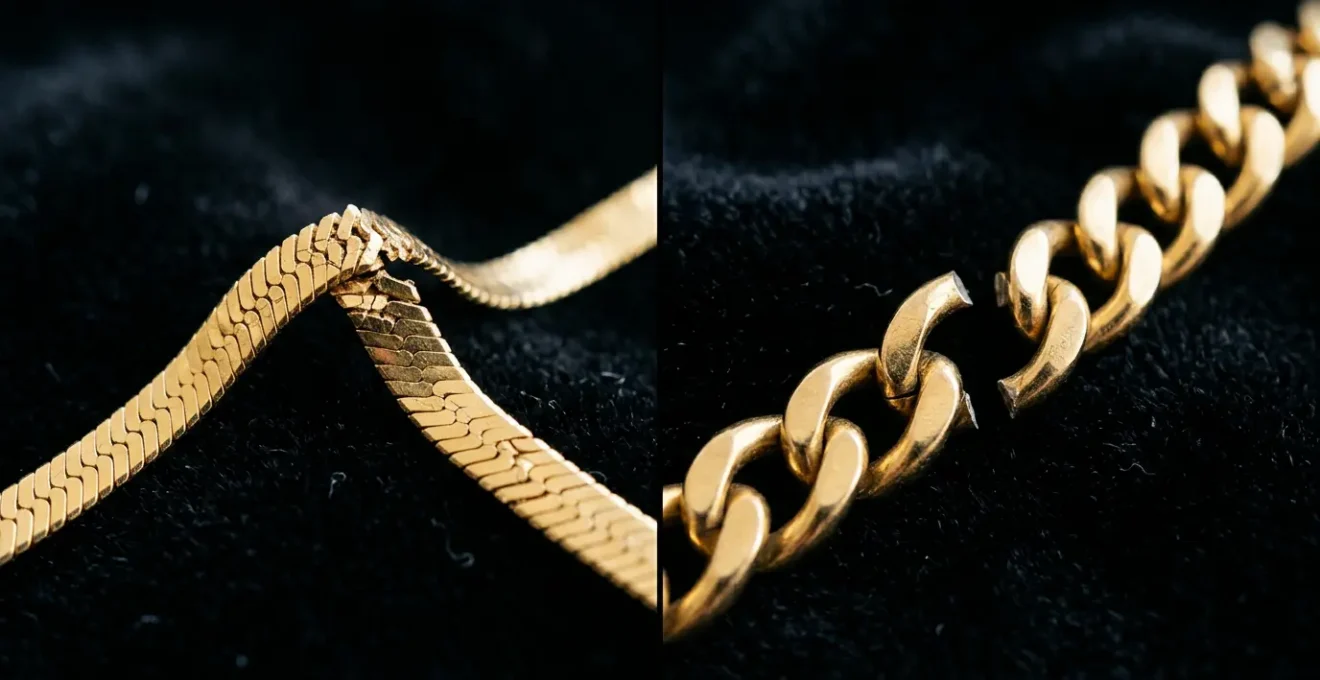
The most important factor in a gold chain’s value isn’t its price, but its ability to be repaired—a detail that separates a lifetime investment from a future piece of scrap.
- Delicate weaves like Snake and Herringbone are often unfixable once kinked or broken, representing a total loss of your investment.
- Hollow chains dramatically increase repair costs and risks, as their paper-thin walls can easily melt during a standard soldering job.
Recommendation: For daily wear, especially with a pendant, always choose solid-link chains like Curb, Figaro, or Wheat for maximum durability and cost-effective repairs.
When you’re buying a gold chain, especially for a cherished pendant, the focus is almost always on style, length, and karat weight. It’s a purchase driven by aesthetics. But as a chain repair specialist, I see the side of the story that customers discover too late: not all gold chains are created equal when it comes to durability and repair. Some popular styles are beautiful but fragile, essentially becoming ‘disposable’ jewelry the moment they snag on a sweater. The conversation rarely touches on the structural integrity or the long-term cost of ownership.
The common advice is to just pick a “strong” chain, but this is an oversimplification. True strength isn’t just about resisting a single pull; it’s about resilience to daily wear, resistance to kinking, and, most importantly, the ability to be repaired cleanly and affordably if something does go wrong. The reality is that the intricate, machine-made beauty of some chains is also their greatest weakness, making a simple break a financial write-off. The real question isn’t just “which chain is strongest?” but “which chain is a smart, repairable investment?”
This guide takes you behind the jeweler’s bench. We will analyze the most common chain styles not by their looks, but by their ‘Repairability Index’—their inherent structural flaws and the real-world costs associated with fixing them. We’ll explore why some breaks are a simple fix while others are a catastrophe, exposing the hidden costs and risks that can turn your beautiful accessory into a costly problem. This is the information you need to choose a chain that will last a lifetime, not just until the first accident.
To help you make an informed choice, this article breaks down the specific repair challenges and advantages of the most popular gold chain styles. We will look at each chain’s common failure points and what a repair actually entails in terms of cost and labour.
Summary: A Jeweler’s Guide to Repairable Gold Chains
- Why Herringbone Chains Cannot Be Fixed Once Kinked?
- The ‘Meltdown’ Risk: Why Soldering Hollow Rope Chains Is So Expensive?
- Where Do Box Chains Usually Snap and How to Prevent It?
- Why White Gold Chains Need Rhodium Plating After Every Solder Repair?
- Can You Shorten a Byzantine Chain Without Ruining the Pattern?
- Why Snake Chains Catch on Hair and Are Impossible to Repair Invisible?
- Why Refining Fees Can Eat Up Your ‘Free’ Gold Savings?
- Curb, Trace, or Belcher: Which Gold Chain Is Strongest for Heavy Pendants?
Why Herringbone Chains Cannot Be Fixed Once Kinked?
The Herringbone chain is the perfect example of a style where beauty comes at the cost of durability. Its appeal lies in its smooth, liquid-like appearance, created by tiny, flattened links woven together in a tight, fluid pattern. Unfortunately, this very structure is its fatal flaw. Unlike a chain made of individual, interlocking rings, a Herringbone is more like a delicate, flexible sheet of metal. Once it bends or kinks past a certain point, the individual links are permanently creased and deformed. It’s not a break; it’s a total construct loss.
You cannot “un-kink” a Herringbone chain. Attempting to straighten it only worsens the damage, creating a noticeable, rigid spot in the otherwise fluid chain. Soldering is not an option either, as there are no distinct links to join. The heat would simply melt the delicate, overlapping segments, destroying the pattern. This inherent fragility is a common trait in chains that rely on complex, dense weaving rather than simple, strong links. Some independent strength testing reveals hollow chains are up to 6 times weaker than their solid counterparts, and while not all Herringbones are hollow, their delicate structure behaves with similar fragility.
The honest truth from a repair perspective is this: if your Herringbone chain kinks, it cannot be fixed to its original state. There is no repair. Its life as a necklace is over. The only value it retains is its scrap gold value, making it one of the riskiest choices for daily wear. It’s a beautiful chain for special occasions, but a poor investment for a piece you intend to wear often, especially with a pendant that adds stress.
The ‘Meltdown’ Risk: Why Soldering Hollow Rope Chains Is So Expensive?
Hollow chains, particularly hollow rope chains, are popular because they offer a bold, substantial look for a fraction of the cost and weight of a solid version. However, that cost-saving upfront translates directly into a labor-risk multiplier at the repair bench. Fixing a hollow chain isn’t just about skill; it’s about managing the extremely high risk of destroying the piece entirely. The walls of a hollow link are paper-thin, sometimes no thicker than heavy foil. When a jeweler applies a torch to solder a broken link, that delicate wall can vaporize in an instant.
This is where the high cost comes from. A jeweler isn’t just charging for the 15 minutes of work; they are charging for the years of experience needed to control the heat with microscopic precision, and for the financial risk they assume if the chain is destroyed. As detailed in repair analyses, traditional torch heating presents numerous problems: solder might fail to flow correctly, excess solder can create ugly lumps on the fine links, or multiple links can fuse together, forcing the jeweler to start over on a now-shorter chain. Many jewelers today prefer using a laser welder for such delicate jobs, which allows for far greater precision but represents a significant equipment investment that is factored into the repair price.
The image below shows a microscopic view of the delicate work involved. Notice how thin the material is at the break point; this is the challenge a jeweler faces.
Because of this high risk of a meltdown, many jewelers will refuse to work on hollow chains, or they will price the repair high enough to cover a potential replacement. For the buyer, this means a seemingly simple break can cost a significant percentage of the chain’s original purchase price, making it a surprisingly expensive piece to own in the long run.
Where Do Box Chains Usually Snap and How to Prevent It?
The Box chain is a fantastic choice for durability, especially for pendants. Its square links create a sturdy, geometric structure that is highly resistant to kinking and pulling. It is one of the styles I regularly recommend. However, no chain is indestructible, and Box chains have a specific, predictable structural failure point: the connection to the clasp. The chain itself is incredibly strong, but the stress of a heavy pendant or a sudden snag is often concentrated on the small jump ring that attaches the chain to the clasp mechanism.
Over time, this jump ring—often a simple, unsoldered O-ring—can stretch, wear thin, or pull open. This is, by far, the most common break I see on otherwise pristine Box chains. The good news is that this is also one of the easiest and most affordable repairs. A jeweler can simply replace the worn jump ring with a new, thicker one and, for added security, laser-solder it shut. This simple reinforcement can prevent 90% of future breaks.
Prevention is straightforward. When you buy a Box chain for a pendant, ask the jeweler to inspect the jump rings at the clasp. If they look thin or are not soldered closed, ask for them to be replaced or secured. This tiny, inexpensive upgrade is the best insurance you can buy for your chain. Even if a clasp itself breaks, it’s a standard component. While a full replacement can vary in price, clasp replacements typically range from $20 to $250 depending on the size, metal, and complexity, but a simple jump ring fix is on the lowest end of that scale.
Why White Gold Chains Need Rhodium Plating After Every Solder Repair?
Repairing a white gold chain involves a “hidden cost” that many customers are unaware of until they receive the bill: rhodium plating. This is not an upsell; it’s a necessary final step to restore the chain’s appearance. What most people don’t realize is that “white gold” is not naturally a bright, silvery-white metal. It’s an alloy of yellow gold and white metals (like palladium or nickel), resulting in a color that is actually a dull, yellowish-gray.
The brilliant, mirror-like finish you associate with white gold comes from an extremely thin layer of rhodium, a rare and precious metal from the platinum family, applied over the surface. The problem is that the repair process, which involves high heat from soldering and subsequent polishing to smooth the repair area, completely burns off and strips away this rhodium plating. This exposes the duller, yellowish-gray gold underneath, creating a very obvious color mismatch at the repair site. The chain will look like it has a yellow stain.
To fix this, the entire chain must be professionally cleaned and then re-plated in an electroplating bath to restore its uniform, bright white finish. This process requires specialized equipment and adds a significant cost to the repair. For example, a standard soldering job might be relatively inexpensive, but adding the necessary replating can increase the final price substantially. The cost for this service is non-negotiable if you want your chain to look like it did before the break, with some estimates showing rhodium replating typically costs around $80 for a standard chain. This is a crucial factor to consider when purchasing a white gold chain, as every future repair will carry this additional expense.
Can You Shorten a Byzantine Chain Without Ruining the Pattern?
Yes, a Byzantine chain can absolutely be shortened, but it is a job that requires a high level of skill and a deep understanding of the chain’s intricate structure. The Byzantine weave is a complex, three-dimensional pattern where each link passes through four others. It’s not a simple sequence; it’s a repeating “pattern unit” that gives the chain its unique texture and flexibility. Shortening it is not as simple as cutting out a few links and soldering the ends together.
To do the job correctly, a jeweler must carefully disassemble one of these pattern units, remove the desired length, and then perfectly reconstruct the pattern to rejoin the chain. This involves weaving the final links back through the existing structure in the correct sequence, ensuring the tension and spacing are identical to the rest of the chain. If done incorrectly, the result is a stiff, bunched-up, or gapped section that completely ruins the fluid drape of the chain. It’s a testament to a jeweler’s manual dexterity.
This is a labor-intensive process, and the cost will reflect that. You are paying for the time and expertise required to make the repair invisible. When you get a Byzantine chain shortened, you should not be able to find the connection point. It should flow and feel exactly the same as the rest of the chain. Before committing to the work, you’re entitled to know what to look for in a quality repair.
Your checklist for a quality Byzantine shortening:
- Flexibility Check: Bend the chain at the repair spot. The shortened area must have the exact same fluid movement as the rest of the chain, with no stiffness.
- Density Inspection: Look closely at the connection point. There should be no visible gaps, tight bunches, or differences in spacing compared to the surrounding weave.
- Pattern Continuity: Run your fingers over the repair area and examine it under bright light. The intricate Byzantine weave pattern should be completely uninterrupted and seamless.
- Flow Test: Hold the chain and let it drape over your hand. It should form a smooth curve without any awkward angles or kinks where the work was done.
- Wire Gauge Verification: The wire used for any new or re-soldered links must match the original thickness exactly. A thinner wire creates a weak spot; a thicker one will disrupt the pattern.
Why Snake Chains Catch on Hair and Are Impossible to Repair Invisible?
Snake chains, also known as Brazilian chains, are loved for their sleek, solid appearance and smooth feel. However, that seamless look is created by tightly interlocking plates or bands that form a flexible tube. This structure is the source of its two biggest problems: it’s a magnet for fine hairs, and it’s nearly impossible to perform an invisible repair on it. The tiny gaps between the interlocking segments are the perfect size to trap and pull fine hairs, making them uncomfortable for many people to wear directly against their skin.
More critically, when a Snake chain breaks or kinks, the problem is similar to that of a Herringbone chain. The delicate, interlocking plates are bent or pulled apart. Because the chain lacks an underlying support structure like mesh or wire, the only way to rejoin it is by soldering. However, applying heat to these thin, tight plates almost always results in a stiff, discolored, and slightly lumpy section. The fluid, seamless look is lost forever at the repair point. A jeweler can make it functional again, but it will always have a “scar.”
For anyone who values a pristine look or has issues with hair pulling, a Snake chain is a high-risk choice for an everyday piece. Fortunately, several alternatives offer a similar smooth, dense look without the same structural weaknesses. Omega chains are semi-rigid but very hair-resistant, while Wheat (or Spiga) chains offer excellent flexibility and durability with a much lower chance of snagging.
| Chain Type | Flexibility | Hair Resistance | Repairability |
|---|---|---|---|
| Snake Chain | Very High | Poor – catches easily | Very difficult |
| Omega Chain | Semi-rigid | Excellent | Moderate |
| Wheat/Spiga Chain | High | Good | Easy |
| Square Snake Chain | High | Fair – slightly better | Difficult |
Key Takeaways
- Solid vs. Hollow: Solid link chains are always a better long-term investment for durability and repairability. Hollow chains carry a high risk of being destroyed during repair.
- Simplicity is Strength: Chains with simple, individual links (Curb, Figaro, Belcher) are the easiest and cheapest to repair cleanly.
- Complex Weaves, Specialist Work: Intricate patterns like Byzantine or Wheat chains can be repaired, but require a skilled jeweler and will cost more due to the labor involved.
- Beware the “Unfixables”: Flat, fluid chains like Herringbone and Snake are often a ‘total loss’ once they are kinked or broken, as a seamless repair is virtually impossible.
Why Refining Fees Can Eat Up Your ‘Free’ Gold Savings?
When a delicate chain like a Herringbone or a hollow rope chain suffers a catastrophic break, the only option left is to sell it for its scrap gold value. Many jewelers offer to apply this scrap value as a credit toward a new purchase, which sounds like a great deal. However, it’s important to understand the economics of this process. The value you receive is not the full market price of gold. The jeweler has to send your small, broken piece to a refinery, which charges them fees for melting, assaying (testing for purity), and processing the metal. These refining fees are passed on to you.
You can typically expect to receive anywhere from 70% to 85% of the pure gold’s market value, depending on the refiner’s rates and the jeweler’s policy. The rest is lost to processing costs. With rising gold prices, this can still be a decent amount, especially as some reports note that repair prices have risen an 8-12% increase since 2023, making repairs on other items more expensive. However, simply scrapping a single broken chain might not be the most financially savvy move. Instead of accepting the immediate scrap credit, consider these more creative alternatives to maximize the value of your broken gold:
- Bundle for Better Rates: Save multiple broken pieces (old earrings, tangled chains) and sell them together. Refiners often offer better rates for larger quantities, which means more money in your pocket.
- Create Something Custom: Ask the jeweler if they can melt down your gold to create a simple, solid custom piece, like a unique pendant or a pair of stud earrings. You’re paying for labor but providing the metal yourself.
- Apply as Store Credit: Instead of a direct scrap credit on one item, convert the value into general store credit. This gives you more flexibility for future purchases or repairs without being tied to an immediate decision.
- Strategic Upgrade: Use the credit specifically toward the purchase of a more durable, solid-link chain from the same jeweler, effectively trading up from a poor design to a smart one.
By thinking beyond the simple “scrap for credit” offer, you can transform a broken chain from a disappointment into a valuable asset for your jewelry collection.
Curb, Trace, or Belcher: Which Gold Chain Is Strongest for Heavy Pendants?
After discussing all the problematic chains, we finally arrive at the workhorses of the jewelry world: the simple, solid-link chains. Styles like the Curb, Trace (or Cable), and Belcher are consistently the strongest, most durable, and most easily repairable options available. Their strength lies in their simplicity. They are constructed from individual, uniform links that are interlocked and soldered shut. There are no delicate plates to kink, no hollow walls to melt, and no complex weaves to disrupt.
The Curb chain, and its popular variations like the Miami Cuban and Figaro, features links that have been twisted and flattened so they lie flat. This design distributes weight and stress evenly across the chain, making it exceptionally strong and comfortable to wear. Belcher and Trace chains are made of simple round or oval links, respectively, offering a classic look with fantastic durability. Because each link is a distinct and solid component, a break is almost always a clean and straightforward fix. A jeweler simply needs to reshape or replace the single broken link and solder it closed. The repair is quick, low-risk, and therefore, very affordable. For context, a basic gold chain soldering costs approximately $30-35 for single link repair—a stark contrast to the high costs or impossibility of fixing more complex weaves.
For anyone looking to buy a chain for daily wear, especially to support the weight of a heavy or meaningful pendant, a solid Curb, Belcher, or Figaro chain is unequivocally the best investment. They offer the highest “Repairability Index,” providing peace of mind that a minor accident will be a minor inconvenience, not a major financial loss. When you choose one of these styles, you are buying a piece of jewelry that is truly built to last a lifetime.
To ensure your jewelry remains a lasting investment rather than a potential liability, the next logical step is to evaluate your current collection or next purchase through this lens of repairability. Prioritize solid, simple-link designs for any piece intended for frequent wear.