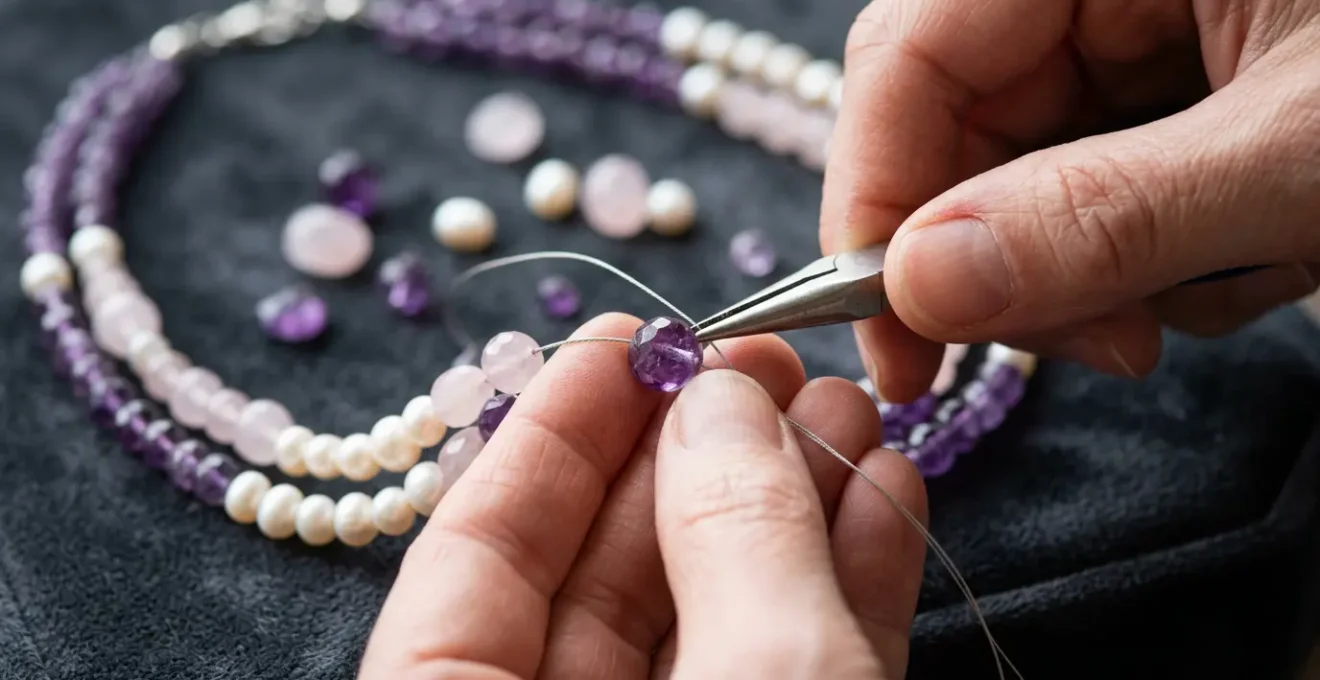
The decision to restring a heavy choker depends more on material science than a simple calendar schedule.
- Heavy beads exert constant tensile stress that demands high-strength wire, not just traditional silk.
- Invisible factors like skin chemistry, clasp mechanics, and bead hole quality are the primary causes of failure.
Recommendation: Proactively assess your choker’s components—thread, clasp, and beads—every 6 to 12 months, focusing on material integrity rather than just visible wear.
That tell-tale gap appearing between the beads of your favorite heavy gemstone choker is more than just a cosmetic issue; it’s a critical warning sign. As a professional stringer, I see this concern daily. Wearers notice the necklace losing its tight, elegant curve and start wondering if it’s about to break. The common advice is often to look for frayed thread or to simply restring it every couple of years. While not entirely wrong, this approach misses the fundamental forces at play.
The maintenance of tension-set neckwear isn’t just about replacing a worn-out component. It’s an issue of physics and chemistry. The weight of the gemstones exerts a constant tensile force, while the close contact with skin introduces a chemical element that can degrade materials surprisingly quickly. Most guides focus on the what—the visible signs of wear—but neglect the why. They talk about “strong thread” without defining what that means in the face of constant stress and material fatigue.
But what if the key to longevity wasn’t a generic restringing schedule, but a deep understanding of your choker as a complete component system? The real secret lies in knowing how the thread, the clasp, and even the beads themselves interact. It’s about recognizing that a heavy choker is an engineering challenge in miniature, where failure is often caused by an invisible weakness, not just obvious wear.
This guide will walk you through a professional’s perspective on choker maintenance. We will analyze the correct materials for heavy loads, explore the hidden dangers of skin chemistry and improper clasps, and provide expert methods for care and storage. By the end, you will be able to assess your jewelry not just by how it looks, but by its structural integrity.
This article provides a structured approach to understanding the critical maintenance points for your tension-set necklaces. The following sections break down each aspect of choker care, from material selection to long-term preservation.
Summary: A Professional’s Guide to Choker Maintenance and Restringing
- Tiger Tail Wire or Silk Thread: Which Is Best for Heavy Gemstone Beads?
- How Skin Acids Weaken Silk Threads on Chokers Faster Than Long Necklaces?
- Why Magnetic Clasps Are Dangerous for Heavy Gemstone Chokers?
- How to Clean Makeup Out of Bead Holes Without Unstringing?
- Flat or Hanging: How to Store Chokers to Prevent Kinking?
- How Often Should You Ultrasonic Clean Your Daily Engagement Ring?
- Where Do Box Chains Usually Snap and How to Prevent It?
- Vintage Akoya vs Freshwater: How to Spot Quality Pearls in UK Antique Shops?
Tiger Tail Wire or Silk Thread: Which Is Best for Heavy Gemstone Beads?
The primary cause of a choker stretching or failing is a mismatch between the weight of the beads and the tensile strength of the stringing material. For daily wearers of heavy gemstone pieces, this is the single most important decision. While silk thread offers a beautiful, natural drape and is the traditional choice for pearls, it is fundamentally unsuitable for heavy loads. Its organic fibers stretch over time and are susceptible to degradation. Heavy gemstones require a modern, engineered solution.
The professional standard for heavy beads is a coated wire product, often known as “tiger tail” or beading wire. These are not single wires, but rather multiple strands of micro-fine stainless steel woven together and coated in nylon. The key metric is the strand count (e.g., 7, 19, or 49 strands)—the higher the count, the more flexible and kink-resistant the wire. A 49-strand wire provides superior drape and durability, making it the ideal choice for high-quality, heavy chokers that need to withstand significant strain without stretching.
This table from a recent analysis shows the clear difference in strength, making the choice for heavy pieces a matter of material science, not just aesthetic preference. For any choker over 100g, wire is not just an option; it’s a necessity for security and longevity.
| Material | Tensile Strength | Best Weight Range | Durability |
|---|---|---|---|
| Tiger Tail Wire (49-strand) | 20-40 lbs | 50-200g chokers | Excellent |
| Silk Thread (Size F) | 4-6 lbs | Under 50g | Good (6-12 months) |
| FireLine (10lb test) | 10 lbs | 50-100g | Excellent |
| Nylon Thread | 8-12 lbs | 30-75g | Very Good |
Ultimately, choosing the right material is the first step in preventative maintenance. A material that is properly matched to the bead weight will resist the stretching that creates those alarming gaps in the first place.
Action Plan: Choosing Your Thread Based on Bead Weight
- Weigh Your Piece: Use a simple jewelry scale to get the total weight of your choker. Professionals consider anything over 100g to be in the “heavy” category, requiring high-strength wire or a robust synthetic like FireLine.
- Inspect Bead Holes: Use a 10x jeweler’s loupe to examine the drill holes of your beads. If the edges are rough, sharp, or uneven, they will act like tiny blades on any thread. In this case, silk is immediately disqualified, regardless of weight.
- Test the Drape: Hold a sample of tiger tail wire and a sample of silk thread vertically. The silk will create soft, natural curves, while the wire maintains a more defined, structured shape. This helps you decide which aesthetic you prefer for your design.
- Consider Wear Frequency: A choker worn daily is under constant stress. For such pieces, it is essential to select materials rated for over 15 lbs of tensile strength to ensure long-term durability.
- Factor in Skin Contact: Because a choker sits directly against the skin, the stringing material must be resistant to chemicals from sweat, lotions, and perfumes. Coated wires and specialized synthetics are far more resilient than natural silk in this environment.
How Skin Acids Weaken Silk Threads on Chokers Faster Than Long Necklaces?
If you’ve ever had a silk-strung choker feel sticky or look discolored, you’ve witnessed chemical degradation firsthand. A choker’s intimate, constant contact with the skin exposes it to a harsh environment that longer necklaces largely avoid. Perspiration, natural skin oils, makeup, and perfume create a chemical cocktail that directly attacks the protein-based fibers of silk. This causes the thread to weaken, stretch, and eventually break, often much faster than expected.
This accelerated wear is a primary reason why professional restringing data confirms that silk threads in chokers require restringing up to 3x more frequently than their longer counterparts. While a long necklace may only touch the skin intermittently, a choker is fully immersed. The silk acts like a wick, absorbing these substances, which breaks down its structural integrity from the inside out. Over time, the thread loses its opacity and becomes translucent, a clear sign that it is saturated with oils and has lost much of its strength.
This image provides a stark comparison between a new, strong silk thread and one that has been weakened by prolonged skin contact. The visual difference highlights the damage that isn’t always visible to the naked eye until it’s too late.
For this reason, even for lightweight chokers where silk might seem appropriate from a weight perspective, its use on a daily-wear piece is a significant compromise. Modern, non-porous materials like coated beading wire or synthetic threads like FireLine and nylon offer far superior resistance to this chemical assault, providing a much more secure and long-lasting foundation for your jewelry.
Why Magnetic Clasps Are Dangerous for Heavy Gemstone Chokers?
Magnetic clasps are popular for their convenience, but for a heavy gemstone choker, they represent a critical point of failure. The danger lies in a simple principle of physics: these clasps are rated for direct pulling force (tensile strength), but they are extremely weak against sliding force, known as shear force. A heavy choker, due to its weight and position, doesn’t just pull downward; it creates torque and is susceptible to being snagged or pushed from the side.
Professional jewelers frequently encounter failures where a magnetic clasp has given way. A study on jewelry mechanics highlights this risk, noting that a magnetic clasp rated to withstand a 1.5kg direct pull can fail instantly when a mere 200g choker experiences a lateral shear force. When a sweater snags the necklace or it gets caught on a seatbelt, the force applied is sideways, not a direct pull. The two halves of the magnet slide apart with minimal resistance, and the heavy choker falls.
This risk is why for any piece weighing over 100 grams, mechanical clasps are considered essential for security. Clasps that require a physical action to open, such as lobster clasps, spring rings, or toggle clasps, provide a secure lock that is resistant to both tensile and shear forces. They form a closed loop that cannot be accidentally opened by a sideways knock or snag. Choosing a robust mechanical clasp is just as important as selecting the right stringing wire; it’s a core part of the choker’s overall security system.
How to Clean Makeup Out of Bead Holes Without Unstringing?
Makeup, foundation, and setting spray are notorious for accumulating inside the drill holes of beads and along the stringing material, creating a grimy residue that can accelerate thread degradation. Cleaning this buildup without unstringing the entire choker requires precision and the right tools. Haphazardly scrubbing or soaking the piece can damage both the gemstones and the thread, especially if they are porous materials.
Professionals use several targeted techniques to address this. The goal is to remove the debris without saturating the stringing material or using harsh chemicals. One of the most effective methods is “micro-flossing,” which involves using a very thin, flexible tool to physically pull the grime out of the bead holes. This can be done with specialized jewelry tools or even a simple dental floss threader paired with a microfiber strand. For more stubborn buildup on non-porous stones like quartz or agate, a dental water flosser on its lowest setting can be used to gently flush out the holes with distilled water.
The most important step, however, is prevention. Always apply all cosmetics, including powders and setting sprays, and wait at least five minutes for them to dry completely before putting on your choker. This simple habit dramatically reduces the amount of residue that can work its way into the delicate spaces of your jewelry.
While these cleaning techniques are effective, some professionals argue that if a choker is dirty enough to require this level of cleaning, its thread is likely already compromised by the buildup. As one expert source puts it, sometimes your best option is to watch tutorials and learn the restringing process yourself. This empowers you to not only clean the beads thoroughly but also to refresh the core component of your choker’s strength.
Flat or Hanging: How to Store Chokers to Prevent Kinking?
How you store your choker when you’re not wearing it has a direct impact on the longevity of its stringing material. The common mistake is to hang a heavy choker on a jewelry tree. While this seems organized, it places the entire weight of the piece on a single point of the thread and the clasp, causing unnecessary, continuous stress. More importantly, it can cause permanent damage to certain types of stringing materials.
The culprit is a property known as “thread memory.” Materials like tiger tail wire, especially in lower strand counts, will develop permanent kinks and bends if stored in a stressed or sharply folded position. Hanging a wire-strung choker causes it to lose its perfect, circular drape, creating awkward angles that cannot be undone. Over time, these kinks become weak points that are more prone to breaking.
Conversely, materials like silk thread have a very low memory and are best stored flat to allow them to relax and maintain their natural drape. The professional recommendation for all chokers, regardless of material, is to store them flat. The ideal method is the “travel coil”: loosely coil the choker around two or three fingers to create a large, gentle loop, and then lay it flat in a lined drawer or jewelry box. This technique avoids sharp bends, prevents kinking, and keeps the piece from tangling with other jewelry, preserving the integrity of both the stringing material and the intended shape of the choker.
How Often Should You Ultrasonic Clean Your Daily Engagement Ring?
While this question concerns rings, the principle behind it is critically relevant to gemstone chokers: not all stones can handle all cleaning methods. An ultrasonic cleaner works by creating microscopic vibrations in a fluid to dislodge dirt from hard-to-reach places. It’s highly effective for hard stones like diamonds, sapphires, and rubies. However, for many popular gemstones used in chokers, this method is destructive.
Porous or delicate stones can be severely damaged by ultrasonic vibrations. This includes stones like opal, emerald (which is often fracture-filled), turquoise, lapis lazuli, and pearls. The vibrations can cause these stones to crack, cloud, or even shatter. As the Professional Jewelers Association notes, the very same stones that are vulnerable to ultrasonic damage are also the ones that require more frequent maintenance on chokers.
The same delicate stones susceptible to ultrasonic damage – opals, emeralds, pearls – require more frequent thread checks and gentler cleaning when used in chokers due to increased exposure to skin chemistry.
– Professional Jewelers Association, Gemstone Care Guidelines 2023
This brings us to a core tenet of jewelry maintenance. Instead of focusing on aggressive deep cleaning, the emphasis should be on regular, gentle care and professional assessment. According to repair specialists, all daily-wear gemstone jewelry requires professional integrity checks every 6-12 months. During this check, a jeweler will inspect the thread for wear, check the security of the clasp, and ensure the prongs and settings are tight. This proactive approach catches problems before they lead to a catastrophic failure, which is far safer and more effective than a periodic, potentially harmful deep clean.
Where Do Box Chains Usually Snap and How to Prevent It?
A box chain, a popular choice for pendants, has its own specific weak points, typically at the solder joints or near the clasp where stress is concentrated. While a beaded choker is a different construction, this question forces us to think about a crucial concept: every piece of jewelry has a “weakest link.” Identifying and reinforcing this point is the essence of preventative maintenance. In a beaded choker, the “weakest link” is rarely in the middle of the strand; it’s almost always at a point of transition or connection.
The three primary failure points in a heavy gemstone choker are:
- The Clasp Connection: The point where the stringing material attaches to the clasp is under constant mechanical stress. A poorly executed crimp on a beading wire or a weak knot on a thread will be the first place to fail. Professionals use high-quality crimp beads and covers or reinforced knots to secure this critical junction.
- The Knots (if applicable): For silk-strung pieces, the knots between beads serve to protect them from rubbing against each other. However, each knot is a potential point of failure. Over time, knots can tighten, stretch, or abrade, particularly the ones closest to the clasp.
- The Clasp Itself: As discussed with magnetic clasps, the clasp is a mechanical component that can fail. A weak spring in a spring ring or a faulty hinge on a lobster clasp can give way long before the stringing material does.
Preventing failure in a choker, therefore, requires a holistic view. It’s not enough to use a strong thread. The entire component system—thread, connections, and clasp—must be robust and properly assembled. During a professional check-up, a jeweler doesn’t just look at the thread; they stress-test the clasp and inspect the crimps or knots that form the true weak points of the construction.
Key Takeaways
- The need to restring is dictated by material science (thread strength vs. bead weight), not a generic timeline.
- Invisible factors like skin chemistry (degrading silk) and shear force (on clasps) are the main causes of failure.
- A choker is a component system; the thread, clasp, and even bead quality must all be considered for true security.
Vintage Akoya vs Freshwater: How to Spot Quality Pearls in UK Antique Shops?
This question about pearl quality, even in a specific context, reveals a final, crucial factor in choker longevity: the quality of the beads themselves. The beads are not just passive weight; their physical characteristics can actively contribute to the abrasion and failure of the stringing material. Using pearls as an example, we can see how to assess any bead for its suitability in a durable choker.
The most important feature to inspect is the drill hole. High-quality beads, whether vintage Akoya pearls or modern gemstones, will have clean, smooth, and straight drill holes. You can inspect this using a 10x jeweler’s loupe. Poorly drilled beads have rough or sharp edges inside the hole that act like a file, slowly sawing away at the thread with every movement. A beautiful but poorly drilled bead will destroy even the strongest stringing material over time.
When assessing beads for a restringing project, especially valuable ones like pearls, professionals look for specific quality markers that indicate they won’t damage the new thread:
- Smooth Drill Holes: The entrance and exit of the hole should be free of chips and sharp edges.
- Consistent Nacre (for pearls): Thick, even nacre on a pearl indicates a durable bead that is less likely to chip near the drill hole.
- Presence of Knots: For pearls and other soft gemstones like fluorite, the presence of knots on the original stringing is a sign of quality construction, meant to prevent the beads from rubbing against each other and causing abrasion. Silk thread is the traditional and best material for this technique, offering a lovely drape.
Ultimately, if you are restringing a piece with beads that have abrasive drill holes, you are starting a countdown to the next failure. In such cases, a professional might recommend using a metal “french wire” or gimp at the ends to protect the thread, or even suggest that the beads are unsuitable for a high-tension choker design. The quality of the bead is the final piece of the structural puzzle.
By adopting this component-based, science-driven approach to maintenance, you move from being a passive owner to an informed caretaker of your jewelry. Assessing your choker based on its material integrity rather than a simple calendar date is the most effective way to ensure it remains secure and beautiful for years to come. The next logical step is to perform a systematic check of your own pieces.