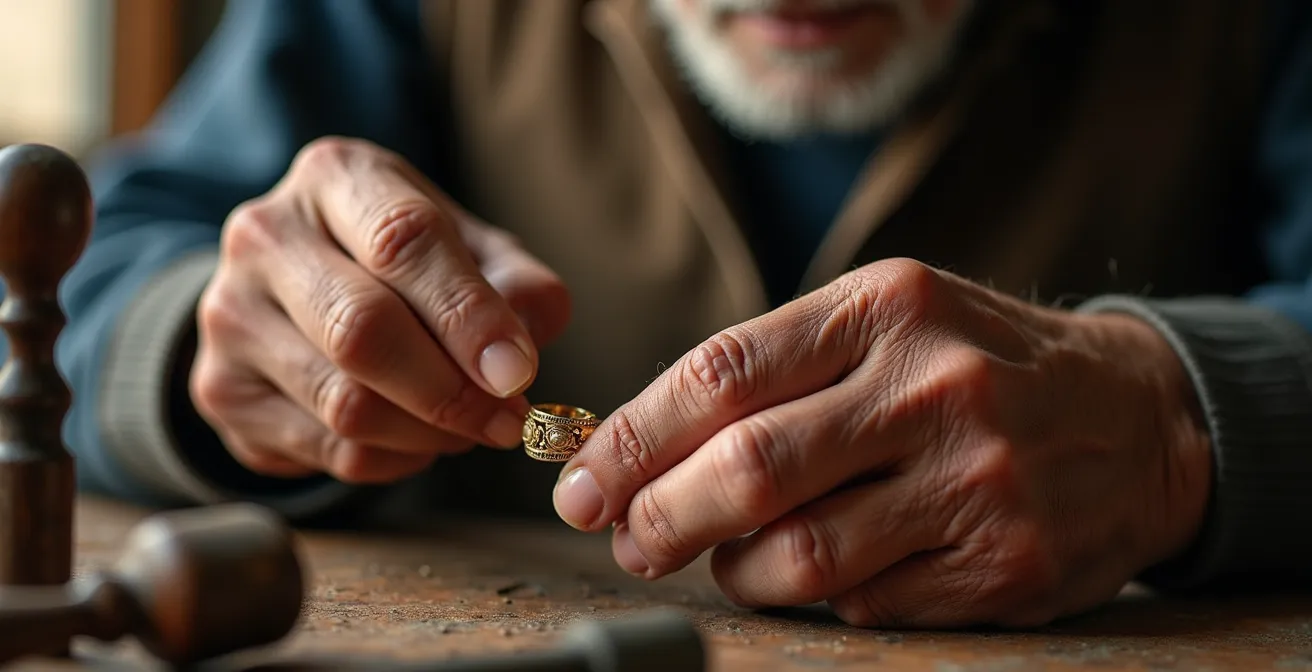
Deciding to repair an heirloom isn’t just about cost; it’s about understanding the metal’s physical limits to avoid irreversible damage.
- The biggest risk isn’t breakage during repair, but choosing the wrong technique or attempting to restore a piece that should be preserved.
- Modern methods like laser welding offer safer alternatives to traditional heat, and knowing what to ask your jeweller is critical.
Recommendation: Before any repair, assess if the goal is daily wear or preservation. This choice dictates the entire restoration path and manages both risk and expectation.
That broken locket or worn-thin wedding band from your grandmother isn’t just metal and stone. It’s a tangible piece of your history, a vessel of memory. The fear of handing it over for repair—and potentially seeing it ruined forever—is completely valid. Many people believe the primary choice is simply whether to fix it or not, focusing on the cost. They search for “the best jeweller” and hope for the best, thinking all repairs are created equal. This overlooks the most crucial factor: the physical state of the material itself.
As a bench jeweller, I can tell you that every old piece of jewellery has a story, and its metal tells a part of that story through wear, brittleness, and fatigue. The real conversation isn’t about sentiment versus budget. It’s a dialogue with the metal itself. Understanding its limitations, its fatigue, and how it will react to heat and pressure is the only way to make a decision that truly honours its legacy. The biggest mistake isn’t a slip of the tool; it’s approaching a delicate, century-old piece with the same mindset as a modern, mass-produced item.
This article will not just tell you *if* you can repair your keepsake. It will walk you through the very questions we ask at the bench. We’ll explore the technical realities behind the risks, from the dangers of torch heat on fragile settings to the hidden pitfalls of resizing a brittle ring. We will shift the perspective from one of fear to one of informed guardianship, empowering you to decide the best path forward for your precious heirloom: active restoration, careful preservation, or creative reinvention.
To help you navigate these critical decisions, this guide breaks down the key considerations and technical realities you need to understand. Explore the topics below to become an informed partner in the preservation of your most cherished pieces.
Summary: A Jeweller’s Honest Look at Heirloom Restoration Risks
- Why Laser Welding Is Safer Than Torch Soldering for Fragile Keepsakes?
- How to Recreate a Lost Earring to Match a Sentimental Survivor?
- Museum Wax or Daily Wear: Which Path for a crumbling Locket?
- The Resizing Mistake That Can Snap Old Shanks in Half
- What to Do with Broken Chains That Cannot Be Soldered?
- Risk of Breakage: What Happens If Your Stone Cracks During Unsetting?
- Why a ‘Same Day’ Repair Service Can Be a Red Flag for Quality?
- Melting Down Old Gold: Is It Cheaper to Remodel or Buy New Bespoke?
Why Laser Welding Is Safer Than Torch Soldering for Fragile Keepsakes?
The traditional image of a jeweller involves a fiery torch, but for delicate heirlooms, this is often the riskiest tool in the workshop. A torch heats a large area of the metal to flow solder, creating a significant risk of what we call thermal shock. This sudden temperature change can crack or discolour fragile gemstones like opals, emeralds, or pearls, even if they are several millimetres away from the join. For intricate designs like filigree, the broad heat can cause the entire piece to warp or even melt.
Laser welding, by contrast, is a surgical procedure. It uses a highly focused beam of light to melt a tiny point of metal, creating a weld that is stronger than solder without heating the surrounding area. We can repair a prong right next to a heat-sensitive stone without even unsetting it. The heat-affected zone is minuscule, preserving the original patina and structural integrity of the antique metal. It’s not just a “better” technique; it’s a fundamentally different approach that prioritizes preservation.
When you entrust a fragile piece to a jeweller, their equipment matters. A workshop equipped with a laser demonstrates a commitment to handling complex, high-risk restorations. It allows for repairs that would be simply impossible or unacceptably dangerous with a traditional torch, making it the gold standard for any sentimental piece with delicate features or stones.
Your Vetting Checklist: Questions to Ask a Jeweller Before a Delicate Repair
- Can you show me before-and-after photos of laser repairs you’ve done on pieces similar to mine (e.g., filigree, antique alloys)?
- How do you mitigate thermal shock on nearby stones during the repair process?
- What type of laser equipment do you use, and are your technicians specifically trained for delicate antique work?
- Do you have experience working with the specific, and sometimes unknown, metal alloy my piece might be made of?
- What insurance coverage do you provide for the piece while it is in your care, and does it cover damage during repair?
How to Recreate a Lost Earring to Match a Sentimental Survivor?
Losing one earring from a cherished pair feels like losing half a memory. The surviving piece becomes a solitary reminder, often relegated to a jewellery box. For years, recreating a perfect match was an almost impossible task, relying on the jeweller’s eye and hand-carved wax models. The results were often close, but never identical. The subtle wear, the unique patina, the slight asymmetry of a handmade original—these were the details that were lost.
Today, technology offers a path to near-perfect replication. As the experts at Joseph Jewelry explain, a combination of traditional craftsmanship and modern technology allows for incredible precision. We can use 3D scanning and computer-aided design (CAD) to create a flawless digital model of the surviving earring. This process captures every minute detail, from the exact curvature of a petal to the precise texture of a hand-engraved line. This isn’t about replacing artistry with machines; it’s about using machines to honour the original artist’s work with unprecedented fidelity.
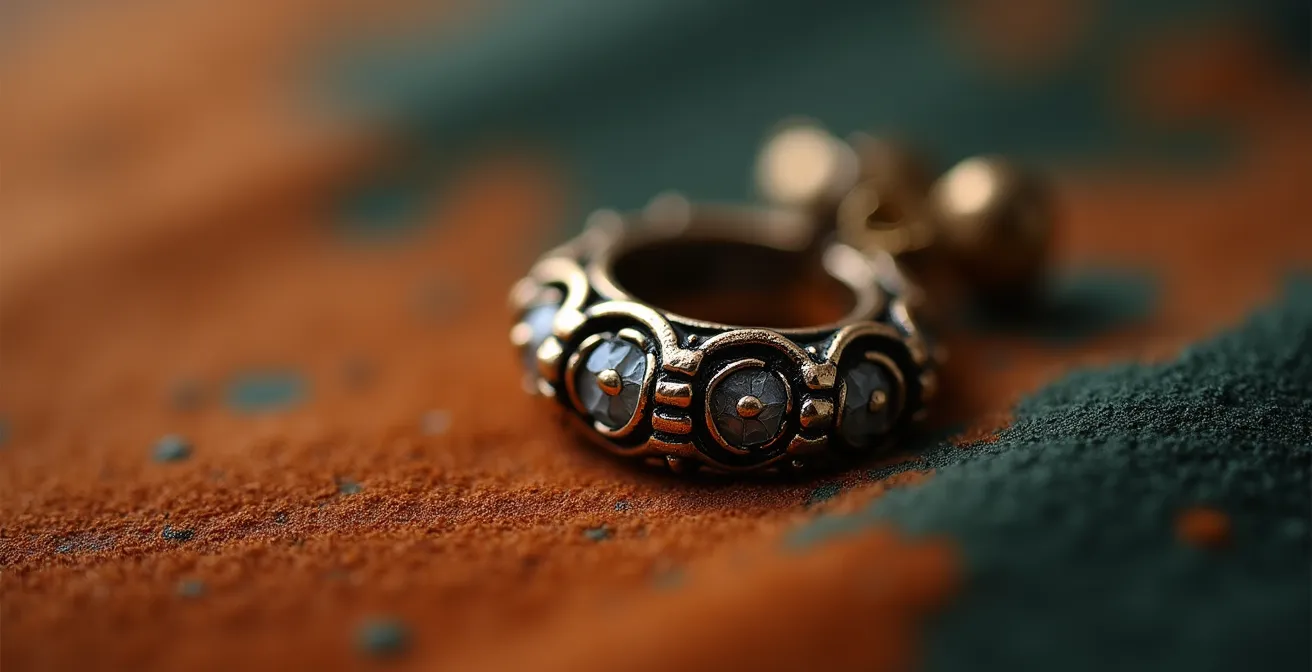
Once the digital model is perfected, we can 3D print a wax replica for casting or, in some cases, directly mill the metal. The final step still rests in the hands of a skilled artisan who will hand-finish, set any stones, and painstakingly replicate the patina to match the original. The goal is not to create a shiny, new-looking earring, but one that looks like it has lived the exact same life as its partner. This blend of digital precision and artisanal finishing is the key to truly resurrecting a pair from a single survivor.
Museum Wax or Daily Wear: Which Path for a crumbling Locket?
When a piece like a locket with a failing hinge or paper-thin walls comes to the bench, the first question isn’t “How do we fix it?” but “What is its future?”. This is the fundamental choice between active restoration and thoughtful preservation. Restoring it for daily wear might involve reinforcing walls, rebuilding the hinge, and polishing away the very signs of age that tell its story. It becomes wearable, but is it the same piece? As the restoration experts at Robinson’s Jewelers wisely note, this can be a double-edged sword.
True antique pieces with historical significance often lose value (and soul) when over-restored. That Art Deco piece with its original patina? The Victorian mourning jewelry with its gentle wear? These pieces tell a story through their imperfections. Over-cleaning or replacing original components can erase the very history that makes them special.
– Robinson’s Jewelers, The Art of Jewelry Restoration Guide
The alternative is to treat it as a precious artifact. This may involve minimal, non-invasive stabilization—perhaps using museum-grade wax to secure a loose component—and then retiring it from active duty. It can be kept in a shadow box or worn only on very rare, gentle occasions. A third path is emerging: digital preservation. A high-resolution 3D scan can create a permanent, detailed record of the piece in its current state, or even a wearable replica, leaving the original untouched. The decision is a deeply personal one, weighing the joy of wearing it against the duty of preserving it for the next generation.
This decision matrix can help clarify the trade-offs. As this comparative analysis highlights, each path has distinct implications for cost, risk, and historical value.
| Factor | Museum Preservation | Active Restoration | Digital Preservation |
|---|---|---|---|
| Structural Integrity | Maintains current state | Reinforces weak points | Creates permanent 3D record |
| Wearability | Display only | Fully wearable | Virtual/display only |
| Cost | $200-500 | $500-2000+ | $300-800 |
| Risk Level | Minimal | Moderate to High | Zero physical risk |
| Historical Value | Fully preserved | May be altered | Digitally preserved |
The Resizing Mistake That Can Snap Old Shanks in Half
“Can you make this ring my size?” It seems like a simple request, but for an old, sentimental ring, it’s one of the most dangerous. The shank—the back part of the ring band—endures the most stress over decades of wear. It gets knocked against desks, gripped on steering wheels, and slowly thins. This constant stress creates a condition invisible to the naked eye: metal fatigue. The internal crystalline structure of the gold becomes brittle and fragile, losing its ability to bend.
A common, cheaper method for resizing a ring up by a small amount is to stretch it on a mandrel. On a new ring, this is fine. On an old, fatigued shank, this is a recipe for disaster. The brittle metal can’t handle the tension and will simply snap. The correct, albeit more expensive, method is to cut the shank and add a new piece of gold, welding it into place. Even this requires skill, as the heat from the process must be carefully managed to avoid further weakening the adjacent metal.
When resizing down, a piece is cut out, and the band is rejoined. Here too, an old shank can be problematic. If it’s already paper-thin, there may not be enough material to create a strong, lasting join. A good jeweller will inspect the shank’s thickness and integrity first. They may tell you that a simple resizing isn’t enough; you need to replace the entire bottom half of the shank—a “re-shanking.” It costs more, but it’s the only way to ensure the ring will survive another generation of wear, rather than breaking a week after you get it back.
What to Do with Broken Chains That Cannot Be Soldered?
A broken chain is one of the most common repairs, but not all chains can be fixed, especially delicate antique ones. Some chains are hollow, woven, or so intricately linked that a traditional solder repair is impossible without freezing the links and creating a stiff, ugly blotch. Others are made from alloys that don’t respond well to heat, or they have simply become too brittle with age to withstand the process. When a jeweller tells you your sentimental chain cannot be soldered, it’s not a refusal to help, but an honest assessment of the material’s limits.
But this doesn’t have to be the end of the road. This is where creative restoration comes into play. Instead of focusing on what the chain *was*, we can envision what it *could become*. A broken chain holds not just sentimental value, but also material value. The gold or silver can be repurposed in countless ways to give it a new life while preserving its emotional core.
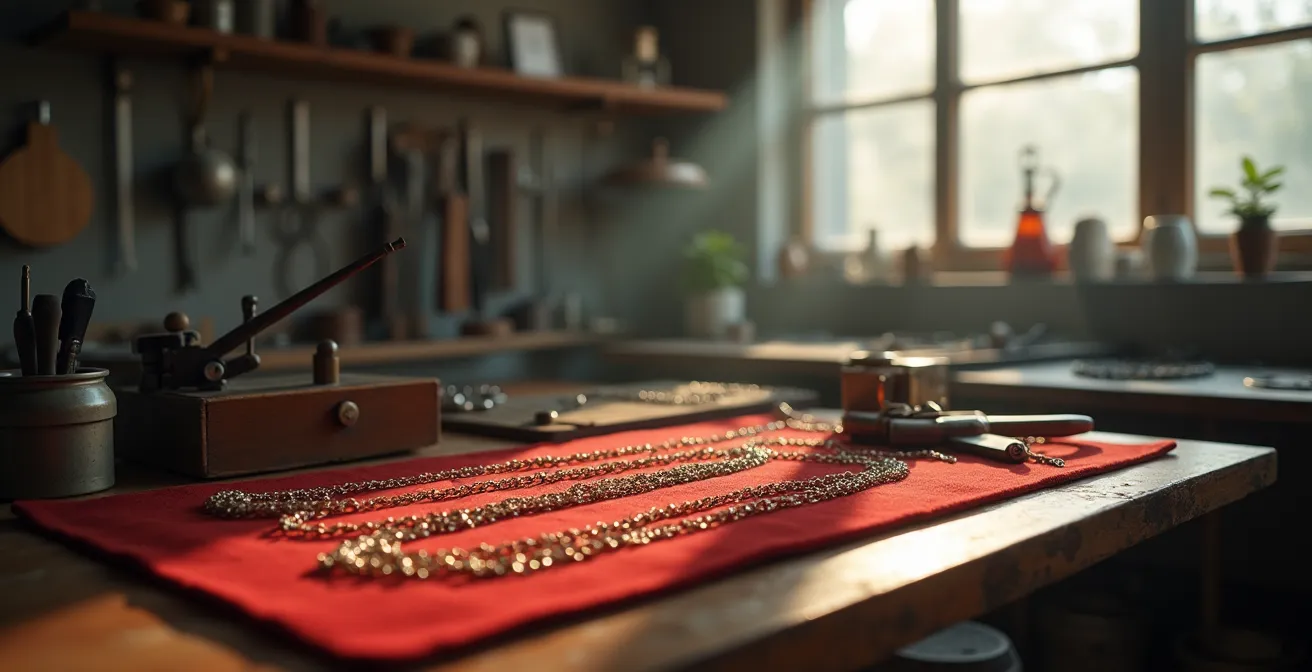
Consider these creative alternatives:
- Create a Bracelet: The usable lengths of the chain can be wound or linked together to form a beautiful, multi-strand bracelet. A new clasp can be added for a modern, secure touch.
- Design a Pendant: The chain can be melted down and recast into a custom pendant. You could even incorporate the original pendant or a loose stone from another family piece.
- Incorporate into a New Piece: Sections of the unique chain link can be used as decorative elements on a new ring or a pair of earrings, blending the old with the new.
- The ‘Kintsugi’ Approach: For some chains, a jeweller can add “connector” elements—small, solid gold rings or bars—to visibly and artfully join the broken ends. This celebrates the repair, much like the Japanese art of Kintsugi.
Risk of Breakage: What Happens If Your Stone Cracks During Unsetting?
This is the conversation every jeweller and client dreads. You bring in a ring for a simple prong tightening, and the jeweller warns you there’s a small risk the stone could crack. Why? Many old stones, especially those passed down through generations, have hidden inclusions or internal fractures from a past impact. They are stable under the current tension of the setting, but the moment a jeweller applies pressure to move a prong—even a tiny amount—that internal weakness can give way, causing a visible crack or a complete fracture.
This risk is highest with fragile stones like emeralds, opals, and tanzanite, but it can happen with any gem, including diamonds if they have a significant inclusion near the girdle. A responsible jeweller will always inspect the stone under magnification and inform you of the risk beforehand. They will ask you to sign a waiver acknowledging that you understand and accept this risk. This isn’t about the jeweller avoiding responsibility for bad workmanship; it’s about acknowledging a pre-existing condition in the stone. Standard Jeweller’s Block Insurance often excludes damage to customer-owned stones during repair for this very reason.
So, what happens if the worst occurs? If the stone cracks, the responsibility for replacement typically falls to you, the owner. This is why getting a formal appraisal and insuring the piece on your homeowner’s policy before any major work is so crucial. If the stone is irreplaceable, you must weigh the risk of breakage against the risk of losing the stone from a loose setting. Sometimes, the safest option is to leave it as is, retiring the piece from daily wear. It’s a difficult choice, but one that must be made with a clear understanding of the potential outcomes.
Why a ‘Same Day’ Repair Service Can Be a Red Flag for Quality?
In our world of instant gratification, the promise of a “while you wait” or “same day” jewellery repair can seem very appealing. However, in the world of quality craftsmanship, speed is often the enemy of excellence, especially with sentimental pieces. A proper repair or restoration is a multi-step process that cannot be rushed. It involves careful assessment, thorough cleaning, the actual repair work, and then polishing and finishing. Each stage requires time and attention.
For example, before any heat is applied, a piece must be meticulously cleaned in an ultrasonic bath to remove any lotion, dirt, or oil. Any residue left behind can burn and contaminate the weld, creating a weak and porous join. After the repair, the piece goes through a multi-stage polishing process to restore its lustre without erasing delicate details, followed by a final rhodium plating for white gold. Rushing these steps results in shoddy work. According to the professional standards at Day’s Jewelers, even a seemingly simple watch battery replacement involves 18 individual steps and takes about 10 minutes to complete correctly. A structural repair on a piece of fine jewellery is exponentially more complex.
A “same day” service often implies that corners are being cut. Perhaps the pre-repair cleaning is skipped, or a quick, low-quality polish is used. It might mean a less experienced technician is doing the work, or they are using a quick-and-dirty solder job instead of a more time-consuming but durable laser weld. While some very minor repairs like a simple clasp adjustment can be done quickly, anything involving heat, stone setting, or resizing requires patience. A reputable jeweller who gives you a timeline of several days or even weeks isn’t being slow; they are respecting your jewellery enough to do the job right.
Key Takeaways
- The condition of the metal (metal fatigue, brittleness) is a more critical factor than cost when deciding on a repair.
- Laser welding is significantly safer for delicate heirlooms than a traditional torch because it minimizes the risk of thermal shock to stones.
- You have three paths for a fragile piece: active restoration (for wear), preservation (as an artifact), or creative reinvention (repurposing).
Melting Down Old Gold: Is It Cheaper to Remodel or Buy New Bespoke?
When a piece is truly beyond repair, or its style is simply not to your taste, melting it down to create something new feels like the perfect solution. It seems to promise the best of both worlds: preserving the original material’s sentiment while getting a piece you’ll actually wear. However, the financial and metallurgical reality is more complex. Remodelling is not always the cheaper or better option.
Firstly, the process involves more than just melting and reshaping. Old gold often contains impurities and solders from previous repairs. During melting, a portion of this material is lost—typically 10-15% of the total weight. Furthermore, the remaining alloy can be brittle and difficult to work with. To create a strong, durable new piece, a significant amount of new, fresh alloy (often 20-40%) must be added to the mix. You are not just paying for labour; you are also paying for new gold.
The labour cost itself is often higher for remodelling than for a new bespoke piece. The jeweller is working with an unknown, potentially problematic material, which requires more time and skill. A new bespoke piece made from 100% fresh, modern alloy is predictable and easier to work with. As the following cost analysis shows, when you factor in material loss, the need for new alloy, and the higher labour costs, remodelling can sometimes end up being more expensive than starting from scratch, as shown in this detailed jewellery repair guide.
| Factor | Melting & Remodeling | New Bespoke Purchase |
|---|---|---|
| Material Cost | Scrap value minus 10-15% process loss | Current market price for new gold |
| Labor Cost | $500-2000 for custom work | $300-1500 for standard designs |
| Alloy Addition | 20-40% new metal required | 100% new metal |
| Sentimental Value | Preserves original material | No connection to original piece |
| Final Quality | May have brittleness issues | Consistent modern alloy |
Ultimately, the decision to repair, preserve, or remodel a sentimental piece is a journey. By arming yourself with this knowledge, you can walk into a jeweller’s workshop not as a fearful customer, but as an informed guardian of your family’s legacy, ready to make the best choice for the next chapter of its story.
Frequently Asked Questions on Jewellery Restoration
Does restoration cost more than repair?
Generally, yes it does. The reason is that it takes much more time to restore jewellery than it does to repair it. In restoration, metals are often joined and welded with a process called “sewing.” This technique seamlessly overlaps each weld reaction, one on top of the other. New metal has to be added to these areas in layers to strengthen the joint. The best way to describe this is like letting candle wax drip and build up layer by layer. This allows us to rebuild metal without using solder, resulting in a piece that looks as good as new but requires significantly more time and skill.
What insurance should I have before repairs?
Before any significant work, it is highly recommended to get a formal, written appraisal of the piece. Then, contact your homeowner’s or renter’s insurance provider and add the item to your policy via a “personal articles floater.” This specifically covers the item for its appraised value against loss, theft, and sometimes damage.
What exclusions exist in jeweller’s insurance?
It is a standard industry practice for a Jeweller’s Block Insurance policy—the policy that covers a jeweller’s inventory and customer property—to exclude damage to customer-owned stones that occurs during the process of setting, unsetting, or repair. This is due to the risk of pre-existing, invisible flaws in the stones. Always assume you are not covered for stone breakage unless the jeweller explicitly states otherwise in writing.