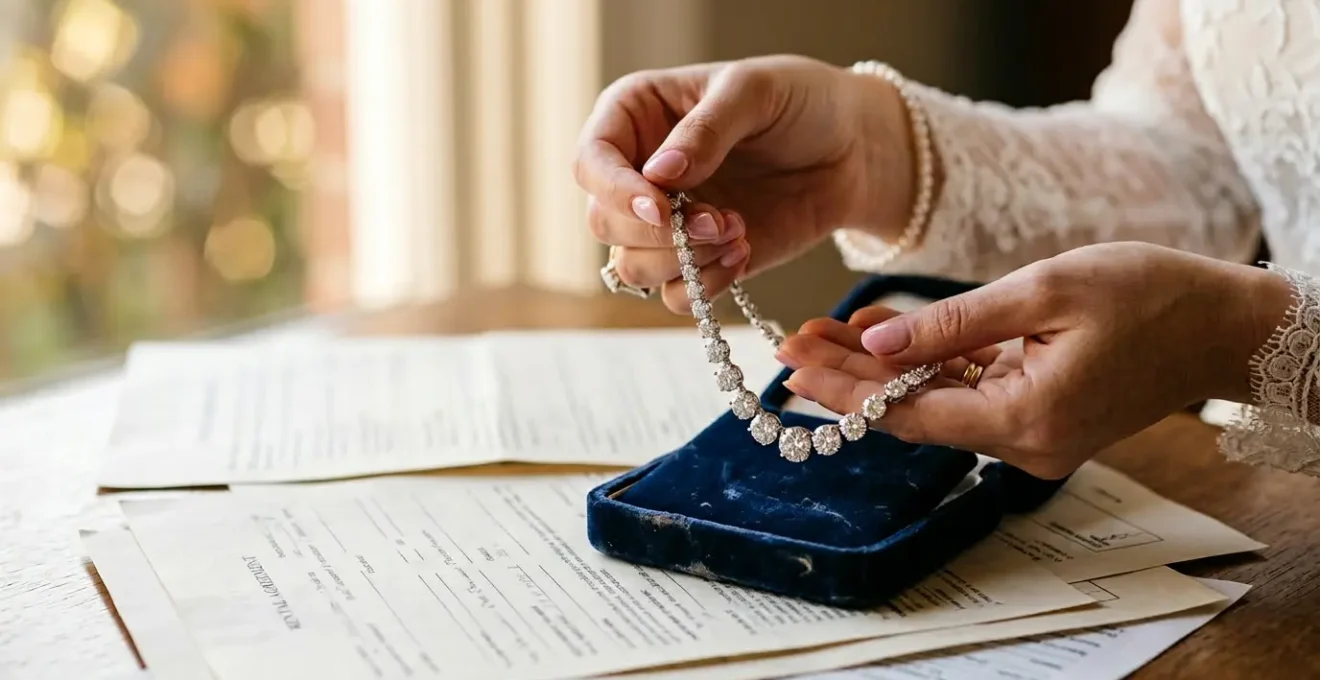
Renting high jewellery for your wedding exposes you to significant financial liability that can exceed the item’s full retail price.
- Minor damage waivers are narrowly defined and contractually exclude common issues like cosmetic stains or damage to delicate materials like pearls.
- Standard home insurance offers almost no protection against the high value of these items; only a specialised, standalone policy provides adequate coverage.
Recommendation: Before renting, demand a full copy of the company’s insurance policy and a detailed breakdown of all potential charges beyond the rental fee to understand the contractual liability you are assuming.
The prospect is undeniably alluring: for a fraction of the retail price, you can adorn yourself with a £10,000 necklace for your wedding day. The rental market presents this as a smart, sustainable, and accessible luxury. For a bride-to-be, it seems like the perfect solution to achieve a high-fashion look without the astronomical investment. Standard advice often revolves around the aesthetic benefits and the importance of booking in advance, treating the transaction like a simple hire.
However, this perspective overlooks the critical legal and financial architecture of the agreement. When you rent a high-value asset, you are not merely a customer; you are a temporary custodian entering into a binding contract with significant liabilities. The conversation must shift from style to substance, from the sparkle of the diamonds to the dense print of the terms and conditions. What happens if the clasp breaks, a stone is chipped, or the item is returned a day late? The financial consequences are rarely advertised and can be devastating.
But what if the key to a secure rental experience was not simply trusting the marketing, but conducting your own contractual due diligence? This guide departs from the conventional narrative. We will not be discussing trends or styles. Instead, from the cautious and methodical perspective of a contract lawyer, we will deconstruct the fine print. We will analyse the explicit and implicit risks, from damage waivers and sanitisation protocols to the stark reality of international travel and insurance loopholes.
This analysis will provide you with the critical questions you must ask before committing, empowering you to weigh the glamour against the potential financial exposure. It is a necessary deep dive into the contractual obligations that underpin the seemingly simple act of renting a piece of jewellery for a day.
This article provides a detailed contractual analysis of the risks associated with high jewellery rental. Below is a summary of the key liability areas we will examine.
Summary: A Contractual Analysis of Jewellery Rental Risks
- What Does the ‘Minor Damage Waiver’ Actually Cover on Rental Sites?
- The Late Return Trap: How One Delay Can Cost You the Full Retail Price?
- How Are Rental Earrings Sanitized Between Wearers?
- Can You Take Rented High Jewellery Abroad for a Destination Wedding?
- The Fake Tan Disaster: Who Pays for Chemical Damage to Pearls?
- How to Value Investment Jewellery for Insurance Purposes in the UK?
- The ‘Away from Home’ Limit: Are You Covered Wearing £50k to Dinner?
- Black Tie Etiquette: Can You Wear a Watch to a Formal UK Gala?
What Does the ‘Minor Damage Waiver’ Actually Cover on Rental Sites?
The “Minor Damage Waiver,” often included for a small fee, is a primary marketing tool used by rental companies to provide a sense of security. However, from a contractual standpoint, its value is extremely limited. The term “minor” is defined narrowly by the rental company and typically only covers normal wear and tear, such as a slightly loosened clasp from use. It is a fundamental error to assume this waiver provides comprehensive protection. Your standard home or renters insurance offers little recourse, as most standard renters insurance policies cap jewelry coverage at $1,000 to $1,500, a sum dwarfed by the value of high jewellery.
The critical issue lies in the exclusions. Any damage deemed “significant” by the company, such as a chipped gemstone or a deep scratch, immediately bypasses the waiver. The renter is then held liable for the full repair cost or, in a worst-case scenario, the Full Replacement Value (FRV) of the item. Furthermore, specific materials are often explicitly excluded from any form of damage coverage due to their delicate nature.
The following table, based on common industry practices, illustrates the significant gap between a renter’s expectation of coverage and the contractual reality. It’s essential to scrutinize the specific definitions of each damage category in your rental agreement, as this is where the most significant financial risks are hidden.
| Damage Type | Example | Covered by Minor Waiver? | Estimated Cost |
|---|---|---|---|
| Normal Wear | Loose clasp after multiple uses | Yes | £0 |
| Minor Damage | Small surface scratch on metal | Yes | £0-50 |
| Material Exclusion | Pearl damage from perfume | No | £500-2000 |
| Significant Damage | Chipped gemstone | No | Full replacement value |
As the table demonstrates, damage to porous gemstones like pearls from common cosmetics is a material exclusion. These items are particularly vulnerable, and the liability for their repair or replacement falls entirely on the renter. This is not an unforeseen accident; it is a calculated exclusion within the contract.
The Late Return Trap: How One Delay Can Cost You the Full Retail Price?
While damage is a clear risk, a more insidious contractual trap lies in the penalty clauses for late returns. The logistics following a major event like a wedding are often chaotic, and a one-day delay in returning a rented item may seem trivial. However, rental agreements are structured to monetise this exact scenario. The penalties are not proportional; they are designed to be punitive. A common clause stipulates a daily late fee, which can quickly escalate. More concerningly, many contracts state that after a short, specified period (e.g., three days), the item is considered “lost,” and the renter is automatically charged the Full Replacement Value (FRV).
This means a simple logistical oversight could result in a charge of £10,000 for a necklace you rented for £200. This is the most significant hidden liability in any rental agreement. Securing your own protection is paramount, as specialized jewelry insurance typically costs 1-2% of the jewelry’s value annually, a small price for mitigating such a catastrophic financial risk. The rental company’s business model relies on the swift turnaround of its inventory, and the contractual penalties reflect the high opportunity cost of an item being unavailable for the next client.
The pressure to meet these deadlines is immense. To mitigate this risk, you must adopt a protocol of extreme diligence. The responsibility for a timely and documented return rests solely with you. Failing to do so is not just an inconvenience; it is a breach of contract with severe, pre-defined financial consequences.
Your Action Plan: A Protocol to Avoid Late Return Penalties
- Pre-emptive Logistics: Book pre-paid, insured return shipping at the time of rental, not after the event. Ensure the service includes tracking and signature confirmation.
- Systematic Reminders: Set multiple, non-negotiable calendar alerts for 48, 24, and 12 hours before the return deadline.
- Evidence Collection: Before sealing the package, photograph the jewellery and packaging extensively as proof of its condition and your compliance with return instructions.
- Secure Shipping Mandate: Never use a standard post box. Always use the specified insured, trackable shipping method and obtain a receipt.
- Confirmation and Archiving: Retain the tracking receipt and actively monitor the delivery status until it is confirmed as received by the company. Archive all communications and receipts.
How Are Rental Earrings Sanitized Between Wearers?
The issue of hygiene, particularly for items like earrings that involve skin penetration, is a valid concern for any renter. Reputable rental companies are legally and reputationally obligated to maintain strict sanitisation protocols. The industry standard for durable materials like diamonds, platinum, and gold is a two-step process involving ultrasonic cleaning followed by UV-C sterilisation. This method is highly effective for ensuring items are hygienically safe for the next wearer.
Professional ultrasonic cleaners create microscopic bubbles through cavitation, a process where professional ultrasonic cleaners operate at up to 45,000 vibrations per second to dislodge dirt and bacteria from intricate settings. This is followed by a cycle in a UV-C light box, which destroys any remaining microorganisms. While this process is thorough for hard gemstones and metals, it introduces another layer of material-specific risk for the renter.
The problem, once again, lies with delicate, organic, or treated gemstones. Materials like pearls, opals, emeralds, and coral cannot withstand the intense vibrations of an ultrasonic cleaner. As reported by professional jewellers, placing these items in such a device can cause cracking, discoloration, or permanent damage. These materials require meticulous, time-consuming hand-cleaning with specialised, pH-neutral solutions. This not only increases the operational cost for the rental company but also means that any damage you cause to these items cannot be easily rectified and will fall under your contractual liability.
Can You Take Rented High Jewellery Abroad for a Destination Wedding?
A destination wedding introduces a significant escalation in risk and contractual complexity. From a legal perspective, taking a high-value rented asset across international borders is a liability minefield. Most standard rental agreements either explicitly forbid international travel or are silent on the matter, which, in legal terms, means it is not permitted. The rationale is clear: the risk of loss, theft, or customs complications increases exponentially. A sobering survey revealed that jewelry was targeted by 78% of convicted burglars, a risk that is magnified in unfamiliar travel environments.
Do not assume you are covered. You must obtain explicit, written permission from the rental company before travelling. This permission will likely be contingent on you securing a separate, specialised insurance policy that explicitly covers the item for international travel, loss, and theft. Standard travel insurance policies are wholly inadequate, with per-item limits that would not even cover the cost of a single diamond.
Specialised jewellery insurers offer policies designed for this exact purpose. As a representative from a leading firm stated, with the right policy, the coverage can be comprehensive. As noted by Jewelers Mutual Insurance regarding their specific coverage:
Your jewelry is covered globally while traveling
– Jewelers Mutual Insurance, Jewelers Mutual specialized coverage details
This highlights the critical distinction: the rental company’s base agreement does not provide this protection. The onus is on you, the renter, to identify this gap in coverage and procure a policy that protects you against the heightened risks of travel. Failure to do so constitutes a major breach of contract and leaves you personally liable for the Full Replacement Value in the event of any incident abroad.
The Fake Tan Disaster: Who Pays for Chemical Damage to Pearls?
The “Fake Tan Disaster” is a classic example of a common wedding-day activity colliding with the strict liability clauses of a jewellery rental contract. The question of who pays is answered unequivocally in the fine print: you do. Organic gemstones, particularly pearls and opals, are extremely porous and susceptible to permanent damage from chemicals found in everyday cosmetics, including fake tan, perfume, hairspray, and lotions.
This type of damage is a textbook material exclusion. It is not considered “minor damage” or “normal wear and tear.” It is renter-induced damage resulting from negligence, and it is never covered by a damage waiver. Professional jewellers confirm that such chemical exposure can cause irreversible discoloration, loss of lustre, or even structural deterioration of the pearl’s nacre. The cost to repair or, more likely, replace the affected pearls falls squarely on the renter, and it can be substantial.
To avoid this entirely preventable financial liability, you must treat rented jewellery with the same care as a museum piece. A strict protocol should be observed on the day of the event:
- Apply First, Adorn Last: Ensure all cosmetics, lotions, perfumes, and fake tan are applied and have fully dried at least 30 minutes before you handle the jewellery.
- Protect During Touch-ups: If using hairspray, cover any worn jewellery with a cloth to prevent contact with the aerosol chemicals.
- Remove Proactively: Remove all jewellery before activities like swimming, exercising, or cleaning where it could come into contact with chemicals or sweat.
- Store Immediately: As soon as you remove the jewellery, place it back in the protective case or pouch provided by the rental company.
This is not a matter of simple etiquette; it is a critical component of your renter’s due diligence. The contract implicitly assumes you are aware of these material sensitivities. Pleading ignorance of a pearl’s vulnerability to chemicals is not a valid defence against a claim for its full replacement value.
How to Value Investment Jewellery for Insurance Purposes in the UK?
Whether you are renting or owning, understanding how high jewellery is valued for insurance is critical. For a UK-based individual, simply using the purchase price is insufficient. You must obtain a formal Insurance Replacement Valuation (IRV) from a qualified and registered valuer. The most credible professionals are members of the National Association of Jewellers (NAJ). An IRV is not the same as a resale value; it is the estimated cost to replace the item with a new one of like-for-like quality in the current retail market.
This valuation is the cornerstone of any insurance policy. Without it, you are underinsured. The cost of such a policy is often less than renters assume. For context, while figures vary, a typical engagement ring insurance policy might cost around £35-£40 per year for a £4,000 ring, according to industry examples. The cost for a £10,000 necklace would be higher but still a fraction of the potential liability.
Crucially, valuations are not static. Due to market fluctuations in precious metals and gemstones, as well as post-Brexit shifts in currency and import duties, a valuation can become outdated quickly. UK insurance experts recommend that high-value pieces be re-valued every two to three years to ensure your coverage accurately reflects the current replacement cost. An outdated valuation could leave a significant gap between your insurance payout and the actual cost to replace the item, a gap for which you would be personally liable.
The ‘Away from Home’ Limit: Are You Covered Wearing £50k to Dinner?
Wearing a high-value piece of jewellery, whether owned or rented, outside the home immediately triggers complex clauses in standard insurance policies. A standard home and contents policy is fundamentally inadequate for protecting such an item. These policies typically include two major limitations: a total limit for all valuables and, more importantly, a ‘Single Article Limit’ (SAL). This is the maximum amount an insurer will pay out for any single item, regardless of its actual value. In the UK, this limit is often as low as £1,500-£2,500. For an item worth £50,000, this coverage is effectively non-existent.
To be covered, the item must be listed as a ‘specified item’ on your policy or, ideally, be covered by a standalone, specialised jewellery insurance policy. This ensures the item is insured for its full, agreed-upon replacement value. However, even with a specialised policy, the coverage is not unconditional. The policy will have specific stipulations regarding how the item is stored and secured when not being worn, especially when “away from home.”
The following table outlines how coverage can vary dramatically based on the situation. It underscores the necessity of reading the specific terms of your policy, as coverage in common scenarios like leaving an item in a hotel safe is often explicitly excluded from standard policies but covered by specialised ones.
| Location | Storage Method | Standard Coverage | Specified Item Coverage |
|---|---|---|---|
| Hotel Room | Locked hotel safe | Often excluded | Usually covered |
| Restaurant | Coat check | Limited/Excluded | Covered with conditions |
| Vehicle | Locked glove box | Rarely covered | May be covered |
| On person | Wearing item | Up to sublimit | Full value covered |
The key takeaway is that relying on your standard home insurance provides a false sense of security. The moment you step outside your home with a £50,000 necklace, you are likely uninsured unless you have taken the proactive and necessary step of securing a specialised policy that explicitly covers the item for its full value, both on your person and in specified “away from home” situations.
Key takeaways
- Contractual Liability is Absolute: A rental agreement is a binding contract where you assume liability for the item’s Full Replacement Value, a risk far exceeding the rental fee.
- ‘Waivers’ Are Not Insurance: Minor damage waivers offer extremely narrow protection and explicitly exclude common forms of damage, leaving you financially exposed.
- Standard Insurance is Inadequate: Home and contents policies provide negligible coverage for high-value jewellery due to low ‘Single Article Limits’. Only a specialised policy offers real protection.
Black Tie Etiquette: Can You Wear a Watch to a Formal UK Gala?
The question of wearing a watch to a black-tie event is a classic point of sartorial debate. Traditional etiquette dictates that one should not wear a watch, the logic being that focusing on the time is disrespectful to the host and the occasion. It implies you have somewhere better to be. For a purist, attending a formal gala at a venue like the Royal Opera House or a traditional charity ball in the UK would mean leaving the timepiece at home.
However, modern interpretations have softened this rule considerably, particularly with the rise of the “jewellery watch.” These are timepieces designed with an explicit focus on aesthetics, functioning as much as a bracelet as a time-telling device. According to reports from high-end rental services, there is an increasing demand for such pieces for formal UK events. Models like the ultra-slim Piaget Altiplano or the gem-set Jaeger-LeCoultre Reverso are considered acceptable as they blend seamlessly into a formal ensemble, prioritising artistry over pure utility.
Therefore, the contemporary answer is conditional. A bulky, functional sports watch would be a significant faux pas. However, a slim, elegant dress watch or a designated jewellery watch is now widely considered appropriate for most UK black-tie events. The key is for the watch to complement the jewellery and attire, acting as a piece of decorative art rather than a tool. From an insurance perspective, these high-value timepieces carry the same risks as any other piece of fine jewellery and must be covered under a specialised policy, not a standard home policy, to be protected against loss, theft, or damage at the event.
To secure your financial peace of mind, the next logical step is to conduct a thorough pre-rental audit of any agreement and secure adequate, specialised insurance coverage before taking possession of any high-value item.
Frequently Asked Questions About Jewellery Rental and Insurance
What materials cannot be cleaned in ultrasonic devices?
Pearls, opals, emeralds, and any fracture-filled, oiled, or coated gemstones should never be placed in ultrasonic cleaners as they can crack, discolor, or lose their treatments. This makes them a higher risk for renters, as any damage sustained will fall under your liability.
How long does proper jewelry sanitization take?
A complete professional sanitisation process typically involves a 3-8 minute ultrasonic cleaning cycle, followed by an additional 5-minute cycle in a UV-C steriliser to ensure all microorganisms are destroyed between wearers.
What documentation is needed for UK jewelry insurance?
To secure a policy in the UK, you will need a formal Insurance Replacement Valuation (IRV) from a NAJ-registered valuer. It is also highly recommended to have detailed photographs of the item and the original purchase receipt, if available.
How often should jewelry be revalued in the UK?
Due to market volatility, currency fluctuations, and post-Brexit changes to import duties, valuations can become outdated. UK insurance experts advise that high-value jewellery should be professionally revalued every 2-3 years to ensure your coverage is sufficient.
What’s the difference between Agreed Value and Replacement policies?
An ‘Agreed Value’ policy pays out a pre-determined cash sum if the item is lost or stolen. A ‘Replacement’ policy, which is more common, involves the insurer having the item remade or replaced through its own network of approved jewellers.