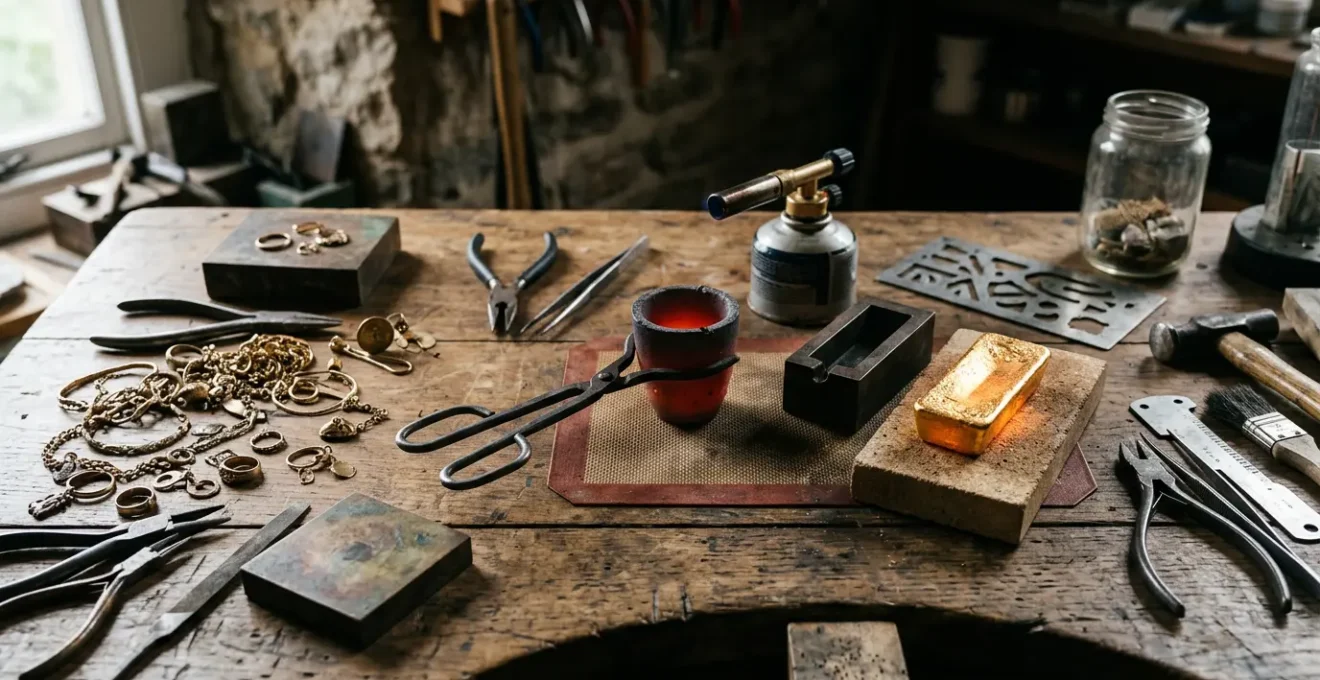
Remodelling inherited gold is rarely the straightforward, money-saving exercise it’s believed to be.
- The value of your “free” gold is often significantly reduced by refining fees, material wastage, and labour costs.
- Technical challenges like metal impurities and the risk of damaging heirloom stones can lead to unexpected results and expenses.
Recommendation: Approach remodelling as a project of sentimental and creative value first, not purely a financial one. Always get a detailed cost breakdown before committing.
That box of inherited jewellery sits tucked away—a tangle of broken chains, a single earring, and rings that feel more like costume pieces than treasured heirlooms. The gold itself holds value, and the idea of transforming it into a modern, bespoke piece is deeply appealing. It feels sustainable, sentimental, and, best of all, economical. After all, you’re providing the most expensive ingredient for free. This is the common wisdom: melting down old gold is a smart, green choice that saves you a fortune on a new commission. But what if the reality is far more complex?
The journey from a collection of mismatched items to a single, beautiful new ring is not a simple act of melting. It’s a technical and metallurgical process fraught with hidden costs, inherent risks, and crucial quality considerations. Before you can truly understand the value of your old gold, you must look beyond its weight and consider the intricate realities of refining, casting, and finishing. The “free” gold you possess is only the starting point of a conversation about material integrity, heirloom liability, and the true cost of craftsmanship.
This guide pulls back the curtain on the remodelling process. We will move past the romantic notion of simply melting and recasting, and instead, provide an honest, practical breakdown of the factors that determine whether remodelling is the right choice for you. By understanding the potential pitfalls—from refining fees to porosity problems—you can make an informed decision that honours both your sentiment and your budget.
To navigate this complex decision, this article breaks down the essential questions and hidden truths of gold remodelling. We’ll explore the real costs, the technical challenges, and the ethical considerations, giving you the clarity needed to proceed with confidence.
Summary: Remodelling Old Gold vs Buying New
- Why Refining Fees Can Eat Up Your ‘Free’ Gold Savings?
- Can You Mix 9ct and 18ct Gold When Melting Down for a New Ring?
- Risk of Breakage: What Happens If Your Stone Cracks During Unsetting?
- The Porosity Problem: Why Recycled Gold Casting Can Look Pitted?
- Do You Need a New Hallmark When Remodeling Old Jewellery?
- What to Do with Broken Chains That Cannot Be Soldered?
- Recycled Gold vs Fairmined: Which Actually Helps Miners?
- Birmingham Jewellery Quarter: Why Commission Direct from Makers?
Why Refining Fees Can Eat Up Your ‘Free’ Gold Savings?
The most common misconception about remodelling is that because you supply the gold, your main cost is just the jeweller’s labour. This overlooks a critical and often expensive step: refining. Your collection of old jewellery isn’t pure gold; it’s an alloy containing other metals and, more problematically, solder from previous repairs. To create a strong, high-quality new piece, this “scrap” gold must be purified. This process involves assaying (testing purity), melting, and removing impurities, all of which incur fees.
These costs are not trivial. Depending on the amount and complexity, typical gold refining fees range from $20 to $150 per ounce, and that’s just the start. Jewellers also account for a wastage allowance, as a small percentage of metal is inevitably lost during melting and polishing. This combination of fixed fees and percentage-based losses quickly diminishes the value of your “free” gold. Suddenly, the financial benefit of using your own material is less significant than you imagined.
To truly grasp the full picture, it’s essential to understand all the potential charges that can accumulate. The table below breaks down the common costs that contribute to the “true cost of ‘free’ gold,” moving beyond just the base refining charge.
| Cost Component | Description | Impact on Total |
|---|---|---|
| Assay Fees | Testing for metal purity | Fixed cost per lot |
| Wastage Allowance | Percentage-based metal loss | 3-15% of total weight |
| Minimum Casting Charges | Base fee regardless of quantity | $100-500 minimum |
| Stone Removal/Setting | Labor for gemstone handling | $20-50 per stone |
| Environmental Surcharges | Waste disposal compliance | Variable percentage |
Therefore, before committing to a project, always request a detailed quote that itemises these fees. This transparency is the mark of a trustworthy jeweller and allows you to accurately compare the cost of remodelling against buying a new bespoke piece.
Can You Mix 9ct and 18ct Gold When Melting Down for a New Ring?
A common question from clients is whether they can combine all their old gold—a 9ct bracelet, a 14ct earring, and an 18ct ring—into one single melt. While technically possible, it’s almost always a bad idea from a quality and legal standpoint. Each carat (ct) number represents a specific purity of gold. For instance, 18ct is 75% pure gold, while 9ct is only 37.5%. When you melt them together, you create a new, non-standard alloy of unknown purity. This immediately creates a problem for hallmarking, as the resulting metal won’t meet any recognised legal standard.
The resulting alloy can also suffer from poor material integrity. The different compositions can lead to an inconsistent colour, structural weaknesses, and a higher likelihood of problems like cracking or porosity. A reputable jeweller will almost always advise against it. As the experts at Jewelust state in their guide, the practice is very specific:
We can mix different karats of the same colour gold (IE we can mix 10K yellow gold with 18K yellow gold), but we cannot mix different colours together (IE we can not mix white gold and yellow gold)
– Jewelust, Jewelust Jewellery Remodeling Guide
Even when mixing karats of the same colour, the final piece must be hallmarked as the lowest carat used, or not at all if the final purity is uncertain. To achieve a specific, higher carat, a jeweller would need to add a calculated amount of pure 24ct gold to the melt, which adds another cost. The best approach is often to refine the different carat golds separately, trade in the less desirable carats for credit, and use the highest quality gold for the new piece. This maintains the quality and value of your new heirloom.
Ultimately, mixing karats is a compromise that sacrifices quality for convenience. For a piece intended to last a lifetime, starting with a clean, standard, and legally hallmarkable alloy is always the superior choice.
Risk of Breakage: What Happens If Your Stone Cracks During Unsetting?
Many pieces of inherited jewellery hold their sentimental value not just in the gold, but in the gemstones they carry. Re-using a grandmother’s diamond or a mother’s sapphire in a new design is a beautiful way to honour family history. However, removing these stones from their original settings is a delicate and risky operation. This is what we call heirloom liability—the inherent risk that a treasured component could be damaged during the remodelling process.
Older settings can be brittle, and claws can be worn thin. Gemstones, especially those with natural inclusions or a lower hardness rating on the Mohs scale, can be surprisingly fragile. A jeweller must exert precise pressure to bend back the metal without putting stress on the stone. Despite the utmost care and skill, the risk of a stone chipping, cracking, or breaking is always present. A professional jeweller will always inspect the stones under a loupe before work begins and warn you of any pre-existing chips or risky inclusions hidden by the setting.
As the image above illustrates, the process requires immense precision. Diamonds, being the hardest natural material, are generally robust and safe to reset. Hard stones like sapphires and rubies are also often fine, but they require careful examination. Softer stones like emeralds, opals, tanzanites, and pearls are at a much higher risk. Most jewellers will require you to sign a waiver acknowledging this risk before they begin work. If a stone does break, the cost of replacing it falls to you, which can be a devastating and expensive outcome.
This risk doesn’t mean you shouldn’t remodel pieces with stones. It simply means you must enter the process with open eyes, understanding that even with expert hands, some heirlooms carry a fragility that cannot be entirely mitigated.
The Porosity Problem: Why Recycled Gold Casting Can Look Pitted?
One of the most disappointing outcomes in gold remodelling is porosity. This is when the surface of the newly cast piece is marred by tiny pits or holes, giving it a slightly spongy or unfinished appearance. This issue is far more common when using old, recycled gold compared to freshly refined new gold. The primary cause is contamination within the metal. Decades of wear, exposure to chemicals, and, most significantly, solder from previous repairs introduce impurities into the alloy.
When this contaminated gold is melted, these impurities can turn into gas, creating bubbles that get trapped as the metal cools. The result is a compromised material integrity that affects both the look and the strength of the final piece. This is also where material loss becomes a factor. To combat porosity, jewellers often have to file away more of the surface, and sometimes a piece must be completely re-cast, leading to further wastage. In fact, it’s not uncommon for professional operations to experience 8-15% material losses during the casting and finishing process, a cost that is factored into your final bill.
While the risk can never be fully eliminated with old gold, a skilled jeweller can take steps to minimise it. A common strategy is to mix your old gold with at least 50% new, refined gold to dilute the impurities. Using advanced techniques like vacuum casting can also help by removing air from the mould before the gold is poured. However, the most problematic items are old chains, which can contain a high percentage of solder in their many links, making them a primary source of contamination.
Your Action Plan: Auditing Your Remodelling Project’s True Cost
- Itemise Your Gold: List each piece, its weight, and its marked carat (e.g., 9ct, 18ct). This is your starting inventory.
- Assess Gemstones: Note any stones to be reused. Acknowledge that unsetting carries risk and factor in potential replacement as a worst-case scenario.
- Request a Fee Breakdown: Ask your jeweller for an itemised quote including assay fees, refining charges, wastage allowance, and labour. Don’t accept a single lump sum.
- Clarify the Metal Plan: Discuss porosity. Will your gold be mixed with new metal? How will different carats be handled? This defines the final quality.
- Account for ‘Extras’: Add the costs for hallmarking, stone setting, and a final polish to your budget. This reveals the complete financial picture.
Ultimately, a perfect, mirror-smooth finish is much harder to guarantee with recycled gold. Opting for a matte, textured, or hammered finish can be a smart design choice, as it beautifully conceals any minor surface imperfections that may arise.
Do You Need a New Hallmark When Remodeling Old Jewellery?
Yes, absolutely. A hallmark is not just a stamp; it is a legal guarantee of the precious metal content in a piece. When you melt down old jewellery and create a new item, like a ring, the original hallmarks are destroyed. The new piece is legally considered a new item and, if it is to be sold or described as a specific carat of gold, it must be sent to an official Assay Office to be tested and stamped with a new hallmark.
This is a non-negotiable step for any reputable jeweller in the UK and many other countries. The hallmark guarantees three things: the maker’s mark (who made it), the metal purity (e.g., 750 for 18ct gold), and the Assay Office that tested it. Without this, there is no proof of the ring’s quality. This is particularly important if you’ve mixed different carats, as only an official test can determine the final, legal purity of the new alloy.
This process adds another line item to the “true cost” of remodelling. As jeweller Armelle Ellison notes, it’s a standard part of the service:
For gold rings the hallmark is your guarantee that your ring is solid gold. Hallmarking usually costs about £40 for the standard service plus postage
– Armelle Ellison, Jewellery Remodelling Guide
It’s also worth noting the differences in marking standards. While American jewellery is typically marked with its carat (10K, 14K, 18K), European pieces use a numerical system representing parts per thousand. For example, 18ct gold is marked ‘750’ (750 parts per 1000, or 75%). When your new piece is hallmarked, it will receive the appropriate numerical stamp for its verified purity. This legal requirement protects you as a consumer and ensures the lasting value and integrity of your new heirloom.
Skipping this step is not an option for a professionally made piece. The cost of hallmarking is a small but essential investment in guaranteeing the authenticity and quality of your remodelled jewellery.
What to Do with Broken Chains That Cannot Be Soldered?
Broken chains, especially fine or intricately woven ones, are often the most frustrating items in an old jewellery box. Many cannot be effectively repaired by soldering, either because the links are too small or because a repair would be unsightly and weak. As we’ve discussed, they are also poor candidates for melting down due to the high solder content from their original construction, which can cause porosity in a new casting. So, does that render them useless? Not at all.
Rather than seeing them as a problem for melting, consider them as creative components for upcycling. This approach aligns perfectly with a sustainable mindset, as it reuses the material with minimal processing. A skilled designer can transform segments of old chains into beautiful new features. For instance, multiple short lengths can be gathered together to create elegant tassels for a new pendant or a pair of earrings. Broken segments can be woven or braided to form a unique, textured bracelet.
The image above hints at the possibilities when you think of chains not as scrap, but as raw material for new designs. You can use small pieces as articulated ‘droppers’ in earrings, adding movement and delicacy. For a more financially-driven approach, if the chains are a standard purity like 9ct, it often makes more sense to sell them for their scrap value. You can then use the cash proceeds to offset the cost of commissioning a new piece made from fresh, clean, high-quality gold, avoiding all the risks of contamination.
This reframing turns a “problem” material into an opportunity. By separating chains from your main melt and either upcycling them creatively or trading them in, you improve the quality of your primary remodelling project and make the most of every last piece of your inherited gold.
Recycled Gold vs Fairmined: Which Actually Helps Miners?
For many, the primary motivation for remodelling is sustainability. The logic is simple: recycling existing gold avoids the environmental and ethical damage associated with new mining. This is a powerful and valid argument. The gold industry has a well-documented history of environmental degradation and poor labour practices. Using recycled gold, which according to the World Gold Council, accounted for 28 percent of total global gold supply, effectively removes your purchase from that cycle. It’s a closed-loop system that reduces demand for newly mined metal.
Recycling is undeniably a better choice than using gold from an unvetted, unknown mining source. It significantly lowers the carbon footprint of your jewellery and ensures you are not contributing to issues like deforestation or mercury pollution. The environmental case for recycled gold is strong. It is possible to recover nearly the same amount of gold from recycling 40 old mobile phones as from mining an entire tonne of ore, which highlights its efficiency.
However, this is where “informed sustainability” becomes crucial. While recycled gold reduces harm, it does nothing to improve the conditions of the millions of people in artisanal and small-scale mining (ASM) communities who depend on this work for their livelihood. This is where Fairmined gold enters the conversation. Fairmined is an assurance label that certifies gold from ASM organizations that meet high standards for environmental protection, fair labour conditions, and social development. When you buy Fairmined gold, you are directly supporting these communities, helping them to work in safer conditions and earn a fair price. It’s a proactive choice that aims to fix the system from within.
So, which is better? There is no single answer. Recycled gold is a choice to “do no harm” by stepping outside the mining cycle. Fairmined gold is a choice to “do good” by actively investing in a more equitable and responsible mining system. The best option depends on your personal ethics: do you want to reduce your impact, or do you want to be part of the solution for those on the ground?
Key Takeaways
- Remodelling is a sentimental and creative project first; cost savings are a secondary and often minimal benefit.
- The quality of recycled gold is not guaranteed; issues like porosity and inconsistent colour are real risks.
- Always get a fully itemised quote that includes fees for refining, wastage, labour, hallmarking, and stone setting.
Birmingham Jewellery Quarter: Why Commission Direct from Makers?
After weighing the costs, risks, and ethics of remodelling, you might decide that the best path is to commission a new bespoke piece, perhaps using the scrap value of your old gold as a credit. When you do, the question becomes: where do you go? While high-street retailers offer convenience, there is immense value in going directly to the source. A place like Birmingham’s historic Jewellery Quarter offers a unique advantage: direct access to the artisans who will actually make your ring.
The Jewellery Quarter is not just a collection of shops; it’s a thriving ecosystem of small, independent workshops, casters, stone setters, and polishers, many of whom have been honing their craft for generations. When you commission a piece here, you are often speaking directly to the designer-maker. This direct relationship is invaluable. It allows for a level of collaboration, personalisation, and transparency that is simply impossible in a traditional retail environment. You can discuss your ideas, see sketches, and be involved in the creative process from start to finish.
This “maker’s touch” ensures the final piece is not just a product, but a co-created memory. You are buying into a story of craftsmanship and heritage. As the workshops in the Quarter are often small, they are perfectly positioned to handle projects that are personal and unique, whether it’s a completely new design or a thoughtful remodelling project. This direct-to-maker model often provides better value, as you are not paying for the overheads of a large retail brand. You are paying for skill, time, and materials.
Whether you choose to remodel your old gold or start fresh with Fairmined or recycled metal, engaging directly with a maker ensures your vision is understood and your new heirloom is crafted with the care and expertise it deserves. Find a jeweller whose work you love and start a conversation; this is the first step toward creating something truly extraordinary.