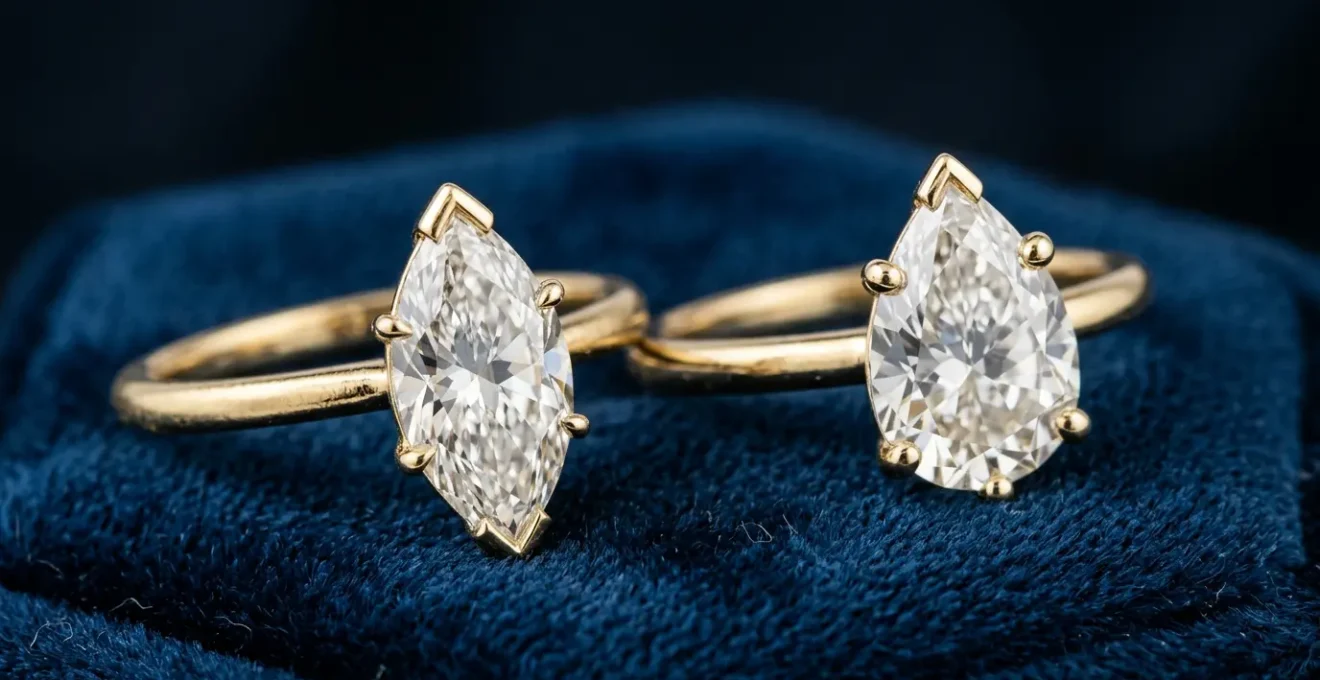
In summary:
- The safety of a pointed diamond depends on its complete security system, not just the setting style.
- Key protective features include V-shaped prongs, a suitable length-to-width ratio (1.75-2.15), and hand-forged construction.
- Choosing a bezel setting is not a universal solution and can introduce its own risks if poorly crafted.
- A pre-purchase audit of the stone’s geometry and the ring’s engineering is the best prevention against damage.
The allure of a marquise or pear-shaped diamond is undeniable. Their elongated forms create a dazzling, finger-slimming effect that sets them apart from the classic round brilliant. Yet, for every admirer, there’s a cautionary tale—a horror story of a chipped point, a snagged prong, and a costly repair. This fear often pushes potential buyers toward “safer” shapes or overly bulky settings, compromising the very elegance they desired.
Conventional wisdom offers simple solutions: choose a full bezel setting or just “be more careful.” But this advice misses the fundamental truth about protecting these unique gems. True security doesn’t come from encasing the diamond in a wall of metal or living in constant fear of a gentle knock. It comes from understanding the stone’s inherent vulnerabilities and the engineering principles designed to mitigate them.
This guide moves beyond the platitudes. We will not simply debate prongs versus bezels. Instead, we will adopt the mindset of a security expert to deconstruct the entire protective ecosystem of a pointed diamond ring. The key isn’t a reactive choice of setting, but a proactive pre-purchase audit of the stone’s architecture, the mounting’s fabrication, and the subtle trade-offs between brilliance and durability. It’s about empowering you with the knowledge to select a ring that is not only beautiful but structurally sound from its very foundation.
By understanding this complete security system, you can confidently choose a marquise or pear-shaped diamond that is built to last, allowing its distinctive beauty to shine without the shadow of anxiety. This article breaks down the critical components of that system, giving you the tools to assess any ring for its true resilience.
Summary: Protecting Marquise and Pear Cut Diamonds
- Why You Must Insist on V-Claws for Marquise Cut Diamonds?
- The ‘Bow-Tie’ Shadow: How to Avoid Dark Spots in Elongated Diamonds?
- Why Pear Shape Diamonds Snag on Jumpers More Than Rounds?
- Chubby or Slender: What Is the Ideal Length-to-Width Ratio for a Marquise?
- Bezel vs Prong: Is a Full Rim Setting the Only Safe Option for Active Wear?
- The Hidden Risk of Losing Tiny Calibre Cut Sapphires in Deco Rings
- Cast vs Hand-Forged: Which Fabrication Method Justifies a Higher Price?
- Beyond Diamonds: Which Coloured Gemstones Can Survive Daily Wear in the UK?
Why You Must Insist on V-Claws for Marquise Cut Diamonds?
The most vulnerable parts of a marquise or pear-shaped diamond are its sharp points. A direct impact here, even one that would be harmless to a round stone, can cause a chip. The single most effective defence against this is not a bulky bezel, but a well-engineered prong system. The standard of care for any pointed stone is the V-claw or V-prong. Unlike a standard rounded claw that secures the stone from the top, the V-claw is a specially formed piece of metal that cradles the point in a chevron or ‘V’ shape. This design serves a dual purpose.
First, it shields the delicate tip from direct impact. The metal of the ‘V’ acts as a bumper, absorbing and deflecting forces that would otherwise be concentrated on the diamond’s most fragile area. Second, it holds the stone securely without obscuring its shape. A properly executed V-claw should be substantial enough to offer protection yet refined enough to blend into the diamond’s silhouette, preserving the sharp, clean lines that define the cut. Insisting on V-claws is the first and most critical step in a pre-purchase security audit. It’s a non-negotiable feature for ensuring the long-term structural integrity of your diamond.
symbolism > aesthetics. Absolutely no legible text, letters, numbers, logos, or UI.”/>
As this image shows, the V-prong offers a targeted solution that protects the point while maximizing light exposure, whereas a bezel provides a different kind of security by encircling the stone. The choice between them is a matter of balancing security priorities with aesthetic goals, but for a prong-set marquise, the V-claw is essential.
Your 5-Step Security Audit for a Pointed-Stone Ring
- Vulnerability Points: Identify all fragile areas. This includes the main tip(s) of the marquise or pear shape, as well as any sharp corners on accent stones or pavé settings.
- Inventory Existing Protections: List the current security features. Note the presence and thickness of V-prongs, the total number of prongs, the metal type (e.g., platinum vs. gold), and whether it’s a bezel or prong setting.
- Confront with Lifestyle: Honestly compare the ring’s protection level against your daily activities. An active lifestyle requires more robust features than one spent primarily in an office. Does the security match the risk?
- Assess Structural Weaknesses: Look for hidden risks beyond the prongs. Is the length-to-width ratio overly slender, creating needle-like points? Is the girdle extremely thin? A severe bow-tie can also indicate suboptimal cutting.
- Create an Action Plan: Based on your audit, prioritize necessary steps. This could range from scheduling bi-annual prong inspections to discussing reinforcement options with a trusted jeweler or, if still shopping, rejecting a ring that fails the audit.
The ‘Bow-Tie’ Shadow: How to Avoid Dark Spots in Elongated Diamonds?
When shopping for a marquise, pear, or oval diamond, you will inevitably encounter the “bow-tie” effect. This is a dark, bow-tie-shaped shadow that runs across the center of the stone. It’s crucial to understand that this is not a flaw or a defect; it is an inherent cutting characteristic of all elongated brilliant cuts. It appears in the area where the pavilion facets are less effective at returning light directly to the viewer’s eye. The goal is not to find a stone with no bow-tie, as virtually all will have one to some degree. The goal is to find one where the effect is minimal and does not severely detract from the stone’s overall brilliance.
A prominent, dark bow-tie can create a “dead” spot in the middle of the diamond, significantly impacting its beauty. This is caused by light leaking out of the back of the stone instead of being reflected. According to a landmark GIA study on fancy shape appearance, evaluating a marquise cut involves at least 19 different geometric parameters, compared to just 6 for a round brilliant. This complexity is why the bow-tie effect is so variable and why it’s essential to view a stone in person or via high-quality video before purchasing. While a slight bow-tie can add depth and character, a severe one is an architectural flaw in the cut that no setting can fix.
However, the choice of setting can help mask or minimize the appearance of a moderate bow-tie. Certain prong placements or the distracting sparkle of a halo can break up the shadow, making it less noticeable.
| Setting Style | Bow-Tie Masking Effect | Light Performance | Protection Level |
|---|---|---|---|
| 6-Prong | Moderate (breaks up shadow) | Excellent | High |
| 4-Prong | Low | Excellent | Moderate |
| Halo | High (visual distraction) | Very Good | Excellent |
| Bezel | Very High (edge reflection) | Good | Maximum |
Why Pear Shape Diamonds Snag on Jumpers More Than Rounds?
The very feature that makes a pear or marquise shape so elegant—its sharp, defined point—is also its greatest liability in daily wear. A round diamond presents a smooth, continuous curve to the world, allowing fabrics and objects to slide past it easily. A pointed diamond, by contrast, acts like a tiny hook. The acute angle of its tip is perfectly shaped to catch on fibres, especially those in knitwear like jumpers, scarves, and even bed sheets. This is a simple matter of physics and geometry: the protruding point creates a high-pressure snag point that round shapes lack.
This risk is amplified by the fact that these cuts often provide a larger face-up appearance for their carat weight. For instance, a pear shape can have an 8% larger visible surface area than a round diamond of the same weight, making it a more prominent feature on the hand and increasing its exposure to potential hazards. While a secure V-prong is the primary defence, awareness of common snag hazards is a crucial secondary layer of protection. It’s not about being paranoid; it’s about forming mindful habits to protect your investment.
Recognizing these everyday risks allows you to make small adjustments, like removing your ring before making the bed or putting on a chunky knit sweater, that can prevent a catastrophic snag. A snag doesn’t just risk pulling a thread; it can bend or lift a prong, instantly compromising the security of your diamond. Here are some of the most overlooked hazards:
- Car seatbelts – the webbing catches pointed tips during buckling/unbuckling
- Hair elastics and ponytail holders – points hook during hair styling
- Fitted bed sheets – elastic corners trap points when making beds
- Laptop bags and purse linings – interior pockets catch protruding points
- Knit gloves and mittens – wool fibers wrap around exposed tips
Chubby or Slender: What Is the Ideal Length-to-Width Ratio for a Marquise?
Beyond the quality of the cut, the overall proportion of a marquise or pear shape plays a critical role in its durability. This is quantified by the length-to-width (L/W) ratio. A “chubby” marquise with a low L/W ratio (e.g., 1.6:1) will have broader, more robust points. A “slender” or “skinny” marquise with a high L/W ratio (e.g., 2.3:1) will have delicate, needle-like points. While the aesthetic choice is personal, from a security perspective, there is a clear optimum.
Extremely slender shapes are significantly more vulnerable to chipping. The narrow points have less mass to absorb impact and are more susceptible to breaking under pressure. The classic, most desirable L/W ratio for a marquise is generally considered to be around 1.85:1 to 2.0:1. This range provides the elegant elongated look without creating excessively fragile points. A pre-purchase audit must include an assessment of this ratio. A study on marquise durability confirmed that proportions are directly linked to risk; it found that marquise diamonds with ratios below 1.75 had 40% fewer tip-related damage claims over a five-year period. The analysis concluded that ratios between 1.75 and 2.15 offer the best balance of elegance and structural integrity.
minimalism > comparison. Absolutely no legible text, letters, numbers, logos, or UI.”/>
As illustrated here, the difference between a stocky, an ideal, and a needle-like marquise is significant. Choosing a stone within the optimal ratio range is a proactive step that builds security into the very architecture of your gem, making it inherently more resistant to the stresses of daily wear. A beautiful but overly slender stone is a long-term liability.
Bezel vs Prong: Is a Full Rim Setting the Only Safe Option for Active Wear?
The default recommendation for anyone with an active lifestyle is often a full bezel setting. This style encases the entire perimeter of the diamond in a thin metal rim, offering maximum protection from side impacts. On paper, it is the most secure option available. It eliminates prongs that can be snagged or bent and completely shields the stone’s girdle and points. However, declaring it the “only” safe option is an oversimplification that ignores crucial trade-offs and potential pitfalls.
The primary drawback of a full bezel is its impact on brilliance. By covering the edge of the diamond, it reduces the amount of light that can enter from the sides, which can make the stone appear slightly less sparkly than it would in a prong setting. Furthermore, a bezel is not foolproof. As diamond expert Kaeleigh from The Diamond Reserve warns, “An improperly made bezel can actually apply uneven pressure on the diamond’s girdle, and dirt accumulation can be harder to clean, potentially abrading the stone over time.” This insight, detailed in The Diamond Reserve’s expert guide, highlights that craftsmanship is as important as the setting style itself. A poorly executed bezel can create its own set of risks.
For those who want a balance of high security and brilliance, a partial bezel or a robust 6-prong setting with V-claws can be excellent compromises. The choice is not a binary one between “safe” and “unsafe” but a nuanced decision based on lifestyle, aesthetic preference, and the quality of the jeweler’s work.
| Setting Type | Security Score | Brilliance Score | Maintenance | Best For |
|---|---|---|---|---|
| Full Bezel | 10/10 | 6/10 | Moderate | Active lifestyle |
| Partial Bezel | 8/10 | 8/10 | Easy | Best compromise |
| 6-Prong with V-tips | 7/10 | 9/10 | Regular checks needed | Traditional look |
| Halo | 8/10 | 10/10 | Complex | Maximum sparkle |
The Hidden Risk of Losing Tiny Calibre Cut Sapphires in Deco Rings
While the primary focus is often on the large center stone, the security of smaller accent stones is just as important, particularly in intricate designs like Art Deco-inspired rings. These pieces often feature tiny, custom-cut gems called calibre cuts—typically sapphires or emeralds—set edge-to-edge in narrow channels. The risk here is not chipping, but loss. Because these stones are held in place by tiny metal walls or shared prongs, even slight wear and tear can cause one to become loose and fall out unnoticed.
The danger is compounded by the difficulty and expense of replacement. Unlike standard round diamonds, calibre-cut stones are not mass-produced. Each one was custom-shaped to fit its specific place in the design. Replacing a lost stone is a painstaking process. According to a report by experts at Estate Diamond Jewelry, sourcing and custom-cutting a replacement calibre-cut sapphire can take months and cost 5 to 10 times the value of the original stone, due to the need for precise color and shape matching. This hidden cost underscores the importance of preventative maintenance.
Regularly performing a simple at-home check can save you from this expensive headache. The “toothpick test” is a safe and effective way to check for loose stones. By gently probing each stone, you can detect subtle movement before it becomes a critical failure. This simple audit is an essential habit for owners of any ring with pavé or channel-set accents.
- Step 1: Use a wooden toothpick (never metal) to gently touch each small stone
- Step 2: Apply minimal sideways pressure – loose stones will shift slightly
- Step 3: Listen for any rattling sounds when gently tapping the ring band
- Step 4: Check for gaps between stones and their settings using magnification
- Step 5: If any movement is detected, stop wearing the ring immediately and visit a jeweler
Cast vs Hand-Forged: Which Fabrication Method Justifies a Higher Price?
The way a ring’s setting is made has a profound impact on its strength and durability, especially its prongs. Most commercially produced jewelry is created through casting. In this process, molten metal is poured into a mold to create the ring in one piece. It’s an efficient and cost-effective method. The alternative is hand-forging, a traditional technique where a jeweler works a solid piece of metal—hammering, bending, and shaping it—to form the ring. While significantly more expensive, hand-forging creates a demonstrably superior product from a security standpoint.
The process of hammering and working the metal compresses its crystalline structure, a phenomenon known as work-hardening. This results in a material that is far denser and stronger than cast metal. When it comes to the delicate prongs that hold your diamond, this difference is critical. According to the professional jewelers at Ken & Dana Design, this process is not just a matter of artistry; it has tangible benefits: “Hand-forging creates denser, work-hardened metal, resulting in prongs that are 30% stronger and more resistant to bending than cast alternatives.” A hand-forged prong is less likely to deform from an accidental knock, providing a much more secure grip on your stone over the long term.
detail > atmosphere. Absolutely no legible text, letters, numbers, logos, or UI.”/>
While a cast setting is perfectly adequate for many, for a high-value pointed diamond where prong security is paramount, the higher initial investment in a hand-forged setting is a worthwhile insurance policy against future damage and loss.
| Aspect | Cast Setting | Hand-Forged | 5-Year Cost Impact |
|---|---|---|---|
| Initial Price | Base price | +40-60% | Higher upfront |
| Prong Replacement | Every 3-4 years | Every 7-10 years | -$300 savings |
| Resizing Capability | Limited (2 sizes) | Extensive (4+ sizes) | Better adaptability |
| Metal Density | Standard | 30% denser | Superior durability |
Key takeaways
- A diamond’s inherent structural integrity, determined by its length-to-width ratio, is the first line of defense against chipping.
- The engineering of the setting, particularly the use of V-prongs and the choice between cast versus hand-forged fabrication, is more critical than the general setting type.
- Protecting a pointed diamond involves a series of trade-offs between security, brilliance, and maintenance, with no single “best” solution for everyone.
Beyond Diamonds: Which Coloured Gemstones Can Survive Daily Wear in the UK?
While diamonds are renowned for their hardness (a 10 on the Mohs scale), the world of coloured gemstones presents a more complex landscape of durability. If you love the marquise or pear shape but desire a splash of colour, it is absolutely essential to consider a gem’s properties beyond its hue. The two most important factors for a daily-wear ring are hardness (resistance to scratching) and toughness (resistance to chipping and breaking). A third, often-overlooked factor is cleavage—a natural tendency for a stone to split along certain planes.
Gems like sapphire and ruby, which belong to the corundum family, are an excellent choice. With a Mohs hardness of 9 and excellent toughness, they can withstand the rigors of daily wear, even in a pointed cut. Conversely, a stone like emerald, despite its hardness of 7.5-8, has poor toughness and natural inclusions that make it notoriously brittle and a very poor candidate for a pointed cut in a ring worn frequently. It is highly susceptible to chipping. Making an informed choice involves looking at a gem’s full security profile.
For those who love the look of a more fragile gem, there are often fantastic, more durable alternatives with similar colours. Choosing a Tsavorite garnet over an emerald, for example, gives you a brilliant green with far superior toughness. This strategic swapping allows you to achieve your desired aesthetic without compromising on long-term security.
| Gemstone | Mohs Hardness | Toughness | Cleavage Risk | Pointed Cut Suitability |
|---|---|---|---|---|
| Sapphire | 9 | Excellent | None | Very Good |
| Ruby | 9 | Excellent | None | Very Good |
| Tsavorite Garnet | 7-7.5 | Good | None | Good |
| Emerald | 7.5-8 | Poor | Imperfect | Not Recommended |
| Tourmaline | 7-7.5 | Fair | None | Moderate |
| Morganite | 7.5-8 | Good | Imperfect | Moderate |
By conducting this thorough, multi-point audit before you buy, you transform from a hopeful buyer into an informed owner. You equip yourself with the criteria to judge a ring not just on its beauty, but on its underlying strength and craftsmanship. This preventative approach is the true secret to wearing a magnificent marquise or pear-shaped stone with joy and confidence for a lifetime. To put these principles into practice, begin by evaluating any potential ring against this complete security system.