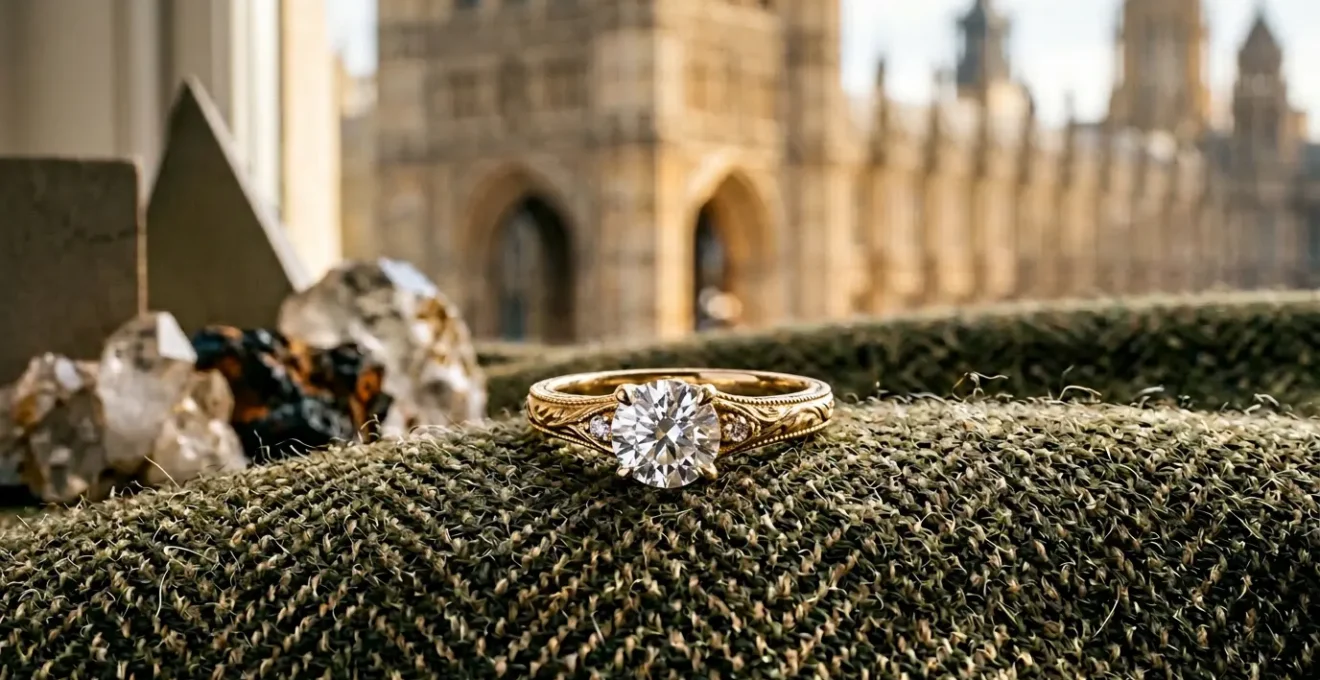
The premium for Fairtrade gold is justified, but only if you treat it as a verifiable ethical investment, not just a label.
- ‘Conflict-Free’ is a legal minimum, not a guarantee of ethical practice; Fairtrade offers audited standards on child labour, safety, and wages.
- Recycled gold reduces future mining but offers no support to the 90% of gold miners in artisanal operations who need fair wages today.
Recommendation: Approach your purchase like an auditor. Ask for the Fairtrade certification number and chain of custody documents to ensure the premium you pay delivers tangible, proven benefits to mining communities.
Choosing an engagement ring is a deeply personal decision, weighted with emotion and symbolism. For a socially conscious couple in the UK, this choice extends beyond aesthetics to the very heart of its origin. You’re willing to invest more for something ethical, but a crucial question lingers: is the premium for Fairtrade gold a genuine investment in a better world, or is it just a marketing-friendly label? The common advice is to look for certifications, but this often simplifies a complex reality. Terms like ‘conflict-free’ and ‘ethically sourced’ are used interchangeably, yet they represent vastly different standards of impact.
The truth is, many well-intentioned labels offer a baseline of compliance rather than a proactive investment in communities. This guide moves beyond the surface-level claims. We will adopt the mindset of an ethical sourcing auditor, scrutinizing the evidence to determine where your money *actually* goes. The key isn’t simply choosing a certified product, but understanding the hierarchy of ethical claims to verify the tangible return on your ethical investment. We will dissect the differences between mined, lab-grown, and recycled materials, expose greenwashing tactics, and reveal how your choices can support not just miners, but also endangered craft skills right here in the UK.
This article provides a structured audit of the ethical jewellery landscape. Each section addresses a critical verification point, empowering you to ask the right questions and make a choice that is not only beautiful but also holds a story of verifiable, positive impact.
Contents: Your Ethical Audit Checklist
- Why ‘Conflict-Free’ Is Not the Same as ‘Ethically Sourced’?
- Lab-Grown Diamonds: Are They Really Greener Than Mined Stones?
- Recycled Gold vs Fairmined: Which Actually Helps Miners?
- The Risk of Buying Burmese Rubies Without Provenance Documents
- How to Spot Greenwashing on Jewellery Brand Websites?
- How Commissioning Bespoke Helps Save Endangered Heritage Skills?
- Cast vs Hand-Forged: Which Fabrication Method Justifies a Higher Price?
- Choosing British Birthstones: Which Gems Are Actually Mined in the UK?
Why ‘Conflict-Free’ Is Not the Same as ‘Ethically Sourced’?
The term ‘conflict-free’ is a common assurance in the jewellery industry, but from an auditor’s perspective, it represents the absolute minimum ethical bar, not the pinnacle. Primarily associated with the Kimberley Process for diamonds, its scope for gold is limited. It narrowly focuses on preventing funds from reaching rebel groups in specific conflict zones. While vital, this definition leaves massive ethical gaps. It does not address child labour, unsafe working conditions, environmental destruction, or fair pay for miners. A piece can be ‘conflict-free’ yet still be the product of immense human and ecological suffering.
This is where a truly ‘ethically sourced’ standard like Fairtrade provides a verifiable framework. It’s not just about what is prohibited, but what is actively enforced. Fairtrade certification demands a rigorous, audited chain of custody from mine to jeweller. This ensures miners receive a guaranteed fair price—at least 95% of the global market price—and an additional premium to invest in their communities. This “ethical ROI” is quantifiable; for instance, the Fairtrade Premium provides a direct payment of $2000 USD per kilogram for community development projects. The difference is stark, as this comparative analysis shows.
| Aspect | Conflict-Free (Kimberley Process) | Ethically Sourced (Fairtrade) |
|---|---|---|
| Rebel Funding | Prohibited | Prohibited |
| Child Labour Protection | Not addressed | Strictly enforced |
| Environmental Standards | Not covered | Comprehensive requirements |
| Worker Safety | Not included | Mandatory safety protocols |
| Fair Wages | No provision | 95% of global market price guaranteed |
| Community Premium | None | $2000/kg for development projects |
Therefore, when a jeweller offers a ‘conflict-free’ guarantee, an auditor’s follow-up question should always be: “That’s the baseline, but what are your verified standards for labour rights, environmental protection, and community development?” The answer separates marketing from meaningful impact.
Lab-Grown Diamonds: Are They Really Greener Than Mined Stones?
Lab-grown diamonds are often marketed as the definitive “green” alternative to mined stones, and on the surface, the argument is compelling. The process avoids the large-scale land displacement and potential water contamination associated with traditional mining. As a result, many UK jewellers, like The Diamond Store, have embraced them, noting that the production has a significantly lower direct impact on the planet. This controlled environment also allows for a much faster creation process, which contributes to their more accessible price point.
However, an auditor must look beyond the initial claim and examine the primary input: energy. The process of creating a diamond in a lab, whether through High Pressure/High Temperature (HPHT) or Chemical Vapour Deposition (CVD), is incredibly energy-intensive. The “green” credentials of a lab-grown diamond are therefore entirely dependent on the source of that energy. A diamond created using power from a coal-fired grid has a vastly different carbon footprint than one made using dedicated solar or wind power. This is the crucial detail that is often missing from marketing materials.
This visualisation highlights the critical variable in the environmental equation. While avoiding the direct land impact of mining, the carbon cost of lab-grown diamonds can vary dramatically. True sustainability requires transparency not just about the diamond’s origin (lab vs. earth) but about the energy portfolio used in its creation. Without third-party verification of renewable energy usage, the claim of being “greener” remains an unproven assumption.
For the conscious couple, the key question for a jeweller is not “Is this lab-grown?” but “Can you provide documentation verifying that your lab-grown diamonds are created using 100% renewable energy?” This elevates the conversation from a simple label to a verifiable ethical standard.
Recycled Gold vs Fairmined: Which Actually Helps Miners?
The choice between recycled and Fairtrade (or Fairmined) gold presents a genuine ethical dilemma, not a simple choice between ‘good’ and ‘bad’. Recycled gold is an excellent option from a circular economy perspective. It places no new demand on mining, avoiding the environmental and social impacts of extracting more metal from the earth. For those whose primary concern is reducing future mining, it is a logical and commendable choice. However, its impact is limited. The global stock of scrap gold is finite; it only covers about 30% of demand for new jewellery.
This limitation highlights a critical blind spot: recycled gold does nothing to help the estimated 15 million artisanal and small-scale miners (ASM) currently working, who represent 90% of the gold mining workforce. These individuals often work in hazardous conditions for negligible pay. Opting exclusively for recycled gold effectively ignores their plight, leaving them in a precarious informal economy. As Poppy Elder Fine Jewellery aptly notes in their guide:
Buying Fairtrade gold tackles the root problem by giving current miners a safer workplace and a fair wage today rather than leaving them in the informal economy.
– Poppy Elder Fine Jewellery, Fairtrade Gold Jewellery Guide
Choosing Fairtrade gold is a direct intervention. The premium you pay is an investment in safer working practices, the elimination of toxic chemicals like mercury, and fair wages that can transform communities. It’s a choice to engage with the problem and improve it from within, rather than turning away from it. To make an informed decision aligned with your values, you must first clarify your primary ethical goal.
Your Action Plan: Choosing Between Recycled and Fairtrade
- Define Your Priority: Are you focused on reducing future environmental impact (recycled) or improving the lives of current mining communities (Fairtrade)? List your primary and secondary goals.
- Traceability Audit: For Fairtrade, ask the jeweller for the specific certification and chain of custody documents. For recycled, ask about the source of the scrap gold and the refiner’s certification (e.g., RJC certified).
- Budget Impact Analysis: Ask for a price comparison for the same piece in recycled vs. Fairtrade gold. Quantify the premium and weigh it against the documented social benefits it provides.
- Artisanal Support Check: Acknowledge that 90% of gold miners work in small-scale operations. Evaluate how your choice supports or bypasses this vast community.
- Final Decision Framework: Based on your audit, make a conscious choice. There is no single “right” answer, only the answer that best aligns with your verified ethical priorities.
Ultimately, this isn’t a vote against recycled gold, but a call to recognise its limitations. It’s a good choice, but Fairtrade gold is the choice that actively empowers the people at the very beginning of the supply chain.
The Risk of Buying Burmese Rubies Without Provenance Documents
When it comes to coloured gemstones, provenance is not just a matter of romance; it is a critical issue of ethics and, in some cases, legality. Burmese rubies, famed for their ‘pigeon’s blood’ hue, are a prime example. The mining industry in Myanmar has long been linked to severe human rights abuses and conflict, a situation that has dramatically worsened since the military coup in February 2021. The military junta now controls a significant portion of the country’s natural resource trade, including gems, using the profits to fund its oppressive regime.
In response, the international community has acted. The British government, for its part, has been clear in its stance, having imposed sanctions on numerous individuals and entities linked to the junta. Specifically, sanctions have been imposed on 25 individuals and 33 entities connected to the Myanmar military. For a UK buyer or jeweller, this creates a significant legal and ethical risk. Purchasing a new ruby that has passed through military-controlled channels could mean inadvertently funding the regime and violating UK sanctions, a serious offence.
The only ethically defensible Burmese rubies on the market today are those with impeccable, verifiable provenance that proves they were mined and exported *before* the 2021 coup. This is not a matter of a simple certificate of authenticity. It requires specific, independent documentation that establishes a clear timeline. An auditor would demand to see original, dated reports from globally respected gemological laboratories like Gübelin, SSEF, or GIA. A report dated post-January 2021 should be considered an immediate red flag, as its journey out of the country is highly suspect.
Without this stringent level of proof, the risk of contributing to human rights abuses is simply too high. For a new engagement ring, the most prudent and ethical choice is to seek out rubies from alternative, transparent sources like Mozambique or to consider other red gemstones, such as spinels, with a clean and documented chain of custody.
How to Spot Greenwashing on Jewellery Brand Websites?
As consumer demand for ethical products grows, so does the practice of ‘greenwashing’—the use of vague, misleading, or unsubstantiated claims to create an unearned image of environmental and social responsibility. For the socially conscious couple, learning to see through this marketing fog is a crucial skill. An auditor’s mindset means looking for evidence, not just accepting appealing language. Jewellery websites are rife with potential red flags that should prompt further questioning.
The most common tactic is the use of broad, undefined terms. Words like ‘eco-conscious’, ‘sustainable’, ‘mindful’, or ‘ethically made’ are meaningless without specific, verifiable details to back them up. What does ‘sustainable’ mean to that brand? Which specific standards do they adhere to? If they can’t answer, it’s a red flag. Similarly, a ‘Made in Britain’ label is often used to imply local, ethical production. However, this label can refer only to the final assembly of a piece, while the raw materials—the gold, the diamonds—may have been sourced from the other side of the world with no ethical oversight whatsoever.
Authentic ethical commitment is demonstrated through transparency and third-party verification. A truly ethical brand will be proud to display its credentials and provide details. They will name their specific partner cooperatives, display their Fairtrade or Fairmined license number, and be members of respected industry bodies like the Responsible Jewellery Council (RJC). They won’t just show stock photos of smiling miners; they will tell you the names of the mines and the communities your purchase is supporting. Vague claims are a sign of a weak or non-existent ethical sourcing policy. Always be wary of claims about carbon offsetting without links to the specific, verified projects they support. The absence of detail is often the most telling detail of all.
Your audit should be simple: if a brand makes a claim, look for the proof on the same page. If it’s not there, be sceptical. Ask for it directly. A brand with nothing to hide will be happy to provide it.
How Commissioning Bespoke Helps Save Endangered Heritage Skills?
Choosing to commission a bespoke engagement ring can be an act of preservation, extending beyond the ethical sourcing of its materials. While we rightly focus on the origins of gold and gemstones, the methods used to craft the final piece hold their own stories and ethical weight. In the UK, particularly in historic centres like Birmingham’s Jewellery Quarter or London’s Hatton Garden, traditional goldsmithing techniques are endangered heritage skills, threatened by the efficiency of mass production.
When you commission a piece from a master craftsperson, you are directly investing in the continuation of these skills. Techniques like hand-forging, intricate engraving, or specialised stone setting are passed down through generations of apprenticeships. This human-to-human transfer of knowledge cannot be replicated by machines. By choosing a hand-forged ring over a cast one, for example, you are funding the hours of focused labour and years of expertise required to master that craft. You are paying for a person’s time and talent, ensuring their craft remains viable and can be taught to the next generation.
This creates a powerful synergy of value, especially when combined with ethically sourced materials. The UK Heritage Crafts Association touches on this, describing how combining a material with a story (like Fairtrade Gold) with a creation method that has a story (heritage handcraft) creates what they term a ‘double-narrative’.
Combining a material with a story (Fairtrade Gold) with a creation method that has a story (heritage handcraft) creates a ‘double-narrative’ of value, powerfully justifying the premium for both.
– UK Heritage Crafts Association, Preserving Traditional Goldsmithing Skills
The premium paid for a bespoke piece is not just for a unique design; it’s a patronage of artistry. It ensures that the tangible connection to a long line of British craftsmanship is not lost, making your engagement ring a vessel for heritage as well as a symbol of your commitment.
Cast vs Hand-Forged: Which Fabrication Method Justifies a Higher Price?
Beyond the choice of materials, the fabrication method is a significant factor in a ring’s final cost, durability, and character. The two primary methods, casting and hand-forging, produce visually similar results but are fundamentally different processes. Understanding these differences is key to auditing whether a higher price is justified by a tangible increase in quality. Casting is the most common method for mass-produced jewellery. It involves creating a wax model of the ring, which is then used to make a mould. Molten metal is poured into the mould, creating the final piece. It’s an efficient process, allowing for the creation of many identical pieces relatively quickly.
Hand-forging, by contrast, is a traditional, labour-intensive craft. The process begins with a simple bar or wire of metal, which the goldsmith meticulously hammers, bends, and shapes into the final ring form. This continuous working of the metal—known as work-hardening—compresses its molecular structure, resulting in a finished piece that is significantly denser and more durable than a cast equivalent. While a cast ring is perfectly suitable for occasional wear, a hand-forged ring offers superior resilience for a piece intended for a lifetime of daily use.
The price difference, which can be 30-50% higher for a hand-forged piece, is a direct reflection of time and superior structural integrity. The audit is not just about aesthetics but about material science, as this comparison illustrates.
| Aspect | Cast Method | Hand-Forged Method |
|---|---|---|
| Molecular Structure | Standard density | Work-hardened, compressed structure |
| Durability | Good for occasional wear | Superior for daily wear |
| Production Time | 1-2 hours per piece | 8-15 hours per piece |
| Alloy Control | Dependent on casting house | Absolute control by craftsperson |
| Risk of Porosity | Possible if not high-standard | Virtually eliminated |
| Character | Consistent reproduction | Unique maker’s touch |
| Price Premium | Base price | 30-50% higher |
Ultimately, the premium for a hand-forged ring is an investment in durability and craftsmanship. You are paying for a demonstrably stronger product and the unique, subtle character that only comes from the direct touch of a skilled artisan’s hands.
Key Takeaways: Your Auditor’s Mindset
- Look Beyond ‘Conflict-Free’: This is a baseline, not a badge of honour. Demand specifics on labour rights, environmental standards, and fair wages.
- Interrogate ‘Green’ Claims: For lab-grown gems, the key question is about the energy source. Ask for proof of renewable energy use.
- Weigh Your Impact: Choose between reducing future impact (recycled gold) and actively improving the lives of current miners (Fairtrade gold).
Choosing British Birthstones: Which Gems Are Actually Mined in the UK?
The idea of incorporating a “British birthstone” into an engagement ring holds a powerful romantic appeal, suggesting a piece of jewellery that is deeply connected to the land. For a UK couple, it feels like the ultimate expression of local sourcing. However, an auditor must separate this appealing narrative from geological reality. While the UK does have native gemstones, their suitability for a piece of jewellery intended for daily wear, like an engagement ring, is extremely limited.
Gems like Blue John Fluorite from Derbyshire are genuinely British and beautiful, but they are far too soft for an engagement ring. Registering only a 4 on the Mohs scale of hardness (compared to a diamond’s 10 or a sapphire’s 9), it would be quickly scratched and damaged by everyday life. Similarly, Whitby Jet, a fossilised wood from Yorkshire, has a rich history in Victorian mourning jewellery but lacks the hardness and brilliance expected in a modern engagement ring. The reality is that the UK does not have commercial mining operations for durable, high-quality gemstones like diamonds, sapphires, or rubies.
This doesn’t mean the desire for a UK-centric ring cannot be fulfilled. It simply requires a shift in focus from the origin of the gem to other elements of the ring’s story. A truly ethical and British-connected ring can be created through other means. The focus can shift to supporting local craftsmanship, using recycled metals refined in Britain, or choosing vintage pieces with a rich British history. The most pragmatic and impactful approach involves a combination of verified ethical sourcing from abroad with local artistry. Here are some meaningful alternatives:
- Choose ethically sourced sapphires or other durable gems from known, transparent origins and have them set by a British artisan.
- Consider a lab-grown diamond that was produced in the UK, ideally with verified use of renewable energy.
- Opt for a ring made from recycled gold refined in Britain, combined with a vintage or ethically sourced stone.
- Select a genuine antique or vintage British ring, which recirculates existing materials and carries its own unique history.
- Support global communities and local craft by using Fairtrade certified gold crafted into a final piece by a UK-based jeweller.
Embracing one of these strategies allows you to create a ring with a powerful and authentic connection to the UK, grounded in verifiable craftsmanship and responsible choices rather than a geological impossibility.
Frequently Asked Questions about Ethical Gem Sourcing
What are the UK’s current sanctions on Myanmar gems?
The UK government has imposed financial, trade, director disqualification and immigration sanctions in respect of Myanmar. The UK’s autonomous sanctions regime is established by the Myanmar (Sanctions) Regulations 2021.
How can UK buyers verify pre-coup Burmese rubies?
Reliable provenance requires specific reports from Gübelin, SSEF, or GIA laboratories dated before February 2021, clearly establishing the gem was mined and exported before sanctions.
What are the legal risks for UK jewellers?
Making funds or economic resources available to, or for the benefit of, a designated person (directly or indirectly), without a licence constitutes a sanctions violation.