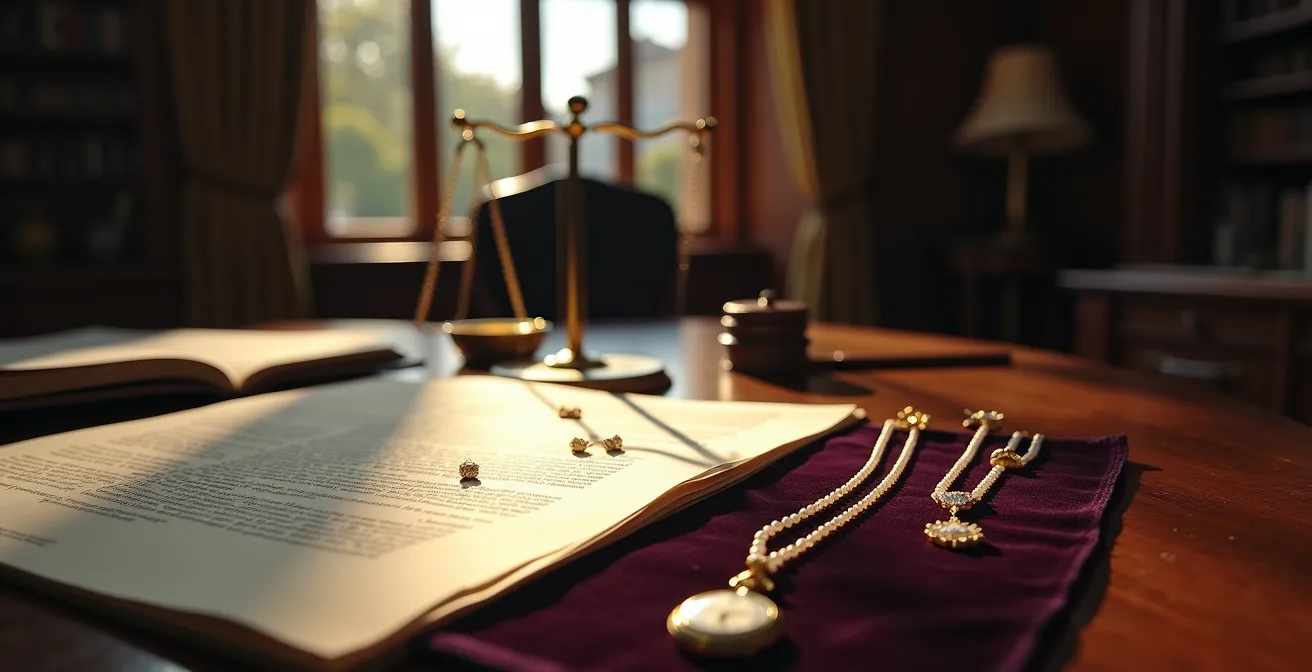
Receiving a piece of family jewellery is a deeply personal moment, a tangible link to a loved one. Yet, for an executor, this inheritance immediately brings with it a set of complex legal and financial responsibilities. In the midst of grief, you are tasked with navigating the stringent requirements of His Majesty’s Revenue and Customs (HMRC), and the most common and costly mistake I see in my practice involves valuation. Many assume an insurance valuation is the correct figure to use, or that a quick online search will suffice. These are dangerous assumptions.
The core of the issue is a fundamental misunderstanding of what HMRC is looking for. They are not interested in the cost to replace an item, nor its sentimental worth. Their focus is solely on the ‘open market value’ at the date of death—a specific, legally defined figure that represents what the item would fetch if sold. Getting this wrong can lead to difficult questions, potential penalties, and significant overpayment of Inheritance Tax (IHT). Furthermore, the disparity between this probate value, its insurance value, and its emotional value can become a flashpoint for family disputes if not managed with care and transparency.
This guide moves beyond generic advice. As a probate solicitor specialising in personal chattels, my goal is to provide you with the legal framework and practical steps to value heirlooms correctly. We will dissect the critical differences between valuation types, outline the tax traps that emerge after probate is granted, and offer strategies for both preserving value and family harmony. We will explore why a simple guess can trigger an investigation and how to handle the process with the diligence HMRC expects, ensuring you fulfill your duties as an executor without putting the estate at risk.
This article provides a detailed roadmap for executors and beneficiaries. The following sections will guide you through the critical aspects of jewellery valuation for probate, from satisfying HMRC to managing the complexities of division and restoration.
Summary: A Practical Guide to Valuing Inherited Jewellery for Probate
- Why Estimating Values Yourself Can Trigger an HMRC Investigation?
- How to Equitably Split a Jewellery Collection Without Family Conflict?
- Probate Valuation vs Insurance Value: Which Figure Should You Submit?
- The Capital Gains Tax Trap When Selling Heirlooms Within 12 Months
- Should You Modernise an Heirloom Ring or Keep It Original for Value?
- Why Winning an Auction for £500 Actually Costs You £650?
- Hair Work in Lockets: Macabre or Romantic History?
- Repairing Sentimental Jewellery: When Is Restoration Too Risky?
Why Estimating Values Yourself Can Trigger an HMRC Investigation?
As an executor, the temptation to estimate the value of jewellery to save time and expense is understandable. However, this is one of the most significant risks you can take during the administration of an estate. HMRC’s systems are designed to flag inconsistencies, and a valuation that appears arbitrary or uninformed is a primary trigger for a compliance check. The legal standard is not a guess; it is the ‘open market value’, defined by Section 160 of the Inheritance Tax Act 1984 as the price the asset “might reasonably be expected to fetch if sold in the open market.”
The key issue is that HMRC operates with specific thresholds that demand professional scrutiny. While a general ‘sweeping’ valuation may be acceptable for low-value chattels, a different rule applies to significant pieces. In fact, according to HMRC guidance, items worth over £1,500 must be listed and valued individually on the IHT407 form. An executor’s unsubstantiated estimate for a diamond ring or a designer watch will not withstand scrutiny. HMRC may appoint its own valuer, leading to delays, increased costs, and potential penalties if your initial figure is found to be negligently low.
Conversely, overvaluing items to be ‘on the safe side’ is equally problematic. Using a high insurance valuation, for example, will artificially inflate the value of the estate, potentially pushing it over the Nil-Rate Band and resulting in an unnecessary Inheritance Tax liability. The only prudent path is to obtain a formal, written probate valuation from a qualified professional who understands the distinction and can provide the necessary documentation to satisfy HMRC from the outset. This is not an expense; it is an essential protection for the estate and for you as the executor.
Your Action Plan: Safe Harbour Checklist for Executors
- Group all costume and low-value jewellery and list it as a single entry under the general chattels exemption, ensuring the total is under £500.
- Identify and list separately any single item you believe could be worth more than £1,500 and secure a professional valuation for it.
- Instruct the valuer to provide a report explicitly stating the ‘open market value’ in accordance with Section 160 of the IHTA 1984.
- Document any items that were separately insured (such as high-value watches or diamond jewellery) as these are an immediate focus for HMRC.
- Ensure you use a qualified, accredited valuer (e.g., from the NAJ or IRV) who can provide HMRC-compliant documentation.
How to Equitably Split a Jewellery Collection Without Family Conflict?
Dividing a jewellery collection is often more emotionally charged than distributing cash or property. Each piece can carry a weight of memory and personal significance that far exceeds its monetary worth. A common source of conflict arises from what I call ‘valuation dissonance’—where one beneficiary values a ring for its connection to a grandmother, while another sees only its financial value. A fair distribution process must acknowledge and address both aspects.
A purely financial approach, where items are simply allocated to balance the books, can feel cold and dismissive of personal attachments. Conversely, allowing beneficiaries to simply choose items can lead to disputes if one person selects all the most monetarily valuable pieces. A structured, two-stage approach can preemptively defuse these tensions and lead to a more amicable outcome. The goal is to separate the emotional selection from the financial equalisation, giving each its proper weight.
This paragraph introduces the illustration of family members choosing jewellery. To understand this delicate process, it’s helpful to visualise the moment of decision.
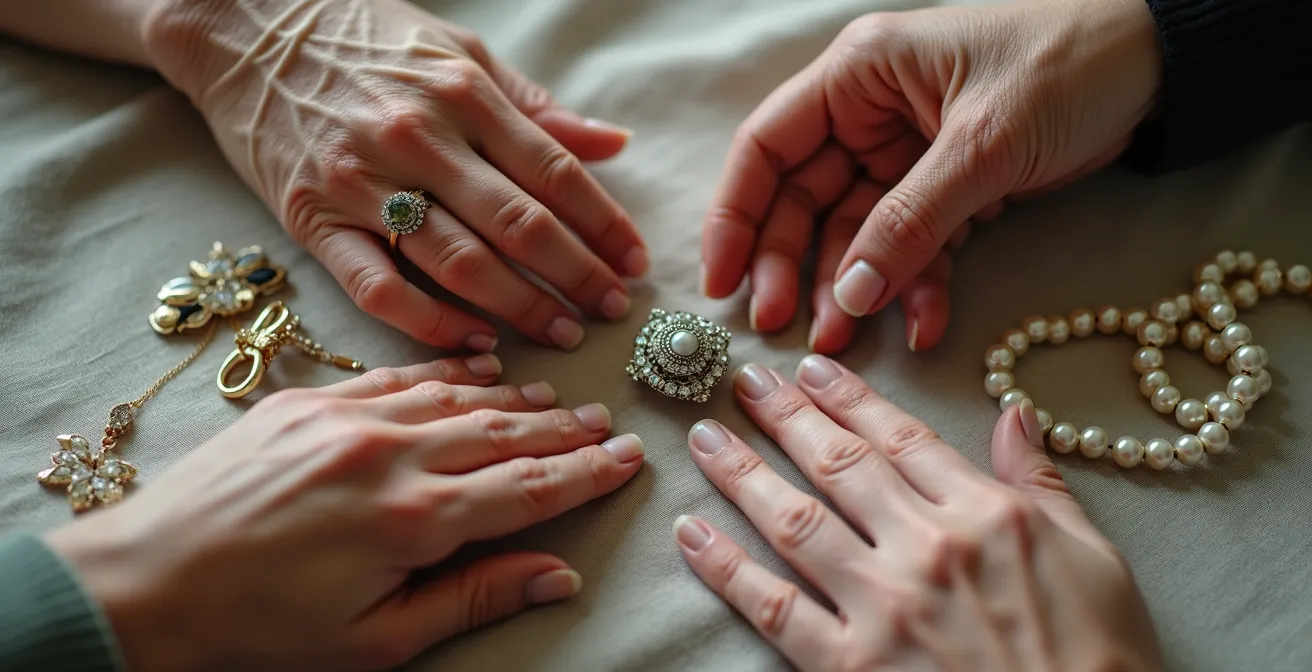
As this image suggests, the act of division is a deeply human and sensitive affair. The following case study outlines a method that respects this reality while ensuring legal and financial fairness for all involved.
Case Study: The Two-Stage Valuation Process
A practical and effective approach involves separating sentimental and monetary value into two distinct phases. Stage 1 is the ‘Sentimental Draft,’ where, before any formal valuation figures are revealed, each beneficiary privately lists their top three “must-have” items for purely personal reasons. Stage 2 uses the professional probate values to financially balance the distribution. Beneficiaries who receive a total value higher than their share of the collection make an ‘equalisation payment’ back to the estate, which is then distributed to those who received less. This method has proven highly successful in reducing conflict by formally acknowledging both the emotional and financial stakes.
Probate Valuation vs Insurance Value: Which Figure Should You Submit?
This is arguably the most critical distinction an executor must understand. Submitting the wrong valuation figure to HMRC is a definitive red flag and can lead to serious consequences. An insurance valuation represents the full retail replacement cost of an item—what it would cost to buy a brand-new, equivalent piece from a high-street jeweller. A probate valuation, or ‘open market value’, is the realistic second-hand price the item would likely achieve if sold at auction or to a dealer. The difference is not trivial; it is often vast.
An insurance valuation is forward-looking and accounts for retail mark-ups, craftsmanship, and branding. A probate valuation is a snapshot of the present market, reflecting the value of the raw materials and desirability of the piece in its current, pre-owned condition. For example, a one-carat diamond ring might be insured for £8,000 but have a probate value of just £2,500. Using the £8,000 figure for IHT purposes would mean paying tax on an extra £5,500 of phantom value. HMRC is acutely aware of this discrepancy and will query any submission that appears to be based on an insurance schedule. As a probate solicitor, I must be firm on this point: an insurance valuation is never acceptable for IHT calculations.
The following table, based on common valuation scenarios, starkly illustrates the financial implications of this distinction. It highlights why a probate-specific report is not just a formality but a financial necessity for the estate.
| Aspect | Probate Value | Insurance Value |
|---|---|---|
| Definition | Open market value at date of death | Replacement cost for new equivalent |
| Typical Amount | £2,000-3,000 for 1ct diamond ring | £5,000-9,500 for same ring |
| Legal Basis | Section 160 IHTA 1984 | Retail replacement pricing |
| HMRC Acceptance | Required for tax calculation | Not acceptable – will trigger query |
| Example Impact | Lower inheritance tax liability | Could overpay tax by thousands |
The official guidance from HMRC itself underscores the importance of this. As a caseworker’s manual points out, their primary concern is the accuracy of the open market value. As stated in their internal guidance available to the public via an analysis of HMRC’s manuals, they are focused on the correct application of the law.
If you are concerned that the value returned does not reflect the open market value ask SAV for advice
– HMRC Caseworker Guidance, HMRC Inheritance Tax Manual IHTM21041
The Capital Gains Tax Trap When Selling Heirlooms Within 12 Months
Once probate is granted and the Inheritance Tax has been settled, many beneficiaries decide to sell inherited jewellery. However, this action can trigger a second, often unexpected, tax liability: Capital Gains Tax (CGT). It is a common misconception that once IHT is paid, all tax obligations are settled. This is incorrect. CGT is levied on the profit you make when you ‘dispose of’ an asset, which includes selling it.
The ‘gain’ is calculated as the difference between the sale price and the item’s value at the time you inherited it—which is the probate value. For example, if a brooch was valued at £5,000 for probate and you later sell it for £7,000, you have made a capital gain of £2,000. In the UK, inherited jewelry is subject to a hefty 28% capital gains tax rate for higher-rate taxpayers on collectibles, which is significantly more than the standard CGT rates. This can come as a nasty shock to beneficiaries who were not properly advised.
Fortunately, there are legal strategies to mitigate this liability. The UK tax system provides every individual with an annual CGT allowance (the Annual Exempt Amount), which is the amount of gain you can make in a tax year before any tax is due. There is also a specific exemption for ‘chattels’ sold for £6,000 or less. By planning the timing and structure of sales, it is often possible to significantly reduce or even eliminate the CGT bill. Rushing to sell all items in a single tax year is rarely the most tax-efficient approach.
- Utilise the Annual CGT Allowance: Spread the sales of multiple items across different tax years (the tax year runs from 6th April to 5th April) to use your annual allowance each year.
- Leverage the Chattels Exemption: Any single item sold for £6,000 or less is exempt from CGT.
- Hold for Longer Term: While UK CGT rates for collectibles are high, holding assets for more than one year can sometimes offer planning advantages, though rates are currently fixed.
- Offset with Losses: If you have made capital losses on other assets (e.g., stocks and shares), these can be used to offset the gains made on jewellery sales.
- Document Your Basis: Keep the formal probate valuation safe. This document is your proof of the ‘acquisition cost’ for CGT purposes.
Should You Modernise an Heirloom Ring or Keep It Original for Value?
The decision to alter an inherited piece of jewellery is a classic conflict between heart and head. An antique ring might feel dated or not to your taste, and the desire to modernise it into something you will wear and cherish is powerful. However, from a purely financial and legal perspective, such alterations can have significant, and often negative, consequences on its value. As a solicitor, I advise clients to treat this decision with the same diligence as any other financial investment.
The key principle is that originality and provenance are paramount in the antique market. A Victorian ring in its original, unaltered condition, perhaps with hallmarks from a known maker, has a historical and collectible value that is distinct from the value of its component parts (gold and gemstones). When you ‘modernise’ it—by re-shanking the band, replacing the setting, or re-cutting the stones—you often destroy that historical value. While the piece may become more ‘wearable’ to you, its open market value for a collector or dealer can plummet.
This image presents the core dilemma: the aged, authentic original versus the clean, polished potential of a restored piece. This visualises the trade-off at the heart of the decision.
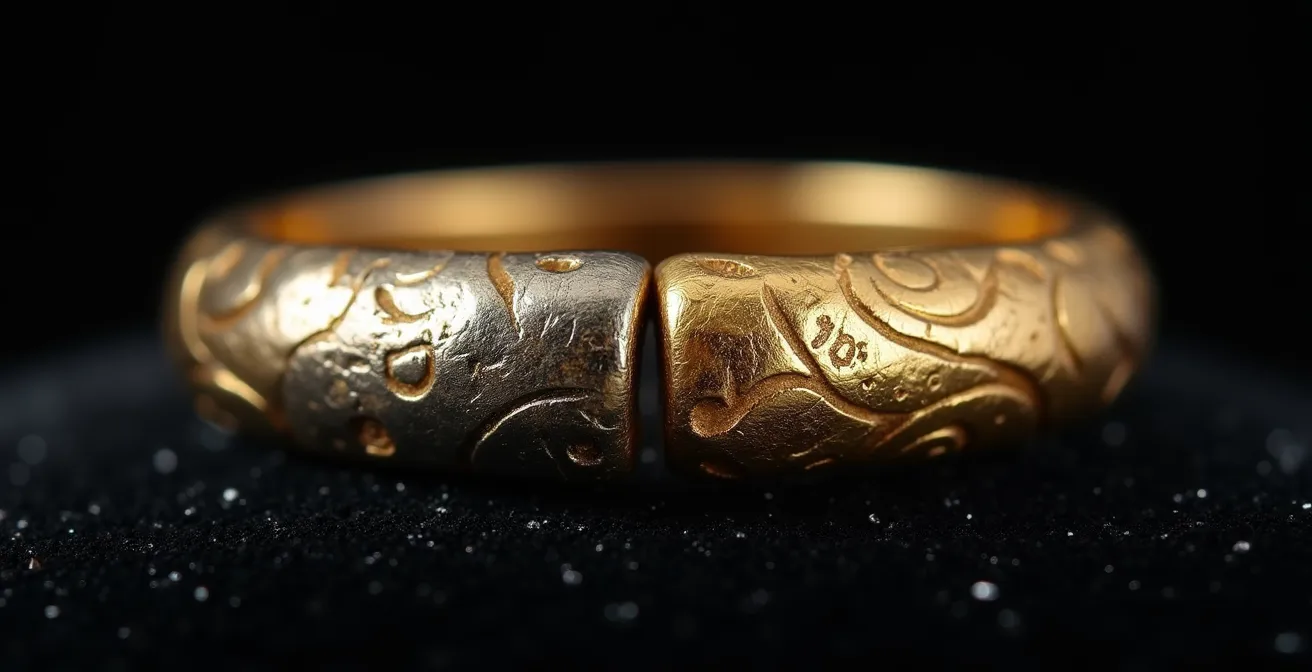
The financial equation is not always straightforward. You are spending money on the restoration, which might inadvertently reduce the overall asset value of the piece, as demonstrated by workshops that specialise in this field.
Case Study: The Hatton Garden Cost of Personalisation
Workshops in London’s famous jewellery quarter, Hatton Garden, frequently encounter this scenario. A classic example is a Victorian cluster ring with an initial probate value of £3,000 in its original condition. A beneficiary might spend £1,500 to have it modernised into a sleek, contemporary design. While this adds immense ‘wearable value’ for the individual, the piece has now lost its antique status. Its value in the secondary market might drop to £2,000. The net result is that the beneficiary has spent £1,500 only to reduce the asset’s market value by £1,000, effectively costing them £2,500, though they now have a piece they love to wear.
Why Winning an Auction for £500 Actually Costs You £650?
Whether you are selling heirlooms or acquiring new ones, understanding the true cost structure of an auction house is essential. The ‘hammer price’—the price at which the auctioneer’s gavel falls—is not the final price you pay as a buyer, nor the amount you receive as a seller. Auction houses operate on a commission model, and these additional fees, known as the Buyer’s Premium, can add a substantial amount to the final bill.
The Buyer’s Premium is a percentage of the hammer price that the successful bidder must pay to the auction house. In the UK, this rate typically ranges from 20% to as high as 27.5% at major houses like Christie’s and Bonhams. Crucially, this premium is also subject to VAT at 20%. So, a ‘win’ at a £500 hammer price can quickly escalate. A 25% premium (£125) plus 20% VAT on that premium (£25) results in a total bill of £650. This 30% increase over the hammer price is a standard cost of business in the auction world and must be factored into any bidding strategy.
The fees vary between auction houses, and online platforms often add their own additional surcharges. The following table breaks down the typical costs at major UK auction houses, demonstrating how the final price is calculated.
This comparative data, drawn from a recent analysis of auction house fees, provides a clear picture of the additional costs involved.
| Auction House | Buyer’s Premium Rate | VAT on Premium | Total on £500 Hammer |
|---|---|---|---|
| Christie’s | 25% (up to £100k) | 20% VAT | £625 |
| Bonhams | 27.5% (up to £300k) | 20% VAT | £637.50 |
| Regional Houses | 20-25% | 20% VAT | £600-625 |
| Online Platforms | +3-5% extra | 20% VAT | £618-650 |
Furthermore, there can be other hidden costs. For certain items, particularly contemporary pieces, an additional levy may apply. For example, some pieces of studio jewellery by living artists may incur up to a 4% additional levy known as the Artist’s Resale Right (ARR). This right entitles the original creator to a royalty each time their work is resold. It’s another layer of cost that beneficiaries looking to sell, or buyers looking to acquire, must be aware of.
Hair Work in Lockets: Macabre or Romantic History?
Among the more unusual heirlooms that cross my desk are pieces of mourning jewellery, particularly Victorian lockets or brooches containing intricately worked human hair. To a modern eye, this can seem macabre. However, in its historical context, it was a profound and romantic expression of love and remembrance. Understanding this history is key to appreciating the piece’s cultural, and therefore its collectible, value.
The Victorian era had a relationship with death that is very different from our own. High mortality rates, especially among children, meant that death was a far more visible and integrated part of family life. Mourning was a highly ritualised and public process, and jewellery played a central role. A lock of a loved one’s hair was a physical memento, a part of them that could be kept close long after they were gone. As experts from the V&A Museum note, this was a specialised art form.
Death was highly visible in Victorian culture. Throughout the Victorian period, there were ‘hair artists’ who specialised in turning locks of hair into jewellery that could be worn as a very physical memorial
– V&A Museum, V&A Blog on Victorian Hair Jewellery
This practice was not a fringe activity; it was a mainstream cultural phenomenon, largely driven by the most powerful trendsetter of the age: Queen Victoria herself. Her influence cemented hair work not as something strange, but as a deeply fashionable and respectable way to signify love and loss.
Case Study: Queen Victoria’s Influence and the ‘Cult of Mourning’
Following the death of her beloved Prince Albert in 1861, Queen Victoria entered a period of deep mourning that lasted for 40 years. Her actions transformed British society and created what historians now call ‘the Cult of Mourning.’ She made mourning attire and jewellery mandatory at court for years, popularising materials like jet from Whitby and, most notably, hair work. This royal endorsement made mourning jewellery a huge industry. Catalogues from the period offered elaborate designs for brooches, rings, and lockets, even providing guarantees that the client’s supplied lock of hair would not be substituted during the intricate crafting process, a testament to its sentimental and commercial importance.
Key Takeaways
- The correct value for Inheritance Tax is the ‘open market value’ at the date of death, which is significantly lower than an insurance valuation.
- Any single item of jewellery reasonably expected to be worth over £1,500 must be professionally and separately valued for HMRC.
- Selling inherited jewellery can trigger a separate Capital Gains Tax liability, and strategic planning is essential to minimise the amount due.
Repairing Sentimental Jewellery: When Is Restoration Too Risky?
When an inherited piece is damaged—a broken clasp, a loose stone, a snapped chain—the immediate instinct is to have it repaired. For an item intended for wear, this is a sensible step. However, for a piece of significant antique or collectible value, any intervention carries risk. An improper or overly aggressive restoration can diminish, or even destroy, its financial and historical worth. The key is to distinguish between a necessary stabilisation and an alteration that erases its character.
The most critical element at risk is often the hallmark. These small stamped marks, indicating the maker, the assay office, the date, and the metal purity, are the piece’s legal passport. They are a cornerstone of its provenance and value. As the leading professional body for valuers warns, a clumsy repair can have devastating consequences.
An improper repair or alteration can legally invalidate an antique hallmark, destroying a key part of its provenance and value
– Institute of Registered Valuers, Professional Standards for UK Jewellery Restoration
Before authorising any work, a careful triage is required. The goal must be clear: are you aiming for conservation (preserving the piece as a historical object) or wearability (making it functional for today)? A simple surface polish can remove decades of patina that collectors find desirable. Replacing a worn claw setting is essential for security, but it should be done by a specialist who can replicate the original style, not just use a modern equivalent. Consulting a qualified restorer, not just a high-street repair shop, is a non-negotiable first step.
To help you assess the situation, follow this initial guide:
- Check for Signatures: Look for any maker’s marks or signatures (e.g., Garrard, Cartier, Asprey). These indicate potentially high value and demand extreme care.
- Verify Hallmarks: Assess the clarity and completeness of any hallmarks. Are they crisp or worn? This impacts its historical traceability.
- Assess the Damage: Is the damage structural (e.g., a broken shank, loose stones that risk being lost) or purely cosmetic (surface scratches, minor dents)?
- Define the Goal: Be clear on your primary objective. Is it to make the piece wearable for you, or to conserve its maximum financial value for a potential future sale?
- Consult a Specialist: Only use restorers who are registered with professional bodies like The Goldsmiths’ Centre or the National Association of Jewellers (NAJ).
- Document Everything: Take high-resolution photographs of the piece from all angles, including close-ups of hallmarks and damage, before any work begins.
To ensure you meet your legal obligations as an executor and protect the value of the estate, seeking professional guidance on valuation is not just a recommendation—it is a necessity. Start by documenting the collection and identifying pieces that may exceed statutory thresholds.