Entrusting an heirloom isn’t a matter of trust, but of methodical verification; the jeweller’s qualifications are more critical than their location or positive online reviews.
- Look for the National Association of Jewellers (NAJ) coat of arms as a primary indicator of professionalism and accountability.
- Confirm the jeweller has an on-site workshop to avoid the risks associated with a fragmented ‘send-away’ liability chain.
- Verify that any new work or metal additions will be correctly hallmarked by a UK Assay Office to preserve the item’s legal and resale value.
Recommendation: Always ask to speak directly with the goldsmith at the bench, not just the sales assistant, to discuss the technical specifics of your repair.
The moment you notice a loose stone or a broken clasp on a cherished family heirloom, a sense of panic can set in. This piece is more than just metal and gems; it’s a tangible link to your family’s history. The immediate instinct is often to find a local jeweller, perhaps one with good online reviews or a friendly face. However, when it comes to irreplaceable antiques, this approach mistakes convenience for competence and trust for verification. The stakes are simply too high for guesswork.
Many owners assume that all jewellers are equipped to handle the delicate intricacies of antique restoration. The reality is that repairing a modern, mass-produced item is vastly different from restoring a unique, historical piece. The skills, tools, and understanding of historical metallurgy required are highly specialised. Leaving your heirloom with an unqualified person can lead to irreversible damage, loss of value, or worse, the complete loss of the item through a convoluted and uninsured ‘send-away’ process.
But what if the key to peace of mind wasn’t about finding someone you can trust, but about understanding the professional standards you can verify? The UK’s jewellery industry has robust systems of accountability, from professional bodies to legal hallmarking requirements. The true challenge is knowing what questions to ask and which credentials matter. This guide shifts the focus from emotional hope to empowered verification.
We will provide a clear, standards-based framework to help you methodically vet any jeweller before entrusting them with your precious items. We will explore the significance of the NAJ, the risks of off-site repairs, the critical role of insurance, and the legalities of hallmarking, ensuring you have the knowledge to protect your legacy.
This article provides a comprehensive checklist and a professional framework for making an informed decision. The following sections break down the key areas of verification you must investigate to ensure your heirloom is in the hands of a true expert.
Contents: How to Vet a Jeweller for Heirloom Repair
- Why You Should Check for the NAJ Coat of Arms Before Booking a Repair?
- The ‘Send-Away’ Risk: Does Your High Street Jeweller Actually Repair on Site?
- Will Your Insurance Cover Damage Occurring During a Third-Party Repair?
- Goldsmith vs Sales Assistant: How to Ensure You Speak to the Person at the Bench?
- Why a ‘Same Day’ Repair Service Can Be a Red Flag for Quality?
- Why Is the Assay Office Stamp Critical for UK Resale Value?
- Do You Need a New Hallmark When Remodeling Old Jewellery?
- How to Remove Limescale Buildup from Diamond Rings in Hard Water Areas?
Why You Should Check for the NAJ Coat of Arms Before Booking a Repair?
Before you even discuss a repair, the first and most important verification is to look for the National Association of Jewellers (NAJ) coat of arms. This emblem is not a mere marketing tool; it is a mark of professionalism, accountability, and adherence to a strict Code of Conduct. The NAJ is the UK’s leading jewellery trade association, and its members are vetted to ensure they operate with honesty, integrity, and professionalism. Entrusting your heirloom to an NAJ member means you are protected by a larger governing body.
An NAJ-accredited jeweller is committed to consumer protection. This includes access to the Association’s Alternative Dispute Resolution (ADR) service, providing an impartial mediation process should any issues arise with your repair. This is a level of security that non-affiliated shops simply cannot offer. Businesses like TheDiamondStore.co.uk prominently feature their NAJ membership as a cornerstone of their customer promise, understanding that it builds enduring trust. When vetting a jeweller, don’t just look for the logo on their website; ask to see their membership certificate for the current year, as this confirms their active and compliant status.
Verifying a jeweller’s commitment to these standards is a non-negotiable first step. It establishes a baseline of credibility and provides you with a clear path for recourse, transforming a potentially risky transaction into a secure, professionally managed service. The following checklist provides a clear framework for this initial verification.
Your Action Plan: Verifying NAJ Membership and Standards
- Ask to see their NAJ membership certificate and ensure it is validated for the current year.
- Inquire if the business or its staff are part of the Institute of Registered Valuers (IRV) for any associated valuation services.
- Request information about their participation in the NAJ’s Alternative Dispute Resolution (ADR) scheme for your peace of mind.
- Confirm they follow the NAJ Code of Conduct, which is based on principles of honesty, integrity, and professionalism.
- Use the NAJ’s official ‘Find a Jeweller’ tool on their website to independently verify the shop’s membership status online.
The ‘Send-Away’ Risk: Does Your High Street Jeweller Actually Repair on Site?
A welcoming high street shop front does not guarantee the work will be done on the premises. Many jewellers act as intermediaries, sending valuable items away to a third-party workshop for repair. This practice introduces significant risks and breaks the direct chain of communication and liability between you and the person handling your heirloom. The most critical question to ask is: “Do you have an on-site workshop and goldsmith?” If the answer is no, you should proceed with extreme caution.
When your jewellery leaves the shop, it enters a complex liability chain involving the original jeweller, a courier service, and the external workshop. If damage or loss occurs, determining who is responsible can become a nightmare, with each party potentially pointing fingers at the other. Furthermore, you lose all ability to communicate directly with the craftsman. Any questions or specific instructions must be relayed through a sales assistant, increasing the chances of miscommunication and errors. An on-site workshop provides a single point of responsibility and allows for direct consultation with the goldsmith at the bench.
This transparency is invaluable for complex heirloom repairs. Being able to see the workshop, discuss the techniques, and potentially view the work in progress provides a level of assurance that a send-away service can never match. The table below outlines the clear advantages of choosing a jeweller with in-house expertise.
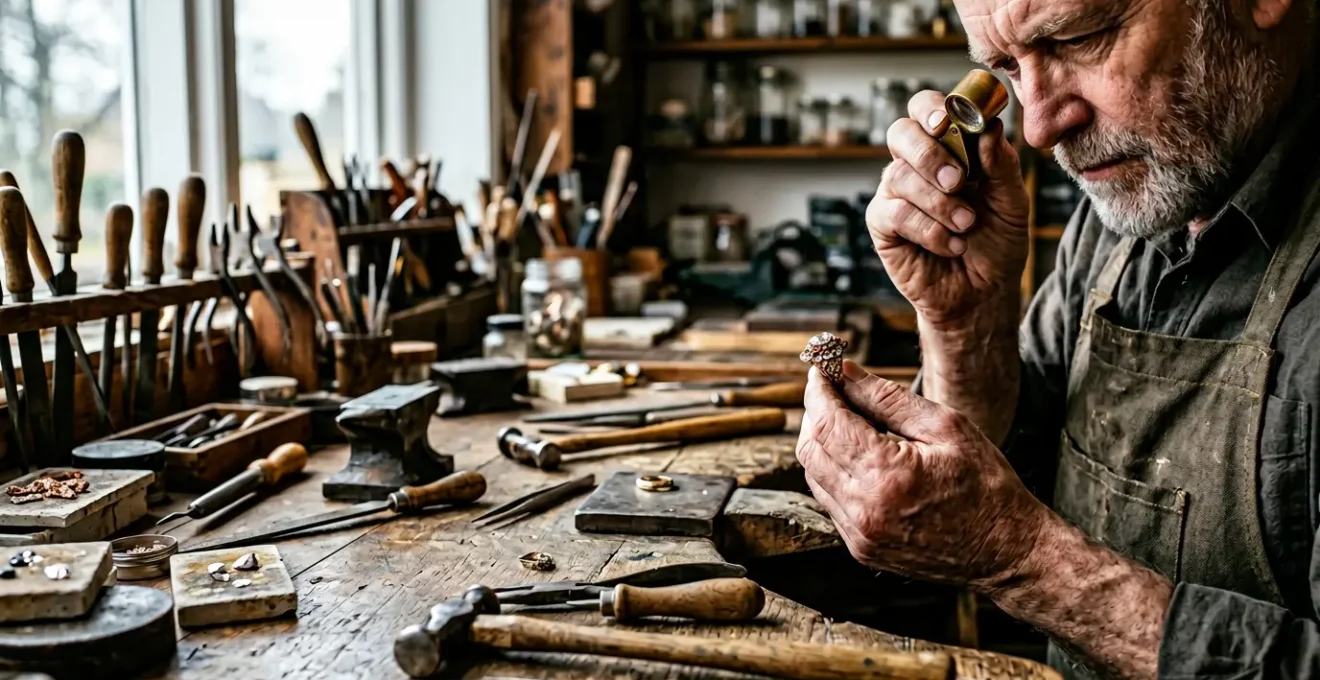
The difference in process, accountability, and transparency is stark. As illustrated below, the skill of a master goldsmith is a hands-on, precision craft that benefits immensely from direct client communication.
This visual underscores the expertise involved. When you choose a jeweller with an on-site workshop, you are not just buying a service; you are engaging directly with this level of skill and maintaining a clear line of sight over your precious item from start to finish.
The following table clearly contrasts the security of an on-site workshop with the uncertainties of a send-away service.
| Aspect | On-Site Workshop | Send-Away Service |
|---|---|---|
| Direct Communication | Speak directly with the goldsmith | Sales staff intermediary only |
| Liability Chain | Single point of responsibility | Multiple parties (shop, courier, workshop) |
| Insurance Coverage | Clear single policy | Potential gaps between policies |
| Work Transparency | Can observe work in progress | No visibility of actual repair |
| Timeline Control | Direct scheduling possible | Dependent on third-party availability |
Will Your Insurance Cover Damage Occurring During a Third-Party Repair?
While your home insurance may cover your jewellery for loss or theft, it typically does not cover damage that occurs while it is in the care of a third party for repair. This responsibility falls to the jeweller’s own business insurance, specifically a policy known as Jeweller’s Block insurance. This is a specialised policy designed to cover the unique risks of the jewellery trade, and it is a crucial element of your verification process. You must confirm that the jeweller has adequate coverage for customer property left for repair.
A reputable jeweller will have a policy that explicitly includes coverage for customer items damaged during the repair process. This protects you if a stone is chipped, a setting is warped, or the item is damaged by fire or theft while on their premises. The risk is magnified in a ‘send-away’ scenario. You must be certain that the insurance policy covers the item not only within the shop but also during transit and while at the third-party workshop. Any gap in this chain of coverage leaves your heirloom exposed.
Experts in the field stress the importance of understanding the nuances of these policies. As the team at HPM Insurance notes in their guide, the scope of coverage can vary significantly. It is your right as a customer to ask for confirmation of their insurance coverage for customer property.
Jewelers Block Insurance is often an ‘all-risk’ policy—meaning coverage against all perils except those listed in the policy’s exclusions. It is critical you understand how your policy will respond as your business changes.
– HPM Insurance, Jewelers Block Insurance Guide
Asking “Are you fully insured for damage to customer items during repair?” is not a rude question; it is a responsible one. A professional and trustworthy jeweller will be transparent about their coverage and understand that it is a key part of providing a secure service for high-value and sentimental pieces.
Goldsmith vs Sales Assistant: How to Ensure You Speak to the Person at the Bench?
The person who greets you at the counter is rarely the person who will be working on your heirloom. While sales assistants are knowledgeable about products, they are not the craftsmen. To properly vet a jeweller’s technical competence, you must speak directly with the goldsmith or master jeweller at the bench. This is the only way to accurately assess their experience with your specific type of repair, metal, and gemstone setting. Insist on a “bench consultation”, even if it requires a scheduled appointment and a small fee.
This direct conversation allows you to move beyond sales talk and into the technical details of the job. You can ask about their specific training, such as their Jewellery Education and Training (JET) certification level, or their experience with specialised techniques like laser welding versus traditional soldering. This is your opportunity to gauge their confidence and expertise. A true craftsman, like the master goldsmiths at Revolution Jewelry Works, will be able to discuss metal compatibility, stone protection methods, and the structural implications of the repair with precision and clarity. If the person you are speaking with cannot answer these questions without deferring to someone else, you are not speaking to the right person.
During this consultation, ask to see examples of similar repair work they have completed. A portfolio of past work is a tangible testament to their skill. Key questions to ask the goldsmith include:
- What is your experience with [specific metal, e.g., 18ct white gold] from this era?
- How will you protect the delicate stones or enamel work during the heating process?
- What are the risks associated with this repair, and how will you mitigate them?
- Can you explain the difference between the laser welding and traditional soldering you might use?
The quality of their answers will reveal their depth of knowledge. A confident, detailed response indicates true expertise, while vague or evasive answers should be considered a major red flag.
Why a ‘Same Day’ Repair Service Can Be a Red Flag for Quality?
In a world of instant gratification, the offer of a ‘same day’ or ‘one-hour’ repair can seem appealing. However, when it comes to antique and heirloom jewellery, speed is often the enemy of quality. The meticulous process of assessing, cleaning, repairing, and finishing a delicate historical piece cannot be rushed. A jeweller offering an unusually fast turnaround for a complex job may be cutting corners, using inappropriate modern techniques, or simply not giving the piece the attention it deserves. A rushed timeline is a significant red flag.
Quality heirloom restoration begins with a thorough assessment. As detailed by the restoration experts at Gray & Sons, this involves carefully examining the piece’s construction, identifying areas of weakness, and understanding its historical integrity. This diagnostic phase alone can take time. After assessment, the actual repair requires careful, deliberate work. For example, rebuilding a worn-out claw setting or repairing delicate filigree work is a process of patience and precision. Rushing can lead to visible solder joints, tool marks, or even damage to the gemstones.
A realistic timeline is a sign of a professional craftsman who respects the materials and the object’s history. According to a case study on heirloom restoration, a timeline can vary from a few days to several weeks depending on the complexity. A jeweller who provides a considered, multi-day or multi-week estimate is likely giving your piece the thoughtful attention it requires. They are accounting for necessary steps such as deep cleaning, sourcing period-appropriate components, allowing settings to cure, and final polishing. In contrast, a ‘same day’ service for anything beyond a simple chain solder suggests a one-size-fits-all approach that is unsuitable for irreplaceable items.
Do not be tempted by the promise of speed. Instead, view a longer, well-explained timeline as an indicator of a jeweller’s commitment to quality and preservation. Ask the goldsmith to walk you through the proposed stages of the repair and the time each will take. This transparency is a hallmark of a true professional.
Why Is the Assay Office Stamp Critical for UK Resale Value?
A hallmark is not a brand name; it is a legal mark of quality and authenticity applied by an independent UK Assay Office. It guarantees the precious metal content of an item, and its presence is critical for an item’s provenance, insurance valuation, and resale value. The UK Hallmarking Act 1973 legally requires that all gold, silver, platinum, and palladium items sold in the UK that are over a certain weight be hallmarked. Understanding these marks is essential when assessing a repairer’s professionalism, as any new metal added during a repair must also be legally accounted for.
According to the stringent standards outlined by the UK Hallmarking Act 1973, items for sale require hallmarking if they weigh more than 1 gram for gold, 0.5 grams for platinum, and 7.78 grams for silver. A professional jeweller will be intimately familiar with these laws. When a repair involves adding new metal that exceeds these weights—for example, rebuilding a shank on a ring—the item must be sent to an Assay Office to be re-hallmarked. A jeweller who fails to mention this or dismisses its importance is operating outside the law and devaluing your property.
These marks tell a story. A full traditional UK hallmark consists of a sponsor’s mark (who sent it for hallmarking), a metal and fineness mark, and the mark of the Assay Office (e.g., a leopard’s head for London). Historical pieces may also have a date letter. Preserving these original marks during a repair is paramount, as they are a key part of the item’s historical identity.
As the image suggests, these stamps are a rich part of an item’s character and history. A competent jeweller will know how to work around them or use “Addition Marks” to add new hallmarks without compromising the originals. Always ask a potential repairer: “If you add new metal, how will you manage the re-hallmarking process with the Assay Office?” Their answer will be a clear indicator of their professionalism and respect for UK law.
Do You Need a New Hallmark When Remodeling Old Jewellery?
When an heirloom is not just repaired but significantly altered or remodelled, the rules surrounding hallmarking become even more critical. If you are adding a new section, resizing a ring with additional metal, or combining elements from different pieces, you may be legally required to have the item re-hallmarked. This ensures the entire piece is accurately and legally described, protecting its future value. A qualified jeweller will not see this as a bureaucratic hurdle, but as a fundamental part of a professional and legally compliant service.
The legal trigger for re-hallmarking is the addition of new precious metal above the exemption weights. This means if a goldsmith adds more than one gram of gold or 0.5 grams of platinum, the piece must be sent to an Assay Office. It is possible to preserve the original, historically significant hallmarks by having the new sections stamped with “Addition Marks.” This is the best practice for maintaining the piece’s integrity. You should explicitly ask the jeweller how they plan to manage this process. A vague answer is a sign of inexperience or a disregard for legal standards.
Furthermore, significant remodelling, especially involving gemstones, requires an even higher level of expertise. As experts from Chrysella Jewelers advise, any work that involves altering the primary gemstones must be handled with extreme care by a certified professional.
Diamond reshaping, chip removal, and re-cutting should only be managed by a qualified gemologist and master diamond cutter. If your heirloom requires this maintenance, check your jeweler’s qualifications first to see if they hold certification by the GIA.
– Chrysella Jewelers, Jewelry Repair Guidelines
This highlights the dual expertise required: not just a goldsmith for the metalwork, but potentially a GIA-certified gemologist for the stones. Before committing to a major remodel, ask about both the hallmarking plan and the specific qualifications of the person who will be handling your gemstones. This ensures every aspect of your remodelled heirloom meets the highest professional and legal standards.
Key Takeaways
- Verification over trust: Base your decision on verifiable credentials like NAJ membership and on-site workshop capabilities, not just reviews or location.
- Understand the process: A quality repair involves a thorough assessment and cannot be rushed. A ‘same-day’ service for complex work is a major red flag.
- Legal compliance is non-negotiable: Ensure your jeweller understands and adheres to the UK Hallmarking Act, especially when adding new metal to a piece.
How to Remove Limescale Buildup from Diamond Rings in Hard Water Areas?
Once your heirloom has been professionally repaired and restored, proper aftercare is essential to maintain its beauty, especially if you live in a hard water area. Hard water, which is prevalent across many parts of the UK, contains high levels of minerals like calcium and magnesium. Over time, these minerals can deposit on your jewellery, creating a dull, cloudy film known as limescale, which is particularly noticeable on the facets of diamonds and behind settings.
While professional cleaning is always the safest option, some light surface maintenance can be performed at home. For simple, sturdy bands and settings, a soft-bristled toothbrush and a solution of warm water with a few drops of mild dish soap can gently remove recent buildup. However, DIY cleaning comes with significant risks. You should never use harsh chemicals or abrasive materials. Soaking a piece in vinegar can be effective for limescale, but it should be done with extreme caution—for no more than 10 minutes—as the acid can damage porous stones like pearls or opals and may affect the integrity of older solder joints.
The most important rule is to know when to stop and seek professional help. Certain situations demand the expertise and specialised equipment of a jeweller. Your decision to clean at home versus seeking professional help should be based on the type and location of the buildup:
- DIY Safe: Light surface limescale on a simple, modern gold or platinum band.
- DIY with Caution: Minor buildup on a sturdy, modern diamond solitaire setting.
- Professional Only: Any buildup under a stone’s setting, around the gallery, or on delicate antique filigree work. This requires ultrasonic or steam cleaning equipment that can dislodge stones if used improperly.
- Professional Recommended: Regular deep cleaning every 3-6 months is advised for those in very hard water areas to prevent significant buildup.
Protecting your newly restored heirloom means adopting a careful maintenance routine. Gentle at-home cleaning can help, but regular professional check-ups will ensure it remains in pristine condition for generations to come, preventing the need for more complex restorative work in the future.
By following this structured verification process, you replace anxiety with confidence. Your role is not just to hand over a precious item, but to act as its custodian, ensuring it is placed in the hands of a verified, insured, and legally compliant craftsman. For your peace of mind and the preservation of your family’s legacy, taking these steps is the most valuable investment you can make.
Frequently Asked Questions on How to Verify if a Jeweller Is Qualified to Repair Your Heirlooms?
When is a new hallmark legally required?
A new hallmark is legally required if new precious metal is added to a piece that exceeds the legal exemption weights. In the UK, this is 1 gram for gold and palladium, 0.5 grams for platinum, or 7.78 grams for silver. This often applies during resizing or significant restoration work.
Can original hallmarks be preserved during remodeling?
Yes, original and historically significant hallmarks can and should be preserved. A professional jeweller will work with the Assay Office to use “Addition Marks,” which are new hallmarks stamped onto the newly added sections of metal, leaving the original marks untouched to maintain the piece’s historical integrity and value.
What should I ask my jeweller about re-hallmarking?
You should ask a very specific question: “How will you manage the re-hallmarking process with the Assay Office for the new metal being added?” A professional and compliant jeweller will be able to provide a clear, detailed answer explaining the process of sending the item to an Assay Office for marking. A vague or dismissive response is a major red flag.