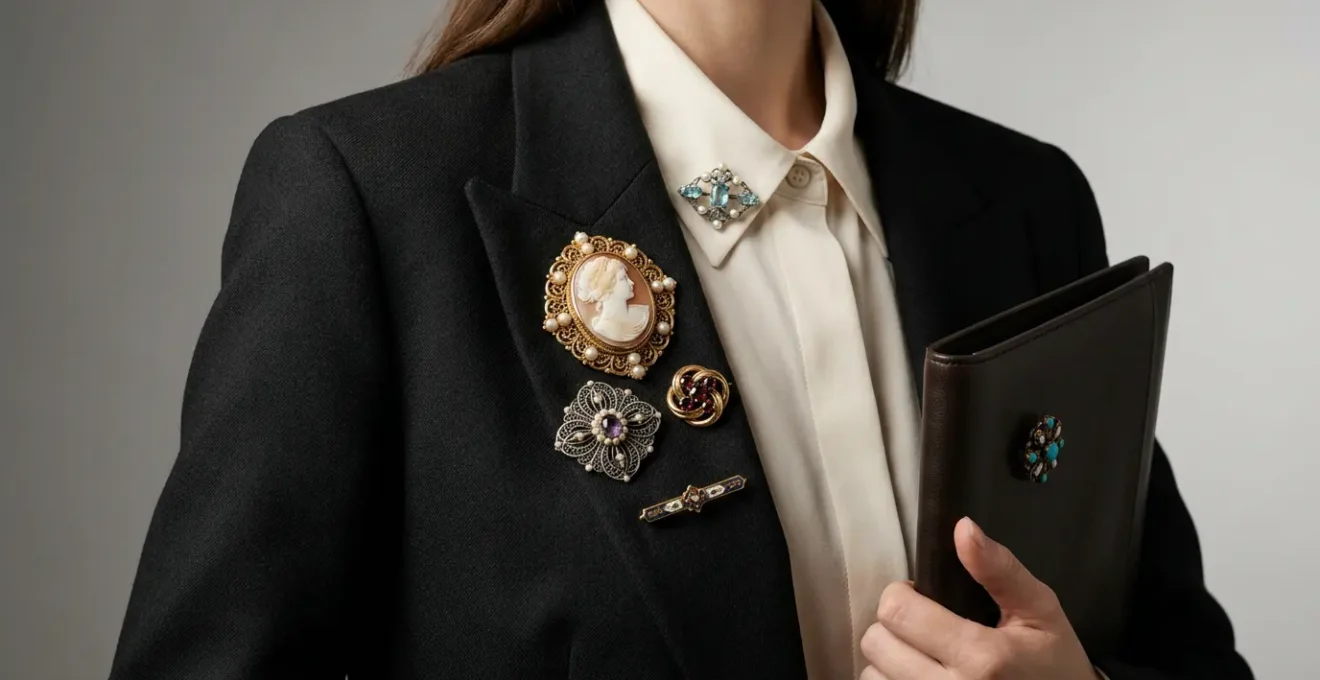
That inherited Victorian brooch is more than just jewelry; it’s a piece of history resting in a velvet-lined box. It’s intricate, beautiful, and carries the weight of stories you can only imagine. Yet, for the modern professional woman, it also carries a risk. The line between ‘timeless heirloom’ and ‘costume drama extra’ can feel perilously thin, especially under the fluorescent lights of a corporate boardroom. You want to honor its legacy, but not at the expense of your contemporary, professional image.
The common advice often misses the point. You’ll hear suggestions to simply pin it to a lapel or use it to fasten a cardigan, but these tips don’t address the core fear: looking dated. The challenge isn’t just about placement; it’s about integration. Many believe the secret lies in finding the perfect, subdued outfit to avoid a clash, but this can inadvertently make the brooch look even more like a museum piece on a bland wall. Other forms of body adornment, like delicate dental gems or minimalist ear cuffs, have found their modern footing, so why does the brooch feel so challenging?
What if the true secret to styling a Victorian brooch isn’t about downplaying its character, but about amplifying the contrast? The key lies in a principle of contextual contrast. This is not about finding a quiet home for an old object, but about treating the brooch as a deliberate piece of historical art and setting it against a powerful, minimalist, modern canvas. It’s an intentional juxtaposition that signals confidence and sophistication.
This guide will deconstruct that principle, moving from the practical mechanics of wearing a heavy piece to the strategic psychology of making a statement. We will explore how to protect your garments, master modern layering techniques, and understand the subtle codes of corporate jewelry, transforming your heirloom from a source of anxiety into your most powerful professional accessory.
To navigate the art of vintage styling in a modern workplace, this article breaks down the essential strategies. Discover how to handle everything from fabric care to boardroom etiquette in the sections below.
Contents: How to Integrate Antique Jewellery into a Modern Wardrobe
- Why Heavy Brooches Ruin Silk Blouses and How to Fix It?
- How to Layer Art Deco Necklaces with a Modern T-Shirt?
- Clip-ons to Posts: Is Converting Vintage Earrings Worth the Cost?
- The Styling Mistake That Makes Real Vintage Look Like Fancy Dress
- Gold and Silver Together: How to Break the Taboo with Vintage Pieces?
- How to Use a Lapel Brooch to Draw Attention During Negotiations?
- Central Saint Martins Graduates: How to Spot Talent Before Prices Rise?
- Statement Jewellery in the City: What Is Acceptable in a Corporate Boardroom?
Why Heavy Brooches Ruin Silk Blouses and How to Fix It?
The first hurdle in wearing a Victorian brooch is often a practical one: its weight. These pieces were crafted in an era of sturdier fabrics. A heavy, silver-and-jet mourning brooch that sat perfectly on a structured wool bodice can create disastrous pulls, snags, or even permanent holes in a modern silk or satin blouse. The delicate weave of contemporary fabrics simply isn’t engineered to support the concentrated weight and sharp pin of a 19th-century fastening.
The image above highlights the tension between a delicate fabric and a traditional pin mechanism. But preventing this damage doesn’t mean relegating your brooch to a drawer. The solution lies in creating support and distributing the weight. Modern innovations offer elegant fixes that make almost any brooch wearable. For instance, powerful magnetic converters provide a no-pierce solution that, according to MagnaPin’s patented technology, works on most fabric types including satin, leather, and silk.
Beyond magnets, consider these structural solutions. Placing a small, discreet fabric support patch on the inside of the garment acts as an anchor, reinforcing the area. Another clever technique for blouses is to secure the brooch through the outer layer onto a camisole strap underneath. The strap bears the weight, making the support completely invisible. The most fundamental rule, however, is to pin at structural points. Areas like lapels, collars, cuffs, or plackets are often reinforced with interfacing or have double layers of fabric, providing the natural sturdiness required to hold a heavier piece without sagging or damage.
How to Layer Art Deco Necklaces with a Modern T-Shirt?
While this article focuses on Victorian brooches, the principles of styling vintage jewelry often cross-pollinate. The question of layering an Art Deco necklace with a simple T-shirt shares a core challenge with wearing multiple brooches: how do you create a cohesive, intentional cluster rather than a chaotic mess? The goal is to achieve a look that feels curated and modern, not like you’ve raided a costume box. The modern T-shirt, much like a minimalist blazer, acts as a blank canvas for artistic expression.
When clustering brooches—the parallel concept to layering necklaces—the technique you choose sends a distinct message. It’s a game of balance, theme, and asymmetry. One popular approach is the “Scattered Similar,” where multiple brooches of a similar theme, like a collection of enamel butterflies, are placed artistically on one side of a jacket. This works exceptionally well in creative industries where personal expression is encouraged. For a more balanced look suitable for business casual settings, the “Two-Plus-One” technique offers a sophisticated asymmetry.
Case Study: The Avant-Garde Lapel
As demonstrated by fashion writer Lauren Sands, a modern way to wear brooches in a professional setting is to double up on a blazer lapel. She advises using larger statement pieces to avoid a “grandma” aesthetic and often combines vintage geometric or figural brooches with contemporary Blaze Milano blazers. This creates an avant-garde but sophisticated impact, proving that more than one brooch can be office-appropriate when executed with confidence.
For those in more fashion-forward environments, playing with asymmetry can be particularly effective. The key is to think about how the jewelry interacts with the lines of the garment. The following table breaks down these approaches.
| Technique | Visual Impact | Best For | Example |
|---|---|---|---|
| Scattered Similar | Cohesive, artistic | Creative industries | Multiple JAR butterfly brooches on one lapel |
| Two-Plus-One | Balanced, interesting | Business casual | Two florals on shoulder, one small at decolletage |
| Asymmetric Cluster | Modern, edgy | Fashion-forward offices | Dress clips playing with jacket lines on one side |
Clip-ons to Posts: Is Converting Vintage Earrings Worth the Cost?
The desire to make vintage jewelry wearable often leads to a significant question: should you alter it? This dilemma is common with vintage earrings, where clip-on backings can be uncomfortable for modern wearers. However, the same logic applies to brooches that feel unwearable in their current form. Perhaps the pin mechanism is broken, or its weight and size make it impractical as a brooch. In these cases, converting it into a pendant can give a cherished family heirloom a new life.
The first consideration is whether the alteration is reversible. Temporary conversion options are always preferable for valuable pieces. For brooches, this can be as simple as threading a silk ribbon or a delicate chain behind the pin mechanism to wear it as a necklace. More structured, non-permanent solutions include specialized pin-to-pendant converters, which are small metal components that slide onto the pin and provide a loop for a chain. These converters are widely available and typically cost between $9.99 and $23.68, making them a low-risk way to test a new style.
Permanent alteration is a more serious step. The primary question to ask is: is it worth permanently altering a historic piece? For authentic, rare, or signed Victorian jewelry, any permanent change can be detrimental to its value. Collectors and jewelry experts caution that such alterations can decrease the resale value by a staggering 30-50%. However, there are scenarios where it makes perfect sense. If the original pin mechanism is already broken beyond repair, or if the piece has significant damage that prevents it from being worn as intended, a professional conversion by a skilled jeweler can be a form of restoration, rescuing it from being unworn and unloved.
The Styling Mistake That Makes Real Vintage Look Like Fancy Dress
The single greatest mistake when wearing a significant vintage piece, like a Victorian brooch, is not the piece itself, but its context. Many people try to “match” the vintage feel of the brooch with their clothing, opting for ruffled blouses, velvet jackets, or ornate patterns. This is what tips the scale from chic to costume. It creates a historical reenactment rather than a modern style statement. As one fashion analysis puts it:
The #1 mistake is context, not the item. The golden rule is ‘One Piece of History at a Time’. The brooch is the story; the outfit must be a modern canvas.
– Fashion Analysis, How to Style Victorian Brooches – Article Analysis
Your outfit is the frame, and a minimalist, modern frame makes the historic artwork pop. Think of your brooch as the “hero piece.” Everything else—your clothing, other accessories, even your hair and makeup—should be the supporting cast. An ornate, sentimental Victorian brooch suddenly looks incredibly powerful and intentional when pinned to the sharp lapel of a severely tailored, architectural blazer in a solid, neutral color.
This principle of “contextual contrast” is your most powerful tool. The more intricate and historic your brooch, the cleaner and more contemporary your outfit should be. This deliberate juxtaposition is what creates visual interest and signals a high degree of style consciousness. It tells the world that you are wearing this piece by choice and with intention, not because you are stuck in the past. To master this, you can follow a simple set of guidelines.
Your Action Plan: The Rule of Opposites Styling Guide
- Garment Choice: Pair ornate, intricate brooches with severely minimalist and architectural clothing. Think clean lines, solid colors, and modern silhouettes.
- Fabric & Form: Match geometric, masculine-feeling brooches with soft, feminine fabrics like cashmere or silk to create a compelling tension.
- Hair & Makeup: Keep your hair and makeup clean, modern, and polished. Avoid elaborate updos or heavy, vintage-inspired makeup.
- Accessory Pairing: Choose modern accessories to accompany your look. A sleek leather tote is a better choice than a beaded clutch.
- Mindset: Wear the piece with a sense of conscious irony or appreciation for its history, rather than attempting an earnest historical recreation.
Gold and Silver Together: How to Break the Taboo with Vintage Pieces?
For decades, the rule was simple: don’t mix your metals. You were either a “gold person” or a “silver person.” Thankfully, that outdated rule has been replaced by a more modern, eclectic approach to jewelry. In fact, it is a major trend, with some analysts pointing to mixed metal jewelry as a key look for 2026. This is fantastic news for owners of vintage jewelry, as Victorian brooches are often the perfect “bridge” piece to tie a mixed-metal look together.
The “bridge piece” strategy is simple: use one piece of jewelry that inherently contains both gold and silver tones to justify and unify the other pieces you’re wearing. Many Victorian-era brooches are perfect for this role. It was common for jewelers to use techniques like gold washing over silver (vermeil) or to incorporate both metals in a single design. A brooch with a silver base and gold accents instantly gives you permission to wear a silver-toned watch with your favorite gold hoops. It makes the combination look intentional and sophisticated, not accidental.
Case Study: The ‘Bridge Piece’ Strategy in High Fashion
Fashion editors have embraced the “bridge piece” strategy as a cornerstone of modern styling. As noted by The Fashion Fold, designers like Saint Laurent and Bottega Veneta have prominently featured mixed-metal brooches in recent collections, with prices ranging from $750 to $2,400. These high-fashion examples solidify the brooch’s role not just as an accessory, but as a strategic tool for enabling one of today’s biggest jewelry trends.
To implement this yourself, start with your Victorian brooch. If it has both silver and gold elements, make it the focal point of your outfit. Then, feel free to add other, single-metal pieces. You could pair it with a delicate gold chain necklace and a stack of silver rings. The brooch acts as the anchor, telling a cohesive story and demonstrating that your choice to mix metals was deliberate and chic.
How to Use a Lapel Brooch to Draw Attention During Negotiations?
A brooch is not merely a decorative object; in a professional context, it can be a tool of non-verbal communication. When placed strategically, it can guide an observer’s gaze, project an image of authority, and even convey a subtle message. This is never more true than in a high-stakes meeting or negotiation, where every detail of your professional ‘brand’ is under scrutiny. A well-chosen brooch can be a powerful asset.
A brooch is acceptable if it supports your professional image. A bold, architectural piece can signal authority and creativity. The key is for the piece to seem like a deliberate part of your professional ‘brand’.
– Professional Styling Analysis
The placement itself is a strategic choice. Conventionally, brooches are worn on the left lapel, over the heart. However, for maximum impact during business interactions, consider the right lapel. This is the side that is most prominent during a handshake, drawing the eye at a key moment of introduction and connection. It also keeps the piece in the listener’s line of sight as you gesture or present, subtly reinforcing its presence.
Even more powerfully, you can use the symbolism inherent in Victorian jewelry to your advantage. The Victorians had a complex language of symbols expressed through their adornments, and you can leverage this to project a specific quality. Choosing a brooch with a subtle motif can subliminally reinforce the message you wish to convey.
- Industry and Hard Work: A bee or fly motif was a popular Victorian symbol for diligence. Wearing one can signal your commitment and work ethic.
- Wisdom and Partnership: A snake or serpent, often forming a circle, represented eternal love, loyalty, and wisdom. This can be a powerful symbol in partnership discussions.
- Stability and Steadfastness: An anchor brooch projects a sense of stability and reliability, which can be highly reassuring in uncertain negotiations. As detailed in the rich history of Victorian jewellery, these motifs were far from random.
- Friendship and Agreement: A hand motif was used to signal friendship, and it can be a subtle nod towards collaboration and reaching an agreement.
Central Saint Martins Graduates: How to Spot Talent Before Prices Rise?
The way an art collector learns to spot a promising Central Saint Martins graduate before their work commands astronomical prices is the same way a savvy jewelry wearer should learn to appreciate a piece of vintage. It’s about developing an “eye”—the ability to look beyond the surface sparkle and recognize the markers of quality, craftsmanship, and historical significance. A Victorian brooch isn’t just an accessory; it’s a miniature work of art with its own story and provenance.
Developing this eye transforms your relationship with your heirloom. It moves from being a pretty object to a fascinating artifact. Instead of just seeing “an old pin,” you begin to see the innovation of its materials, the skill of its maker, and its specific place in time. For example, recognizing the difference between an early C-clasp (common before 1900) and a later trombone clasp helps you date the piece more accurately. Spotting the use of then-innovative materials like Vulcanite, jet, or bog oak tells a story about the period’s technological and social changes.
The most significant value multiplier, however, is often a tiny, almost invisible stamp. A maker’s mark or a set of hallmarks can increase a piece’s value by 200-500% or more. These marks attribute the work to a specific creator or workshop, transforming it from an anonymous object into a signed piece of art. Learning to identify these indicators is the first step toward becoming a true connoisseur.
The following table outlines some key quality indicators to look for when assessing a piece of Victorian jewelry. It’s a starting point for training your eye to see the details that matter.
| Quality Indicator | What to Look For | Value Impact |
|---|---|---|
| Maker’s Marks | Stamped signatures, hallmarks | Can increase value 200-500% |
| Clasp Type | C-clasp (pre-1900) vs trombone clasp | Indicates authentic period |
| Stone Settings | Cut-down collets, closed backs | Shows original craftsmanship |
| Materials | Vulcanite, jet, bog oak, micromosaics | Innovative for their time |
Key Takeaways
- The #1 rule for wearing vintage is contextual contrast: pair an ornate brooch with a minimalist, modern outfit.
- Protect delicate fabrics by using magnetic converters, reinforcing patches, or pinning onto structural points like lapels and collars.
- Use a mixed-metal Victorian brooch as a “bridge piece” to stylishly combine both gold and silver jewelry in one look.
Statement Jewellery in the City: What Is Acceptable in a Corporate Boardroom?
The final question for any professional is one of context: what is truly acceptable in a corporate boardroom? The answer is nuanced and depends heavily on your industry culture. The bold, figural brooch that would be celebrated in a creative agency or a fashion house might be seen as distracting in a conservative law firm or financial institution. The key is to match the style of your statement piece to the unspoken rules of your professional environment.
Experts from a Today.com feature on the topic note that brooches carry significant symbolism, from associations with royalty to indicators of military rank, which gives them a gravitas other jewelry may lack. In highly corporate settings like banking or law, the most acceptable pieces are typically small, understated, and made of precious materials. Their value is in their quiet quality, not their size. In contrast, creative industries welcome larger, more artistic, or historically interesting pieces that signal creativity and individuality.
A helpful guideline for any industry is the Total Jewellery Quotient (TJQ) rule. If you are wearing a statement brooch, it should be the “hero” piece. This means keeping all other jewelry minimal. Simple stud earrings are appropriate, but a necklace would likely compete with the brooch and create a cluttered look. The goal is a single, strong focal point. And how do you differentiate between ‘statement’ and ‘distracting’? A statement piece is artistically significant or historically interesting. A distracting piece is one that jingles, flashes excessively, or is cartoonishly oversized for the setting.
By treating your Victorian brooch not as a relic but as a strategic style tool, you transform it. It becomes a testament to your ability to bridge the past and the present, a symbol of heritage worn with modern power. Now, the next step is to open that velvet box and choose the perfect modern canvas for your piece of history.
Frequently Asked Questions about Styling Victorian Brooches
Is it worth permanently altering a Victorian brooch?
You should consider the brooch’s historical value and rarity. For authentic and valuable Victorian pieces, alterations can decrease resale value by 30-50%. Conversion is best reserved for pieces that are already damaged or less historically significant, where the alteration gives an otherwise unwearable piece new life.
What are temporary conversion options?
To wear a brooch as a pendant without permanent changes, you can thread a chain or velvet ribbon behind the pin mechanism. Alternatively, you can use modern pin-to-pendant converters that slide onto the pin, providing a loop for a chain without altering the original piece.
What’s the Total Jewellery Quotient (TJQ) rule?
The TJQ rule dictates that a statement piece, like a large brooch, should be the ‘hero’ of your look. If you wear a statement brooch, keep other jewelry minimal to avoid a cluttered or distracting appearance. Simple stud earrings are fine, but it’s best to forgo a necklace.