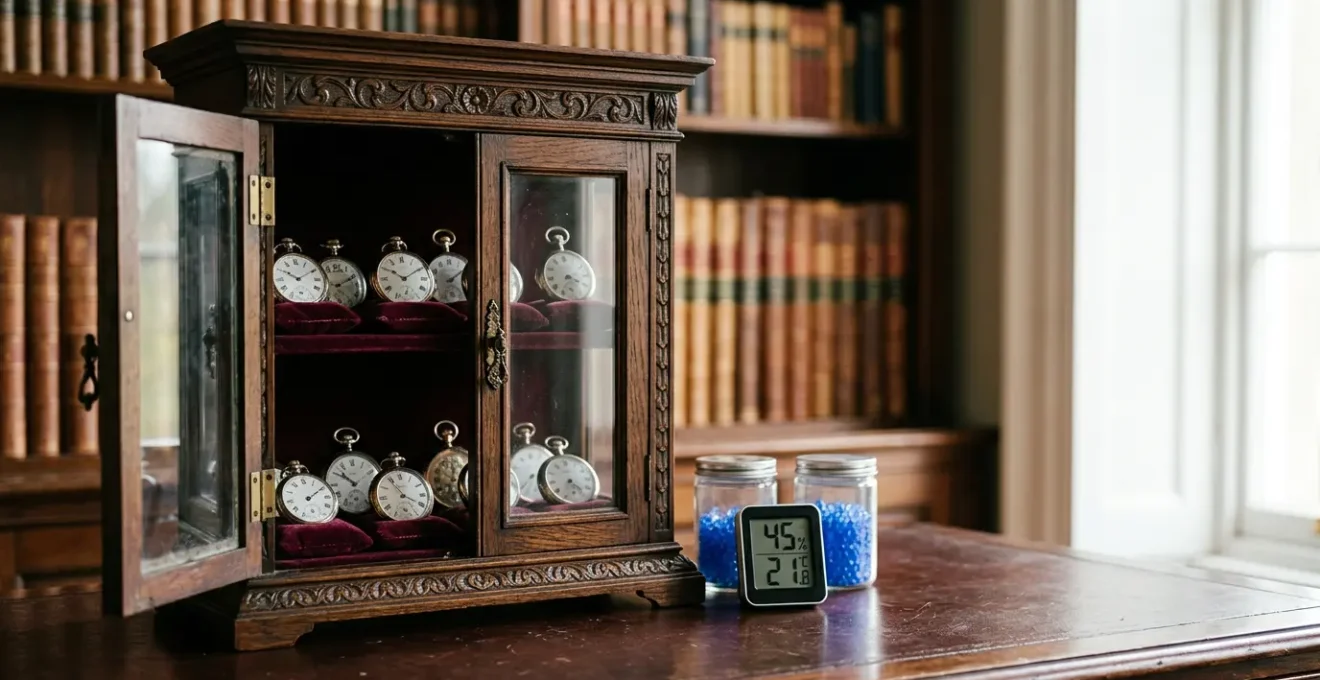
In summary:
- The damp UK climate poses a direct threat to the mechanical and material integrity of vintage timepieces.
- Passive storage is insufficient; you must actively engineer a stable micro-environment using desiccants and proper monitoring.
- Understanding material-specific risks like dried oils, radium paint degradation, and gasket decay is key to preventative care.
- Correct servicing schedules and avoiding improper polishing are crucial for preserving both the function and investment value of your collection.
For the owner of a vintage timepiece in the United Kingdom, there is a quiet, persistent anxiety that accompanies the damp air. It’s the fear of hearing a faint, gritty sound when winding a treasured pocket watch, or spotting the first microscopic bloom of rust on a once-perfect movement. Collectors invest in beautiful watch boxes and seek out “dry” rooms, believing these are sufficient safeguards. Yet, these common practices often fall short because they address the symptom, not the underlying physics of the British climate.
The standard advice overlooks a critical principle of horological conservation: you cannot simply find a dry space; you must create one. Effective preservation is not a passive act of storage but an active process of engineering a stable micro-environment. This approach shifts the focus from the room to the container itself—the watch box or safe—and treats the collection not as a set of static objects, but as a delicate system in constant interaction with its surroundings. The real threat isn’t just a single catastrophic event, but the slow, cumulative damage from fluctuating humidity that degrades lubricants, compromises material integrity, and ultimately erodes both function and value.
This guide moves beyond generic tips to provide a technical, preventative framework. We will dissect the specific ways in which moisture attacks a vintage watch, from the inside out. We will explore the science behind why dried oils become an abrasive paste, how to identify dangerous dial materials, and why a single polishing mistake can erase decades of history and thousands of pounds in value. Finally, we will outline the practical systems—from servicing strategies to insurance requirements—needed to build a robust defence against the inevitable dampness of the UK climate.
To navigate these critical aspects of watch care, this article is structured to address the most pressing concerns for a collector. The following sections provide a clear roadmap for preserving the integrity and value of your heirlooms.
Contents: A Technical Guide to Vintage Watch Preservation
- Why Running a Vintage Watch with Dried Oil Destroys the Pivots?
- How to Wind a Pocket Watch Without Snapping the Mainspring?
- Radium vs Tritium: Is Your Vintage Dial Radioactive?
- The Polishing Mistake That Wipes 30% Off a Vintage Rolex Value
- How Often Should You Service a Watch That Sits in a Safe?
- Do You Really Need a Graded Safe to Insure a Watch Collection at Home?
- Silica Gel Packs: Are They Essential for Storing Watches in the UK?
- How to Verify if a Jeweller Is Qualified to Repair Your Heirlooms?
Why Running a Vintage Watch with Dried Oil Destroys the Pivots?
A common misconception among new collectors is that if a vintage watch is running, it must be healthy. This is a dangerous assumption. Inside the intricate world of a mechanical movement, specialized oils are applied to high-friction points, particularly the tiny pivots of the gear train and balance wheel. Over decades, these oils don’t simply evaporate; they undergo a process called polymerization. They thicken, break down, and mix with microscopic dust and metal particles, transforming from a slick lubricant into a viscous, abrasive paste.
Running a watch in this condition is the equivalent of running a car engine with sand in the oil. The hardened oil residue grinds away at the delicate steel pivots and wears out the jewel bearings. The damage is irreversible, leading to poor timekeeping, loss of amplitude in the balance wheel, and eventually, catastrophic failure. This is why the concept of “mechanical hibernation” is so vital for stored watches; a dormant watch with dried oil is far safer than one that is periodically run, causing continuous wear. It’s essential to recognize the warning signs before significant damage occurs.
Key indicators that the oils in your vintage watch have degraded include:
- A gritty or grinding sound when you wind the crown.
- The power reserve becoming inconsistent, with the watch stopping sooner than expected.
- Increased resistance or stiffness when you pull out the crown to set the time.
- Visibly dark or discoloured residue around the pivot jewels, which can sometimes be seen through a case back.
- Erratic timekeeping, such as gaining or losing significant time, or stopping and starting without reason.
Recognizing these symptoms is the first step in preventative maintenance. If any are present, the watch should not be run and must be scheduled for a full service, where the movement will be completely disassembled, cleaned, and correctly re-lubricated.
How to Wind a Pocket Watch Without Snapping the Mainspring?
The mainspring is the heart of a mechanical watch, storing the energy required to power the entire movement. In antique pocket watches, these springs are often made of carbon steel, which can become brittle with age. The fear of “over-winding” and snapping this critical component is common, but the risk can be managed with proper technique. The term “over-winding” is a misnomer; you cannot wind a manual watch past its fully wound state. The real danger lies in applying excessive force once the spring is already fully coiled.
The correct method is to wind slowly and smoothly, paying close attention to the tactile feedback from the crown. As the mainspring tightens, you will feel a gradual increase in resistance. The goal is to stop at the “plateau of resistance”—the point where the tension stops increasing and becomes firm. Do not try to force it for one last turn. A gentle, consistent winding routine each day is far better for the mechanism than letting it run down completely and then winding it with excessive force. This practice maintains consistent tension on the gear train and can even contribute to better timekeeping.
The image above reveals the coiled power of the mainspring within its barrel. The delicate nature of this component underscores the need for a sensitive touch. By developing a feel for the winding mechanism and respecting its physical limits, you can significantly reduce the risk of a costly and damaging mainspring failure, ensuring your heirloom continues to tick for generations to come.
Radium vs Tritium: Is Your Vintage Dial Radioactive?
The luminous material, or “lume,” on a vintage watch dial is a key element of its character, but it can also be a source of concern. Before the 1960s, the dominant luminous material was Radium-226, a highly radioactive substance. While the alpha particles emitted by radium cannot penetrate a watch case or crystal, the decay process produces radon gas, and flaking paint particles can be hazardous if inhaled or ingested during a service. The binder used in radium paint is also highly susceptible to moisture. As vintage watch preservation guides warn, humidity levels above 60% can accelerate the breakdown of this binder, causing the lume to crumble and potentially contaminate the movement.
From the 1960s to the late 1990s, Radium was replaced by Tritium (H-3), a much less hazardous radioisotope that emits low-energy beta particles. Identifying which material is on your dial is crucial for both safety and understanding its aging characteristics, especially in the damp UK climate.
This table provides a guide to help distinguish between these two common types of vintage lume.
| Characteristic | Radium (Pre-1960s) | Tritium (1960s-1990s) |
|---|---|---|
| UV Light Response | No reaction | Brief afterglow |
| Color After Aging | Brown/Yellow patina | Creamy yellow |
| Flaking Risk | High in humidity | Moderate |
| Half-life | 1,600 years | 12.3 years |
Given Radium’s long half-life of 1,600 years, a pre-1960s watch is still essentially as radioactive as it was when new. A Tritium-lumed watch, with its 12.3-year half-life, will have lost most of its luminosity. Understanding this distinction is vital for safe handling and for appreciating the unique patina each material develops over time.
The Polishing Mistake That Wipes 30% Off a Vintage Rolex Value
For a vintage watch collector, “patina” is a badge of honour, while “polishing” is often a cardinal sin. The financial and historical value of a piece, particularly an iconic sports watch like a vintage Rolex, is intrinsically tied to the originality of its case. The sharp, well-defined edges, the original brushed surfaces, and the precise bevels on the lugs (known as chamfers) are all part of its factory-born identity. An aggressive or amateur polishing job can destroy these features in minutes, erasing decades of history and wiping as much as 30% or more off the watch’s market value.
The goal of a conservator is not to make a watch look brand new, but to preserve its existing state. Polishing is an act of removal; each pass with the wheel strips away a layer of precious metal, softening sharp lines, thinning the case, and distorting its intended geometry. Crown guards become rounded, lug holes become elongated, and the crisp reflections on the case sides turn into a wavy, funhouse-mirror effect. Once metal is removed, it cannot be put back (short of expensive and controversial laser welding). This is why a “never polished” or “unpolished” case commands such a significant premium on the vintage market.
Before acquiring a vintage piece or considering a “refresh” of your own, it is imperative to become an expert at spotting the signs of over-polishing. This audit is one of the most critical skills in vintage watch collecting.
Your Pre-Purchase Polishing Inspection Checklist
- Examine the edges of the lugs under magnification. Are the chamfers sharp and distinct, or are the curves soft and rounded?
- Check the lug holes where the spring bars fit. Are they perfectly round, or do they show elongation and a “dished” appearance from wear and polishing?
- Inspect the crown guards. Do they have their original sharp, defined edges, or have they been rounded into soft profiles?
- Look for distortion in reflections on the flat sides of the case. A perfectly flat, original surface will give a clean reflection, whereas a polished one often appears wavy.
- If possible, compare the case thickness to factory specifications using digital calipers. A heavily polished case will be noticeably thinner.
By internalizing these checks, you can protect yourself from costly mistakes and learn to appreciate the subtle beauty of a case that wears its history with pride.
How Often Should You Service a Watch That Sits in a Safe?
This is one of the most debated topics in watch collecting. The traditional advice of servicing a mechanical watch every 3-5 years applies primarily to watches worn daily. But what about a collector’s piece that spends most of its life in a safe? The answer requires a nuanced, dual-schedule approach that considers both age and usage. For modern watches, the equation is simpler; for example, updated manufacturer recommendations suggest a 10-year service interval for many post-2015 Rolex watches using advanced synthetic oils.
For vintage watches, however, the strategy must be different. The concept of “mechanical hibernation” suggests that as long as a watch is stored in a clean, dry micro-environment, a full service is only necessary when performance issues arise, such as stopping or losing time. Winding the watch once a month is sufficient to keep the lubricants lightly distributed without causing the wear associated with continuous running. However, this does not mean the watch can be ignored indefinitely. A critical point of failure in a stored watch is not the lubricants, but the gaskets.
As the image above starkly illustrates, rubber gaskets that seal the case back, crystal, and crown become brittle and cracked over time, regardless of use. An aged gasket offers zero protection against humidity, making it the weakest link in your defence. Therefore, a sensible dual-schedule strategy for a stored vintage watch is a pressure test and gasket replacement every 3-4 years, and a full movement service only when performance dictates. This approach balances preservation with cost, protecting the watch from its greatest enemy—moisture—while minimizing intervention in the movement itself.
Do You Really Need a Graded Safe to Insure a Watch Collection at Home?
Many collectors assume their high-value watches are covered under their standard home insurance policy. This is often a financially devastating mistake, especially in the UK. Most home insurance policies have a “single-item limit,” which is the maximum amount they will pay out for any one item that isn’t specifically listed on the policy. As UK insurance specialists note, standard UK home policies often have a single-item limit of £1,500-£2,500. If your £10,000 vintage Submariner is stolen, you may only receive a fraction of its value.
To properly protect a collection, you need a standalone, specialist watch insurance policy or a high-value contents policy that allows you to list items individually. These policies provide “Agreed Value” coverage, meaning you and the insurer agree on the watch’s value upfront (based on an appraisal), and that is the exact amount you will be paid in the event of a total loss. This is far superior to “Market Value” coverage, which leaves the insurer to determine its worth at the time of the claim.
However, these specialist policies come with stringent security requirements. For collections of significant value (often over £10,000), insurers will almost certainly mandate the use of a professionally installed, certified graded safe. The required grade of the safe (e.g., Eurograde 1, 2, or 3) will depend on the total value of the items stored within it. Failing to store the watches in the specified safe as required by the policy can void your coverage entirely. While the upfront cost of a graded safe is considerable, it is a non-negotiable component of a comprehensive asset protection strategy for any serious watch collector.
Silica Gel Packs: Are They Essential for Storing Watches in the UK?
In a word: yes. Given that watch storage experts in the UK emphasize that UK home humidity fluctuates significantly between seasons, a passive approach is inadequate. Silica gel is not just an optional extra; it is the primary tool for actively engineering the stable, low-humidity micro-environment that your collection needs to survive. The goal is to keep the relative humidity (RH) inside your watch box or safe consistently below 50%. This level is low enough to prevent corrosion on metal parts and inhibit the moisture-related breakdown of materials like radium paint binder and old gaskets.
However, simply tossing a few packs into a safe and forgetting about them is ineffective. Silica gel has a finite capacity to absorb moisture. Once saturated, it does nothing. This is why proactive monitoring is essential. Many types of silica gel include indicator crystals that change color—typically from blue or orange (dry) to pink or white/green (saturated)—to show when they need to be replaced or recharged. For a collector in the UK, checking these indicators should be a scheduled part of your collection management routine, perhaps on the first of every month.
Recharging silica gel is a simple and cost-effective process, making it a sustainable solution for long-term preservation. Follow these steps to ensure your desiccant is always working at peak efficiency:
- Check the indicator silica gel regularly. The color change from blue (dry) to pink or white (saturated) signals that it’s time for action.
- You should replace or recharge the gel when the color change has affected about 50% of the crystals.
- To recharge, spread the gel crystals evenly on a baking tray and heat them in an oven at 100°C (212°F) for 2-3 hours, or until the original color returns.
- Allow the gel to cool completely, then store it in an airtight container until it’s needed.
- As a rule of thumb, use approximately 10-20 grams of silica gel for each watch stored in a small, sealed container or watch roll.
By treating silica gel not as a disposable item but as a rechargeable component of your storage system, you can effectively combat the UK’s damp climate year-round.
Key Takeaways
- The primary goal of vintage watch storage in the UK is to engineer a stable, low-humidity micro-environment, typically inside a safe or sealed box.
- Moisture is the direct enemy of vintage movements, accelerating the degradation of lubricating oils and radium paint binders.
- The value of a vintage watch is heavily tied to its case condition; aggressive polishing can destroy its historical integrity and market worth.
- Standard home insurance is dangerously inadequate for valuable watches; specialist “Agreed Value” policies are essential but require adherence to strict security protocols like a graded safe.
How to Verify if a Jeweller Is Qualified to Repair Your Heirlooms?
The final link in the preservation chain is the person you entrust with your timepiece. A local jeweller who can change a battery is not the same as a horologist qualified to service a 70-year-old chronograph. Choosing the wrong person can lead to irreparable damage, the use of incorrect or non-original parts, and a significant loss of value. The onus is on the collector to perform due diligence and verify the watchmaker’s qualifications before handing over a treasured heirloom.
A qualified watchmaker will understand the nuances of vintage pieces. They will respect the value of originality, have the correct tools to work without leaving marks, and possess the crucial network of parts suppliers. They should be transparent about their process and willing to discuss their work in detail. When vetting a potential watchmaker, you are not just a customer; you are conducting an interview for a highly skilled position. Do not be intimidated to ask direct questions about their expertise and workshop.
To ensure you are placing your watch in competent hands, use this checklist during your initial consultation:
- Ask about their professional certifications, such as WOSTEP (Watchmakers of Switzerland Training and Educational Program) or the British Horological Institute’s CW21 (Certified Watchmaker for the 21st Century).
- Request to see their workshop. A clean, organized, and well-equipped space is a sign of a professional.
- Inquire if they have parts accounts with major brands (e.g., Rolex, Omega). This is crucial for obtaining authentic components.
- Ask for the warranty terms on their service work. A reputable watchmaker will stand by their work for at least one year.
- Request to see examples of similar vintage watches they have recently serviced. This demonstrates direct experience with the type of work you require.
Finding a trustworthy and skilled horologist is the most important investment you can make in your collection. Take the time to conduct this verification process diligently before any service is needed, so you have a trusted partner ready when the time comes.
Frequently Asked Questions on Watch Storage and Insurance
What’s the difference between ‘Agreed Value’ and ‘Market Value’ coverage?
Agreed Value guarantees a fixed payout amount that you and the insurer agree upon at the start of the policy, usually based on a recent appraisal. Market Value coverage allows the insurer to determine the watch’s current worth at the time of a claim, which can be lower than its replacement cost.
Do I need a graded safe for full coverage?
For collections over a certain threshold (often around £10,000), many specialist insurance policies will require that the watches be stored in a certified, professionally installed safe. Coverage may be reduced or voided if items are stolen from outside the safe.
Are mechanical failures covered by watch insurance?
No, standard watch insurance policies typically cover theft, loss, and accidental damage only. They do not cover mechanical failure resulting from lack of servicing, age-related wear and tear, or improper maintenance.