Trusting papers and a ‘perfect’ finish is the fastest way to get scammed on a pre-owned Cartier Love bracelet in the UK.
- Counterfeit “full sets” with forged papers are often more convincing than the poorly made jewellery they accompany.
- A simple kitchen scale is a more reliable first-line defence than a visual inspection, as counterfeiters rarely match the precise weight of solid 18k gold.
Recommendation: Your best defence is a healthy dose of skepticism, knowing the specific tricks counterfeiters use, and never letting the allure of a deal override your judgment.
You’ve found it. Scrolling through eBay or Gumtree, there it is: the Cartier Love bracelet, gleaming at a price that feels too good to be true, but just plausible enough. The seller has a good rating, the photos look clean, and the description ticks all the boxes. Your heart races with the thrill of the hunt, but a cold knot of fear tightens in your stomach. Is it real? In the treacherous waters of London’s pre-owned luxury market, that single question can be the difference between a savvy investment and a £4,000 mistake.
Most guides will give you a tired, generic checklist. They’ll tell you to “check the stamps,” “feel the weight,” and “look at the screws.” This is beginner-level advice, and frankly, it’s what counterfeiters expect you to do. The market is now flooded with “super-fakes”—high-grade replicas engineered to pass these simple tests. They use real gold plating, have clean engravings, and come with perfectly forged certificates that look more real than the authentic ones.
But if you think like an authenticator, you stop looking for the jewellery and start looking for the scam. The real giveaways aren’t just in the craftsmanship; they’re in the subtle inconsistencies of the counterfeiter’s methods. This isn’t a simple guide to spotting fakes. This is a masterclass in criminal methodology, exposing the specific tricks, from the “Full Set” scam to the “Marriage” piece, that are rampant in the UK’s secondary market.
This article will dissect the anatomy of a super-fake, moving beyond the obvious to reveal the tests that counterfeiters can’t pass. We will explore why misaligned screws remain a fatal flaw, how a simple kitchen scale can be your best tool, and why the paperwork is often the most fraudulent part of the entire package. Prepare to develop a healthy paranoia; it’s your best asset.
Summary: An Authenticator’s Field Guide to London’s Pre-Owned Cartier Market
- Why Misaligned Screws Are the #1 Giveaway of a Fake Love Bracelet?
- How to Verify a Serial Number with the Manufacturer Before Buying?
- Real Gold vs Plated Steel: How a Kitchen Scale Can Save You £4,000?
- The ‘Full Set’ Scam: Why Fake Papers Are Easier to Forge Than the Jewellery?
- Sterling or Silver: How to Date Tiffany Pieces by Their Stamps?
- The ‘Gold Filled’ Scam That Catches Out New Buyers on eBay UK
- The ‘Marriage’ Trick: How to Spot Frankestein Jewellery Pieces?
- eBay Authenticity Guarantee vs Vestiaire: Which Is Safer for UK Buyers?
Why Misaligned Screws Are the #1 Giveaway of a Fake Love Bracelet?
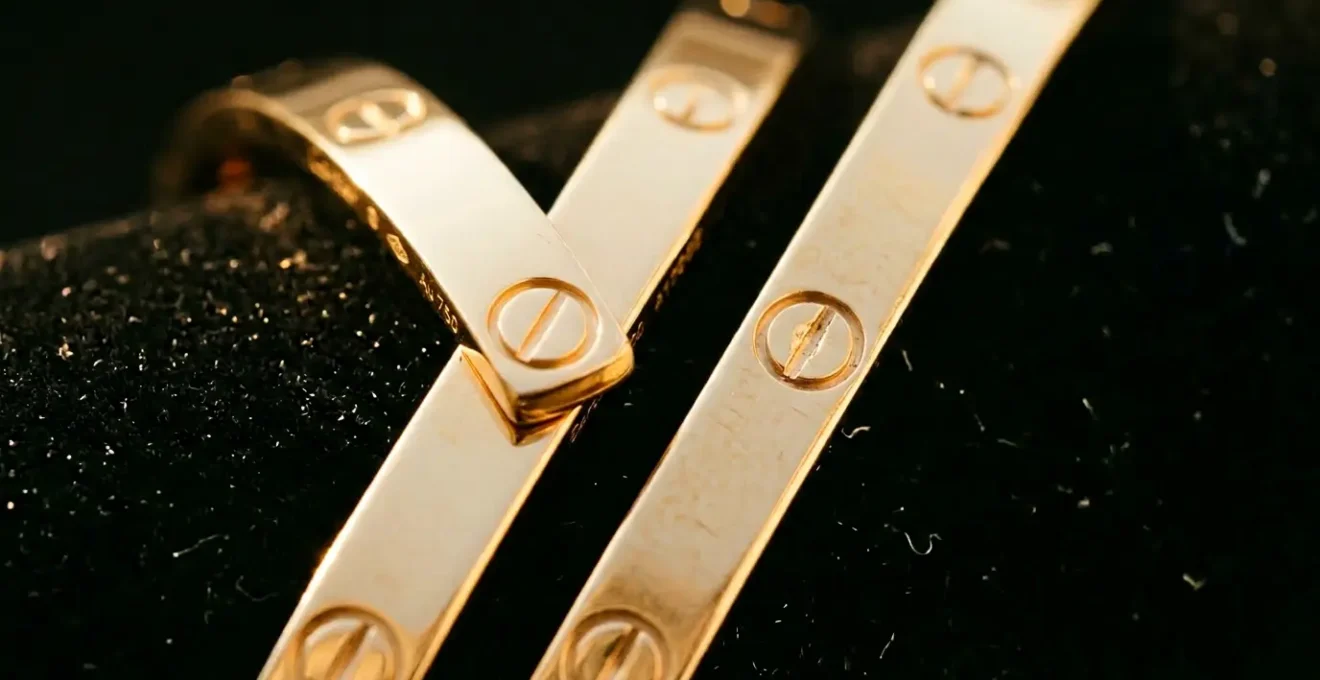
Forget the logo for a moment. The first place a seasoned authenticator looks is the screws. It’s the one area where mass-production laziness consistently betrays counterfeiters. They focus on the look, not the function. An authentic Cartier Love bracelet is a feat of micro-engineering; the screws are designed to secure perfectly and sit flush. Fakers, on the other hand, produce hardware that is merely decorative.
The visual difference, as shown in the comparison, is stark. On an authentic piece, the screw slots are perfectly perpendicular to the bracelet’s edge. They are crisp, sharp, and uniform. Fakes often feature slightly angled or inconsistently stamped screws. More damningly, fake screws often protrude and feel clunky when the bracelet is closed. Authentic screws should be so smooth that you can barely feel the seam. Some dealers attempt to mask imperfections with a heavy-handed polish, a trick known as the “London Polish”. While this can soften the edges on a real piece, it turns the crude lines of a fake into a blurry, rounded mess—an immediate red flag.
The included screwdriver is another point of failure. The authentic tool is designed to engage with the screw head perfectly, with no wiggle room. If the screwdriver feels loose or slips, you are holding two fakes: the tool and the bracelet. This isn’t just about aesthetics; it’s about precision manufacturing that is simply too expensive for counterfeit operations to replicate at scale.
Action Plan: The 3-Step Screw Alignment Test
- Check the screw ‘seam’ orientation: On authentic bracelets, the screws are subtle and smooth once closed. If they protrude or look clunky, it’s a major warning sign.
- Verify screw consistency: Both screws must be identical in size and shape, with the button neatly aligned. Counterfeits often have mismatched or poorly sized screws.
- Test the screwdriver fit: An authentic Cartier screwdriver should engage perfectly with the screw head without any wiggling. An improper fit indicates that both the tool and the bracelet are fake.
How to Verify a Serial Number with the Manufacturer Before Buying?
A serial number can feel like a guarantee of authenticity, but it’s often just another element for counterfeiters to copy. Many fakes on the UK market use legitimate serial numbers copied from photos of real bracelets. Therefore, simply seeing a clean serial number means nothing. The key is not just to check the number, but to verify its format and, if possible, its existence with Cartier. However, this requires a tactical approach.
Walking into a Cartier boutique on Bond Street and asking them to authenticate a bracelet you bought on Gumtree is a fool’s errand. For privacy and policy reasons, they will refuse. However, you can use a more subtle method. By pretending to be a prospective buyer, you can often get them to confirm if a serial number’s *format* is correct for a given production era. For example, current serial numbers come in three combinations: five digits and one letter, two letters and four digits, or three letters and three digits. A number that doesn’t fit these patterns is an instant fake.
When contacting a boutique, use a script. Start by saying, “I’m considering purchasing a pre-owned Love bracelet and would like to verify the serial number format.” Provide the number and ask, “Can you confirm if this follows the correct format for the production year?” Never ask for details about the original owner, as they are legally bound not to disclose this. While they may not give you a definitive “yes” or “no” on authenticity, a hesitant or confused response from the sales associate is often a telling sign that the number is bogus. It’s an indirect test, but a powerful one.
Real Gold vs Plated Steel: How a Kitchen Scale Can Save You £4,000?
In the world of high-end authentication, we use X-ray fluorescence analysers and microscopic imaging. But for your first line of defence against a super-fake, your most powerful tool is likely already in your kitchen. A simple digital scale can expose the vast majority of fakes, because while counterfeiters can replicate a look, they can’t easily replicate density. Solid 18k gold is heavy. Gold-plated steel is not.
Authentic Cartier Love bracelets are made of solid gold or platinum and have a significant, satisfying heft. As one expert notes, if the bracelet feels light or flimsy, it’s likely fake. This isn’t just a feeling; it’s a measurable fact. Counterfeiters often use stainless steel or a cheaper alloy as the base metal, which is then plated with a thin layer of gold. Even the best “super-fakes” struggle to match the exact weight specifications because the underlying materials have different densities. A bracelet that is 10-15 grams underweight is an open-and-shut case.
The table below, compiled from authentication data, shows the expected weights for genuine Cartier Love bracelets. If the piece you’re examining falls significantly outside these ranges, walk away. No excuse from the seller about “polishing” or “model variation” can account for a major weight discrepancy.
| Model | Size Range | Weight (grams) |
|---|---|---|
| Classic 6mm | Size 16-21 | 40-45g |
| Thick 8mm | Size 16-21 | 50-55g |
| Small Model | Size 15-20 | Minimum 20g |
| Standard with Diamonds | Size 16-21 | 30-38g |
For more definitive proof, many jewellers in London’s Hatton Garden offer specific gravity testing for a small fee (£20-£40). This non-invasive test measures the density of the metal, providing foolproof verification that goes beyond a simple scale. It’s a small price to pay for absolute certainty.
The ‘Full Set’ Scam: Why Fake Papers Are Easier to Forge Than the Jewellery?
A seller proudly presenting the “full set”—the iconic red box, the screwdriver, and the certificate of authenticity—can feel incredibly reassuring. This is a deliberate psychological trick. In today’s market, you should treat a full set with more suspicion, not less. The brutal truth is that it’s far easier and cheaper to perfectly replicate a piece of paper and a cardboard box than it is to replicate a precision-engineered piece of solid gold jewellery.
Counterfeiters know that buyers have been trained to ask for papers. So, they provide them. Flawless-looking ones. However, their forgeries often fail on the small details. Authentic certificates have a specific, classy, almost retro finish; they are not pure, bright yellow. The font and spacing must be perfect. Crucially, genuine Cartier documents confirm the style, serial number, the store of purchase, and the date. This is where you can catch them out. Cross-reference the boutique address on the receipt (e.g., ‘Cartier, 175-177 New Bond Street, London’) with official records. Verify the UK VAT number format against HMRC standards. Does the purchase date align with the seller’s story?
Packaging is another tell-tale sign. The design of Cartier boxes has evolved over the years. A major authentication red flag is seeing a bracelet supposedly from 2022 housed in packaging from 2010. Furthermore, there’s a key detail many fakers miss: genuine Cartier inner jewellery boxes do not have logos on top. The Cartier logo is printed in gold on the *inside* of the lid. The outer presentation box is the one with the logo on top. If you see a logo on the inner box itself, you are looking at a fake.
Sterling or Silver: How to Date Tiffany Pieces by Their Stamps?
While this section’s title mentions Tiffany, the underlying skill—hallmark literacy—is a universal and indispensable tool for any jewellery buyer, and it applies directly to authenticating Cartier. The ability to read the tiny stamps inside a piece is like learning to read its biography. These marks tell you the who, what, and where of its creation.
On a genuine Cartier Love bracelet, the engravings are your most reliable narrator. Get a jeweller’s loupe and examine the inner surface. According to experts in London’s luxury arcades, authentic Love bracelets are inscribed with Cartier’s signature cursive font, followed by codes for the size (e.g., 17), the metal purity (e.g., 750 for 18k gold), and the unique serial number. The key here is the quality of the engraving. Genuine engravings are bold, sharp, and perfectly smooth to the touch. Counterfeits, on the other hand, often reveal smudged logos, uneven spacing between letters and numbers, and rough, unfinished edges under magnification. It looks ‘scratchy’ rather than engraved.
The principle of understanding hallmarks, often learned by examining UK marks like the Leopard’s Head for the London Assay Office on silver pieces, is about appreciating that these are marks of quality control. Cartier applies the same rigorous standard to its own branding. The logo should be the iconic cursive script, not a generic font. Any sign of pixelation, blurriness, or uneven depth in the engraving is a dead giveaway that the piece was made with a crude casting or stamping process, not by the master craftsmen at Cartier.
The ‘Gold Filled’ Scam That Catches Out New Buyers on eBay UK
The eBay UK marketplace is a minefield, and to navigate it, you need to learn the language of the scammer. Sellers of fakes rarely use the word “fake.” Instead, they employ a glossary of euphemisms designed to mislead buyers while providing them with plausible deniability. If you see terms like ‘Cartier Style’, ’18k GP’ (Gold Plated), ‘Tribute’, or ‘Inspired by’, you are looking at a counterfeit. These are red-flag terms, and no legitimate seller of a genuine Cartier piece would ever use them.
Beyond the language, scrutinise the seller’s profile. Where are they located? Be wary of sellers from cities known for counterfeit distribution. Are they using stock photos downloaded from the internet, or have they taken multiple, high-resolution pictures of the actual item from various angles? A seller hiding behind generic images is a seller with something to hide. Most importantly, check for an easy, no-questions-asked returns policy. This is crucial. It allows you to inspect the piece in person and take it for a professional evaluation without risk. A seller who doesn’t offer returns on a high-value item is not to be trusted.
Don’t assume any platform’s verification is foolproof. In a shocking case, it was found that even official Cartier stores have occasionally missed sophisticated fakes, sending them for polishing service and charging the owner. This underlines the critical importance of services like eBay’s Authenticity Guarantee. It’s not just a convenience; it’s an essential layer of protection when even the brand’s own boutiques can be deceived by the quality of modern super-fakes.
The ‘Marriage’ Trick: How to Spot Frankestein Jewellery Pieces?
One of the most insidious scams on the pre-owned market is the “marriage” piece. This is a Frankenstein’s monster of a bracelet, created by combining authentic parts with counterfeit ones to fool a buyer. The most common combination seen in London markets involves attaching an authentic clasp, complete with a legitimate serial number, to a fake bracelet body. An unsuspecting buyer checks the serial number, sees that it’s legitimate, and assumes the entire piece is authentic. It’s a clever, cynical deception.
How do you spot such a hybrid? The giveaway is in the seams. Look at the point where the two halves of the bracelet connect. On a fake, the edge where the bangle attaches may not be perfectly aligned. The attachment lines can be uneven or appear rounded and soft, often a result of over-polishing to blend the two disparate parts. An authentic bracelet is made as a whole; the lines are crisp, flat, and perfectly flush. Any gap, misalignment, or difference in finish between the two halves is a sign of a potential marriage.
Another detection method is to look for mismatched patina. Under natural light, examine the colour consistency between the two bracelet halves. Does one side look slightly warmer or have a different lustre? Check the wear patterns, especially around the screws. They should be uniform across the entire piece. If one half looks more worn than the other, you may be looking at a marriage of an older, authentic part with a newer, fake one. The weight can also be a clue here; counterfeiters struggle to replicate the precise balance of a genuine piece, so a married bracelet might feel oddly distributed in weight.
Key Takeaways
- Never trust papers or packaging at face value; they are the easiest elements to forge.
- A digital kitchen scale is your most reliable initial tool. A significant weight discrepancy is a definitive sign of a fake.
- Learn to spot “marriage” pieces by checking for mismatched colours, wear patterns, and seam alignment between the two halves of the bracelet.
eBay Authenticity Guarantee vs Vestiaire: Which Is Safer for UK Buyers?
For a UK buyer terrified of super-fakes, purchasing from a platform that offers an in-house authentication service is the only sane choice. The two dominant players are eBay’s Authenticity Guarantee and Vestiaire Collective. While both aim to protect buyers, their methods and protections differ, and understanding these is key to a safe purchase.
eBay’s service is typically faster, with items being physically inspected by their partners and dispatched within 3-5 business days. Their buyer protection is robust, promising a full refund if the item is found to be a fake. Vestiaire Collective’s process can take slightly longer (5-7 business days) but also involves expert verification. Their return policy is also strong, offering returns within 14 days. For ultimate peace of mind, a London boutique can offer same-day verification using advanced technology like X-ray Fluorescence Analysis and 3D Microscopic Imaging, all backed by the UK Consumer Rights Act 2015.
| Service | Authentication Method | UK Processing Time | Buyer Protection |
|---|---|---|---|
| eBay Authenticity | Physical inspection | 3-5 business days | Full refund if fake |
| Vestiaire Collective | Expert verification | 5-7 business days | Return within 14 days |
| London Boutiques | X-ray Fluorescence Analysis and 3D Microscopic Imaging | Same day | UK Consumer Rights Act 2015 |
The choice between them often comes down to the specific item, seller, and your personal risk tolerance. However, the authentication field is constantly evolving to combat ever-more-sophisticated fakes. As Sarah Johnson, Head of Authentication at Gray & Sons, predicts:
By 2025, we anticipate seeing nano-scale markers embedded within the metal itself, invisible to the naked eye but detectable with specialized equipment
– Sarah Johnson, Head of Authentication at Gray & Sons
This highlights that the cat-and-mouse game between brands and counterfeiters will only intensify, making third-party expert verification more critical than ever.
So before you click ‘Buy It Now’, pause. Arm yourself with this knowledge, trust your gut, and remember: the best deal is the one that’s actually real. Your bank account will thank you.