The difference between a priceless heirloom and a worthless fake on the UK market often comes down to four tiny, legally mandated symbols.
- British hallmarks are a state-backed legal guarantee of metal purity, not a manufacturer’s self-certified promise.
- Decoding them requires a forensic approach, from using correct lighting and magnification to verifying the specific Assay Office and date letter.
Recommendation: Treat every hallmark as a legal document; verifying it with forensic precision is your primary due diligence before any purchase.
In the world of fine jewellery, particularly within the bustling online and pre-owned markets, a nagging uncertainty often shadows the thrill of a potential purchase. You find a piece that speaks to you, but a quiet voice questions its legitimacy. Is that gleaming gold truly 18 carat? Is the platinum piece an investment or an expensive mistake? Many guides will offer a superficial overview of symbols, but this approach is dangerously incomplete. It’s akin to knowing the alphabet without being able to read a legal contract.
The common advice to “check the hallmarks” barely scratches the surface. The true skill lies not in simply spotting a mark, but in conducting a forensic verification of a complete, legal marking system. The British hallmark is not a mere decorative stamp; it is a legally binding statement of fact, a documented asset that has protected consumers and underpinned the value of precious metals in the UK for over 700 years. Falling for a convincing “750” stamp on a piece of Italian origin or misinterpreting a “gold filled” item on eBay UK can be a costly error.
This guide departs from simple identification. We will treat the hallmark as it should be: a legal document etched in metal. The real key to protecting your investment isn’t just recognising the leopard’s head of the London Assay Office, but understanding the system’s integrity and how it serves as your ultimate safeguard against fraud. It is a skill that transforms you from a hopeful buyer into an informed investor, capable of discerning true value from clever deception.
This article will provide you with a systematic method to decode these crucial marks, understand their legal weight, and spot the deceptive tactics used by unscrupulous sellers. By mastering this process, you will be able to navigate the pre-owned market with the confidence of a seasoned valuer.
Summary: A Forensic Guide to British Jewellery Hallmarks
- Why Is the Assay Office Stamp Critical for UK Resale Value?
- How to Decode the 4 Symbols of a British Hallmark Using a Loupe?
- British Hallmarks vs Italian ‘750’ Stamps: Which Offers Better Purity Guarantees?
- The ‘Gold Filled’ Scam That Catches Out New Buyers on eBay UK
- How to Clean Dirt from Deep Hallmarks Without Damaging the Stamp?
- Why 9ct Gold Is the Best Choice for Heavy Signet Rings?
- Sterling or Silver: How to Date Tiffany Pieces by Their Stamps?
- How to Spot Fake Cartier Love Bracelets on the London Pre-Owned Market?
Why Is the Assay Office Stamp Critical for UK Resale Value?
The British hallmark is far more than a simple stamp; it is the bedrock of consumer confidence and resale value in the UK’s precious metals market. Its importance is enshrined in law. Under the Hallmarking Act of 1973, it is illegal to describe an item as gold, silver, platinum, or palladium unless it bears a legally recognised hallmark. This law is strict: according to the UK Hallmarking Act, any gold item over 1 gram or silver over 7.78 grams cannot be legally sold in the UK without this mark. This legal requirement is the first layer of protection, instantly separating legitimate articles from a vast sea of questionable goods.
This legal status directly translates into quantifiable financial value. A British hallmark acts as an independent, third-party guarantee of purity. It removes all doubt and debate between buyer and seller regarding the metal content, streamlining transactions and commanding trust. This objective verification is a powerful value multiplier, especially in the international market where British hallmarks are globally respected for their centuries-old integrity. The presence of a full set of marks provides:
- Legal Guarantee: The Assay Office provides objective, third-party proof of metal purity, which prevents disputes and provides a legal recourse that self-certification does not.
- Historical Premium: Date letters and maker’s marks create a documented provenance. This story can add significant collector value that goes far beyond the simple scrap weight of the metal.
- International Recognition: Pieces with British hallmarks are universally trusted, often commanding 15-30% higher prices on the international market compared to unverified items.
- Transaction Efficiency: Pre-verified authenticity allows sales negotiations to focus on the piece’s design, condition, and artistry, rather than wasting time on purity debates.
Ultimately, the Assay Office stamp transforms a piece of jewellery from a mere object into a documented asset. It provides a chain of custody—who made it, where it was assayed, its purity, and when it was marked. This irrefutable provenance is precisely what savvy buyers and collectors pay a premium for, making the hallmark a critical driver of its true market value.
How to Decode the 4 Symbols of a British Hallmark Using a Loupe?
Decoding a British hallmark is a forensic process, not a casual glance. It requires the right tools, proper technique, and a systematic approach. The four core components of a modern hallmark are the Sponsor’s Mark, the Fineness Mark, the Assay Office Mark, and the Date Letter. Each provides a specific piece of information, and together they tell the item’s story. To begin your investigation, you will need a jeweller’s loupe (10x is standard, 20x can be helpful for worn marks) and a good light source.
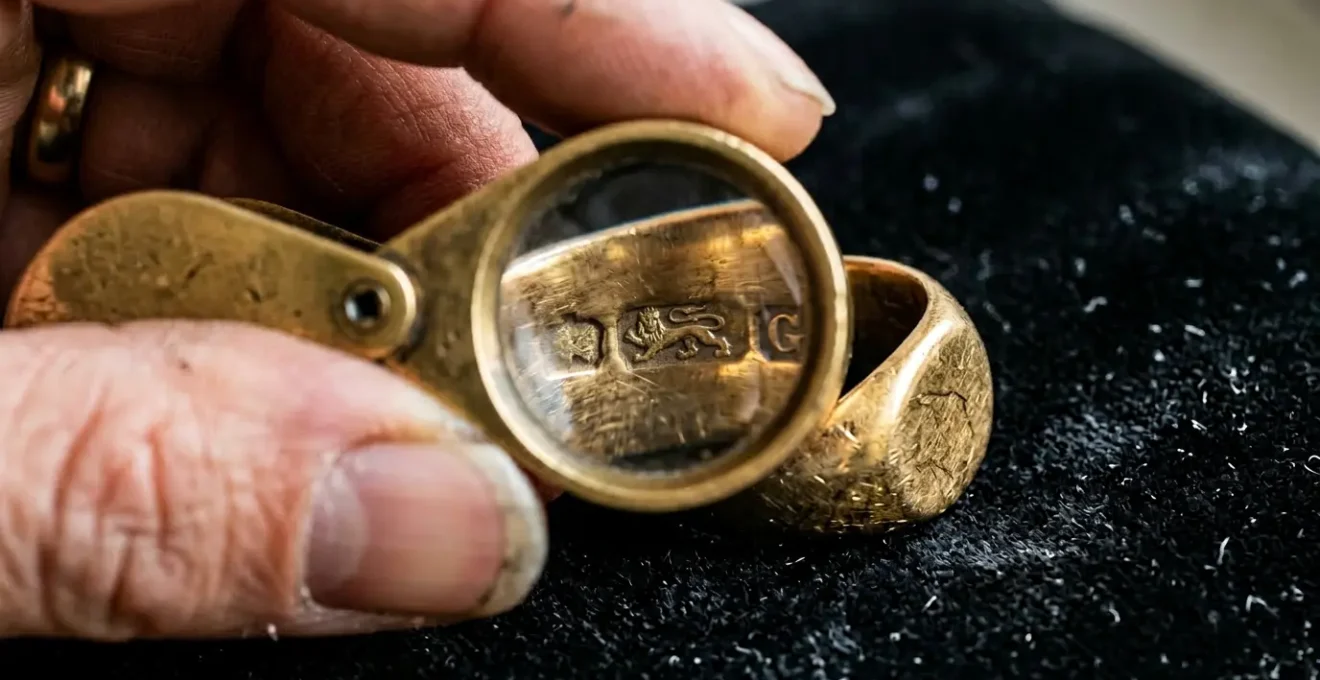
The technique is as important as the tool. Hold the loupe close to your eye and bring the jewellery piece towards the loupe until it comes into sharp focus. This stability is key to reading the minuscule details. The image below demonstrates the focused, careful examination required for this work.
As you can see, a steady hand and controlled lighting are paramount. Once you have a clear view, you can begin the systematic process of identification. It is not just about finding four symbols; it’s about verifying their consistency and correctness. For instance, a traditional hallmark is physically struck into the metal, displacing it and creating a ‘bruised’ edge with tangible depth. Modern laser marks, while valid, are often shallower and can be a red flag if they appear too perfect or are inconsistent with the supposed age of the piece.
Your Action Plan: A Forensic Hallmark Investigation
- Prepare the Surface: Gently clean the item with a microfibre cloth to remove surface oils and dirt. Avoid any harsh chemicals or polishing pastes that could abrade the marks.
- Establish Proper Lighting: Use a bright, direct light source, such as a smartphone’s LED, held at a 45-degree angle. This creates shadows that reveal the depth and detail of the stamps.
- Identify the Anchor Point (Assay Office): Locate the Assay Office mark first. The leopard’s head for London, the anchor for Birmingham, the Yorkshire rose for Sheffield, or the castle for Edinburgh are the most common. This is your geographical anchor.
- Verify the Fineness Mark: Check the number (e.g., 375 for 9ct gold, 750 for 18ct, 925 for sterling silver) and the specific shape of the cartouche (the shield or outline) it sits within.
- Cross-Reference the Date Letter: The style, case (upper or lower), and shield shape of the date letter are all critical. Match these three elements precisely using an online chart to determine the year of assay.
British Hallmarks vs Italian ‘750’ Stamps: Which Offers Better Purity Guarantees?
A common point of confusion for buyers is the difference between a British hallmark and a simple fineness stamp, such as the ubiquitous ‘750’ mark found on Italian gold. While both indicate a purported gold content of 18 carats (75.0% pure gold), their legal standing and the guarantee they offer are vastly different. The British system is built on independent, third-party verification, whereas the Italian system often relies on manufacturer self-declaration. This distinction is the absolute core of consumer protection.
With a British hallmark, an item is physically sent to one of the four independent Assay Offices. There, it is tested by impartial experts using methods like X-Ray Fluorescence (XRF) or even physical scraping to confirm its purity. Only after it passes this rigorous, objective testing is the legal hallmark applied. If the item fails, it is not marked. In contrast, an Italian ‘750’ stamp is typically applied by the manufacturer themselves. It is a claim, not an independently verified fact. While reputable Italian houses have excellent quality control, the system lacks the unimpeachable, state-backed guarantee of the UK’s method. Since 1972, the Vienna Convention on the Control of the Fineness and Marking of Precious Metal Objects has provided a framework for mutual recognition, but only for marks that include the “Common Control Mark” (a set of scales), which confirms they meet the standard of independent assaying.
This table breaks down the crucial differences for any prospective buyer:
| Aspect | British Hallmark | Italian ‘750’ Stamp |
|---|---|---|
| Verification | Third-party independent assay office | Often manufacturer’s self-declaration |
| Legal Status | Legally required for items over 1g gold | Self-certification unless CCM present |
| Consumer Protection | Legal recourse against Assay Office | Recourse against manufacturer only |
| Testing Method | Physical scraping or XRF by assay office | Manufacturer’s internal quality control |
| International Trust | Vienna Convention recognized | CCM mark needed for equal recognition |
For a UK-based buyer, the conclusion is clear. A full British hallmark offers a superior, legally-backed guarantee of purity. While a ‘750’ stamp from a trusted brand is generally reliable, it does not carry the same weight of independent, forensic verification. When investing significant sums, the British system provides an unparalleled level of security and trust.
The ‘Gold Filled’ Scam That Catches Out New Buyers on eBay UK
Navigating online marketplaces like eBay requires an especially vigilant eye. One of the most common traps for inexperienced buyers is the misunderstanding of terminology designed to sound valuable but which actually describes a product of significantly lower worth. Terms like ‘Gold Filled’ or ‘Rolled Gold’ are not descriptions of solid gold and have no relation to the British hallmarking system. They describe a manufacturing process where a thin layer of gold is bonded to a base metal core, usually brass or copper.
The scam is not always in the product itself, but in the deceptive listing. A seller might use a title like “Stunning 9ct Gold Bangle” but bury the term “GF” or “Gold Filled” deep in the description. The value difference is immense: a solid 9ct gold bangle’s value is based on its substantial gold content, while a gold-filled bangle’s value is a tiny fraction of that, as it contains only a small percentage of gold by weight. These items will never carry a UK Assay Office hallmark. Instead, they might be marked with ‘GF’, ‘RG’, ‘HGE’ (Heavy Gold Electroplate) or other manufacturing codes.
The most telling sign of a gold-filled or plated piece is wear. Over time, the thin gold layer can rub off, especially on high-contact areas like clasps, hinges, and edges, revealing the different-coloured base metal underneath. This is a dead giveaway.
To protect yourself, you must be able to recognise these red-flag terms and inspect items for physical signs of wear. Here are the key deceptive terms to watch for:
- Gold Filled (GF): A layer of gold (often 1/20th of the total weight) bonded to a base metal. It is not solid gold.
- Rolled Gold (RG): Similar to gold filled, but typically with an even thinner layer of gold.
- Heavy Gold Electroplate (HGE): A microscopically thin layer of gold applied via electroplating. It has negligible intrinsic value.
- 9ct Bonded: A vague marketing term used for gold-plated items. It is legally meaningless in the context of solid gold.
Always check the clasps, edges, and underside of a piece for any discolouration or exposed brassy/coppery tones. The presence of ‘GF’ or ‘RG’ stamps instead of a full British hallmark is definitive proof that the item is not solid gold.
How to Clean Dirt from Deep Hallmarks Without Damaging the Stamp?
Over decades or even centuries, dirt, oils, and polishing residue can accumulate within the recesses of a hallmark, obscuring its fine details. Cleaning these marks is a delicate operation where the wrong move can cause irreparable damage. Aggressive methods like polishing pastes, abrasive cloths, or ultrasonic cleaners can dull the sharp edges of a struck mark or even wear it away entirely, destroying its historical and financial value. The goal is to reveal, not restore. A conservator’s approach is required, using gentle, targeted methods.
The first step is always the least invasive. Using a piece of museum-grade cleaning putty, like Rodico, is often sufficient. By pressing it gently into the hallmark, it can lift out loose surface debris and grime without any abrasion. For more stubborn, compacted dirt, a softened wooden toothpick can be used for careful, targeted excavation under magnification. It is crucial to use a tool that is softer than the metal itself to avoid scratching. Chemical dips should be avoided at all costs, as they can be overly aggressive and unevenly strip the metal’s surface.
However, the most important rule is knowing when not to clean. In many antique pieces, especially silver, the dark patina that has developed within the hallmark’s crevices is considered part of its character and authenticity. This ‘tarnishing’ provides contrast that can actually make the mark easier to read and is seen by collectors as a sign of genuine age. Removing it can diminish the piece’s historical integrity and, consequently, its value.
For safe and effective cleaning, follow this museum-approved method:
- Step 1: Use Lifting Putty. Press a small piece of museum putty (e.g., Rodico) into the hallmark and lift it away. Repeat several times to pick up surface debris.
- Step 2: Employ a Soft Probe. For compacted dirt, use a softened wooden toothpick or a sharpened bamboo skewer to gently dislodge particles. Never use a metal pin.
- Step 3: Rinse with Pure Water. If necessary, use a very soft artist’s brush (sable or camel hair) to gently rinse the area with a small amount of deionised water, then pat dry immediately with a soft cloth.
- Step 4: Know What to Avoid. Never use ultrasonic cleaners, polishing compounds, or chemical dips on or near hallmarks, as they are too abrasive and can destroy the fine details that confirm a piece’s origin.
Why 9ct Gold Is the Best Choice for Heavy Signet Rings?
When selecting a metal for a piece intended for daily, heavy wear, such as a signet ring, durability is just as important as appearance. While higher carat golds like 18ct or 22ct are more valuable due to their higher pure gold content, they are also significantly softer. This is where 9ct gold excels, offering a superior balance of richness and resilience, making it the pre-eminent choice for robust items like signet rings.
The science lies in its composition. Pure gold (24ct) is a very malleable metal. To create workable alloys for jewellery, it is mixed with other metals like copper, silver, and zinc. As a metallurgical analysis shows, 9ct gold contains 37.5% pure gold, with the remaining 62.5% being a carefully balanced mix of these harder alloy metals. This higher proportion of strengthening alloys results in a metal that is considerably tougher and more resistant to scratches, dents, and the general wear-and-tear of everyday life.
An 18ct gold signet ring, containing 75% pure gold, will be much more susceptible to damage. A sharp knock can easily deform its shape, and the surface will accumulate scratches more quickly, dulling its finish. For a heavy signet ring, which by its nature is exposed to constant contact, the superior hardness of 9ct gold ensures that its crisp engravings and polished surfaces remain intact for much longer. It provides the classic, warm hue of gold while offering the practical longevity required for a piece that is often worn for a lifetime and passed down through generations. This makes 9ct gold not the “cheaper” option, but the “smarter” option for this specific application.
Sterling or Silver: How to Date Tiffany Pieces by Their Stamps?
Tiffany & Co. is a brand with a rich history, and its marking system has evolved over time, allowing collectors to date pieces with considerable accuracy. For UK buyers, there’s an additional layer of verification. By law, all Tiffany items sold new in the UK must carry full British hallmarks alongside the brand’s own stamps. This provides a powerful, dual-authentication system. If you are offered a “new” Tiffany piece in the UK without a British hallmark, it is a significant red flag.
The primary Tiffany stamp to look for is the ‘TIFFANY & CO.’ mark itself. The font and kerning (spacing between letters) should be crisp, even, and consistent with the brand’s standards. Alongside this, you will typically find a purity mark. Older American pieces are often marked ‘STERLING’, while more modern pieces, conforming to international standards, are marked ‘925’.
To narrow down the date, you can look for the “Director’s Mark.” This was a letter representing the artistic director in charge at the time of manufacture. For example, pieces made between 1873 and 1891 under Edward C. Moore are marked with a small ‘M’. Pieces made between 1907 and 1947 under John C. Moore II bear a ‘C’. For pieces sold in the UK, the date letter from the British hallmark provides a definitive year of assay, which can be cross-referenced with the Tiffany-specific marks to confirm the period of production.
Use this checklist for authenticating Tiffany & Co. pieces on the UK market:
- Check for the UK Hallmark: Any piece sold new in the UK must have a British Assay Office mark (e.g., the leopard’s head for London) in addition to Tiffany’s own stamps.
- Verify the Purity Stamp: Look for either ‘STERLING’ (common on older, US-market pieces) or ‘925’. The absence of either is suspicious.
- Examine the Director’s Mark: If present, the letter must correspond to the correct historical period. For example, an ‘M’ mark on a piece with a post-1891 British date letter would be a contradiction.
- Cross-Reference Date Marks: The date letter on the UK hallmark must align with the production period indicated by the Tiffany serial number or Director’s Mark.
- Inspect Font and Quality: The ‘TIFFANY & CO.’ stamp should be perfectly executed, with clean lines and consistent spacing. Sloppy or uneven engraving is a sign of a counterfeit.
Key Takeaways
- A full British hallmark is a legal guarantee of purity backed by an independent Assay Office, making it superior to manufacturer self-declarations.
- Reading a hallmark is a forensic skill requiring a loupe, good lighting, and a systematic approach to verifying all four marks (Sponsor, Fineness, Assay Office, Date).
- Be wary of deceptive online terms like “Gold Filled (GF)” or “HGE” on platforms like eBay; these are not solid gold and will never have a UK Assay Office hallmark.
How to Spot Fake Cartier Love Bracelets on the London Pre-Owned Market?
The Cartier Love bracelet is one of the most counterfeited luxury items in the world. On the London pre-owned market, distinguishing a genuine piece from a high-quality fake requires a meticulous eye and a firm understanding of the required markings. As with Tiffany, any Love bracelet sold new through an authorised UK retailer must have a full British hallmark in addition to Cartier’s own stamps. This is your first and most powerful line of defence. Many fakes omit this crucial legal mark or feature a poorly executed copy.
A genuine Love bracelet will feature several crisp, deeply engraved stamps. These include the Cartier signature, the ‘Au 750’ purity mark (for 18ct gold), and a unique serial number. The font, depth, and placement of these stamps are critical. Fakes often have shallow, messy, or incorrectly spaced laser engravings that lack the precision of Cartier’s craftsmanship. The screw motifs on the bracelet should also be perfectly aligned and cleanly stamped, not crooked or poorly defined.
When examining a piece on the London market, your focus should be on the consistency between the Cartier marks and the British hallmark. The date letter on the UK hallmark must align with the era of the bracelet’s serial number. A mismatch is an immediate red flag. For instance, a serial number from the 2010s paired with a British date letter from the 1980s indicates a fake. Counterfeiters may get some details right, but they rarely get all of them right. Your job is to find the inconsistency.
To protect your investment, use this authentication guide:
- Demand the UK Assay Mark: This is non-negotiable for a bracelet that was originally sold new in the UK. Look for the London leopard’s head, the ‘750’ in its correct octagonal cartouche, and the appropriate date letter.
- Verify All Marks Are Present: A genuine piece will have the Cartier signature, ‘Au 750’, a unique serial number, Cartier’s maker’s mark (a key symbol inside a lozenge), and the full set of British marks.
- Examine Engraving Depth and Quality: Authentic stamps are deep, sharp, and flawless. Counterfeits often feature shallow, blurry, or uneven laser engravings that feel rough to the touch.
- Check Serial Number Consistency: The serial number format and the UK hallmark’s date letter must correspond to the same production period.
Equipped with this knowledge, you can approach the pre-owned market with confidence. The hallmark is your legal proof, and your forensic skill is your ultimate protection. By applying this rigorous discipline to every piece you evaluate, you can secure your investment and ensure you are acquiring a genuine work of art, not a worthless imitation.