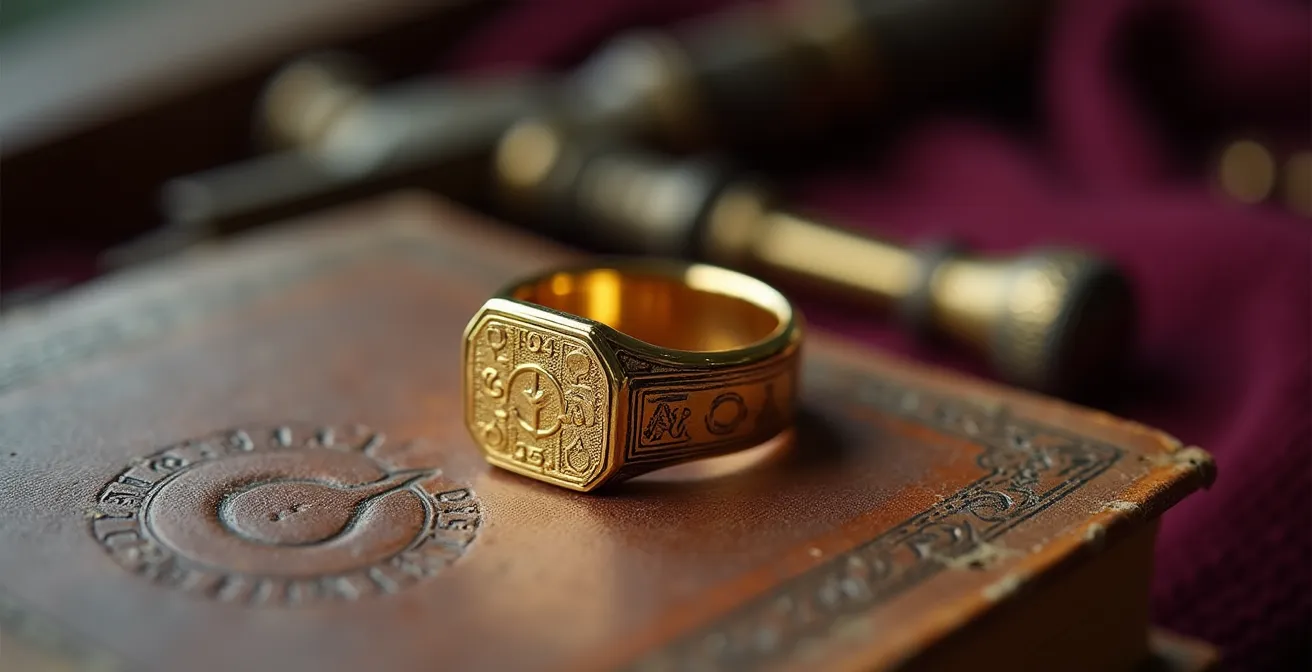
Understanding a British hallmark is not an academic exercise; it’s the single most powerful defensive skill you have against the rising tide of sophisticated counterfeit jewellery online.
- This system provides an independent, legally-binding guarantee of purity that self-certified marks (like ‘750’) lack.
- Learning to read the four core symbols correctly protects both your wallet and the future value of your collection.
Recommendation: Treat your jeweller’s loupe as your most important tool and learn to distinguish a state-guaranteed mark from a simple manufacturer’s stamp before you ever consider a purchase.
The thrill of finding that perfect piece of vintage gold online is often tempered by a nagging doubt: is it genuine? As a valuer with decades of experience in the heart of Birmingham’s Jewellery Quarter, I’ve seen the heartbreak and financial loss that comes from mistaking plated brass for solid gold. You’ve likely been told to ‘look for the stamp’ or seen basic charts of symbols. This advice, while well-intentioned, barely scratches the surface and misses the most critical point for a UK buyer.
A British hallmark is not a mere brand stamp or a decorative flourish. It is a legal certificate of authenticity, a physical guarantee of precious metal content that has been independently tested and verified by a government-appointed Assay Office. To confuse it with a manufacturer’s mark, like the common ‘750’ stamp on Italian gold, is the single costliest mistake a modern collector can make. The integrity of the mark is your ultimate protection.
This guide will teach you to think like a valuer. We will move beyond simply seeing the marks and learn to *understand* their legal weight, their history, and how they act as your primary defence against fraud. You will learn to decode the story told by these tiny symbols, a skill that secures the value of every piece you acquire. This is not just about appreciating history; it’s about active, defensive valuation for the modern luxury market.
To navigate this crucial topic, we will break down the essential knowledge into clear, actionable sections. This structured approach will equip you with the expertise needed to identify authentic pieces, understand their value, and protect your investments with confidence.
Contents: A Valuer’s Deep Dive into British Hallmarks
- Why Is the Assay Office Stamp Critical for UK Resale Value?
- How to Decode the 4 Symbols of a British Hallmark Using a Loupe?
- British Hallmarks vs Italian ‘750’ Stamps: Which Offers Better Purity Guarantees?
- The ‘Gold Filled’ Scam That Catches Out New Buyers on eBay UK
- How to Clean Dirt from Deep Hallmarks Without Damaging the Stamp?
- Why 9ct Gold Is the Best Choice for Heavy Signet Rings?
- Sterling or Silver: How to Date Tiffany Pieces by Their Stamps?
- How to Spot Fake Cartier Love Bracelets on the London Pre-Owned Market?
Why Is the Assay Office Stamp Critical for UK Resale Value?
In the pre-owned market, certainty is currency. An item’s resale value is not just determined by its beauty or brand, but by the verifiable proof of its material content. The British hallmark is the ultimate expression of that proof. It removes all doubt and debate about the precious metal’s purity, making any subsequent sale smoother and more profitable. An unhallmarked piece, regardless of its appearance, will always be viewed with suspicion by any discerning buyer or dealer, immediately diminishing its worth.
This suspicion is well-founded. The online marketplace is flooded with fakes. In fact, research by the British Hallmarking Council reveals that an alarming 24% of unhallmarked ‘gold’ jewellery listings on UK online platforms were suspected to be counterfeit. When you purchase a piece with a full, legitimate British hallmark, you are not just buying a piece of jewellery; you are acquiring a legally certified asset. The hallmark acts as a passport, guaranteeing its composition and ensuring its value is recognised and respected in any future transaction.
Think of it as a built-in certificate of authenticity that cannot be lost or forged as easily as a paper document. For a serious collector or investor, purchasing any significant gold, silver, or platinum item for sale in the UK without this stamp is an unnecessary and costly gamble. The presence of the mark is a non-negotiable indicator of value and a critical component of defensive investing in precious metals.
How to Decode the 4 Symbols of a British Hallmark Using a Loupe?
The first tool I reach for in any valuation is not a scale or a testing kit, but a 10x jeweller’s loupe. This simple magnifier is your window into the story of a piece. A complete, traditional British hallmark consists of four key components, each providing a specific piece of information. Learning to read them is the foundational skill of defensive valuation. These compulsory marks are the Sponsor’s Mark, the Fineness Mark, the Assay Office Mark, and, for pieces made before 1999, the Date Letter.
The process of examination requires patience and a steady hand. Position the piece under good light and hold the loupe close to your eye, bringing the item towards the loupe until the marks snap into sharp focus. Look for the crisp, sharp edges of a legitimate stamp, rather than the soft, cast-in appearance of many fakes.

Each Assay Office has a unique symbol that tells you where the item was tested and certified. This geographical context is crucial for understanding a piece’s history. The main offices have used iconic marks for centuries, and recognising them is essential.
To aid in identification, here is a breakdown of the primary UK Assay Office symbols. As a valuer, knowing these by heart is second nature, and it should become the same for any serious collector.
| Assay Office | Symbol | Active Since | Distinguishing Features |
|---|---|---|---|
| London | Leopard’s Head | 1300 | Crowned until 1821, uncrowned thereafter |
| Birmingham | Anchor | 1773 | Consistent anchor design throughout history |
| Sheffield | Rose/Crown | 1773 | Crown until 1974, Yorkshire rose from 1975 |
| Edinburgh | Castle | 1485 | Three-towered castle, sometimes with thistle |
British Hallmarks vs Italian ‘750’ Stamps: Which Offers Better Purity Guarantees?
This is a question I am often asked, and the answer is unequivocal. While both marks relate to gold purity, they represent fundamentally different systems of verification. A stamp that simply says ‘750’ or ’18K’, common on Italian or American jewellery, is a manufacturer’s declaration. It is the company’s own claim that the item contains 75% pure gold. There is no independent, third-party verification required to apply this mark.
A British hallmark, however, is a state-guaranteed certification. Before a piece can be legally sold as gold in the UK, it must be sent to one of the four independent Assay Offices. There, it is scientifically tested to verify its precious metal content. Only after it passes this rigorous, impartial testing is the hallmark permanently struck into the metal. This is the critical difference: one is a claim, the other is a verified fact.
Case Study: The Birmingham Assay Office’s ‘Zero Negative Tolerance’ Standard
The Birmingham Assay Office, where much of the UK’s jewellery is tested, operates a strict ‘zero negative tolerance’ policy. This means that an item stamped ‘750’ by the Birmingham office must contain at least 75.0% pure gold. It cannot be 74.9% or less. Some international standards allow for a small negative tolerance, meaning a ‘750’ piece might legally be slightly less pure. The British system, employing advanced XRF analysis and fire assay, provides an absolute guarantee, ensuring you get exactly what you paid for. This integrity of the mark is what sets it apart globally.
This is why, for a UK buyer, the British hallmark offers an unparalleled level of security. It replaces trust in a distant manufacturer with the certainty of a centuries-old, legally-backed system of consumer protection. As Andrew Berry Jewellery notes in their comprehensive guide:
The British Hallmark is of unquestioned and unquestionable integrity as a guarantee of quality. It is accepted as such in every part of the world.
– Andrew Berry Jewellery, British Hallmarks Guide
The ‘Gold Filled’ Scam That Catches Out New Buyers on eBay UK
The term ‘gold’ is used with dangerous ambiguity on online marketplaces. One of the most common traps for inexperienced buyers is the confusion between solid gold and ‘gold filled’ or ‘gold plated’ items. These terms describe items made of a base metal (like brass or copper) with a thin layer of gold bonded or plated onto the surface. While they may look convincing initially, their value is a tiny fraction of a solid gold piece, and the gold layer will eventually wear away.
Deceptive sellers often use misleading titles and descriptions, banking on buyers not understanding the terminology or the importance of hallmarking. Stamps like ‘GF’ (Gold Filled), ‘HGE’ (Heavy Gold Electroplate), or ‘RGP’ (Rolled Gold Plate) are dead giveaways that you are not looking at a solid gold item. These are not hallmarks. The problem is particularly widespread on peer-to-peer platforms; according to research where 56% of suspect ‘gold’ items with no hallmark mention were found on eBay, this digital deception is a significant risk.
Another red flag is an item from an overseas seller stamped simply ’18K’. While a legitimate mark in some countries, it is not a legal UK hallmark. Any 18-carat gold item weighing over 1 gram and sold in the UK must have a full British hallmark, including the ‘750’ fineness mark and an Assay Office symbol. The absence of this is a clear warning sign. Always demand clear, close-up photographs of the hallmarks before purchasing online. A legitimate seller with a genuinely hallmarked item will have absolutely no reason to refuse this simple request.
How to Clean Dirt from Deep Hallmarks Without Damaging the Stamp?
Over decades, dirt, polish residue, and skin oils can become compacted into the deep recesses of a hallmark, obscuring its details. Cleaning these marks is a delicate operation. The goal is to reveal the information without causing any damage, as the sharp edges and fine details of the stamp are part of its authenticity. Aggressive cleaning with a stiff brush or polishing compounds is the fastest way to destroy the historical and monetary value of a piece.
Using the wrong tools can permanently round off the crisp edges of the stamp, making it harder to read and potentially raising questions about its legitimacy during a future valuation. Never use abrasive materials or harsh chemical dips, which can strip away the metal’s surface and patina. The professional approach is one of patience and precision, using tools that are softer than the precious metal itself.
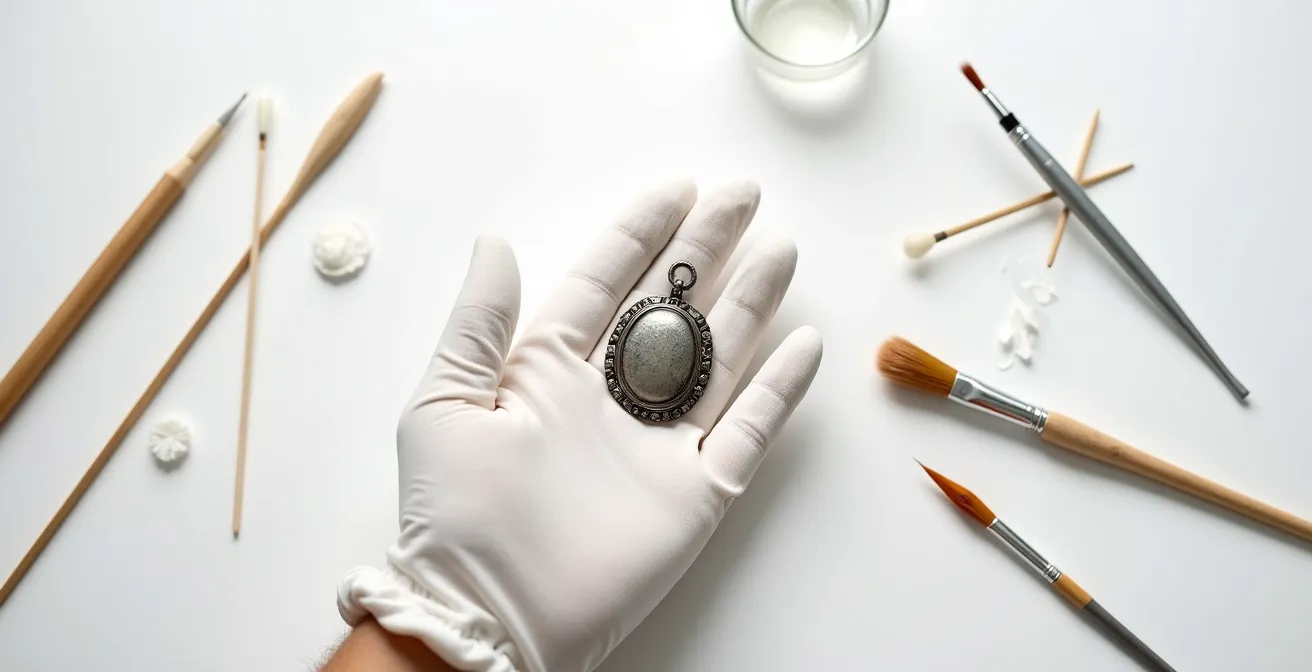
This methodical process ensures that you remove only the accumulated grime, leaving the precious metal and its vital historical record untouched. Here is the exact method we use in the workshop for safely conserving and revealing obscured hallmarks.
Your Action Plan: The Professional Hallmark Cleaning Method
- Gently dislodge compacted dirt from the stamped recesses using a sharpened wooden toothpick.
- Apply a pH-neutral soap solution with a very soft sable artist’s brush; avoid toothbrush bristles as they are far too harsh.
- Rinse the area with distilled water to prevent mineral deposits and gently pat dry with a lint-free microfibre cloth.
- Never use abrasive silver dips or polishing cloths directly on hallmarks, as these will wear down the sharp edges.
- For long-term protection, apply a micro-crystalline Renaissance Wax with a soft brush to create an invisible barrier against future tarnish.
Why 9ct Gold Is the Best Choice for Heavy Signet Rings?
There is a common misconception among new buyers that higher carat gold is always ‘better’. While 18ct gold (75% pure gold) has a richer, yellower colour, for an item intended for daily, heavy wear like a traditional signet ring, 9ct gold (37.5% pure gold) is often the superior choice from a practical standpoint. This is not a matter of opinion, but of material science.
The higher proportion of other alloys in 9ct gold, typically copper and silver, makes the metal significantly harder and more durable. It is more resistant to the scratches, dents, and deformation that are an inevitable part of everyday life. An 18ct gold signet ring, being softer, will show wear and tear much more quickly, and a deep, crisp engraving may wear smooth over a shorter period.
Case Study: The Durability of 9ct Gold in Birmingham’s Signet Ring Tradition
For over two centuries, Birmingham’s Jewellery Quarter has been a centre for crafting traditional signet rings. Master engravers and jewellers in the Quarter have long favoured 9ct gold for these workhorse pieces. Their experience shows that the superior hardness of 9ct gold not only resists daily damage but also enhances the longevity of the engraving. The crisp, deep cuts made into the harder metal retain their legibility for generations, whereas the details on a softer 18ct ring can become blurred and worn with time.
The physical properties speak for themselves. The comparison below clearly illustrates why 9ct gold is the valuer’s choice for a ring that is meant to be worn and lived in, not just admired in a box.
| Property | 9ct Gold (375) | 18ct Gold (750) |
|---|---|---|
| Gold Content | 37.5% | 75% |
| Hardness (Vickers) | 120-135 HV | 95-105 HV |
| Scratch Resistance | Excellent | Good |
| Deformation Resistance | Superior for daily wear | Softer, prone to denting |
| Engraving Retention | Maintains detail longer | Details wear faster |
| Patina Development | Rich, deep over time | More static colour |
Sterling or Silver: How to Date Tiffany Pieces by Their Stamps?
Tiffany & Co. is a world unto itself, with its own complex system of marks that evolved over its long history. However, for a UK-based buyer, there’s a crucial intersection between Tiffany’s own branding and the legal requirements of British hallmarking. Authentic Tiffany items sold legally through their London Bond Street store, particularly in the 20th century, were required to bear full British hallmarks in addition to their own maker’s marks.
This provides a fantastic cross-referencing opportunity for dating and authentication. If you find a piece with both a ‘TIFFANY & CO’ stamp and, for example, the leopard’s head of the London Assay Office, you have a very strong indicator of its provenance. The absence of a British hallmark on a piece supposedly sold in the UK should be a significant red flag.
Dating a UK-sold Tiffany piece then becomes a process of synthesising information from both marking systems. Here are the key steps a valuer would take:
- Check for British Hallmarks: The presence of a full set of UK marks on a Tiffany piece is the first sign it was intended for the UK market.
- Identify the Assay Office: The leopard’s head confirms London testing, which is logical for a piece sold through their Bond Street location.
- Decode the Date Letter: This is the most precise tool. Using a date letter chart specific to the London office, you can pinpoint the exact year the item was assayed. The font and the shape of the shield surrounding the letter are crucial.
- Examine the Purity Mark: Tiffany used the word ‘STERLING’ on its American-made silver from the 1870s onwards. A ‘925’ numerical mark often indicates a more modern or European-market piece, which aligns with the UK system.
- Look for Director’s Initials: From 1873 to 1965, Tiffany pieces were marked with the initial of the company’s acting director (e.g., ‘M’ for Edward C. Moore). This can help narrow the production era significantly.
Key Takeaways
- A British hallmark is a legal guarantee of purity from an independent Assay Office, not a manufacturer’s brand stamp.
- For durability in daily-wear items like signet rings, harder 9ct gold is often superior to softer, purer 18ct gold.
- Online marketplaces are high-risk; the absence of a full British hallmark on an item sold in the UK is a major red flag for fakes or mis-sold items.
How to Spot Fake Cartier Love Bracelets on the London Pre-Owned Market?
The Cartier Love Bracelet is one of the most counterfeited luxury items in the world. The London pre-owned market is awash with fakes, ranging from clumsy copies to highly sophisticated replicas that can fool the untrained eye. However, for a buyer armed with knowledge of the UK hallmarking system, there is a powerful line of defence. Every genuine Cartier Love Bracelet sold legally in the United Kingdom must be hallmarked by a UK Assay Office.
This is a non-negotiable legal requirement. The Hallmarking Act of 1973 mandates that 100% of gold items over 1 gram sold in the UK must be hallmarked. A genuine Cartier bracelet will therefore bear not only the Cartier signature, serial number, and ‘750’ stamp but also the specific marks of a UK Assay Office (e.g., the London leopard’s head) and the corresponding fineness mark. Many fakes, even high-quality ones produced for a global market, miss this UK-specific detail.
Case Study: Authentication Standards at Burlington Arcade vs. Online Platforms
There is a world of difference between buying from a reputable dealer and a peer-to-peer platform. Established pre-owned luxury specialists, such as those in London’s famous Burlington Arcade, have stringent authentication protocols. They will not accept a Cartier piece for resale without verifying its complete and correct markings, including the legally required British hallmarks for UK-sold items. They stake their professional reputation on this guarantee. In contrast, online marketplaces have no such mandatory verification, placing the entire burden of authentication—and all the risk—onto the buyer.
Therefore, when examining a Love Bracelet on the London pre-owned market, your first check should be for the British hallmark. If it’s missing, you should walk away, no matter how convincing the story or the other markings may seem. This single piece of knowledge can save you from a very expensive mistake and is the clearest application of using the hallmarking system as a defensive tool against high-level counterfeiting.
To truly protect your investments, the next logical step is to become proficient in applying these standards. Begin by examining pieces you already own with a loupe, familiarising yourself with the feel and appearance of a legitimate mark. This hands-on practice is the best way to turn theoretical knowledge into an invaluable expert eye.
Frequently Asked Questions about Identifying British Jewellery Marks
What stamps indicate gold filled rather than solid gold?
Look for stamps like ‘GF’ (Gold Filled), ‘HGE’ (Heavy Gold Electroplate), or ‘RGP’ (Rolled Gold Plate). These are NOT solid gold marks and indicate a base metal with a thin gold coating.
How can I spot fake hallmarks on eBay listings?
Be wary of items stamped ’18K’ from overseas sellers – this is uncommon in the UK where 9ct and 14ct are more standard for many items. Most importantly, check if the item has a full, legal UK hallmark if it’s being sold as new or pre-owned within the UK. Always request clear, close-up photos of the hallmark from the seller.
What recourse do I have if sold fake gold on eBay UK?
If you purchase an item that is not as described (e.g., sold as solid gold but is actually plated), you should immediately file a ‘Significantly Not as Described’ claim through eBay’s resolution centre. Provide clear evidence, such as a test receipt from a jeweller and photos showing the lack of a proper hallmark. PayPal and most credit card companies offer buyer protection, typically for up to 180 days from the payment date.