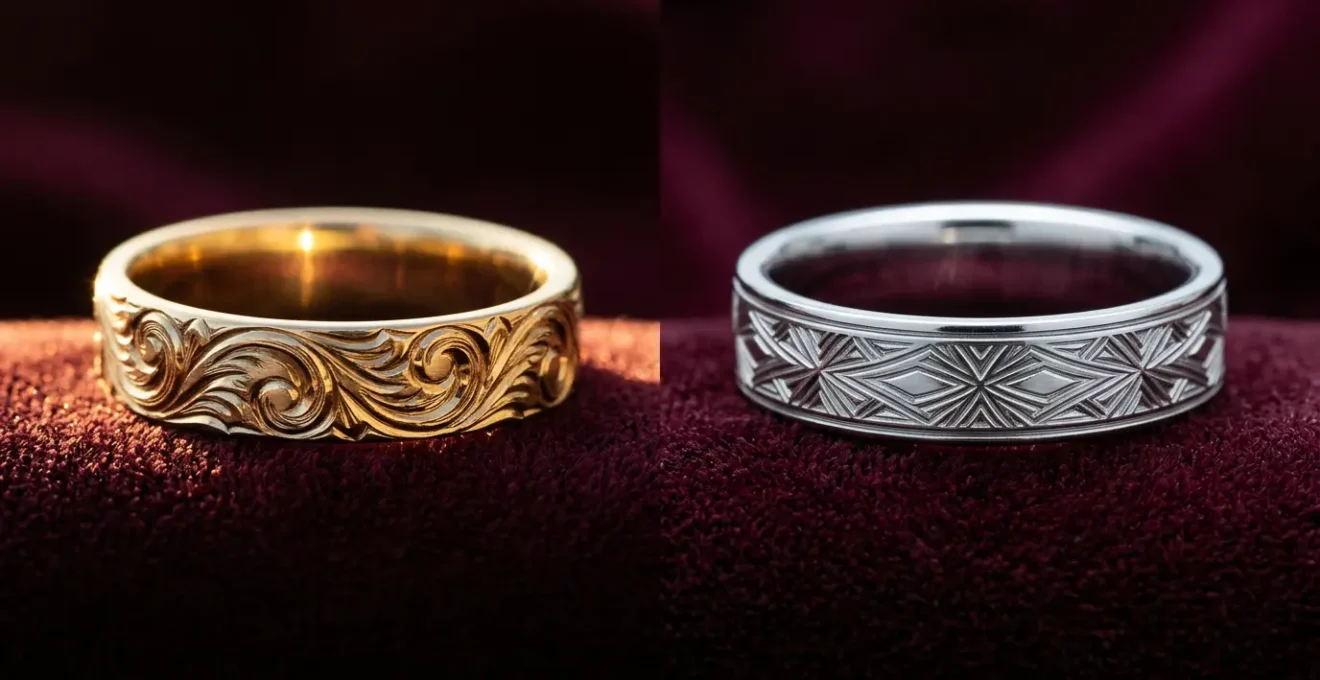
For a symbol meant to last a lifetime, hand engraving is not merely a “deeper” option; it is a fundamentally different act of creation that offers true permanence.
- Laser engraving is a surface-level thermal marking, vulnerable to fading from daily wear and friction.
- Hand engraving is a sculptural art, displacing metal to create deep, V-shaped grooves that endure for generations.
Recommendation: For a wedding band, an heirloom in the making, invest in the timeless artistry and durability of hand engraving. It is a choice for permanence.
When you hold your wedding bands, you are holding a promise made tangible. The decision to inscribe a date, a name, or a secret message inside is the act of sealing that promise into the very metal. In this moment, you are faced with a choice: the swift, modern precision of the laser, or the time-honored touch of the hand engraver. Many will present this as a simple trade-off between cost and complexity, but this view misses the soul of the matter.
The allure of laser engraving is its speed and its ability to replicate any font or image with digital perfection. It seems like the logical, efficient choice. But as a master engraver who has spent a lifetime with a burin in hand, I ask you to consider what “longevity” truly means. It is not just about a mark that is visible; it is about a mark that has character, depth, and the resilience to journey through life with you. An inscription is a story, and the method you choose determines whether that story is merely printed on the surface or carved into the heart of the ring itself.
The difference is not one of degree, but of kind. It is the difference between a photograph and a sculpture. One is a surface impression; the other has dimension, shadow, and a physical presence that commands respect. This guide will walk you through the physical realities of each method, from why one fades while the other endures, to how an artisan’s skill adapts where a machine cannot, ensuring your most personal messages are not lost to the gentle abrasion of time.
To help you make a truly informed decision for your forever rings, this article explores the crucial differences between these two personalization techniques. We will delve into the technical reasons for their varying durability, the limits of detail, and the practical considerations like resizing and restoration.
Summary: The Definitive Guide to Choosing a Lasting Ring Inscription
- Why Laser Engraving Fades Faster on High-Wear Areas?
- How Small Can You Engrave a Family Crest Before It Becomes a Blob?
- Fingerprint Engraving: Gimmick or Lasting Memorial?
- The Resizing Mistake That Destroys Your Engraved Message
- Can You Re-cut a Worn Inscription Without Thinning the Ring?
- How Deep Can You Engrave on a Comfort Fit (Curved Interior) Band?
- How Commissioning Bespoke Helps Save Endangered Heritage Skills?
- Court, D-Shape, or Flat: Which Wedding Ring Profile Suits Your Finger Shape?
Why Laser Engraving Fades Faster on High-Wear Areas?
The fundamental difference between hand and laser engraving lies in how they interact with the metal. A laser is a thermal process; it uses a high-intensity beam of light to vaporize or burn a microscopic layer of the metal’s surface, creating a dark mark. This is a surface treatment, not a structural one. In contrast, hand engraving is a true sculptural cut. Using a hardened steel tool called a burin, I physically displace the metal, carving a deep, V-shaped groove into the band.
This physical difference is the root of its longevity. Research confirms that while a laser mark is often just 5 to 50 microns deep, a hand-carved line can reach 0.2 to 0.5 millimeters. That is up to 100 times deeper. On a high-wear item like a wedding ring, which constantly rubs against skin, fabric, and other objects, a 50-micron surface mark is highly susceptible to abrasion. Over years of daily wear, the microscopic peaks and valleys of the laser mark are slowly polished away until the inscription vanishes.
The V-shaped groove of a hand engraving, however, is far more resilient. As the ring’s surface wears down, the groove simply becomes shallower, but its lines remain crisp and legible for much longer. The shadows cast by its depth ensure the inscription remains visible, gaining a soft patina that tells the story of your years together rather than fading into oblivion.
This table clearly illustrates the trade-offs between the primary methods. As you can see from this comparative analysis, the choice impacts far more than just aesthetics.
| Method | Depth | Wear Resistance | Best For |
|---|---|---|---|
| Hand Engraving | 0.2-0.5mm | Excellent (years of wear) | Heirloom pieces, daily wear rings |
| Laser Engraving | 5-50 microns | Moderate (surface marking) | Hard metals, intricate designs |
| Machine Engraving | 0.1-0.3mm | Good | Simple text, cost-effective |
Ultimately, choosing hand engraving is choosing a mark that becomes part of the ring’s physical structure, designed not just for the wedding day, but for every day that follows.
How Small Can You Engrave a Family Crest Before It Becomes a Blob?
This question touches upon the true meaning of artistry in engraving: artisan’s intent. A laser is a literal machine; it will attempt to replicate every tiny, complex line of a digital file. When scaled down to the inner curve of a 4mm wedding band, an intricate family crest with filigree and tiny figures can become a muddled, illegible “blob” from the moment it is made. The laser lacks the judgment to simplify.
A master engraver, however, approaches this not as a problem of replication, but of translation. We study the crest and identify its core, most powerful elements—the posture of a lion, the sweep of a chevron, the silhouette of a helmet. Our job is to strategically simplify the design, removing superfluous detail while preserving its heraldic essence. We thicken lines that need to endure and open up spaces to create negative-space definition. This ensures that even after decades of wear, the symbol remains recognizable and proud.
The result is not a lesser version of the crest, but an interpretation optimized for its medium and its lifespan. It is an art of omission, of knowing what to leave out so that what remains can speak clearly for a century.
Case Study: Krikawa’s Strategically Simplified Mountain Bands
The artisan jewelers at Krikawa exemplify this principle. When commissioned to engrave mountain landscapes, their engravers don’t try to capture every tree. Instead, they focus on the majestic peaks and ridgelines. By strategically simplifying the design to its most essential forms, they ensure the engraved landscape retains its grandeur and legibility, even after years of daily wear, proving that an artisan’s judgment is key to lasting detail.
So, how small can you go? With a laser, you are limited by the machine’s resolution. With a hand engraver, you are limited only by the artist’s ability to capture the soul of the design, which is a far more forgiving and meaningful boundary.
Fingerprint Engraving: Gimmick or Lasting Memorial?
Fingerprint engraving is an intimate and beautiful concept—the unique touch of your partner, forever with you. Whether it becomes a lasting memorial or a fleeting gimmick, however, depends entirely on the method and materials chosen. A fingerprint is a map of fine, shallow ridges. If you simply laser-etch a high-resolution scan onto a ring’s surface, you are creating the most delicate and vulnerable kind of engraving possible. The daily friction of life will almost certainly polish it into a smooth, unrecognizable blur within a few years.
For a fingerprint to endure, it must be treated not as a picture to be printed, but as a landscape to be sculpted. A skilled engraver will not try to replicate every pore. Instead, they will interpret the print, focusing on the dominant ridges and valleys—the “heart” of the fingerprint. They will carve these lines deeply, creating a tactile and living inscription that you can feel with your own finger. This transforms it from a surface mark into a miniature, wearable sculpture of your loved one’s touch.
The choice of ring is also paramount. To provide a sufficient canvas for the detail and to ensure the metal has enough “body” to support a deep cut, jewelry experts recommend a minimum band width of 3mm for women and 4-5mm for men. Anything narrower compromises the longevity of the design. By combining an artisan’s interpretation with a substantial band, a fingerprint engraving transcends gimmickry and becomes the profound, lasting memorial it is intended to be.
Action Plan: Ensuring Your Fingerprint Engraving Lasts
- Capture the fingerprint using a high-resolution (minimum 600 DPI) scanner or a professional ink-and-paper method to get a clear source image.
- Choose harder, more durable metals like platinum, tungsten, or titanium, which retain fine detail better than softer gold.
- Insist on deeper hand engraving over superficial laser marking, especially for rings that will be worn daily.
- Request that the engraver interpret and simplify the print to its boldest ridge patterns, prioritizing legibility over perfect biometric accuracy.
- Keep a digital backup of the original high-resolution fingerprint file in case future restoration is ever needed.
A fingerprint is the most personal signature there is. Honoring it with a method that gives it depth and permanence is essential if you want that touch to last a lifetime.
The Resizing Mistake That Destroys Your Engraved Message
There is no greater heartbreak for a jeweler than to see a beautiful, sentimental engraving destroyed by a necessary resizing. This is a common and devastating mistake, born from a lack of foresight. When a ring is resized, the jeweler almost always cuts the band at the bottom, in the 6 o’clock position. They then either remove a piece to make it smaller or add metal to make it larger, before soldering it back together. If your precious wedding date or secret message is engraved in that spot, it will be completely obliterated.
As the experts at Ben Garelick Jewelers wisely note, “Adjusting a ring’s size after engraving might distort or even erase the inscription entirely.” This is not a risk; it is a certainty if the engraving is in the path of the cut. This is where planning becomes crucial. The safest place for any inscription is in the top half of the ring, centered around the 12 o’clock position. It is vital to communicate with your jeweler to leave the bottom quarter of the band completely blank. This creates a dedicated “sizing gap” for any future adjustments.
Furthermore, the heat from a jeweler’s torch during soldering can cause its own problems. Laser engravings are particularly vulnerable, as the heat can cause the metal around the mark to discolor permanently, leaving an ugly scar near the new seam. A deep, hand-cut engraving is far less susceptible to this, as the discoloration is a surface effect and the integrity of the deep V-cut remains intact. Planning for a potential future resizing is not pessimistic; it’s a practical act of love, ensuring the symbol of your bond can adapt and endure through all of life’s changes without sacrificing its core message.
Before you allow any tool to touch your ring, have a conversation about the future. A good engraving plan considers not just the “now,” but the “what if,” protecting your message for the long road ahead.
Can You Re-cut a Worn Inscription Without Thinning the Ring?
For generations, the answer was a qualified “no.” To re-engrave a worn inscription, a jeweler had to polish down the entire inner surface of the band until the old, faded lines disappeared. Then, they would cut the new inscription into this freshly thinned surface. With each restoration, the ring would lose precious metal, becoming thinner and weaker. For a cherished heirloom, this process was a countdown to its eventual demise. It was a painful choice between letting a memory fade or sacrificing the ring’s very substance.
However, modern technology, when used with an artisan’s care, has provided a miraculous solution. Instead of removing metal, we can now add it back. This is where the world of high-tech and heritage craft can meet beautifully. The process involves an incredibly precise micro-welding laser.
The worn engraving is meticulously filled, molecule by molecule, with the exact same alloy as the original ring. The area is then polished perfectly flat, restoring the band to its original thickness and weight. At this point, the ring is a blank slate, ready to be re-engraved. This allows an inscription to be restored to its day-one crispness with absolutely zero loss of material. It is a true resurrection of the original message.
Case Study: Precision Restoration with LaserStar Technology
Companies like LaserStar have pioneered this technology. Their systems allow a skilled technician to restore a worn engraving with microscopic precision. By using a laser to weld matching alloy into the old grooves before polishing the surface flat and re-engraving, they can achieve a full restoration with no thinning of the band. While this premium service can be costly, it offers a way to preserve an heirloom’s integrity and message indefinitely, proving that technology can serve, rather than replace, traditional preservation.
So yes, a worn inscription can be brought back from the brink. It is no longer a choice between memory and material, but a testament to how we can honor the past while embracing the future.
How Deep Can You Engrave on a Comfort Fit (Curved Interior) Band?
The smooth, domed interior of a comfort fit band is a wonder against the skin, but it presents a significant challenge for engraving. Achieving a consistent depth and clean line on a curved surface is a test that separates the machine from the master. A standard, flat-bed laser engraver struggles immensely with this task. As the ring’s surface curves away from the laser’s focal point, the beam loses intensity and precision, resulting in an engraving that is deep in the center and fades to a faint, shallow scratch at the edges.
While technical specifications reveal that only advanced 5-axis laser systems can dynamically adjust to maintain consistent depth on a curve, these machines are rare and costly. The vast majority of laser services use simpler setups, leading to uneven and unsatisfying results on curved bands. This is where the elegant, low-tech solution of the hand engraver demonstrates its supremacy. The key is a tool called a ball vise.
This heavy, spherical vise holds the ring securely and allows me to rotate it effortlessly in any direction with one hand, while I guide the burin with the other. As I carve, I am constantly turning the ring, ensuring that my tool is always perfectly perpendicular to the exact spot on the metal I am cutting. This constant, fluid adjustment is second nature, allowing for a perfectly uniform V-cut across the entire curve of the band. It’s a dance of hands and steel that a machine cannot replicate.
The hand-engraver’s tool—a ball vise—allows them to constantly rotate the ring. This ensures the tool is always perpendicular to the metal surface, achieving consistent depth across the entire curve, a feat standard lasers cannot match.
– CDM Engraving, Fine Hand Engraving for Jewelry
The beauty of a comfort fit band shouldn’t come at the cost of a shallow, fading inscription. With the right hands and the right tools, its curve can be graced with an engraving as deep and enduring as one on any flat surface.
Key Takeaways
- Longevity: Hand engraving physically removes metal for deep, lasting grooves, while laser engraving is a surface mark that can wear away.
- Detail: An artisan’s hand can strategically simplify complex designs to ensure legibility at small sizes, a task where literal machines often fail.
- Resilience: Deep, hand-cut V-grooves are more resistant to daily wear and the heat of future resizing than shallow, laser-etched marks.
How Commissioning Bespoke Helps Save Endangered Heritage Skills?
When you choose to have your wedding bands hand-engraved, you are doing more than personalizing a piece of jewelry. You are becoming a patron of a living art form. In a world rushing towards automation, skills like hand engraving are endangered. They cannot be learned from a textbook or a video; they are passed down through years of apprenticeship, from master to student, in workshops that are often hidden away from the main street, like the ones in London’s famous Hatton Garden.
Each commission is a lifeline for this tradition. The fee you pay does not just compensate an artist for their time; it funds the entire ecosystem of a heritage craft. It pays for the rent on a workshop, the maintenance of specialized tools that are often decades old, and, most importantly, it makes it possible for a master to take on an apprentice. Without a steady stream of work, there is no financial stability to support the slow, multi-year process of training the next generation.
Case Study: Supporting Hatton Garden’s Underground Workshops
As detailed by Lebrusan Studio, who works with a master engraver in London, each bespoke commission directly supports artisans in places like Hatton Garden. These workshops are vital hubs where centuries-old techniques are practiced and passed down. By choosing their services, clients are not just buying a product; they are making a direct investment in the preservation of these skills, funding apprenticeships and ensuring the continuation of a craft that machines cannot replicate, as their work with these artisans demonstrates.
A machine can be programmed. An artist must be nurtured. When you choose the hand of a master, you are casting a vote for human skill, for tradition, and for the belief that some things are too beautiful and too important to be delegated to a machine.
We believe that human beings are vessels of cultural heritage and the only possible means by which knowledge and tradition can continue to be passed down from one generation to the next.
– Lebrusan Studio, Hand engraving vs. Laser engraving comparison
Your wedding band becomes a small part of a much larger story: the story of keeping human artistry alive in a digital age.
Court, D-Shape, or Flat: Which Wedding Ring Profile Suits Your Finger Shape?
The final piece of the longevity puzzle is the very shape of your ring. The profile of the band—its cross-sectional shape—is not just an aesthetic choice; it is a functional one that acts as a shield for your precious inscription. Choosing the right profile for your lifestyle can dramatically extend the life of your engraving, whether it’s hand-cut or lasered.
Think of it as a built-in bumper. A D-Shape profile, with its flat interior and domed exterior, offers the maximum protection. The curved outer surface takes the brunt of daily impacts and abrasion, leaving the flat, engraved interior relatively sheltered. This is an excellent choice for those with active lifestyles or hands-on jobs. A Court or Comfort Fit profile, which is curved on both the inside and outside, also offers high protection. Its rounded edges mean the central part of the band, where the engraving typically sits, makes less direct contact with surfaces.
Conversely, a Flat profile band offers the least protection. Its flat interior and exterior mean the entire inner surface is in more frequent and direct contact with your finger and anything you touch. The engraving is more exposed and will inevitably wear faster. Your choice of metal plays a role too; a softer metal like 22k gold will benefit far more from a protective D-Shape or Court profile than a scratch-resistant metal like platinum or tungsten. By aligning your ring’s profile with your daily activities, you are making a final, crucial decision to safeguard the story carved within.
This table breaks down how the ring’s physical shape directly contributes to the preservation of the engraving inside it.
| Profile Type | Engraving Protection | Wear Pattern | Best For |
|---|---|---|---|
| D-Shape | Maximum (curved exterior shields interior) | Exterior takes wear first | Active lifestyles, heirloom pieces |
| Court (Comfort Fit) | High (rounded edges protect center) | Even distribution | Daily wear, larger fingers |
| Flat | Minimum (direct surface contact) | Interior engraving vulnerable | Stacking rings, minimal wear |
Consider this your final act of stewardship for your rings. By choosing a profile that suits your life, you ensure that the ring and its message will not just survive, but thrive, for all the years to come.
Frequently Asked Questions About Ring Engraving and Resizing
Can I resize an engraved ring without damaging the inscription?
Resizing typically requires cutting the band at the 6 o’clock position. If your engraving is placed there, it will be completely removed during the process.
What’s the safest placement for engraving if I might resize later?
Engrave at the top half of the inner band (12 o’clock position) and leave the bottom quarter blank as a ‘sizing gap’ where jewelers traditionally make cuts.
How does laser engraving react to resizing heat?
The jeweler’s torch heat can cause unpredictable discoloration on laser-altered metal surfaces, potentially creating permanent marks around the sizing seam.