Custom Jewelry
Custom jewellery represents far more than simply buying a ring or pendant. It is the art of transforming your vision—whether a sketch on a napkin or a treasured family heirloom—into a wearable piece that exists nowhere else in the world. Yet for many first-time commissioners, the process can feel opaque, even intimidating. How much should you pay? How long will it take? Can you bring your own materials?
This resource answers those fundamental questions and more. Whether you are considering a bespoke engagement ring from Hatton Garden, remodelling your grandmother’s gold into something modern, or sourcing genuinely British gemstones for a meaningful piece, understanding the custom jewellery landscape will help you make informed decisions. From fabrication methods to engraving techniques, from wedding band profiles to the peculiarities of working with platinum, each aspect of the bespoke journey has its own considerations—and its own potential pitfalls.
Think of commissioning custom jewellery like renovating a period property: the more you understand about materials, craftsmanship and realistic timelines, the smoother the process becomes. Let us walk through the essential knowledge you need before placing your first commission.
Understanding the Bespoke Commission Process
The journey from initial concept to finished piece typically spans six to twelve weeks, though complex designs may require longer. This timeline surprises many clients accustomed to next-day delivery, but quality custom work cannot be rushed. A typical commission involves several distinct stages, each with its own costs.
What Drives the Price of Custom Work?
Custom jewellery pricing encompasses design fees, materials and fabrication labour. CAD (computer-aided design) renders, for instance, can range from complimentary to £500 or more depending on complexity and the jeweller’s business model. Some makers absorb design costs into the final piece, whilst others charge separately to filter serious commissions from casual enquiries.
Fabrication method significantly impacts price. Hand-forged pieces—where metal is shaped from solid stock through hammering and manipulation—command higher prices than cast pieces poured into moulds. The former offers superior density and structural integrity; the latter enables intricate details that would be impractical to forge by hand.
Payment Structures and Protecting Yourself
Reputable makers typically request a deposit of 30-50% to begin work, with the balance due upon completion. Be cautious of any jeweller demanding full payment upfront before showing design proofs. Staged payments protect both parties: the maker covers initial material costs, whilst you retain leverage should the project go awry.
- Request written confirmation of all specifications before any payment
- Ask to approve CAD renders or wax models before metal fabrication begins
- Clarify what happens if you wish to modify the design mid-process
- Understand the policy if your supplied stone is damaged during setting
Remodelling Heirloom Pieces: Hidden Costs and Considerations
The appeal of melting down inherited gold seems straightforward: transform outdated jewellery into something wearable whilst recycling precious metal you already own. Reality, however, involves more complexity than many expect.
Why ‘Free’ Gold Is Rarely Free
When old gold is melted for recasting, it must typically be refined to remove alloys, solder and impurities. These refining fees can consume a surprising portion of your material’s value. A 20-gram piece of mixed old gold might yield only 15 grams of usable refined metal after processing. Additionally, mixing 9ct and 18ct gold creates an intermediate alloy that may not match either standard—potentially requiring further refinement or the addition of pure gold.
The Porosity Problem
Recycled gold, particularly when not professionally refined, can produce castings with microscopic air pockets. This porosity creates a pitted surface texture that no amount of polishing will fully correct. Professional jewellers mitigate this through proper refining and careful casting techniques, but the risk remains higher than with fresh bullion.
Hallmarking Requirements
Any remodelled piece must be submitted to one of the UK’s Assay Offices for new hallmarking. The original hallmark on your grandmother’s ring has no legal bearing once the metal is reworked. Budget for assay fees and understand that this is a legal requirement, not an optional extra.
Sourcing Genuinely British Materials
The desire to incorporate locally sourced materials into custom pieces has grown substantially. However, the British gemstone and precious metal market presents both opportunities and risks for the uninformed buyer.
British Gemstones: What Actually Exists?
Contrary to what some sellers imply, the UK produces a limited range of gem-quality materials. Whitby Jet from Yorkshire, Blue John fluorite from Derbyshire and Cairngorm quartz from Scotland represent the most significant native stones. Each has specific characteristics affecting its suitability for different jewellery types:
- Blue John—Soft and fragile; suitable only for pendants and brooches, never rings
- Whitby Jet—Lightweight organic material; beware plastic imitations
- Cairngorm—Increasingly rare; many ‘Scottish’ smoky quartz pieces are actually Brazilian
Welsh Gold and Scottish Gold
Both command significant premiums over standard bullion. Welsh gold from the Clogau mines has historical royal associations, whilst Scottish gold is extracted in minute quantities from river panning. Expect to pay several times market gold prices for verified British-origin metal. Authentication documentation is essential; without it, provenance claims are impossible to verify.
Engraving: Methods, Limitations and Longevity
Personalisation transforms custom jewellery from merely unique to deeply meaningful. However, engraving involves technical constraints that many clients discover only after their piece is finished.
Hand Engraving Versus Laser
Traditional hand engraving cuts grooves into metal using hardened steel burins. The result is tactile, with variations that catch light beautifully. Laser engraving, by contrast, vaporises a thin surface layer to create marks. Whilst laser work offers precision for minute details—fingerprints, tiny crests—it produces shallower impressions that wear faster on high-contact surfaces like wedding bands.
Practical Limitations
Every engraving method has minimum legible sizes. A family crest reduced below approximately 8mm risks becoming an indistinct blur. Interior ring engravings, particularly on comfort-fit bands with curved inner surfaces, present additional challenges—the curved surface limits both the depth and length of inscriptions.
Perhaps most critically, future resizing can destroy engraved messages. If your ring needs to go up or down more than one size, interior engravings may be stretched, compressed or removed entirely. Discuss this with your jeweller before committing to extensive personalisation.
Finding Genuine Makers in Britain’s Jewellery Quarters
The UK’s historic jewellery centres—Hatton Garden in London and the Birmingham Jewellery Quarter—house both genuine workshop-makers and resellers operating from impressive premises. Distinguishing between them protects both your budget and your commission’s quality.
Workshop Verification
Request to visit the actual workshop where your piece will be made. Genuine makers welcome this; it demonstrates their craft and builds trust. Resellers, who send work to external workshops or overseas factories, will deflect such requests with various excuses. A workshop visit reveals the difference between ‘hand-made’ (fabricated from raw materials on-site) and ‘hand-finished’ (mass-produced elsewhere, polished locally)—a distinction with profound quality implications.
The Independent Advantage
High street chain jewellers typically apply markups of 200-300% over independent makers for comparable custom work. Their overhead structures—retail premises, staff, marketing—inflate prices without improving craftsmanship. Independent makers operating from workshop premises can offer equivalent or superior quality at substantially lower cost. The trade-off is typically less polished customer service and premises; the benefit is value.
Custom Wedding Bands: Profiles and Practicalities
Wedding bands seem straightforward until you confront the range of profile options, each affecting comfort, appearance and longevity differently.
Profile Options Explained
The three primary profiles are court (domed exterior, curved interior), D-shape (domed exterior, flat interior) and flat (flat on both surfaces). Court profiles offer maximum comfort for continuous wear; D-shapes provide a traditional appearance with reasonable comfort; flat profiles suit modern aesthetics but can feel less comfortable, particularly on fleshy fingers.
The Flush-Fit Challenge
If your engagement ring has a low setting, a standard wedding band will leave a visible gap or sit crookedly. Custom shaped bands contoured to match your engagement ring’s profile solve this but require precise measurements and skilled fabrication. Bring your engagement ring to any wedding band consultation.
Material Limitations
Titanium bands cannot be resized after fabrication—their hardness defeats standard jeweller’s tools. Similarly, hollow ‘lightweight’ gold bands may deform within months of daily wear. For pieces intended to last decades, solid construction in resizable metals represents the wiser investment.
Working with Platinum: Special Considerations
Platinum’s density, melting point and working properties differ fundamentally from gold, creating cost and fabrication implications that catch many commissioners unprepared.
Traditional jeweller’s torches struggle to achieve the 1,768°C melting point platinum requires—nearly double gold’s melting temperature. This demands specialist equipment and skills, explaining why platinum fabrication commands premium labour charges. Jump rings, safety catches and charm attachments all cost substantially more in platinum than equivalent gold components.
The metal’s weight, whilst conveying quality, can prove uncomfortable in larger pieces. A platinum charm bracelet with multiple charms becomes genuinely heavy on the wrist. For such pieces, white gold offers similar aesthetics at lower weight and cost, though it requires occasional rhodium replating to maintain colour.
Custom jewellery, approached with knowledge and realistic expectations, produces pieces that mass production simply cannot match. Whether commissioning your first bespoke engagement ring or transforming inherited gold into contemporary designs, understanding materials, processes and the people who shape them ensures your investment—financial and emotional—yields exactly what you envision.
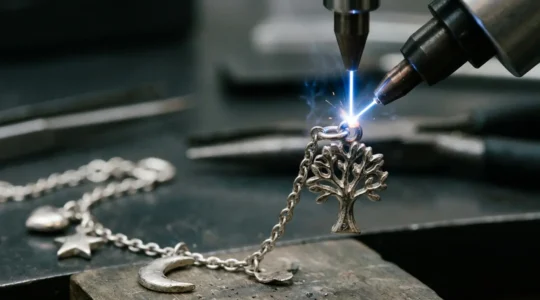
Why Is It So Difficult to Add Charms to a Platinum Bracelet?
If you’re a collector frustrated by jewelers refusing to add charms to your platinum bracelet, the reason is not unwillingness but complex physics. Working with platinum requires a completely different workshop ecosystem—including specialized laser welders and safety protocols—that is fundamentally…
Lire la suite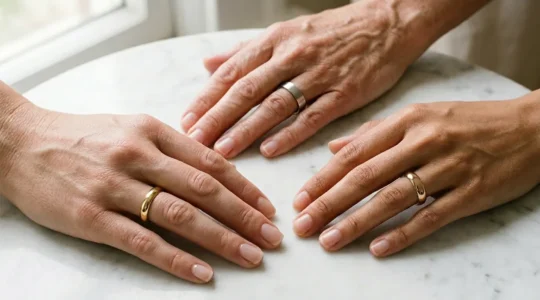
Court, D-Shape, or Flat: An Ergonomic Breakdown of Wedding Ring Profiles
Choosing a wedding band profile is an engineering decision, not just a style choice; the cross-section geometry directly dictates long-term comfort and durability. The ‘comfort fit’ is not a single feature but an ergonomic principle based on reducing the ring’s…
Lire la suite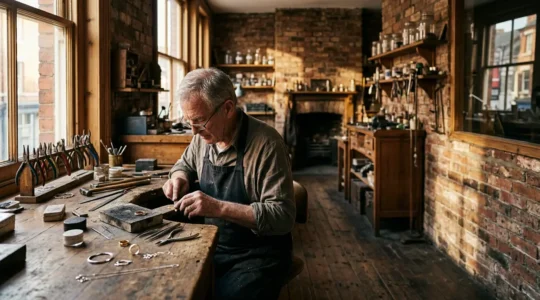
Birmingham Jewellery Quarter: Why Commission Direct from Makers?
Commissioning directly from a British maker provides vastly superior value and quality compared to high street retailers, whose prices are inflated by hidden costs. High street chains add markups averaging 100-300% to cover marketing and overhead, not craftsmanship. Terms like…
Lire la suite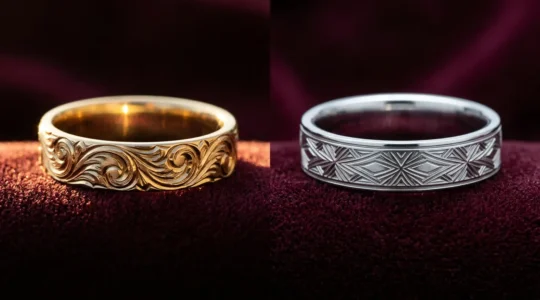
Hand Engraving vs Laser: Which Method Lasts Longer on Wedding Bands?
For a symbol meant to last a lifetime, hand engraving is not merely a « deeper » option; it is a fundamentally different act of creation that offers true permanence. Laser engraving is a surface-level thermal marking, vulnerable to fading from daily…
Lire la suite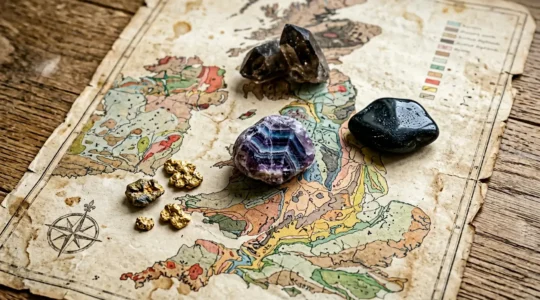
A Geologist’s Guide to Authentic British Gemstones: Beyond the Souvenir Shop
Owning a genuine British gemstone requires more than patriotism; it demands the discerning eye of a geologist to navigate a market filled with imitations and misinformation. Material integrity is paramount: a gem’s geological properties (like hardness and structure) dictate its…
Lire la suite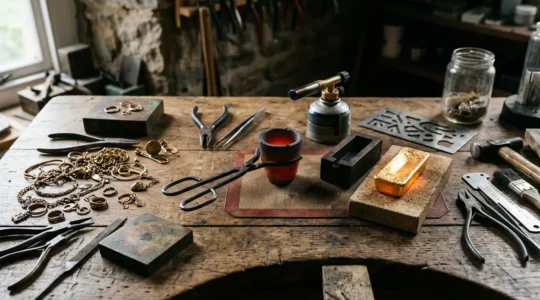
Melting Down Old Gold: Is It Cheaper to Remodel or Buy New Bespoke?
Remodelling inherited gold is rarely the straightforward, money-saving exercise it’s believed to be. The value of your « free » gold is often significantly reduced by refining fees, material wastage, and labour costs. Technical challenges like metal impurities and the risk of…
Lire la suite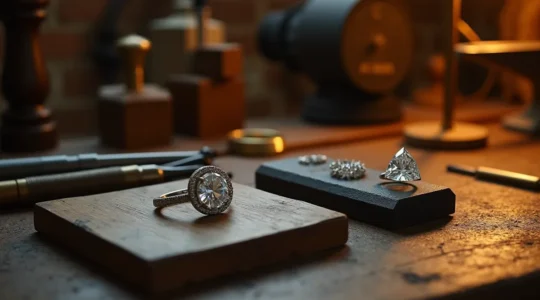
Commissioning Bespoke in Hatton Garden: What Costs Should You Expect?
A bespoke commission in Hatton Garden often costs significantly less than High Street equivalents because you pay for craftsmanship rather than branding overheads. Independent makers typically allocate ~60% of the price to the actual materials and labour, compared to just…
Lire la suite
Custom jewelry meets security: how a tailored clasp transforms your Rolex
That split-second glance at your wrist during a meeting. The subtle tug before boarding a plane. The instinctive clasp-check when walking through a crowded market abroad. If you own a Rolex worth five figures, you know these habits intimately. What…
Lire la suite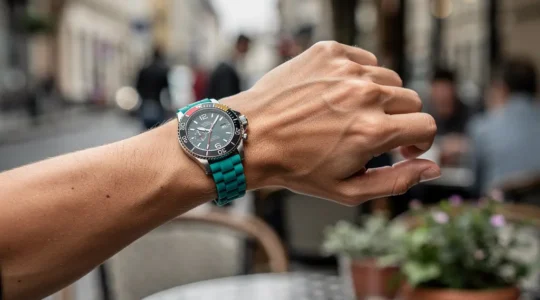
Custom jewelry trends: personalizing your Omega with vibrant rubber bands
Your Seamaster cost a small fortune. Three years on, the steel bracelet has desk-diving scars that make you wince. Worse, it feels heavy in summer and looks identical to every other Omega at the office. The official replacement strap from…
Lire la suiteDiscover the need for made-to-order earrings
Delving into the realm of custom jewelry reveals a growing demand for made-to-order earrings. This trend, fueled by a desire for individuality and personal expression, allows one to wear a piece of art, crafted to reflect their unique personality. With…
Lire la suite