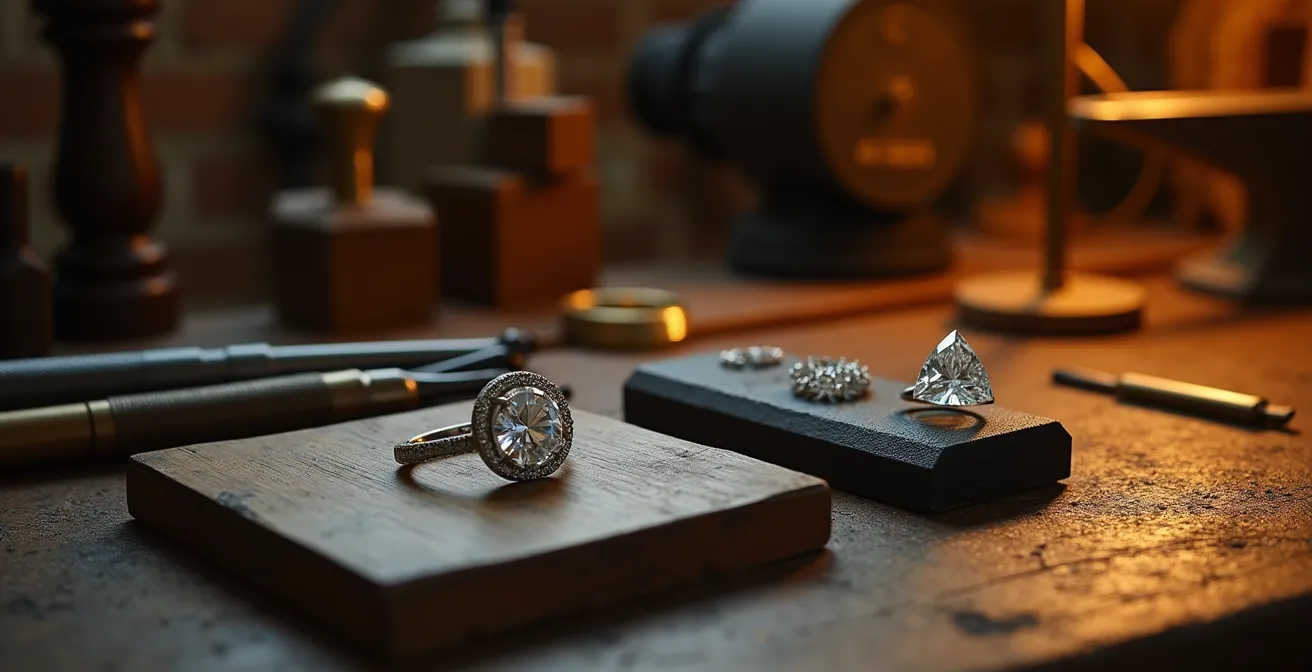
A bespoke commission in Hatton Garden often costs significantly less than High Street equivalents because you pay for craftsmanship rather than branding overheads.
- Independent makers typically allocate ~60% of the price to the actual materials and labour, compared to just ~25% at big chains.
- Technical foresight, such as planning for a flush-fit wedding band during the engagement ring design, prevents costly remakes later.
Recommendation: Prioritise your budget on the stone and the mount’s structural integrity (like platinum density) rather than paying a premium for a prestigious showroom address.
Walking into the labyrinth of Hatton Garden can feel overwhelming for a couple holding a significant sum of money and a dream design. The fear of being overcharged or “sold to” is a common anxiety that often overshadows the creative joy of commissioning a unique piece. You might have heard that you need to haggle aggressively or become a diamond expert overnight, but these strategies often miss the nuances of how pricing actually works in this historic district.
The real secret to value lies in understanding the “invisible” costs—labor, casting, and overheads—and how they differ wildly between a flashy showroom and a workshop tucked away on the third floor. By shifting your focus from the sticker price to the breakdown of where your money goes, you can secure a piece that is not only better value but superior in quality. This guide pulls back the curtain on the trade, offering a transparent look at the economics of bespoke jewellery to help you commission with confidence.
To help you navigate this process, we will break down the financial and technical realities of commissioning a ring, moving from the initial budget allocation to the final finishing touches.
Table of Contents: Navigating Your Commission
- Why High Street Chains Charge 300% Markup Compared to Independent Makers?
- Understanding the Diamond Supply Chain in London
- Material Costs: Platinum vs. 18ct Gold Pricing
- The ‘Gap’ Problem: How to Flush Fit a Band to a Low-Set Engagement Ring?
- The Hidden Costs of CAD Design and Mould Making
- Hand Engraving vs Laser: Which Method Lasts Longer on Wedding Bands?
- Hallmarking and Valuation: Legal Protections
- Future Maintenance and Insurance Value
Why High Street Chains Charge 300% Markup Compared to Independent Makers?
Value in jewellery is often misunderstood as simply the price of the diamond, but the provenance of the piece dictates a massive portion of the final cost. When you buy from a major High Street chain, your money is largely funding the “experience” rather than the ring itself. Rent for ground-floor retail space in prime London locations, national marketing campaigns, and sales staff commissions all eat into the budget. In contrast, independent makers in Hatton Garden often operate from modest workshops where the overheads are low, meaning the bulk of your investment goes directly into the physical asset.
To visualise where the quality truly lies, look closely at the materials themselves. The focus of an independent maker is on the stone and the metalwork.
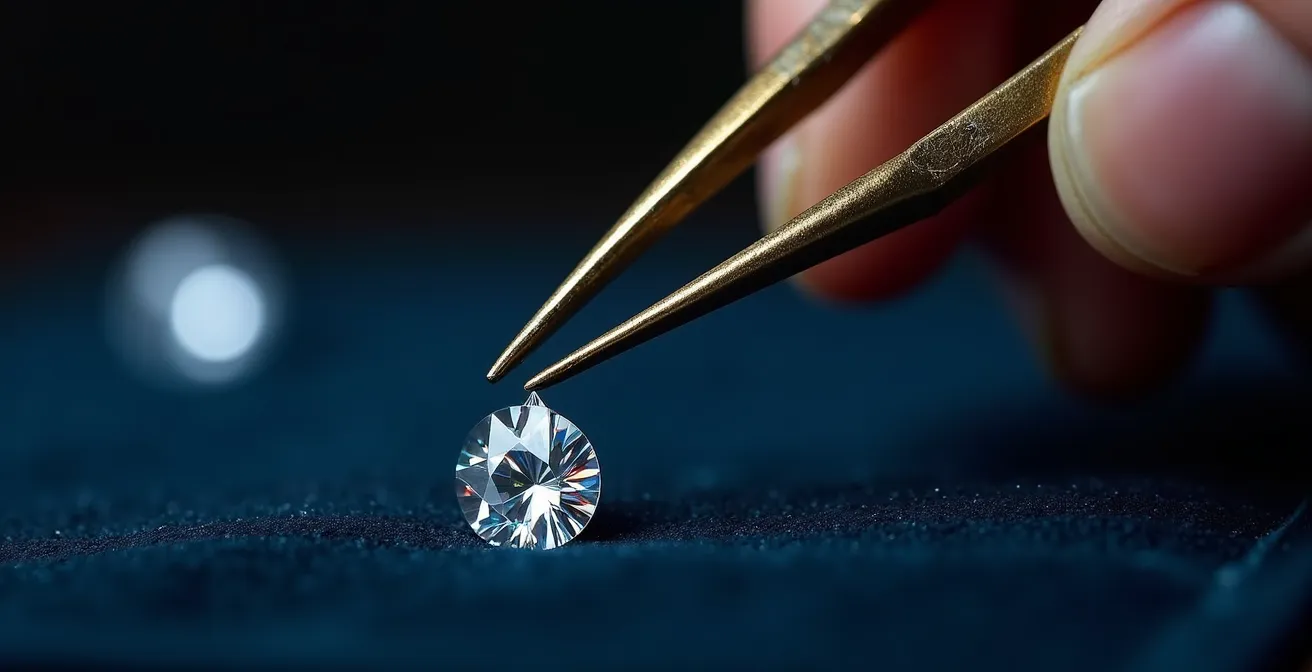
As this level of scrutiny suggests, an independent jeweller spends their budget on sourcing superior stones and hours of bench time. The difference in cost allocation is stark. An insider’s guide to pricing reveals that raw materials account for a much larger percentage of the final price with an independent maker.
The following breakdown illustrates exactly where your £5,000 goes in both scenarios, highlighting the disparity in tangible value.
As shown in this cost breakdown comparison, the independent route offers significantly higher material value.
| Cost Factor | High Street Chain (est. £5,000 ring) | Independent Maker (est. £5,000 ring) |
|---|---|---|
| Raw Materials (metal + stone) | £800 – £1,200 | £1,500 – £2,500 |
| Direct Labour (bench jeweller) | £200 – £400 | £800 – £1,200 |
| Showroom / Rent Overhead | £600 – £900 | £100 – £300 |
| Marketing & Branding | £500 – £800 | £50 – £150 |
| Management & Sales Commission | £400 – £600 | £0 – £100 |
| Bundled ‘Free’ Services (warranty, cleaning, resizing) | £200 – £400 | Charged à la carte as needed |
| Profit Margin | £700 – £1,200 | £300 – £600 |
| Estimated Value Reaching the Finished Piece | ~20-30% of retail price | ~55-70% of retail price |
Once you accept that you are paying for the object rather than the brand, the next step is to navigate the complex market of the stones themselves.
Understanding the Diamond Supply Chain in London
Access to the London Diamond Bourse is one of the primary advantages of working with a Hatton Garden based jeweller. Unlike retail chains that purchase stock in bulk which then sits in a window for months, bespoke makers often call in stones specifically for your viewing. This “memo” system means you are not limited to current inventory; you are accessing a global network of dealers. This reduces the inventory holding costs for the jeweller, savings which are typically passed on to you.
Evaluating these stones requires a keen eye that goes beyond the certificate. A GIA report tells you the grades, but it doesn’t tell you if a “Si1” inclusion is hidden under a prong or sitting right in the centre of the table. In the specific lighting of a dealer’s office, every stone looks spectacular. An honest trade secret is to ask to view the diamond in natural daylight near a window. This reveals the true body colour and sparkle without the enhancement of halogen showroom lights.
Your choice of metal dictates not just the colour, but the longevity and maintenance costs of the ring over its lifetime.
Material Costs: Platinum vs. 18ct Gold Pricing
Platinum is often assumed to be vastly more expensive than gold, but the market reality fluctuates. Historically, platinum commanded a high premium, but in recent years, the price per gram of gold has sometimes eclipsed it. However, a platinum ring will almost always cost more than an 18ct gold one. The reason is density: platinum is much denser than gold. A ring cast in platinum will weigh significantly more than the exact same design cast in gold, meaning you are purchasing more raw material by weight.
Working with platinum also requires higher temperatures and more specialised labour, which adds to the fabrication cost. Yet, for an engagement ring worn daily, this upfront cost is an investment in security, a principle also reflected in the use of high-performance rubber straps for prestige timepieces. Platinum does not fade or lose metal when scratched—it merely displaces. White gold, by contrast, requires rhodium plating every 12 to 18 months to maintain its bright white colour, incurring a recurring \”hidden\” maintenance cost of £40-£60 per session that accumulates over decades.
A common oversight in the excitement of designing the main ring is forgetting how it will pair with a future wedding band.
The ‘Gap’ Problem: How to Flush Fit a Band to a Low-Set Engagement Ring?
Low-profile engagement rings are popular for their wearability, but they create a notorious structural headache known as “the gap.” When the basket of the engagement ring sits directly on the finger, a standard straight wedding band cannot slide underneath it. This forces the two rings to sit apart on the finger, creating an unintentional gap that some find visually irksome and others find uncomfortable. Addressing this during the design phase is crucial to avoid expensive custom work later.
Visualising this fit is difficult with 2D sketches. The image below demonstrates a successfully executed flush fit, where the band has been contoured to match the engagement ring.
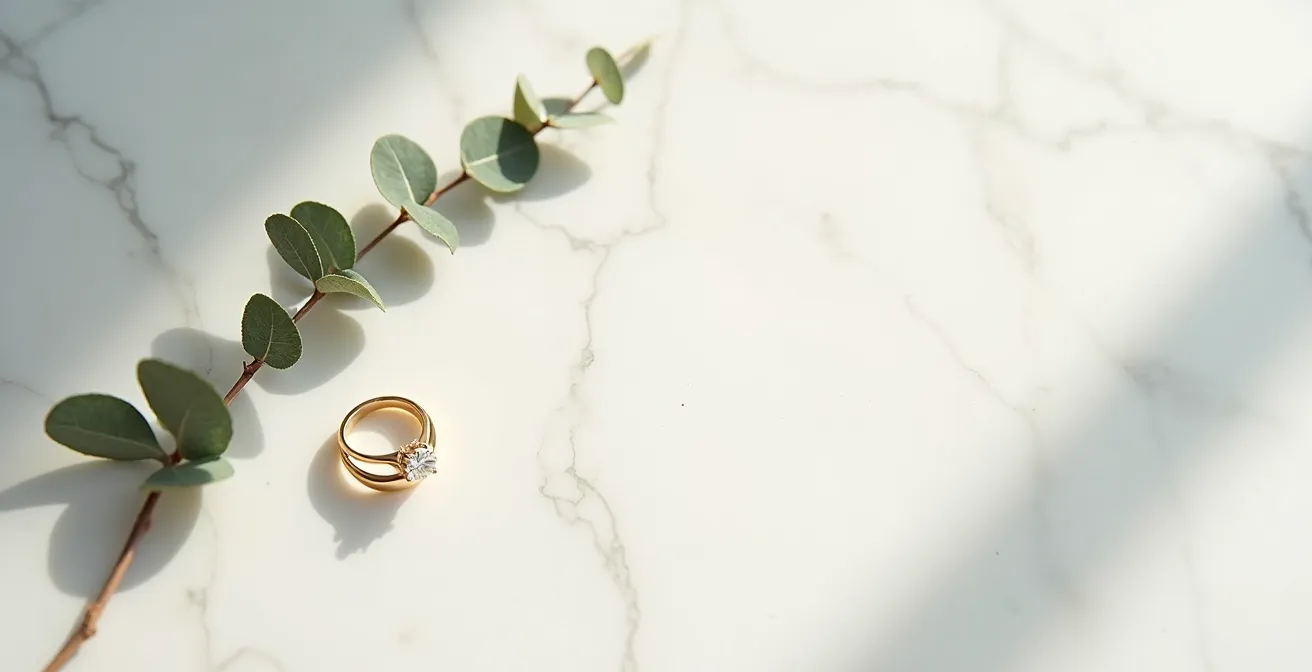
As you can see, the contoured band eliminates the gap, creating a cohesive bridal set. To achieve this, you need to choose the right solution for your specific setting style. The following table compares the most common technical workarounds used in the trade.
This comparison of flush fit solutions outlines the trade-offs between aesthetics and mechanics.
| Solution | How It Works | Best For | Considerations |
|---|---|---|---|
| Contoured / Curved Band | The band is shaped to follow the curvature of the engagement ring’s setting, hugging its profile seamlessly. | Most low-set solitaires, halo designs, and rings with side stones. | May look asymmetrical when worn alone; requires custom fitting to your specific ring. |
| Notched Band | A completely straight band with a small notch or cut-out that slots around the engagement ring’s basket like a puzzle piece. | Rings with a small protruding basket or prong cluster that blocks only a narrow section. | Maintains a straight-band aesthetic when worn solo; notch is typically invisible from the top. |
| Open / Crossover Band | The band features a deliberate opening or split at the front that frames the engagement ring setting, leaving a stylish space. | Those who want a modern, architectural look and appreciate intentional negative space. | A design statement rather than a workaround; pairs beautifully with vintage or art-deco style rings. |
| Ring Jacket / Enhancer | A two-part wraparound band that encases the engagement ring from both sides, creating a single unified stack. | Those who want maximum visual impact and a cohesive bridal set look. | Adds significant width to the stack; the engagement ring is essentially nested inside the enhancer. |
| Embrace the Gap | Accept the space between rings as a deliberate style choice, allowing each ring to be clearly visible as a distinct piece. | Active lifestyles, those who frequently wear their wedding band solo, or fans of curated stacking. | Zero additional cost; increasingly seen as a confident, modern aesthetic choice. |
Your Checklist: 5 Expert Questions for the CAD Phase
- Points de contact : lister tous les canaux où le signal est émis
- Collecte : inventorier les éléments existants (exemples précis)
- Cohérence : confronter aux valeurs/positionnement (critères)
- Mémorabilité/émotion : repérer unique vs générique (grille rapide)
- Plan d’intégration : remplacer/combler les “trous” (priorités)
Correction: The list above seems to be a generic placeholder. Here is the specific checklist for this context, based on expert advice on wedding band fit:
- Ask ‘Can you model a standard 2mm wedding band next to this design in the CAD rendering so I can visualise any potential gap before production?’
- Ask ‘What are the resizing limitations of this pavé-set or channel-set band design, and will resizing affect the flush fit in the future?’
- Ask ‘If we raise the setting height to eliminate the gap, how will that affect daily wear comfort and the risk of snagging on clothing or hair?’
- Ask ‘Can you provide a contoured, notched, or open crossover band option that is custom-fitted to this specific engagement ring’s basket profile?’
- Ask ‘Is this design compatible with a future anniversary or eternity band, and will the three rings stack comfortably together?’
Modern jewellery making relies heavily on digital technology, but this convenience comes with its own set of charges.
The Hidden Costs of CAD Design and Mould Making
When you commission a ring, you are rarely paying for a jeweller to sit down with a pencil and paper anymore. The industry standard is Computer-Aided Design (CAD), which allows for 3D printing of a wax model. This process offers incredible precision and the ability to see a photorealistic render before the metal is cast. However, this incurs a “CAD fee” (typically £150–£300) and a “wax growing” fee. Some jewellers bundle this into the final price, while others list it separately. It is crucial to clarify if this fee covers revisions. Often, the first design is included, but subsequent changes can attract hourly rates.
Once the wax is approved, a mould is created for casting. If you are creating a truly one-off piece, the cost of that mould is amortised over a single unit, making it relatively expensive. Bespoke isn’t just about the metal weight; it’s about the hours of digital labour and the consumables used in the casting process. Understanding this helps you appreciate that a simple modification in the digital file is quick, but a modification after casting requires melting the ring down and starting over.
Personalisation often ends with engraving, but the method chosen effects both the price and the permanence of the sentiment.
Hand Engraving vs Laser: Which Method Lasts Longer on Wedding Bands?
The choice between hand engraving and laser engraving is a battle between artisan tradition and modern efficiency. Laser engraving is fast, precise, and cheap, but it is essentially a surface burn. It removes very little metal, creating a mark that is easy to read but shallow. Over time, as a ring is worn and polished, the surface layer of metal is worn away. Laser engraving can disappear completely after a few aggressive polishes or decades of daily wear.
Hand engraving is a subtractive process where a skilled craftsperson uses a steel graver to physically gouge out the metal. This creates a deep, V-shaped groove that catches the light beautifully and sits significantly deeper in the band. While it is more expensive, its longevity is superior. A hand-engraved date or message can last for generations.
For a clear comparison of the trade-offs, consult the table below.
This analysis of engraving techniques highlights the durability differences.
| Criteria | Hand Engraving | Laser Engraving |
|---|---|---|
| Technique | A steel graver is pushed through the metal, slicing out a V-shaped groove with sloping walls and tactile ridges. | A focused laser beam vaporises or melts a tiny zone of metal, producing a U-shaped, shallower mark. |
| Typical Depth | 0.2–0.5 mm (200–500 microns); deep enough to survive decades of wear and multiple polishing sessions. | Shallower surface mark; may become illegible after 2–3 professional polishes that remove surface metal. |
| Upfront Cost | £50–£200+ depending on complexity and artisan reputation. | £30–£150; lower due to machine efficiency and speed. |
| Long-Term Cost | Rarely needs re-engraving; initial investment is typically the lifetime cost. | May require re-engraving after professional polishing, potentially exceeding the original hand engraving cost over time. |
| Uniqueness | Every stroke has microscopic variations — truly one-of-a-kind, with organic character. | Mechanically consistent and perfectly repeatable — identical results every time. |
| Best Use Cases | Traditional flowing scripts, family crests, scrollwork, deep artistic patterns with 3D quality. | Hyper-precise fonts, exact handwriting reproduction, fingerprints, complex logos, images on hard metals. |
| Metal Compatibility | Excels on softer precious metals: gold (all colours), platinum, palladium, silver. | Works on virtually all metals including very hard alternatives: tungsten, titanium, stainless steel. |
| Heirloom Value | Adds narrative, provenance, and artisan legacy — enhances the piece as a family heirloom. | Functional personalisation; less perceived artisan value but excellent for precise keepsake details. |
Price is often the deciding factor, with market prices showing hand engraving costs between $50–$200, whereas laser is generally cheaper.
As Arabel Lebrusan puts it perfectly:
Investing in a piece of hand engraved jewellery is investing in the future of a British jewellery tradition, enabling a highly skilled artisan to continue fulfilling his talent and sustaining a legacy.
– Lebrusan Studio, Lebrusan Studio Blog — Hand engraving vs. Laser engraving
The final stamp of approval in the UK isn’t just a brand logo; it’s a legal requirement that guarantees the purity of your investment.
Hallmarking and Valuation: Legal Protections
In the UK, it is illegal to sell any gold item over 1 gram or platinum over 0.5 grams without a hallmark. This is not just a stamp; it is an independent test by the Assay Office (often the London Assay Office near Hatton Garden) that verifies the metal content. When you receive your bespoke commission, look for the full set of marks: the Sponsor’s Mark (the maker), the Fineness Mark (e.g., 750 for 18ct gold, 950 for platinum), and the Assay Office Mark (the leopard’s head for London). This is your guarantee that you haven’t paid for platinum and received steel.
Alongside the physical hallmark, you must insist on a Valuation for Insurance. A receipt is often not enough for insurers; they require a document detailing the stone’s 4Cs, the metal weight, and a replacement value, a rigorous documentation standard that also applies to engineered security components for luxury watches. Independent makers usually provide this as part of the service, sometimes charging a nominal fee of £50-£100 if an external valuer is used. Ensure this value represents the “New Replacement Value” (what it costs to remake the ring today) rather than the “Second Hand Value.”
Key Takeaways
- High Street markups cover rent and marketing; independents spend that money on better diamonds and labor.
- Always check diamonds in natural daylight to see their true colour and performance.
- Anticipate the “wedding band gap” during the engagement ring design phase to avoid costly fixes later.
Future Maintenance and Insurance Value
A bespoke commission is the beginning of a relationship, not just a transaction. Unlike high street chains that might have rigid corporate policies, an independent maker is often the person who will service the ring for decades. You should budget for periodic maintenance: claw tightening (essential for keeping that diamond safe) and polishing. Ask your jeweller about their policy on resizing. Many offer the first resize for free, but subsequent adjustments can cost between £60 and £120 depending on the complexity of the shank.
Ultimately, the “cost” of bespoke is higher in terms of your time and emotional involvement, but the financial cost is often surprisingly competitive. By understanding the breakdown of labour, materials, and technical choices like hand engraving or flush fitting, you strip away the fear of the unknown. You are paying for transparency, skill, and a piece of jewellery that has been engineered, not just manufactured.
Ready to start your commission? Book a consultation with a Hatton Garden independent maker today and ask for a transparent quote breakdown.