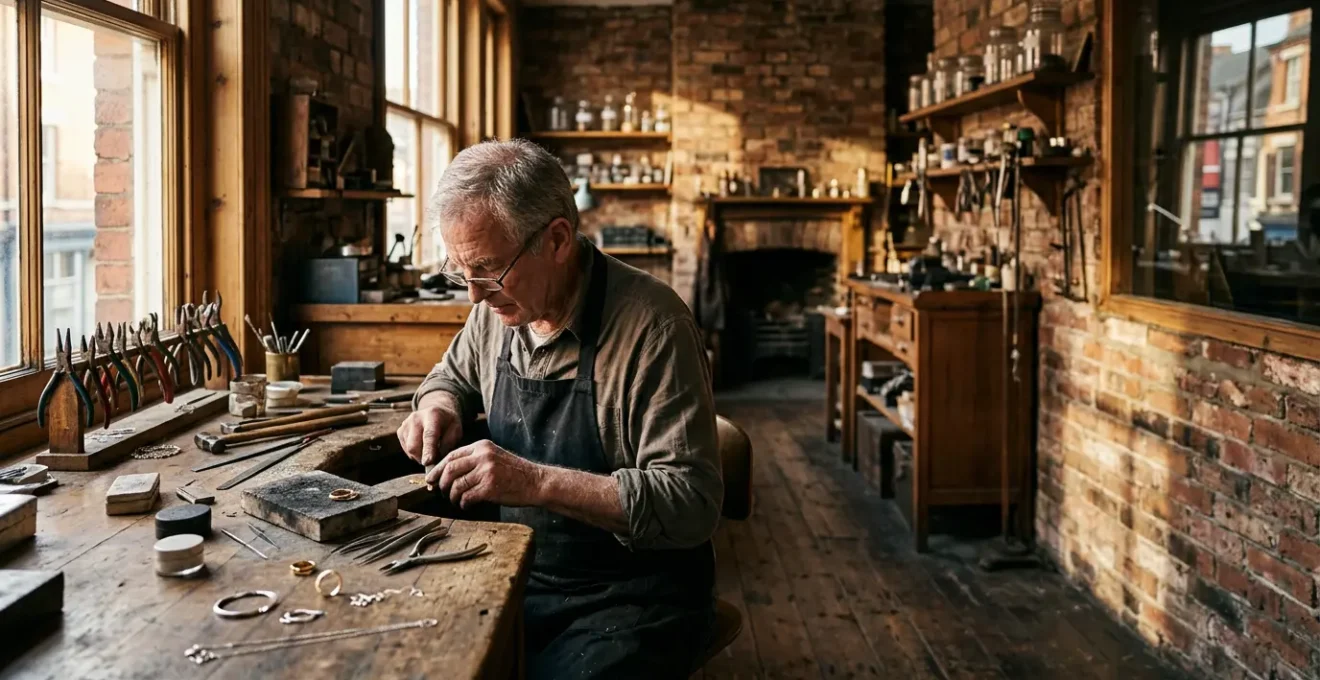
Commissioning directly from a British maker provides vastly superior value and quality compared to high street retailers, whose prices are inflated by hidden costs.
- High street chains add markups averaging 100-300% to cover marketing and overhead, not craftsmanship.
- Terms like “hand-finished” often disguise mass-produced items, unlike genuinely “handmade” pieces with greater structural integrity.
Recommendation: Visit a maker’s workshop in person to verify their craft and invest in a piece with guaranteed provenance and lasting value.
When considering a significant jewellery purchase, the glittering windows of high street chains seem like the obvious destination. They offer convenience, familiar brand names, and a sense of security. Yet, for the discerning buyer looking to support the UK’s local economy and secure better value, a far more rewarding path lies within the historic workshops of master artisans. The common belief is that bespoke means more expensive, but this overlooks the complex economics of mass retail versus direct craft patronage.
The conversation often revolves around personal taste and unique designs, but the true advantage of commissioning directly is rooted in transparency, material quality, and the preservation of irreplaceable skills. While high street brands spend fortunes on marketing and prime retail locations, independent makers invest their resources directly into superior materials and countless hours of skilled labour. Understanding this distinction is the first step towards becoming not just a customer, but an intelligent patron of British craftsmanship.
This guide moves beyond the surface-level romance of bespoke jewellery. It provides the insider knowledge needed to navigate the world of independent makers with confidence. We will deconstruct retail pricing, reveal the difference between marketing terms and true craftsmanship, and explain how your commission directly contributes to saving endangered heritage skills. You will learn how to verify a genuine workshop, communicate effectively for a remote commission, and recognise the hallmarks of an investment-grade piece that will become a future antique.
To help you navigate this world of authentic British craft, this article breaks down the key considerations for commissioning directly from a maker. Explore the sections below to become an informed buyer and a true supporter of our national jewellery heritage.
Contents: Your Guide to Commissioning British Craft
- Why High Street Chains Charge 300% Markup Compared to Independent Makers?
- How to Visit a Workshop to Verify It Is Not Just a Reseller?
- Hand-made vs Hand-finished: Which Term Is a Marketing Trap?
- The Communication Mistake That Ruins Remote Custom Commissions
- How Commissioning Bespoke Helps Save Endangered Heritage Skills?
- Why Is the Assay Office Stamp Critical for UK Resale Value?
- Why Do Some Jewellers Charge £500 for CAD While Others Offer It Free?
- Collecting Future Antiques: Which Modern British Jewellers Are Investment Grade?
Why High Street Chains Charge 300% Markup Compared to Independent Makers?
The price tag on a piece of jewellery from a major high street retailer is often misleading. While buyers assume they are paying for precious materials and skilled work, a significant portion of the cost has nothing to do with the item itself. The fundamental difference lies in value transparency. An independent maker’s price primarily reflects two things: the cost of the materials and the time spent by a skilled artisan. In contrast, a high street chain’s price is burdened by multiple layers of operational and marketing overhead.
These additional costs include expensive retail leases in prime shopping centres, multi-million-pound advertising campaigns, extensive corporate administrative structures, and shareholder profits. As a result, the actual ‘jewellery’ part of the price can be surprisingly small. While extreme cases can see markups of 300% or more, industry data shows that even the average is substantial. For instance, analysis of major retailers reveals an average markup of over 100%, meaning at least half the price you pay is not for the product.
This table breaks down the typical cost structures, illustrating clearly where your money goes. For high street chains, craftsmanship is a minor expense, whereas for an independent maker, it represents the core value of the piece.
| Cost Component | High Street Chains | Independent Makers |
|---|---|---|
| Materials Cost | 15-20% | 40-50% |
| Labour/Craftsmanship | 5-10% | 35-45% |
| Marketing & Advertising | 20-30% | 5-10% |
| Retail Overhead | 15-20% | 5-10% |
| Corporate Structure | 10-15% | 0% |
| Profit Margin | 15-20% | 10-15% |
By commissioning directly, you are not just buying a piece of jewellery; you are making a strategic decision to invest in tangible value—superior materials and dedicated craftsmanship—rather than subsidising a retailer’s marketing budget. This is the foundation of getting better value while supporting authentic British skill.
How to Visit a Workshop to Verify It Is Not Just a Reseller?
In an industry where “handmade” can be a loosely applied term, ensuring you are dealing with a genuine maker is paramount. The Birmingham Jewellery Quarter, for example, is a thriving ecosystem where over 800 businesses operate, including true designer-makers and simple resellers. The ability to distinguish between them is key to guaranteeing workshop provenance and ensuring your investment supports a real artisan. A visit to the workshop is the most effective way to do this, but you need to know what to look for.
A genuine workshop is a place of active creation, not a polished showroom. It should feel lived-in and functional. Don’t be put off by what seems like clutter; the signs of authentic work are often found in the details of the workspace. A real maker will be proud to show you their bench and discuss their process. In contrast, a reseller’s premises will feel more like a conventional shop, with staff who are trained in sales, not technical craft, and who may be unable to answer detailed questions about how a piece is made.
To empower your visit, use this checklist to spot the tell-tale signs of an authentic jeweller’s workshop. These points will help you look beyond the finished pieces and identify a true craftsperson at work.
Your Workshop Authenticity Checklist
- Observe the workspace: Look for active workbenches with visible metal filings, worn tools, and scorch marks from soldering torches.
- Ask to see work-in-progress: Genuine makers always have several ongoing projects at different stages of completion.
- Listen for technical language: A true craftsperson will use terms like ‘alloys’, ‘porosity’, ‘setting tension’, and ‘annealing’, not just retail-focused language.
- Check for specialised equipment: Spotting rolling mills for shaping metal, mandrels for sizing rings, and pickle pots for cleaning pieces are all positive signs.
- Request to see hallmarking tools: Ask to see the unique sponsor’s punch they use to mark pieces before sending them to the Assay Office.
By actively verifying the source of your commission, you are not just confirming authenticity; you are connecting with the creator and the story behind your piece. This direct relationship is a core part of the value offered by the independent craft sector.
Hand-made vs Hand-finished: Which Term Is a Marketing Trap?
The language used to sell jewellery can be deliberately ambiguous. While terms like “handmade” and “hand-finished” might sound similar, they represent vastly different levels of quality, craftsmanship, and value. Understanding this distinction is perhaps the most important piece of knowledge a buyer can have. The term “hand-finished” is a common marketing trap, designed to imply a level of artisanal quality that is often not present.
A “hand-finished” piece is typically mass-produced. The item is cast in a mould, often overseas in large quantities, and the “finishing” involves a final polish or the setting of a stone by hand. The core structure is created by machine, not a craftsperson. In contrast, a truly “handmade” piece is forged, shaped, and constructed by a jeweller from raw materials. This process, known as work-hardening, fundamentally changes the molecular structure of the metal, resulting in an item with far greater structural integrity and durability than a cast equivalent. These authentic marks of creation are what make a piece truly unique, a concept English Heritage noted in its assessment of the Jewellery Quarter, describing it as having, “A particular combination of structures associated with jewellery and metalworking which does not seem to exist anywhere else in the world.”
The subtle tool marks and unique character of a handmade piece are not flaws; they are the signature of the artist and the proof of its superior construction. The image below highlights the authentic texture and impressions left by hand-forging, evidence that is impossible to replicate in a mass-produced item.
Case Study: The Market Reality of Handmade Jewellery
While handmade jewellery offers superior quality, it faces inherent market challenges. According to an analysis of the handmade jewellery market, its limited accessibility is a key hurdle. These pieces are not found in shopping malls but must be sought out at craft fairs or through direct commissions. Furthermore, the time-intensive craftsmanship required for work-hardening and hand-fabrication results in a higher intrinsic cost compared to “hand-finished” alternatives, which benefit from the economies of scale of bulk casting.
When you commission a handmade piece, you are paying for this superior structural quality and the hours of skill required to create it. Don’t be swayed by vague marketing language; always ask specifically how a piece was constructed.
The Communication Mistake That Ruins Remote Custom Commissions
In today’s connected world, you don’t need to live near a jewellery quarter to commission a bespoke piece. Remote commissions are increasingly common, facilitated by digital tools. The process relies heavily on clear communication, and a single misunderstanding can lead to disappointment and costly revisions. The biggest mistake clients make is assuming a visual mood board is a sufficient brief. While inspiration images are a great starting point, they are not a technical specification.
A successful commission translates aesthetic desire into functional reality. A jeweller needs to understand not just what you want the piece to look like, but how you will live with it. A beautiful but impractical design is a failure. Key details often missed in early discussions include lifestyle constraints (e.g., a delicate setting for someone with a very active job), potential metal allergies, and specific wearability requirements (e.g., the weight of earrings). Relying solely on pictures without this functional context is the most common path to a ruined commission.
The rise of digital design has made this process easier, with a recent study showing that nearly 67% of independent designers use AI-assisted tools to create and share designs. However, even with perfect 3D renderings, the client’s feedback must be precise. Vague comments like “make it more delicate” are unhelpful. Instead, provide specific, measurable instructions such as “reduce the band width by 1mm” or “use a four-claw setting instead of a six-claw.” This clarity is vital, especially before the “point of no return”—once the metal is cast or forged, major changes become difficult and expensive, if not impossible.
Clear, technical, and early communication is the bedrock of a successful remote commission. It ensures the final piece is not only beautiful but also perfectly suited to the person who will wear it.
How Commissioning Bespoke Helps Save Endangered Heritage Skills?
Choosing to commission a bespoke piece of jewellery is more than a personal transaction; it is an act of craft patronage that plays a vital role in preserving Britain’s cultural heritage. Many traditional jewellery-making techniques, such as hand-engraving, chainmaking, and lapidary (gemstone cutting), are endangered skills. They are time-consuming, difficult to master, and cannot be replicated by machines. These skills survive through a master-apprentice model, where knowledge is passed down directly from one generation to the next within a workshop environment.
This fragile ecosystem is funded almost entirely by bespoke commissions. When you pay a maker for their work, you are not just funding a single piece; you are enabling them to invest the time needed to train the next generation of artisans. This direct support system is what keeps these precious skills alive. The Birmingham Jewellery Quarter is a world-leading example of this principle in action, a fact recognised on the global stage.
Case Study: Birmingham’s World Craft City Status
In 2024, Birmingham’s Jewellery Quarter was awarded the prestigious status of a World Craft City, joining an elite group of only eight cities worldwide, including craft capitals like Kyoto and Jaipur. This award specifically recognised the Quarter’s unique concentration of heritage skills. It is home to the Birmingham School of Jewellery, the Assay Office, and over 200 listed buildings where traditional techniques are actively practiced and preserved. This recognition highlights how the direct master-apprentice model, funded by private and public commissions, is critical to safeguarding these endangered crafts for the future.
By choosing a bespoke commission, you become a direct participant in this story of preservation. Your decision provides the economic fuel that allows a master jeweller to teach an apprentice a technique that might otherwise be lost forever. It is a powerful way to ensure British craftsmanship has a future as rich as its past.
Why Is the Assay Office Stamp Critical for UK Resale Value?
A hallmark from a UK Assay Office is far more than a simple stamp; it is an legally binding guarantee of quality and provenance that is critical for the long-term value of any piece of precious metal. For buyers in the UK, it is the single most important feature to look for, especially concerning investment and resale value. The Birmingham Assay Office, the largest in the world, hallmarks over 12 million items annually, providing an independent certification of the metal’s purity. Without it, a piece has no verifiable standing in the secondary market.
The hallmark is essentially the jewellery’s passport. It tells you who made it, what it is made from, where it was tested, and when. This level of detail is invaluable for valuation, insurance, and future sale. A piece without a hallmark is, in the eyes of the market, of unknown origin and unverified quality, drastically reducing its value. For anyone considering their jewellery as a potential heirloom or asset, a full UK hallmark is non-negotiable.
Understanding the components of the hallmark allows you to read the story of your piece. It consists of several compulsory marks:
- Sponsor’s Mark: This unique mark identifies the specific maker or company that submitted the item for hallmarking. It’s the signature that links the piece directly to its creator.
- Fineness Mark: A number that shows the purity of the precious metal as parts per thousand (e.g., 925 for Sterling Silver, 750 for 18ct Gold).
- Assay Office Mark: A symbol for the office that performed the testing. The anchor is the historic and iconic mark for Birmingham.
- Date Letter: A letter in a specific font and shield shape that denotes the exact year the item was hallmarked, allowing it to be precisely dated.
Optional marks, such as those for royal coronations or jubilees, can add further to a piece’s collectability. Insisting on a hallmarked piece from your maker is not just a quality check; it’s the ultimate protection for your investment.
Why Do Some Jewellers Charge £500 for CAD While Others Offer It Free?
In the world of bespoke jewellery, Computer-Aided Design (CAD) has become an essential tool, but its pricing can be confusing. Some jewellers offer it as a free service, while others charge a substantial fee, often around £500. This disparity isn’t arbitrary; it reflects two fundamentally different business models and philosophies of design. Understanding this helps you assess the true value you are receiving.
Jewellers who offer “free” CAD are often operating a high-volume, direct-to-consumer (D2C) model. Their goal is to convert a sale quickly. The CAD process is streamlined, often using pre-existing templates that are slightly modified. The cost of the designer’s time is absorbed into the final price and offset by higher conversion rates, sometimes boosted by tools like Augmented Reality (AR) try-ons. The design itself is a means to an end: the sale.
Conversely, a traditional maker who charges a separate, transparent fee for CAD is treating the design phase as a distinct and valuable service. A £500 charge typically represents 5-10 hours of a skilled designer’s dedicated time. This is for creating a genuinely unique piece from scratch, not modifying a template. In these cases, the client is not just paying for a rendering; they are paying for a collaborative design process and the expertise required to translate their vision into a technically sound and beautiful object. Often, the client will also receive ownership rights to the design files, which is rarely the case in the “free” model.
Case Study: The Economics of Digital vs. Traditional Commissions
According to 2024 research on the jewellery market, D2C brands that integrate online and offline experiences see higher conversions. Brands using AR tools can afford to absorb CAD costs into their pricing model because the technology streamlines the sales process. In contrast, a traditional maker charging a fee for CAD is billing for a bespoke creative service. The fee covers the intensive labour of a unique design process, ensuring the client receives a one-of-a-kind piece and often intellectual property rights to the design itself.
A “free” CAD service is a sales tool; a paid CAD service is a professional design consultation. Choosing between them depends on whether you are seeking a customised product or a truly bespoke creation.
Key Takeaways
- High street jewellery prices are inflated by marketing and overhead, not craftsmanship.
- “Handmade” ensures superior structural integrity; “hand-finished” is often a marketing term for mass-produced items.
- A full UK hallmark from an Assay Office is the only true guarantee of a piece’s quality and resale value.
Collecting Future Antiques: Which Modern British Jewellers Are Investment Grade?
Thinking of a bespoke jewellery commission purely in terms of immediate wear is to miss half its value. When you work with a skilled independent maker, you are acquiring a piece of contemporary applied art. You are not just a customer; you are a collector. The very best pieces commissioned today are the investment-grade antiques of the future, holding both financial and cultural value for generations to come.
An investment-grade piece is defined by a combination of factors: the unique vision of the maker, exceptional craftsmanship, the quality of the materials, and impeccable provenance (guaranteed by the hallmark). Unlike mass-produced items that lose value the moment they leave the shop, a well-made bespoke piece from a recognised artisan has the potential to appreciate over time. Identifying which modern jewellers are creating this calibre of work is the final step in becoming a true patron of the craft.
The UK is home to a vibrant community of world-class artisans. As Danila Tarcinale, Chair of the Institute of Professional Goldsmiths, states, the goal is to champion their work:
We want to bring these small independent makers to centre stage and push for them to reach a younger clientele too.
– Danila Tarcinale, Institute of Professional Goldsmiths
This highlights a growing movement to recognise these makers not just as tradespeople, but as artists whose work is worthy of collection. Finding them involves research, visiting craft shows, and engaging with the community in hubs like the Birmingham Jewellery Quarter.
By commissioning directly, you are acquiring an object with a story, a verifiable origin, and a level of quality that can stand the test of time. You are making a choice to invest in lasting value over fleeting fashion, and in doing so, you are collecting a small piece of British history.
To begin your journey as a patron of British craft, the next logical step is to explore the workshops and makers of the Birmingham Jewellery Quarter, equipped with the knowledge to make a confident and valuable choice.
Frequently Asked Questions about Bespoke Jewellery Commissions
What’s the biggest mistake when starting a bespoke commission?
Relying solely on mood boards without creating a functional brief that covers lifestyle constraints, metal allergies, and specific wearability requirements. Visual inspiration must be translated into technical specifications.
When is the ‘point of no return’ in the commission process?
After metal casting or forging begins. Changes before CAD approval are easy; changes after the wax model is approved are expensive; changes after casting are often impossible without starting over.
How should feedback be communicated to be effective?
Provide specific, measurable feedback like ‘reduce band width by 1mm’ or ‘lower the stone setting by 2mm’ rather than vague comments like ‘make it more delicate’ or ‘I want it to pop more’.