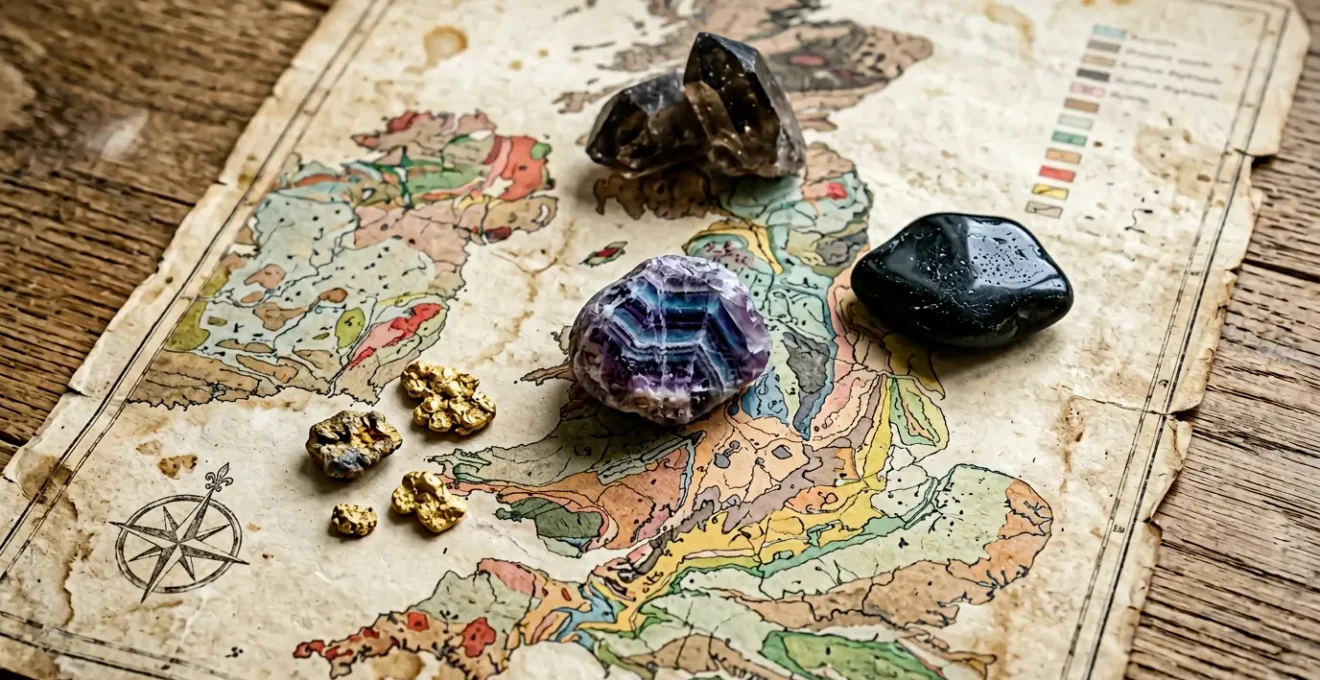
Owning a genuine British gemstone requires more than patriotism; it demands the discerning eye of a geologist to navigate a market filled with imitations and misinformation.
- Material integrity is paramount: a gem’s geological properties (like hardness and structure) dictate its use and longevity, especially for fragile stones like Blue John.
- Provenance verification is non-negotiable, as many “Scottish” Cairngorms are irradiated Brazilian quartz and “Whitby” Jet can be simple plastic.
Recommendation: Before purchasing, use physical tests and ask for specific locality documentation to ensure you are acquiring a true piece of British geology, not just a story.
The allure of a gemstone mined from British soil is powerful. For a patriot or a discerning tourist, it represents a tangible connection to the history and landscape of the United Kingdom, a story captured in stone. Many seek a piece of Whitby Jet for its Victorian mourning heritage or a Claddagh ring as a symbol of their ancestry. The common advice is to look for jewellers in heritage locations and trust the label.
However, from a geologist’s perspective, this romantic notion often collides with a harsh reality. The market is rife with sophisticated imitations, mislabelled materials, and a general lack of understanding about the physical limitations of these native treasures. Simply buying a dark stone in Whitby does not guarantee it’s authentic Jet, and a “Cairngorm” brooch might have more in common with a Brazilian quarry than the Scottish Highlands. True ownership goes beyond the purchase; it begins with knowledge.
But what if the key to acquiring a genuine piece of British heritage wasn’t about trusting a sales pitch, but about understanding the stone itself? The secret lies not in romance, but in practical geology. This guide abandons the broad strokes of tourist advice and equips you with the specific, practical knowledge to assess authenticity, understand material vulnerabilities, and make informed choices. We will move beyond what a gem is and focus on why it behaves the way it does.
This article will address the critical questions a discerning buyer must ask. We will explore the structural weaknesses of certain stones, provide definitive tests for identifying fakes, compare the true rarity of precious metals, and offer a clear path for commissioning work, all from a geologist’s standpoint. This is your guide to owning a true, enduring piece of the British Isles.
Contents: A Geologist’s Guide to Authentic British Gemstones
- Why Blue John Should Only Be Used in Pendants, Not Rings?
- How to Test if Your Whitby Jet Is Real or Just Hard Plastic?
- Scottish Gold vs Welsh Gold: Which Is Rarer and More Expensive?
- The ‘Smoky Quartz’ Scam Selling Brazilian Stones as Scottish Cairngorm
- How to Commission a Cutter for a Pebble You Found on the Beach?
- Why Wearing Your Claddagh Ring the Wrong Way Sends the Wrong Signal?
- How Commissioning Bespoke Helps Save Endangered Heritage Skills?
- Gold or Silver: Which Metal Suits Pale British Complexions Best?
Why Blue John Should Only Be Used in Pendants, Not Rings?
Blue John, a rare, banded form of fluorite found only in Derbyshire, is visually stunning. Its deep purple, blue, and golden-yellow bands make it an icon of British decorative arts. However, its beauty belies a significant structural vulnerability that makes it entirely unsuitable for high-impact jewellery like rings. The primary issue is its softness. From a mineralogical standpoint, Blue John fluorite has a hardness of only 4 on the Mohs scale. This means it can be easily scratched by common materials like steel (a knife blade is around 5.5) and even household dust, which contains microscopic quartz particles (hardness 7).
Beyond its softness, fluorite possesses perfect octahedral cleavage in four directions. This means it has a natural tendency to split along smooth, flat planes when struck. A sharp knock on a doorframe, something a ring endures daily, is enough to cause a fracture or cleave the stone. This is why you will predominantly see Blue John set in pendants, brooches, and earrings. These pieces are less exposed to accidental impact, preserving the material integrity of the stone. A knowledgeable jeweller will almost always use a protective bezel or rub-over setting, which encases the stone’s fragile edge in metal, further shielding it from harm. Choosing a pendant over a ring is not a matter of style, but a necessary geological precaution.
How to Test if Your Whitby Jet Is Real or Just Hard Plastic?
Genuine Whitby Jet is not a mineral but a gemstone of organic origin, formed from the intense compression of fossilised wood over 180 million years. Its deep, velvety black, light weight, and warm feel made it the material of choice for Victorian mourning jewellery. Unfortunately, its fame led to a plethora of imitations, from black glass (“French Jet”) to early plastics like Vulcanite and Bakelite. Distinguishing real jet requires more than a simple visual inspection; it requires a series of simple, non-destructive geological tests that you can often perform yourself.
The most reliable home test is the streak test. When rubbed gently on an unglazed ceramic surface (like the back of a tile), genuine jet leaves a characteristic brown or dark brown streak. Most imitations, particularly glass and hard plastics, will leave no streak or a black one. Another key indicator is its thermal property; jet is a poor conductor of heat and will feel warm to the touch, whereas glass will feel cold and dense. Finally, when rubbed vigorously on a cloth, genuine jet can build up a static charge sufficient to attract small pieces of paper or dust. This combination of a brown streak, light weight, and warm, static-producing nature is the trifecta of authentic Whitby Jet.
The prevalence of fakes is not a modern problem. As the British Museum’s analysis of Victorian mourning jewellery found, a significant portion of historical pieces were not genuine jet. This makes provenance verification and physical testing essential for any collector.
This comparative table summarises the key differences, providing a quick reference for identifying genuine Whitby Jet from its most common simulants.
| Material | Streak Test Result | Weight | Static Test | Feel |
|---|---|---|---|---|
| Genuine Whitby Jet | Brown streak on unglazed ceramic | Very light | Attracts dust when rubbed | Warm to touch |
| French Jet (Glass) | No streak | Heavy | No static | Cold to touch |
| Vulcanite | Black streak | Medium weight | Slight static | Room temperature |
| Bakelite | Yellow streak | Medium weight | No static | Slightly warm |
| Bog Oak | Brown streak | Light | No static | Warm to touch |
Scottish Gold vs Welsh Gold: Which Is Rarer and More Expensive?
While the UK is not a major gold producer, it is home to two of the world’s most sought-after and symbolic types of gold: Scottish and Welsh. Both are exceptionally rare, but they differ in their geology, history, and ultimate value. Scottish gold is primarily alluvial, found as small grains and nuggets panned from rivers in areas like Sutherland and Perthshire. Its colour is typically a rich, buttery yellow. Welsh gold, by contrast, was historically hard-rock mined, primarily from the Clogau St. David’s mine in the Dolgellau gold belt. Its most distinctive feature is a subtle rose or pinkish tint, a result of trace amounts of copper in the natural alloy.
In the contest of rarity, Welsh gold is the undisputed champion. The last significant mining operations for Welsh gold ceased in the early 20th century. As the Lillicoco Heritage Report notes:
Welsh Gold was in regular use until 1938, today only surviving in small increments with a small yield
– Lillicoco Heritage Report, British Gemstone Archives
This scarcity has created an extraordinary premium. Today, items containing a certified trace of Welsh gold are sold for many times the value of their gold content alone; some estimates suggest Welsh Gold today is estimated to be up to 30,000 times more valuable than standard gold. Scottish gold is also rare and commands a premium, but active panning means a small, steady supply still enters the market. For this reason, Welsh gold, used in royal wedding rings since 1923, remains the rarer and significantly more expensive of the two, representing the pinnacle of British precious materials.
The ‘Smoky Quartz’ Scam Selling Brazilian Stones as Scottish Cairngorm
True Scottish Cairngorm is a variety of smoky quartz found exclusively in the Cairngorm Mountains. Historically treasured, it has a distinctive colour palette ranging from pale, sherry-like yellow to a deep, smoky brown, almost black (known as morion). Its scarcity and historical significance make it a prime target for substitution. The most pervasive scam involves selling common, inexpensive smoky quartz from Brazil—or even clear quartz that has been artificially irradiated—as genuine Scottish Cairngorm. To the untrained eye, they can look identical, but a knowledgeable buyer can spot the deception.
The key to provenance verification lies in understanding the subtle characteristics of the genuine article. Natural Cairngorm almost always exhibits colour zoning, with variations and subtle shifts in hue within a single crystal. Irradiated quartz, by contrast, often has a suspiciously uniform, unnaturally dark, and ‘dead’ appearance. Furthermore, authenticating stones from the Royal Collection at Balmoral revealed that genuine Cairngorm often turns honey or amber when gently heated, a trait not shared by most Brazilian material. Magnification can also reveal tiny needle-like inclusions of the mineral rutile, a common feature in Scottish quartz.
An ethical seller should be able to provide a specific Scottish locality for the stone and documentation confirming its natural, untreated colour. The price itself is a major clue: if a large, dark, perfectly clear “Cairngorm” is being sold cheaply, it is almost certainly an irradiated import. True Cairngorm is rare, and its price reflects that.
Buyer’s Checklist: Verifying Authentic Cairngorm
- Ask for specific Scottish locality: Genuine Cairngorm comes only from the Cairngorm mountains. Insist on knowing the specific source.
- Request documentation of natural vs treated colour: Scrutinise stones that are unnaturally dark or perfectly uniform in colour, as they are likely irradiated.
- Examine under magnification: Look for natural inclusions, such as fine rutile needles, which are common fingerprints of genuine Scottish material.
- Check for colour zoning: Turn the stone in the light. Natural Cairngorm should show subtle variations in colour and intensity, not a flat, uniform darkness.
- Verify price reflects rarity: Be highly suspicious of low prices. A genuine, high-quality Cairngorm commands a significant premium over standard smoky quartz.
How to Commission a Cutter for a Pebble You Found on the Beach?
Finding a beautiful pebble on a British beach—perhaps a piece of translucent agate, colourful jasper, or patterned flint—and imagining it as a polished gemstone is a romantic notion. Transforming that raw stone into a wearable piece of jewellery is a process known as lapidary commissioning. It involves finding a skilled gem cutter (a lapidarist) to shape and polish your find. However, before you approach a cutter, there are a few practical and legal steps to consider.
First, ensure your pebble is suitable for cutting. A good candidate should be free of major cracks. Hold it up to a strong light; translucency is a great sign. The most important test is hardness. Using a steel nail, try to scratch the stone in an inconspicuous spot. If the nail leaves a metal streak on the stone without scratching it, the stone is harder than the nail (over 5.5 on the Mohs scale) and is generally robust enough for cutting. If the stone scratches, it’s likely too soft for most jewellery.
Next, you need to decide on the cut. For opaque or translucent stones with interesting patterns, like agate or jasper, a smooth, domed ‘cabochon’ cut is ideal. For clear, translucent stones like quartz, ‘faceting’ will create the sparkle associated with traditional gems. Finding a lapidarist can be done through local lapidary clubs or online directories. When you contact them, provide a clear photo of your stone and its dimensions. Be aware that cutting is a skilled, time-consuming process; professional lapidary services in the UK typically charge between £15-£50 per carat, depending on the complexity of the cut. It’s a wonderful way to create a truly personal piece of jewellery with a story connected directly to the British coastline.
Why Wearing Your Claddagh Ring the Wrong Way Sends the Wrong Signal?
The Claddagh ring, with its iconic design of two hands holding a crowned heart, is a globally recognised symbol of Irish heritage. But it is more than a beautiful object; it is a piece of communicative jewellery, a status update worn on the hand. The meaning of the design is constant—the heart for love, the hands for friendship, and the crown for loyalty—but the message it sends to the world changes dramatically based on how it is worn. Wearing it “the wrong way” for your relationship status can send a confusing, and traditionally incorrect, signal.
The ‘code’ is a simple but strict tradition passed down through generations. It revolves around two factors: which hand the ring is on, and which direction the heart is pointing. For a single person, the ring is worn on the right hand with the point of the heart facing away from the body, signifying that their heart is open and looking for love. Once that person enters a relationship, the ring is flipped, so the heart points inward toward their own heart, indicating it has been captured.
The ring’s position moves to the left hand to signal a more permanent commitment. A person who is engaged wears the ring on their left ring finger with the heart pointing outwards, showing they are promised to another. Finally, upon marriage, the ring is turned for the last time, with the heart pointing inwards on the left hand, a declaration that their love and loyalty are forever sealed. Mistaking these positions can lead to awkward social assumptions, making it essential for any wearer to understand this centuries-old language.
The following table clearly outlines the four traditional positions and their meanings.
| Hand | Direction | Relationship Status | Traditional Meaning |
|---|---|---|---|
| Right Hand | Heart pointing outward | Single | Heart is open to love |
| Right Hand | Heart pointing inward | In a relationship | Heart is taken |
| Left Hand | Heart pointing outward | Engaged | Promise of commitment made |
| Left Hand | Heart pointing inward | Married | Heart belongs to spouse forever |
Key Takeaways
- Authenticity is paramount: Many “British” gems are imitations. Learning simple geological tests for materials like Whitby Jet and Cairngorm is essential.
- Fragility dictates function: A gem’s physical properties, like the softness of Blue John (Mohs 4), determine its suitability for rings versus pendants.
- Rarity defines value: The extreme scarcity of materials like Welsh Gold creates a massive price premium that is disconnected from the spot price of the metal itself.
How Commissioning Bespoke Helps Save Endangered Heritage Skills?
In an age of mass production, the traditional skills of mining, cutting, and setting British gemstones are endangered. Crafts like hand-turning Blue John on a lathe or delicately carving Whitby Jet are highly specialised, often passed down through generations within small family-run workshops. When you commission a bespoke piece of jewellery using a British gem, you are doing more than just buying an object; you are casting a direct financial vote for the survival of these unique heritage skills.
Consider the case of the Harrison family, who have operated the Treak Cliff Cavern for Blue John since 1945. They are not just mine operators; they are custodians of a 300-year-old craft. Each bespoke commission they undertake directly funds the wages and training of apprentices, ensuring that the meticulous, time-honoured methods of working this fragile stone are passed to a new generation. According to their records, a single significant commission can support several months of an apprentice’s training, creating a sustainable model for preserving this living history. Without this direct patronage from discerning clients, these skills would face a very real threat of extinction.
This process transforms the buyer from a passive consumer into an active patron of the arts. Your decision to commission a piece from a specialist who uses Scottish alluvial gold or hand-cuts a found agate pebble directly supports the ecosystem of miners, panners, lapidarists, and jewellers who keep these traditions alive. It ensures that the knowledge of how to read the geology of a riverbed or the cleavage planes of a crystal remains a living skill, not just a footnote in a history book. It is a powerful way to ensure that the story of British gems continues to be written by hand.
Gold or Silver: Which Metal Suits Pale British Complexions Best?
The choice between gold and silver is a timeless jewellery debate, but for those with the fair, cool-toned complexions common in the British Isles, the decision has a scientific basis in colour theory. Skin undertone, not overtone (the surface colour), is the deciding factor. Cool undertones, identifiable by blue or purple-looking veins on the wrist and skin that tends to burn before it tans, are complemented by “cool” metals. This makes silver, platinum, and white gold the most classically flattering choices. These white metals create a harmonious contrast, brightening the skin without introducing a clashing warmth.
Yellow gold can sometimes create a sallow or jarring effect against very pale, pink-based skin. However, this doesn’t mean gold is entirely off-limits. There are two key strategies for making it work. The first is to consider rose gold. As the British Jewellers Association highlights, its pinkish hue, derived from a copper alloy, acts as a bridge metal. It provides warmth without the harsh yellow tones, making it exceptionally flattering on a wide spectrum of pale complexions. The second strategy is to choose a different finish. A highly polished, bright yellow gold can be overwhelming, whereas a brushed or matte finish appears softer and more subtle against the skin.
Ultimately, personal preference is key, but understanding your undertones provides a strong foundation for choosing a metal that enhances your natural colouring. For those with cool undertones, the general rules are:
- Best choices: Silver, platinum, white gold.
- Excellent alternative: Rose gold.
- Use with care: Yellow gold, preferably in a matte or brushed finish.
This approach ensures your metal choice creates a cohesive and radiant look, allowing both the gemstone and your skin to shine.
Frequently Asked Questions About Finding British Gemstones
Is it legal to keep stones I find on UK beaches?
Common pebbles are generally fine to collect, but the Treasure Act 1996 applies to precious metals and items of historical significance. Always check local bylaws as some beaches prohibit removal of natural materials.
How do I test if my pebble is worth cutting?
Perform basic tests: tap gently to check for fractures, hold to light for translucency, and do a scratch test with a steel nail (hardness above 5.5 on Mohs scale is suitable for cutting).
What’s the difference between faceting and cabochon cutting?
Faceting creates flat surfaces for transparent stones to maximize brilliance. Cabochon cutting creates smooth, rounded surfaces ideal for opaque or translucent beach pebbles showing patterns or colors.