The common belief that ‘harder’ 9ct gold is more durable for daily wear is a dangerous oversimplification.
- True resilience comes from malleability (how a metal bends without breaking), not just surface hardness (how it resists scratches).
- Structural choices, like solid bands and secure pavé settings, often matter more for longevity than the metal’s carat number alone.
Recommendation: Evaluate a ring based on its complete wear-and-tear profile—alloy properties, construction, and maintenance needs—not just a single metric of hardness.
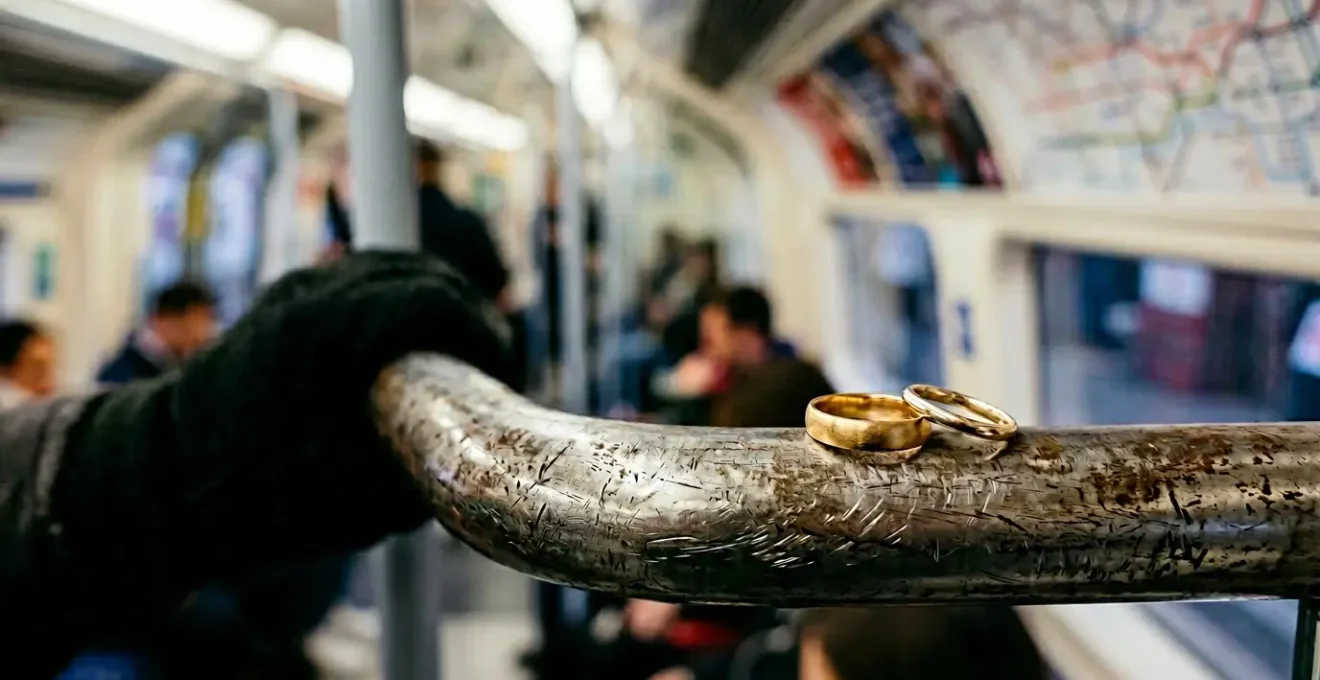
For any commuter, the daily journey is a series of minor impacts. A hand grazing a metal handrail on the Tube, a briefcase bumping against your ring, the simple act of gripping a steering wheel—it’s a life of constant, low-grade mechanical stress. When choosing a wedding band meant to last a lifetime, the question of durability isn’t abstract; it’s a practical concern rooted in these everyday moments. The immediate debate often lands on 9-carat versus 18-carat gold, a conversation frequently dominated by misleading simplifications.
The common wisdom presents a false dichotomy: 18ct is “purer and better,” while 9ct is “harder and more durable.” This leads many to assume that for a high-impact lifestyle, the harder 9ct alloy is the logical choice. It seems intuitive, but this reasoning overlooks the most critical factor in a metal’s long-term survival: the difference between hardness and brittleness. A material that is very hard but brittle is prone to catastrophic failure under pressure. A slightly softer, more malleable material can absorb force by deforming, which is a far more desirable trait in jewellery.
But what if the true measure of a ring’s endurance isn’t found in a simple carat number, but in a deeper understanding of its material science? This guide moves beyond the surface-level discussion. We will analyse these metals from a practical metallurgist’s perspective, exploring not just alloys but also the critical role of ring construction, setting integrity, and proper maintenance. By understanding the complete wear-and-tear profile of your options, you can choose a ring that doesn’t just survive the daily grind, but thrives in it.
This article provides a comprehensive breakdown of the factors that truly determine a ring’s durability for an active, urban lifestyle. Below is a summary of the key areas we will explore to help you make an informed decision.
Summary: A Practical Guide to Jewellery Durability
- Why 9ct Gold Can Snap While 18ct Just Bends Under Pressure?
- How to Deal with the Grey Patina That Develops on Platinum Rings?
- Palladium or White Gold: Which Requires Less Rhodium Plating?
- The Pave Setting Mistake That Leads to Lost Stones in Daily Wear
- How Often Should You Ultrasonic Clean Your Daily Engagement Ring?
- The ‘Soap Magnet’ Effect: Why Washing Hands with Rings On Dulls Them?
- The ‘Lightweight’ Trap: Why Hollow Wedding Bands Deform in 6 Months?
- Beyond Diamonds: Which Coloured Gemstones Can Survive Daily Wear in the UK?
Why 9ct Gold Can Snap While 18ct Just Bends Under Pressure?
The central paradox in the gold durability debate lies in the misunderstanding of “hardness.” 9ct gold is indeed harder than 18ct gold. This is because it contains a higher percentage of other metals (like copper and zinc) in its alloy—62.5% versus 25% in 18ct gold. These alloys increase the surface resistance to scratching. However, this hardness comes at a significant cost: increased brittleness. Think of the difference between a glass plate and a copper plate. The glass is harder and will resist a light scratch better, but if you drop both, the glass will shatter while the copper will merely dent.
This is the essential difference in their wear-and-tear profile. 18ct gold, being more malleable due to its higher gold content, will absorb a sharp impact by bending or denting. This is a form of “graceful failure” that can almost always be repaired by a jeweller. In contrast, the brittle nature of 9ct gold means that under the same sudden force—like getting caught on a door handle—it is more likely to develop micro-fractures and, in extreme cases, snap completely. This is a catastrophic failure. While 18ct gold shows its history through scratches and dents, 9ct gold is more prone to breaking without warning.
drama > saturation. Final constraint: The composition must be entirely free of any legible text, letters, numbers, logos, watermarks, brand marks, or UI elements.”/>
This is confirmed by metallurgical data; while 9ct gold is technically ‘harder’, it is less resistant to knocks on a microscopic level. For a ring worn every day in a high-contact environment, the ability to deform without breaking is a far more valuable trait than simple scratch resistance. The malleability of 18ct gold provides a resilience that 9ct gold’s brittleness simply cannot match over the long term, making it the superior choice for structural integrity.
How to Deal with the Grey Patina That Develops on Platinum Rings?
Platinum is renowned for its durability, but owners are often surprised when a greyish, matte finish—known as patina—develops over time. Unlike the wear on gold, where scratches remove microscopic amounts of metal, platinum’s patina is a result of metal displacement. When platinum is scratched, the metal is moved from one area of the ring to another, creating a unique surface texture. From a metallurgist’s viewpoint, this is not a flaw but a testament to its incredible toughness and density. It’s a sign that the ring is wearing *with* you, not wearing *away*.
However, many prefer the bright, mirror-like finish. Dealing with patina is a matter of maintenance and preference, not a sign of defect. While you can embrace the evolving character of the ring, you can also have it professionally polished to restore its original lustre. It’s crucial to know that each polish does remove a tiny layer of metal, so it shouldn’t be done excessively. The key is to distinguish between the maintenance needs of platinum versus other white metals, like white gold.
This comparative table breaks down the long-term maintenance reality of a platinum patina versus the rhodium plating required for white gold.
| Aspect | Platinum Patina | White Gold Rhodium |
|---|---|---|
| Nature | Natural surface evolution | Applied coating that wears off |
| Maintenance Frequency | Polish once yearly (optional) | Re-plate every 12-24 months |
| Cost per Treatment | £40-80 for polish | £60-100 for re-plating |
| Metal Loss | Minimal with each polish | None – adds layer |
Ultimately, a platinum ring offers a choice: embrace the distinguished patina as part of its story or periodically restore it. This is fundamentally different from white gold, which requires mandatory re-plating to maintain its appearance. For a low-maintenance commuter, understanding this difference is key to managing expectations.
Palladium or White Gold: Which Requires Less Rhodium Plating?
The question itself contains the answer: palladium requires no rhodium plating at all. This makes it a functionally superior choice for anyone seeking a low-maintenance white metal ring. The reason lies in the fundamental nature of the alloys. White gold is not a naturally white metal. It is an alloy of yellow gold mixed with white metals like nickel, silver, or palladium. This process leaves it with a faint yellowish or greyish tint. To achieve the bright, silvery-white finish consumers expect, virtually all white gold jewellery is plated with a thin layer of rhodium, a very hard and brilliantly white metal from the platinum family.
The problem is that this plating is a coating, not part of the metal itself. With daily wear, friction, and exposure to chemicals, the rhodium layer inevitably wears away, revealing the warmer-toned white gold beneath. This necessitates re-plating every 12 to 24 months to maintain its bright white appearance, creating an ongoing maintenance cost and hassle.
Palladium, on the other hand, is a member of the platinum group metals and is naturally white. Like platinum, it does not need plating to achieve or maintain its colour. Its silvery-white hue is consistent throughout the entire piece of metal. While it can get scratched and develop a patina similar to platinum (though it is less dense), its colour will never change or wear away. For a commuter wanting a “set it and forget it” ring, palladium’s inherent colour stability makes it a far more practical choice than white gold, eliminating the cycle of re-plating entirely.
The Pave Setting Mistake That Leads to Lost Stones in Daily Wear
A ring’s durability is not just about the metal; it’s about its entire structure. With pavé-set rings, where small diamonds are set closely together, the most common point of failure is the setting itself. The critical mistake is opting for settings with insufficient metal securing each stone, typically seen in designs using shared prongs or only two prongs per gem. While this creates a dazzling, “all-diamond” look and reduces manufacturing costs, it dramatically compromises the ring’s structural integrity.
In a robust pavé setting, each tiny diamond should be held in place by four small beads or prongs of metal. This ensures the stone is secured from multiple angles, providing redundancy if one prong is worn down or damaged. In cheaper or more delicate designs, a “shared prong” technique is used where two adjacent stones are held by the same prong. This means each stone may only be secured at two or three points. A single sharp knock can be enough to shift a prong and loosen two stones at once, leading to their loss.
drama > saturation. Final constraint: The composition must be entirely free of any legible text, letters, numbers, logos, watermarks, brand marks, or UI elements.”/>
For someone with an active lifestyle, a ring will inevitably be subjected to bumps and scrapes. When a pavé-set ring has inadequate prong work, the risk of losing a stone is not a matter of ‘if’ but ‘when’. The force of a minor impact is magnified on the tiny metal beads holding the gems. Choosing a pavé style where you can clearly see four individual beads securing each stone is the single most important decision for ensuring its longevity. It’s a trade-off between a slightly more “metal-heavy” look and the peace of mind that your diamonds will stay where they belong.
How Often Should You Ultrasonic Clean Your Daily Engagement Ring?
Ultrasonic cleaners are incredibly effective, using high-frequency sound waves to create microscopic bubbles that dislodge dirt and grime from the tiniest crevices of a ring. For a simple, solid metal band, they are a powerful tool. However, for an engagement ring with stone settings, their power is also their greatest risk. The intense vibrations can be damaging to certain gemstones and, more critically, can loosen stones in their settings. If a prong is already slightly worn or a stone is not perfectly secure, an ultrasonic bath is often the final push that causes it to fall out.
Therefore, from a practical, risk-averse perspective, frequent ultrasonic cleaning at home is not recommended for a daily-wear engagement ring. Professional jewellers use them, but they first inspect the settings to ensure all stones are secure. Without that expert eye, you risk damaging your ring. Certain ring types should never be placed in an ultrasonic cleaner, including those with tension settings, delicate pavé styles where stones are held by tiny prongs, and any jewellery containing foil-backed stones, pearls, or opals, as the vibrations can cause irreparable damage.
A much safer and still effective method for regular cleaning involves simple, gentle tools. The best practice for most rings, including those with diamonds and other hard gemstones, is to use warm water, a few drops of mild dish soap (without detergents or moisturisers), and a very soft toothbrush. Gently scrub the top and underside of the setting to remove the build-up of oils and lotions. For a deeper clean at home, a pulsed-water dental cleaning appliance on a low setting can effectively flush out grime from under the main stone without the risky vibrations of an ultrasonic machine.
The ‘Soap Magnet’ Effect: Why Washing Hands with Rings On Dulls Them?
One of the most common complaints about engagement rings is that they lose their sparkle over time. The primary culprit is not damage to the diamond, but the “soap magnet” effect. Diamonds have a natural affinity for grease and oil (a property called lipophilicity). When you wash your hands with your ring on, the lotions, moisturisers, and surfactants in hand soaps and sanitisers leave behind a thin, invisible film on the surface of the diamond. This build-up acts like a magnet for dirt, dust, and other particles.
This opaque layer has a disastrous effect on a diamond’s brilliance. A diamond’s sparkle is created by light entering the stone, reflecting off its internal facets (brilliance), and splitting into a rainbow of colours (fire). When the surface is coated in a film of soap scum and grime, light is diffused and absorbed before it can even enter the stone. The result is a dull, lifeless appearance. The effect is most pronounced underneath the stone, in the small spaces of the setting, where this gunk can accumulate and is difficult to remove.
Removing this film is the key to restoring your ring’s fire. While taking your ring off before washing hands or applying lotion is the best preventative measure, it’s not always practical. Regular, gentle cleaning is essential to combat this inevitable build-up. The process is straightforward and targets the removal of this greasy layer without harming the ring.
Action Plan: Reversing the ‘Soap Magnet’ Effect
- Initial Wipe-Down: Regularly wipe your ring with a soft, lint-free cloth to remove surface-level oils and dirt. This simple habit can significantly prolong its brilliance between deep cleans.
- Soapy Bath: Prepare a small bowl with warm water and a few drops of mild dish soap. Let the ring soak for 20-30 minutes to loosen the grime.
- Gentle Scrub: Use a very soft-bristled toothbrush (a baby toothbrush is ideal) to gently scrub all surfaces of the ring, paying special attention to the underside of the stones and the crevices in the setting.
- Safe Rinse: Rinse the ring thoroughly in a separate bowl of clean water. Never rinse it directly over an open sink drain, as this is how loose stones are most often lost.
- Thorough Dry: Dry the ring completely with a soft, lint-free cloth or let it air dry. This prevents water spots from forming and leaving their own mineral deposits.
The ‘Lightweight’ Trap: Why Hollow Wedding Bands Deform in 6 Months?
In the search for an affordable wedding band, many are drawn to “lightweight” or hollow options. These rings appear substantial from the outside but are constructed from a thin, hollow tube of gold. The initial cost is lower because they use significantly less precious metal. However, this is a classic “lightweight trap” that sacrifices all structural integrity for a better price tag. From a metallurgist’s standpoint, a hollow ring is destined for failure in a daily wear context.
A solid band has the mass to resist deformation. When it receives a knock, the force is distributed through a solid block of metal. A hollow band, by contrast, has no internal support. The same force that would barely scratch a solid ring can easily dent or even crush a hollow one. These dents are often impossible to repair cleanly, and once the ring’s circular shape is compromised, it becomes uncomfortable and prone to further damage. The lifespan of a hollow ring under normal daily wear is often measured in months, not years, before significant deformation occurs.
However die stamped are by far the best, most durable signet rings available. Because of the way these rings are made they are suitable for every-day wear and they will last a life time plus, no matter what the carat. In fact your die-stamped ring will be in a fine state to pass on to future generations and should be seen as a future heirloom.
– Family Seal Rings UK, British Heritage Jewelry Guide
The table below starkly illustrates the trade-offs. While the upfront cost is tempting, the poor resistance, difficult repairability, and short lifespan make hollow bands a poor long-term investment. Even better than a standard cast solid ring is a “die-stamped” or “die-struck” band, which is forged under immense pressure, resulting in a much denser and more durable molecular structure.
| Factor | Hollow Bands | Solid Bands |
|---|---|---|
| Initial Cost | Lower (less metal) | Higher (more metal) |
| Price per Gram | Often higher | Better value |
| Dent Resistance | Poor – can dent from grocery bags | Excellent – resists daily impacts |
| Repairability | Often impossible without visible damage | Easily reshaped by jeweler |
| Expected Lifespan | 6-12 months before deformation | Generations with proper care |
Key Takeaways
- Malleability Beats Brittleness: For daily impacts, 18ct gold’s ability to bend is superior to 9ct gold’s tendency to snap. Don’t confuse surface hardness with true resilience.
- Structure Is Non-Negotiable: A ring’s construction is as important as its material. Always choose solid bands over hollow ones and pavé settings with four prongs per stone for maximum security.
- Know Your Maintenance Profile: Choose a metal based on its long-term upkeep. Platinum develops a patina, white gold needs re-plating, and palladium is naturally white and low-maintenance.
Beyond Diamonds: Which Coloured Gemstones Can Survive Daily Wear in the UK?
While diamonds are the traditional choice for engagement rings due to their supreme hardness (10 on the Mohs scale), many people desire the personality of a coloured gemstone. However, not all gems are created equal when it comes to surviving the rigours of daily wear. The single most important factor is hardness, which is a measure of a mineral’s resistance to scratching. For a ring that will be worn every day, it is crucial to select a stone that can withstand accidental contact with common materials like dust (which contains quartz, a 7 on the Mohs scale), metal, and glass.
As a rule of thumb, gemological research confirms that stones with a Mohs hardness of 8–10 are best suited for daily wear. This elite group is small but offers stunning variety:
- The Champions (Mohs 9-10): This category is dominated by Diamond (10), and the corundum family: Ruby and Sapphire (9). These stones are exceptionally tough and can withstand a lifetime of wear with minimal care. It’s worth noting the leap from 9 to 10 is exponential; a diamond is many times harder than a sapphire.
- The Hidden Champions (Mohs 8): This group offers excellent durability and often better value. It includes Spinel, a brilliant gem available in a huge range of colours (including red and blue that rival ruby and sapphire), and Alexandrite, famous for its remarkable colour-changing properties.
- Good Alternatives (Mohs 7-7.5): Stones in this range, like Tourmaline and some varieties of Garnet, can be suitable for daily wear but require more mindful ownership. They are hard enough to resist scratching from everyday dust.
- Handle With Extreme Care (Below Mohs 7): Gems like Opal (5.5-6.5), Pearl (2.5-4.5), and Tanzanite (6.5) are far too soft and fragile for a daily-wear ring. They are susceptible to scratches, chipping, and damage from chemicals and should be reserved for occasional wear in protective settings.
Choosing a coloured gemstone is a balance of beauty and practicality. By sticking to the hardiest options, you ensure your ring remains vibrant and intact, no matter what the daily commute throws at it.
Therefore, before making a final decision, evaluate the material properties and construction of your chosen ring against the realities of your daily life. A well-informed choice is a choice that will last a lifetime.
Frequently Asked Questions About Ring Care and Durability
How often is safe for ultrasonic cleaning?
Be extra careful with ultrasonic cleaners. Some gemstones are fragile and can be damaged by ultrasonic cleaners, and a stone that is not secure in its setting could come out during the cleaning process.
Which settings should never be ultrasonically cleaned?
Tension settings, certain pave styles, and rings with foil-backed stones should avoid ultrasonic cleaning entirely.
What’s the safer alternative to ultrasonic cleaning?
Most colored gems can be cleaned with warm water, mild dish soap (no detergents) and a soft brush. A pulsed-water dental cleaning appliance and a soft, lint-free cloth can also be used. Be sure to rinse your jewelry in a glass of water to remove cleaning solutions since you risk losing loose stones – or even an entire piece of jewelry – if you rinse directly in the sink.